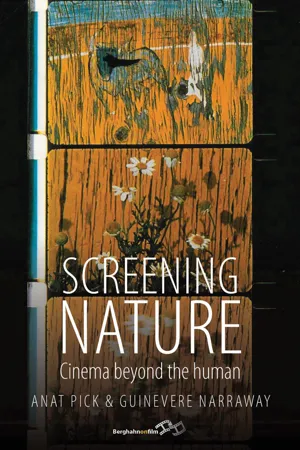
Environmentalism and ecology are areas of rapid growth in academia and society at large. Screening Nature is the first comprehensive work that groups together the wide range of concerns in the field of cinema and the environment, and what could be termed "posthuman cinema." It comprises key readings that highlight the centrality of nature and nonhuman animals to the cinematic medium, and to the language and institution of film. The book offers a fresh and timely intervention into contemporary film theory through a focus on the nonhuman environment as principal register in many filmic texts. Screening Nature offers an extensive resource for teachers, undergraduate students, and more advanced scholars on the intersections between the natural world and the worlds of film. It emphasizes the cross-cultural and geographically diverse relevance of the topic of cinema ecology.
Cinema cannot escape nature. In relation to nature, film is either placed or, if ‘the world is not enough’, displaced. But however fantastical, even non-photographic, film springs forth from the world to which it ultimately returns. When speaking of the worldhood (Weltlichkeit) of film, I am thinking of the ways in which films construct their own worlds and in so doing assert the ontological property of film’s ‘groundedness’ – its dwelling in the totality of its construction. This chapter examines films in which nature and conceptions of worldhood come together, not as mirror images or as overlapping copies, but by invoking different senses of dwelling inspired by visions of nature: cinema’s attesting to the ways in which nature prompts us to think of our place in the world, what in Being and Time (1927) Heidegger described as the fundamental structure of ‘being-in-the-world’. Of course, every film has its worldhood (even if some films are manifestly ‘poor in world’), but the examples that concern me here are those whose central theme is the natural world, and whose connection to place, their mode of dwelling, is achieved primarily through their relation to the environmental question, what Timothy Morton (2007: 175) calls the ‘what-is-it?’ of nature.1
In what follows I explore three alternatives of cinematic worldhood in popular films that foreground the environment. If the images of the BBC’s signature natural history productions like Planet Earth (2006) lean towards ocular inflation,2 Werner Herzog’s ‘wildlife fantasies’ (Fata Morgana [1972], La Soufrière [1977], Lessons of Darkness [1992], Grizzly Man [2005], The Wild Blue Yonder [2005], Encounters at the End of the World [2007], and Cave of Forgotten Dreams [2010]), on a different scale, offer Herzog’s ‘ecstatic truth’ (Herzog 2002: 239) about humanity’s placement in the world. Yet Herzog’s critique of the commercial natural history film betrays its own romantic conceit, positing man (for Herzog’s dramas are predominantly male) and nature in direct opposition. A third conception of worldhood is expressed in Earthlings (2005), a holistic activist film that wears its worldly credentials on its sleeve.3 Unlike David Attenborough’s work, which tends to underplay issues of anthropogenic ecological pressure, and against Herzog’s reactionary tales that cast nature and man in a state of inevitable conflict, Earthlings’ graphic exposure of human violence against nonhuman animals seeks to transform human–animal relations by encouraging humans to ‘make the connection’: Earthlings sees worldhood in radically nonanthropocentric terms and promotes the idea of a more-than-human community.4
While my three examples are not definitive representatives of depictions of nature and animals on screen, they do cover a fair bit of ground: from television, to semi-independent and new media productions. Each alternative at once registers and transcends a concrete (ontic) worldview, and signals the (pre-ontological) notion of worldhood. And each raises questions about the ways in which the relationship between images, nature and worldhood is articulated. In these films, ‘nature’ is both an enclosed system, scientifically and aesthetically knowable through what Morton (2010) calls ‘ecomimesis’, and the mode of our being-in-the-world, which grounds our concrete relations to nature’s beings and things. Thinking the two configurations of nature cinematically also recalls the cinematic realism of André Bazin, which inspires a nonanthropocentric appreciation of onscreen worldhood.
Cinema’s acknowledging of reality is not only, as Bazin claims, impersonal but also ‘inhuman’. As Fay (2008: 42) argues, Bazin’s ‘realism, as reimagined through animals and nature, is not merely the replication or record of the world as we humans perceive it (nor is it merely the space humans and animals share); rather, it reveals the details of animate and inanimate life that are lost to anthropocentric attention and history’. Realism therefore encourages a view of the world as a biodiverse, material plane. At its most distilled, Bazin (2005: 21) envisions cinematic realism as ‘the world in its own image’. None of the films discussed below is paradigmatically Bazinian, though each contains intimations of worldhood through the filming of nature and animals or via the image of Earth seen from space. The trajectory proceeds from nature as a finite terrain to worldhood as a non-spatial mode of being-in-the-world, and back to nature again.
First World
The online spoof I Hate Nature features a recognisably breathless impersonation of David Attenborough over footage of the BBC series Planet Earth.5 Attenborough proclaims his repugnance at the animals he studies. Animals are ‘boring and they suck’, he says, looking up at a family of koala bears lounging in a tree. Although the short describes animals as ‘gross’, recasting Attenborough as a ‘zoocidal’ filmmaker, the butt of the joke is not nature or animals but their packaging by the BBC–Attenborough powerhouse. Poking fun at a ‘national treasure’ disguises a more serious critique by suggesting that it is possible to have had enough, not only of Attenborough’s ‘schoolboy enthusiasm’ (Cubitt 2005: 47), but of the hackneyed tropes of nature’s cuteness and majesty, the sneaky configurations of nature as a secular Eden and faux sublime, formulations that simultaneously tout and tame the so-called mystery of the natural world. Beneath its reverent façade, the parody suggests, lurks the Freudian id of natural history film culture, whose idioms are contempt and disgust.
Not only the voice-of-god but also the eye-of-god is typical of the scope and reach of the big BBC productions. Wildlife programmes are the fruit of particular modes of production. Bousé (2000: 1) makes the striking claim that wildlife films and nature are, in fact, poorly matched: ‘The lives of wild animals, like the stillness of open spaces, may simply be unsuited to film and television representation’, not because they are impossible to capture but because mainstream wildlife film and television are subject to commercial demands. ‘[T]he real sources of film and television’s incompatibility with nature lie in the economics and institutional agendas to which they have been conscripted’ (ibid.):
Stillness and silence have almost no place in wildlife film, or in film and television generally – not because they are incapable, as media technologies, of conveying these qualities, but because stillness and silence are incompatible with the social and economic functions of film and television, and with the expressive ‘vocabularies’ they have developed in fulfilling those functions. (Ibid.: 4)
Such films are closer to Hollywood features, making use of such cinematic devices as emotive musical cues, close-ups, a composite but invisible narrative, individual characters, and dramatic storylines. ‘Wildlife films may be full of scientific facts, but they have largely been freed of the responsibility of looking just like reality. Like advertising, they have become an entertaining art that operates according to its own codes and conventions’ (ibid.: 7).
What precisely are the ‘economics and institutional agendas’ that shape wildlife films? Claire Molloy (2011: 83) points out that the diversification and generic blending in contemporary wildlife programming responds ‘to declining audience numbers and changing consumer demands’. ‘What such programmes do is relocate “wild nature” into the domestic and culturally organised spaces of media reception – the living room, the cinema and so forth – and in doing this, they construct a relationship between viewer and animal that reduces distance and fulfils a desire to bring animals close’. Beyond its commercial and psychological imperatives, Molloy’s description of a relation of containment between human viewers and the represented world has an ontological dimension. In their sheer grandeur, penetration and condensation of space through the use of high-end cameras and non-sync sound in postproduction, wildlife films are not just purveyors of knowledge about and sympathy for the natural world, but emblems of the technical prowess required to ‘produce’ nature. With 3D and CGI, wildlife films offer an increasingly immersive spectacle.6 But spectacular immersion, implicit in titles like Life on Earth (1979), The Blue Planet (2001), Planet Earth, Frozen Planeta (2011) or Earthflight (2011), titles that capture, contain and project the very limits of the earth, can have an uprooting as well as a grounding effect.7
At the opening of her early collection of political essays Oppression and Liberty, Simone Weil states that ‘it is clear that capitalism stands essentially for economic expansion and that capitalist expansion has now [Weil is writing in 1933] nearly reached the point where it will be halted by the actual limits of the earth’s surface’ (2006: 1, emphasis added). Although her essay is primarily a critique of revolutionary Marxism and Stalinism – capitalism is in crisis, ‘yet never have there been fewer premonitory signs of the advent of socialism’ (ibid.: 1) – Weil’s statement is ecologically charged and suggests the close ties between capitalism and environmental exploitation. Something of this expansionist ethos and stretching of limits is, I think, present in Attenborough’s palatial rendering of nature.8 It is this capaciousness, or decadence, that I Hate Nature picks up on and mocks.
The Earth’s image captured from space at the opening of Planet Earth is a recurring motif in fiction and nonfiction films that signifies the earth’s limits. Limits can function progressively, reminding us of the beauty and frailty of Earth, or possessively, affirming a dominant human perspective. Stephen Yearly explains that ‘[t]he photographic portrayal of the globe viewed from an orbiting spacecraft has been used repeatedly to evoke the Earth’s isolation in space, its fragility and wonder, and the sense that the beings on it share a restricted living space surrounded by an unwelcoming void’ (cited in Garrard 2004: 160). But orbiting spacecrafts and satellite technology also mark the new frontiers of visibility and the extension of optics that overpower the Earth: ‘As the century of unbounded curiosity, covetous looking and the de-regulation of the gaze, the twentieth has not been the century of the “image”, as is often claimed, but of optics – and, in particular, of the optical illusion’ (Virilio 2005: 28–29). Earth becomes the ultimate plaything – abstracted and aestheticised – of global capital, or what we might call bio-optical politics:
The Earth, that phantom-limb, no longer extends as far as the eye can see; it presents all aspects of itself for inspection in the strange little window. The sudden multiplication of ‘points of view’ merely heralds the latest globalization: the globalization of the gaze, of the single eye of the cyclops who governs the cave. (Ibid.: 18)
Heightened visibility, what I have called ‘ocular inflation’, promotes a uniform view of the world, encapsulated in the image of the blue planet, or Earth seen from space. Ocular inflation means that in seeing so much, we see too little.
Virilio’s polemic explores this paradox through the interlocking of neoliberalism and film. In The Information Bomb (2005), Virilio links the world’s relentless exposure through the use of ever more precise optical technology to the military-industrial complex. The problem is not reality’s loss in the image, the postmodern problem of pure simulacra, but reality’s overexposure. The image of Spaceship Earth discussed by Garrard (2004), with which many science fiction and natural history films begin, is a symbol of this overexposure. ‘In the West’, Virilio writes in The Vision Machine, ‘the death of God and the death of art are indissociable; the zero degree of representation merely fulfilled the prophecy voiced a thousand years earlier by Nicephorus, Patriarch of Constantinople, during the quarrel with the iconoclasts: “If we remove the image, not only Christ but the whole universe disappears”’ (Virilio 1994: 17). Enhanced optics heralds the end of representation; without iconic representation, without images pointing to the unseen, the seen universe vanishes. Under conditions of optical overexposure, what Virilio calls the ‘zero degree of representation’, the world itself disappears.
Negative readings of new technologies in wildlife cinema as combining militaristic expansionist drives with what Baker (2001: 174) called the ‘Disneyfication’ of nature may not do justice to the intentions of filmmakers or audience responses. Filmmakers often cite conservation, animal protection and the cultivation of a public appreciation of nature as their chief motivation. Dismissing these films as by-products of the military-industrial complex is surely reductive. Sean Cubitt provides a more favourable view of technology:
The construction of technology as the pariah that embodies all the most evil elements of the polis and turns them against nature is not an alternative politics … techne is the only route through which we now can sense the world, most especially that part of the world’s conversations which are not conducted in wavelengths we can hear, see, or otherwise apprehend. (Cubitt 2005: 59)
The titles and imagery of mainstream wildlife films are ambivalent: their planetary ambition is overblown, yet they are also and more humbly aware of the unity of our world as world. At once poetic and predatory, technology embodies the tensions of a totalising (and totalitarian) vision. The crisis of capitalism is inherently ecological, yet, to reiterate Weil, never have there been fewer premonitory signs of the advent of a genuinely environmental politics – at least not yet in primetime wildlife programming.9 Popular wildlife cinema is caught between an acquisitive relation to nature, and an evocative mode addressed to nature’s worldhood that eschews the crudely possessive. What does it mean for film to be thus split between the acquisitive and the evocative mode, and how might different evocations of cinematic worldhood be achieved?
Second World
Werner Herzog’s work has recently reemerged under the sign of nature.10 His ‘science fiction fantasies’, as he sometimes calls them, have assumed the position of counter-cultural wildlife films. Herzog wants to dismantle what he sees as the unqualified enchantment with nature of natural history films. Yet, if Attenborough’s fascination with nature may be said to harbour latent hostilities (t...
Table of contents
Cover
Title Page
Copyright Page
Contents
Illustrations
Acknowledgements
Introduction. Intersecting Ecology and Film
Part I. Eco-Poetics: Film, Form and the Natural World
Part II. Zoē-tropes: Envisioning The Nonhuman
Part III. Eco-Politics: Environment, Image, Ideology
Part IV. Eco-Praxis: Film as Environmental Practice
Notes on Contributors
Index
Trusted by 375,005 students
Access to over 1.5 million titles for a fair monthly price.
Study more efficiently using our study tools.
Frequently asked questions
Yes, you can cancel anytime from the Subscription tab in your account settings on the Perlego website. Your subscription will stay active until the end of your current billing period. Learn how to cancel your subscription
No, books cannot be downloaded as external files, such as PDFs, for use outside of Perlego. However, you can download books within the Perlego app for offline reading on mobile or tablet. Learn how to download books offline
Perlego offers two plans: Essential and Complete
Essential is ideal for learners and professionals who enjoy exploring a wide range of subjects. Access the Essential Library with 800,000+ trusted titles and best-sellers across business, personal growth, and the humanities. Includes unlimited reading time and Standard Read Aloud voice.
Complete: Perfect for advanced learners and researchers needing full, unrestricted access. Unlock 1.5M+ books across hundreds of subjects, including academic and specialized titles. The Complete Plan also includes advanced features like Premium Read Aloud and Research Assistant.
Both plans are available with monthly, semester, or annual billing cycles.
We are an online textbook subscription service, where you can get access to an entire online library for less than the price of a single book per month. With over 1.5 million books across 990+ topics, we’ve got you covered! Learn about our mission
Look out for the read-aloud symbol on your next book to see if you can listen to it. The read-aloud tool reads text aloud for you, highlighting the text as it is being read. You can pause it, speed it up and slow it down. Learn more about Read Aloud
Yes! You can use the Perlego app on both iOS and Android devices to read anytime, anywhere — even offline. Perfect for commutes or when you’re on the go. Please note we cannot support devices running on iOS 13 and Android 7 or earlier. Learn more about using the app
Yes, you can access Screening Nature by Anat Pick, Guinevere Narraway, Anat Pick,Guinevere Narraway in PDF and/or ePUB format, as well as other popular books in Media & Performing Arts & Film History & Criticism. We have over 1.5 million books available in our catalogue for you to explore.