Cholera, although it can kill an adult through dehydration in half a day, is easily treated. Yet in 1992-93, some five hundred people died from cholera in the Orinoco Delta of eastern Venezuela. In some communities, a third of the adults died in a single night, as anthropologist Charles Briggs and Clara Mantini-Briggs, a Venezuelan public health physician, reveal in their frontline report. Why, they ask in this moving and thought-provoking account, did so many die near the end of the twentieth century from a bacterial infection associated with the premodern past?
It was evident that the number of deaths resulted not only from inadequacies in medical services but also from the failure of public health officials to inform residents that cholera was likely to arrive. Less evident were the ways that scientists, officials, and politicians connected representations of infectious diseases with images of social inequality. In Venezuela, cholera was racialized as officials used anthropological notions of "culture" in deflecting blame away from their institutions and onto the victims themselves. The disease, the space of the Orinoco Delta, and the "indigenous ethnic group" who suffered cholera all came to seem somehow synonymous.
One of the major threats to people's health worldwide is this deadly cycle of passing the blame. Carefully documenting how stigma, stories, and statistics circulate across borders, this first-rate ethnography demonstrates that the process undermines all the efforts of physicians and public health officials and at the same time contributes catastrophically to epidemics not only of cholera but also of tuberculosis, malaria, AIDS, and other killers. The authors have harnessed their own outrage over what took place during the epidemic and its aftermath in order to make clear the political and human stakes involved in the circulation of narratives, resources, and germs.
eBook - PDF
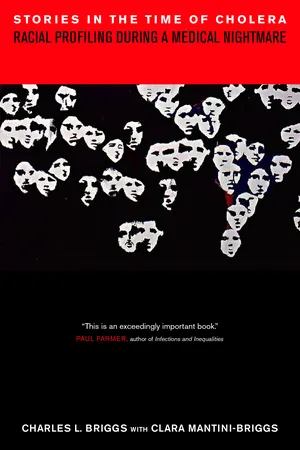
Stories in the Time of Cholera
Racial Profiling during a Medical Nightmare
- 457 pages
- English
- PDF
- Available on iOS & Android
eBook - PDF
About this book
Information
Publisher
University of California PressYear
2003Print ISBN
9780520243880
Edition
1eBook ISBN
9780520938526
Table of contents
- Contents
- List of Illustrations
- Preface
- Acknowledgments
- INTRODUCTION: DEATH IN THE DELTA
- 1. PREPARING FOR A BACTERIAL INVASION: Cholera and Inequality in Venezuela
- 2. EPIDEMIC AT THE DOOR: Cholera Prevention in the Bureaucratic Imaginary of Delta Amacuro
- 3. STORIES OF AN EPIDEMIC FORETOLD: Cholera Reaches Mariusa
- 4. FIGHTING DEATH IN A REGIONAL CLINIC: Cholera Arrives in Pedernales
- 5. TURNING CHAOS INTO CONTROL: Initial Responses by Regional Institutions
- 6. CONTAINING AN INDIGENOUS INVASION: Quarantine in Barrancas
- 7. EXILE AND INTERNMENT: The Mariusans on La Tortuga
- 8. MEDICINE, MAGIC, AND MILITARY MIGHT: Cholera Control on La Tortuga
- 9. CULTURE EQUALS CHOLERA: Official Explanations for the Epidemic
- 10. CHALLENGING THE LOGIC OF CULTURE: Resisting Official Explanations for the Epidemic
- 11. LOCAL NUMBERS AND GLOBAL POWER: The Role of Statistics
- 12. SANITATION AND GLOBAL CITIZENSHIP: International Institutions and the Latin American Epidemic
- 13. VIRULENT AFTERMATH: The Consequences of the Epidemic
- Notes
- Bibliography
- Index
Trusted by 375,005 students
Access to over 1.5 million titles for a fair monthly price.
Study more efficiently using our study tools.
Frequently asked questions
Yes, you can cancel anytime from the Subscription tab in your account settings on the Perlego website. Your subscription will stay active until the end of your current billing period. Learn how to cancel your subscription
No, books cannot be downloaded as external files, such as PDFs, for use outside of Perlego. However, you can download books within the Perlego app for offline reading on mobile or tablet. Learn how to download books offline
Perlego offers two plans: Essential and Complete
- Essential is ideal for learners and professionals who enjoy exploring a wide range of subjects. Access the Essential Library with 800,000+ trusted titles and best-sellers across business, personal growth, and the humanities. Includes unlimited reading time and Standard Read Aloud voice.
- Complete: Perfect for advanced learners and researchers needing full, unrestricted access. Unlock 1.5M+ books across hundreds of subjects, including academic and specialized titles. The Complete Plan also includes advanced features like Premium Read Aloud and Research Assistant.
We are an online textbook subscription service, where you can get access to an entire online library for less than the price of a single book per month. With over 1.5 million books across 990+ topics, we’ve got you covered! Learn about our mission
Look out for the read-aloud symbol on your next book to see if you can listen to it. The read-aloud tool reads text aloud for you, highlighting the text as it is being read. You can pause it, speed it up and slow it down. Learn more about Read Aloud
Yes! You can use the Perlego app on both iOS and Android devices to read anytime, anywhere — even offline. Perfect for commutes or when you’re on the go.
Please note we cannot support devices running on iOS 13 and Android 7 or earlier. Learn more about using the app
Please note we cannot support devices running on iOS 13 and Android 7 or earlier. Learn more about using the app
Yes, you can access Stories in the Time of Cholera by Charles L. Briggs in PDF and/or ePUB format, as well as other popular books in Social Sciences & Diseases & Allergies. We have over 1.5 million books available in our catalogue for you to explore.