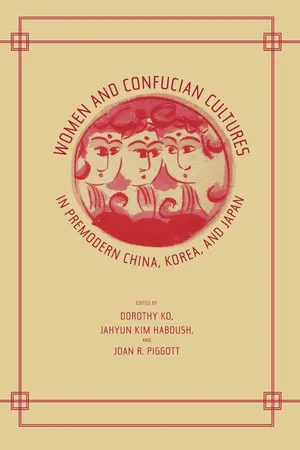
Representing an unprecedented collaboration among international scholars from Asia, Europe, and the United States, this volume rewrites the history of East Asia by rethinking the contentious relationship between Confucianism and women. The authors discuss the absence of women in the Confucian canonical tradition and examine the presence of women in politics, family, education, and art in premodern China, Korea, and Japan.
What emerges is a concept of Confucianism that is dynamic instead of monolithic in shaping the cultures of East Asian societies. As teachers, mothers, writers, and rulers, women were active agents in this process. Neither rebels nor victims, these women embraced aspects of official norms while resisting others. The essays present a powerful image of what it meant to be female and to live a woman's life in a variety of social settings and historical circumstances. Challenging the conventional notion of Confucianism as an oppressive tradition that victimized women, this provocative book reveals it as a modern construct that does not reflect the social and cultural histories of East Asia before the nineteenth century.
eBook - PDF
Women and Confucian Cultures in Premodern China, Korea, and Japan
- 353 pages
- English
- PDF
- Available on iOS & Android
eBook - PDF
Women and Confucian Cultures in Premodern China, Korea, and Japan
About this book
Information
Publisher
University of California PressYear
2003Print ISBN
9780520231382
Edition
1eBook ISBN
9780520927827
Table of contents
- Cover
- CONTENTS
- LIST OF ILLUSTRATIONS AND TABLES
- PREFACE
- NOTES ON CONVENTIONS
- COMPARATIVE TIME CHART FOR CHINA, KOREA, AND JAPAN
- Introduction
- PART I. SCRIPTS OF MALE DOMINANCE
- PART II. PROPAGATING CONFUCIAN VIRTUES
- PART III. FEMALE EDUCATION IN PRACTICE
- PART IV. CORPOREAL AND TEXTUAL EXPRESSIONS OF FEMALE SUBJECTIVITY
- GLOSSARY
- RECOMMENDATIONS FOR FURTHER READING
- LIST OF CONTRIBUTORS
- INDEX
Trusted by 375,005 students
Access to over 1.5 million titles for a fair monthly price.
Study more efficiently using our study tools.
Frequently asked questions
Yes, you can cancel anytime from the Subscription tab in your account settings on the Perlego website. Your subscription will stay active until the end of your current billing period. Learn how to cancel your subscription
No, books cannot be downloaded as external files, such as PDFs, for use outside of Perlego. However, you can download books within the Perlego app for offline reading on mobile or tablet. Learn how to download books offline
Perlego offers two plans: Essential and Complete
- Essential is ideal for learners and professionals who enjoy exploring a wide range of subjects. Access the Essential Library with 800,000+ trusted titles and best-sellers across business, personal growth, and the humanities. Includes unlimited reading time and Standard Read Aloud voice.
- Complete: Perfect for advanced learners and researchers needing full, unrestricted access. Unlock 1.5M+ books across hundreds of subjects, including academic and specialized titles. The Complete Plan also includes advanced features like Premium Read Aloud and Research Assistant.
We are an online textbook subscription service, where you can get access to an entire online library for less than the price of a single book per month. With over 1.5 million books across 990+ topics, we’ve got you covered! Learn about our mission
Look out for the read-aloud symbol on your next book to see if you can listen to it. The read-aloud tool reads text aloud for you, highlighting the text as it is being read. You can pause it, speed it up and slow it down. Learn more about Read Aloud
Yes! You can use the Perlego app on both iOS and Android devices to read anytime, anywhere — even offline. Perfect for commutes or when you’re on the go.
Please note we cannot support devices running on iOS 13 and Android 7 or earlier. Learn more about using the app
Please note we cannot support devices running on iOS 13 and Android 7 or earlier. Learn more about using the app
Yes, you can access Women and Confucian Cultures in Premodern China, Korea, and Japan by Dorothy Ko,JaHyun Kim Haboush,Joan Piggott in PDF and/or ePUB format, as well as other popular books in History & Asian History. We have over 1.5 million books available in our catalogue for you to explore.