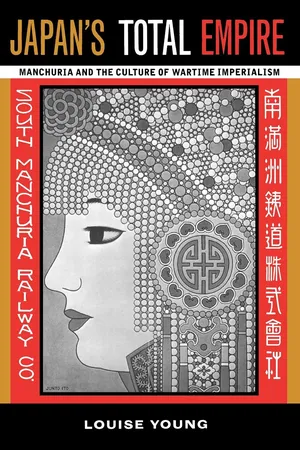
In this first social and cultural history of Japan's construction of Manchuria, Louise Young offers an incisive examination of the nature of Japanese imperialism. Focusing on the domestic impact of Japan's activities in Northeast China between 1931 and 1945, Young considers "metropolitan effects" of empire building: how people at home imagined and experienced the empire they called Manchukuo.
Contrary to the conventional assumption that a few army officers and bureaucrats were responsible for Japan's overseas expansion, Young finds that a variety of organizations helped to mobilize popular support for Manchukuo—the mass media, the academy, chambers of commerce, women's organizations, youth groups, and agricultural cooperatives—leading to broad-based support among diverse groups of Japanese. As the empire was being built in China, Young shows, an imagined Manchukuo was emerging at home, constructed of visions of a defensive lifeline, a developing economy, and a settler's paradise.
- 509 pages
- English
- PDF
- Available on iOS & Android
eBook - PDF
About this book
Information
Table of contents
- Cover
- Title Page
- Copyright Page
- Dedication Page
- Table of Contents
- List of Map and Tables
- Acknowledgments
- Note on Sources
- Part I: The Making of a Total Empire
- Part II: The Manchurian Incident and the New Military Imperialism, 1931-1933
- Part III: The Manchurian Experiment in Colonial Development, 1932-1941
- Part IV: The New Social Imperialism and the Farm Colonization Program, 1932-1945
- Part V: Conclusion
- Bibliography
- Index
- Studies of the East Asian Institute
Trusted by 375,005 students
Access to over 1.5 million titles for a fair monthly price.
Study more efficiently using our study tools.
Frequently asked questions
Yes, you can cancel anytime from the Subscription tab in your account settings on the Perlego website. Your subscription will stay active until the end of your current billing period. Learn how to cancel your subscription
No, books cannot be downloaded as external files, such as PDFs, for use outside of Perlego. However, you can download books within the Perlego app for offline reading on mobile or tablet. Learn how to download books offline
We are an online textbook subscription service, where you can get access to an entire online library for less than the price of a single book per month. With over 1.5 million books across 990+ topics, we’ve got you covered! Learn about our mission
Look out for the read-aloud symbol on your next book to see if you can listen to it. The read-aloud tool reads text aloud for you, highlighting the text as it is being read. You can pause it, speed it up and slow it down. Learn more about Read Aloud
Yes! You can use the Perlego app on both iOS and Android devices to read anytime, anywhere — even offline. Perfect for commutes or when you’re on the go.
Please note we cannot support devices running on iOS 13 and Android 7 or earlier. Learn more about using the app
Please note we cannot support devices running on iOS 13 and Android 7 or earlier. Learn more about using the app
Yes, you can access Japan's Total Empire by Louise Young in PDF and/or ePUB format, as well as other popular books in Historia & Historia asiática. We have over 1.5 million books available in our catalogue for you to explore.