Los Angeles pulsed with economic vitality and demographic growth in the decades following World War II. This vividly detailed cultural history of L.A. from 1940 to 1970 traces the rise of a new suburban consciousness adopted by a generation of migrants who abandoned older American cities for Southern California's booming urban region. Eric Avila explores expressions of this new "white identity" in popular culture with provocative discussions of Hollywood and film noir, Dodger Stadium, Disneyland, and L.A.'s renowned freeways. These institutions not only mirrored this new culture of suburban whiteness and helped shape it, but also, as Avila argues, reveal the profound relationship between the increasingly fragmented urban landscape of Los Angeles and the rise of a new political outlook that rejected the tenets of New Deal liberalism and anticipated the emergence of the New Right.
Avila examines disparate manifestations of popular culture in architecture, art, music, and more to illustrate the unfolding urban dynamics of postwar Los Angeles. He also synthesizes important currents of new research in urban history, cultural studies, and critical race theory, weaving a textured narrative about the interplay of space, cultural representation, and identity amid the westward shift of capital and culture in postwar America.
eBook - PDF
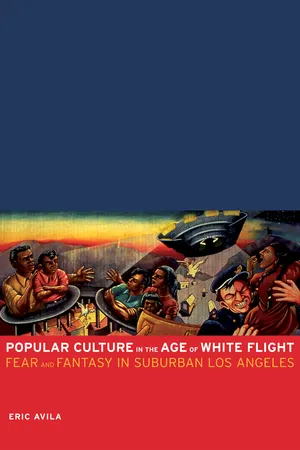
Popular Culture in the Age of White Flight
Fear and Fantasy in Suburban Los Angeles
- 330 pages
- English
- PDF
- Available on iOS & Android
eBook - PDF
About this book
Information
Publisher
University of California PressYear
2004Print ISBN
9780520248113
Edition
1eBook ISBN
9780520939714
1949
Housing
Act
to
build
eleven
apartment
buildings
“so
spaced
and
ori-
ented
as
to
take
full
advantage
of
views,
sun
and
breeze.”
90
The
mid-1950s
defeat
of
public
housing,
however,
freed
the
Los
Angeles
Community
Redevelopment
Agency
(CRA)
to
pursue
a
redevelopment
pro-
gram
that
did
not
contain
a
housing
component,
one
that
more
closely
re-
flected
the
corporate-civic
vision
of
GLAPI
and
the
Downtown
Business-
men’s
Association. A
sense
of
betrayal
descended
on
the
soon-to-be-displaced
residents
of
Bunker
Hill,
who
waged
a
campaign
against
the
CRA
through
letter
writing,
lawsuits,
and
public
protests.
Much
of
their
outrage
focused
on
the
apparent
contradiction
in
the
logic
of
the
city’s
probusiness
forces,
which
decried
government-subsidized
housing
as
“socialistic,”
yet
welcomed
the
use
of
public
monies
for
slum
clearance
and
urban
renewal.
Without
the
support
of
organized
labor,
which
by
the
1950s
had
abandoned
New
Deal
issues
such
as
public
housing
and
had
embraced
the
prodevelopment
agenda
of
the
city’s
corporate
interests,
the
community
activists
of
Bunker
Hill
found
little
support
for
their
cause.
91
The
Nation’s
“White
Spot”
/
59
Figure
1.
Noir
Los
Angeles,
circa
1940:
“blight”
on
Bunker
Hill.
(Courtesy
of
the
Los
Angeles
Public
Library.)
Table of contents
- Cover
- Half title
- Title
- Copyright
- Dedication
- Contents
- List of Illustrations
- Preface
- Acknowledgments
- 1. Chocolate Cities and Vanilla Suburbs: Race, Space, and the New “New Mass Culture” of Postwar America
- 2. The Nation’s “White Spot”: Racializing Postwar Los Angeles
- 3. The Spectacle of Urban Blight: Hollywood’s Rendition of a Black Los Angeles
- 4. “A Rage for Order”: Disneyland and the Suburban Ideal
- 5. Suburbanizing the City Center: The Dodgers Move West
- 6. The Sutured City: Tales of Progress and Disaster in the Freeway Metropolis
- Epilogue. The 1960s and Beyond
- Notes
- Selected Bibliography
- Index
Trusted by 375,005 students
Access to over 1.5 million titles for a fair monthly price.
Study more efficiently using our study tools.
Frequently asked questions
Yes, you can cancel anytime from the Subscription tab in your account settings on the Perlego website. Your subscription will stay active until the end of your current billing period. Learn how to cancel your subscription
No, books cannot be downloaded as external files, such as PDFs, for use outside of Perlego. However, you can download books within the Perlego app for offline reading on mobile or tablet. Learn how to download books offline
We are an online textbook subscription service, where you can get access to an entire online library for less than the price of a single book per month. With over 1.5 million books across 990+ topics, we’ve got you covered! Learn about our mission
Look out for the read-aloud symbol on your next book to see if you can listen to it. The read-aloud tool reads text aloud for you, highlighting the text as it is being read. You can pause it, speed it up and slow it down. Learn more about Read Aloud
Yes! You can use the Perlego app on both iOS and Android devices to read anytime, anywhere — even offline. Perfect for commutes or when you’re on the go.
Please note we cannot support devices running on iOS 13 and Android 7 or earlier. Learn more about using the app
Please note we cannot support devices running on iOS 13 and Android 7 or earlier. Learn more about using the app
Yes, you can access Popular Culture in the Age of White Flight by Eric Avila in PDF and/or ePUB format, as well as other popular books in Social Sciences & Discrimination & Race Relations. We have over 1.5 million books available in our catalogue for you to explore.