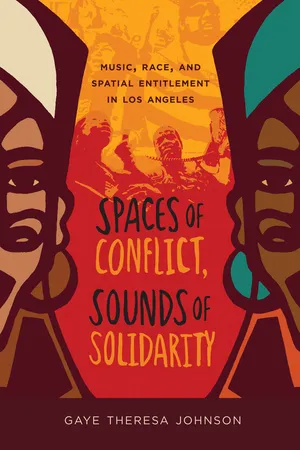
eBook - PDF
Spaces of Conflict, Sounds of Solidarity
Music, Race, and Spatial Entitlement in Los Angeles
- 263 pages
- English
- PDF
- Available on iOS & Android
eBook - PDF
Spaces of Conflict, Sounds of Solidarity
Music, Race, and Spatial Entitlement in Los Angeles
About this book
In Spaces of Conflict, Sounds of Solidarity, Gaye Theresa Johnson examines interracial anti-racist alliances, divisions among aggrieved minority communities, and the cultural expressions and spatial politics that emerge from the mutual struggles of Blacks and Chicanos in Los Angeles from the 1940s to the present. Johnson argues that struggles waged in response to institutional and social repression have created both moments and movements in which Blacks and Chicanos have unmasked power imbalances, sought recognition, and forged solidarities by embracing the strategies, cultures, and politics of each others' experiences. At the center of this study is the theory of spatial entitlement: the spatial strategies and vernaculars utilized by working class youth to resist the demarcations of race and class that emerged in the postwar era. In this important new book, Johnson reveals how racial alliances and antagonisms between Blacks and Chicanos in L.A. had spatial as well as racial dimensions.
Information
Publisher
University of California PressYear
2013Print ISBN
9780520275287
Edition
1eBook ISBN
9780520954854
Table of contents
- Cover
- Title Page
- Copyright Page
- Dedication Page
- Table of Contents
- Introduction: The Future Has a Past
- 1: Luisa Moreno, Charlotta Bass, and the Constellations of Interethnic Working-Class Radicalism
- 2: Spatial Entitlement: Race, Displacement, and Sonic Reclamation in Postwar Los Angeles
- 3: Cold Wars and Counter War (s): Coalitional Politics in an Age of Violence
- 4: “Teeth-Gritting Harmony”: Punk, Hip-Hop, and Sonic Spatial Politics
- 5: Space, Sound, and Shared Struggles
- Conclusion: In This Great Future. . .
- Acknowledgments
- Selected Bibliography
- Index
Trusted by 375,005 students
Access to over 1.5 million titles for a fair monthly price.
Study more efficiently using our study tools.
Frequently asked questions
Yes, you can cancel anytime from the Subscription tab in your account settings on the Perlego website. Your subscription will stay active until the end of your current billing period. Learn how to cancel your subscription
No, books cannot be downloaded as external files, such as PDFs, for use outside of Perlego. However, you can download books within the Perlego app for offline reading on mobile or tablet. Learn how to download books offline
Perlego offers two plans: Essential and Complete
- Essential is ideal for learners and professionals who enjoy exploring a wide range of subjects. Access the Essential Library with 800,000+ trusted titles and best-sellers across business, personal growth, and the humanities. Includes unlimited reading time and Standard Read Aloud voice.
- Complete: Perfect for advanced learners and researchers needing full, unrestricted access. Unlock 1.5M+ books across hundreds of subjects, including academic and specialized titles. The Complete Plan also includes advanced features like Premium Read Aloud and Research Assistant.
We are an online textbook subscription service, where you can get access to an entire online library for less than the price of a single book per month. With over 1.5 million books across 990+ topics, we’ve got you covered! Learn about our mission
Look out for the read-aloud symbol on your next book to see if you can listen to it. The read-aloud tool reads text aloud for you, highlighting the text as it is being read. You can pause it, speed it up and slow it down. Learn more about Read Aloud
Yes! You can use the Perlego app on both iOS and Android devices to read anytime, anywhere — even offline. Perfect for commutes or when you’re on the go.
Please note we cannot support devices running on iOS 13 and Android 7 or earlier. Learn more about using the app
Please note we cannot support devices running on iOS 13 and Android 7 or earlier. Learn more about using the app
Yes, you can access Spaces of Conflict, Sounds of Solidarity by Gaye Theresa Johnson in PDF and/or ePUB format, as well as other popular books in History & North American History. We have over 1.5 million books available in our catalogue for you to explore.