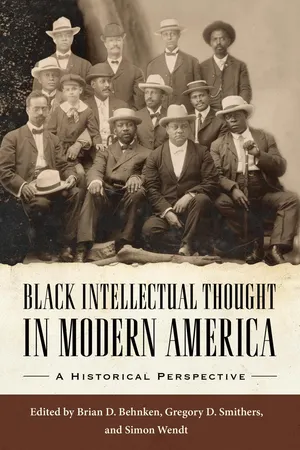
Contributions by Tunde Adeleke, Brian D. Behnken, Minkah Makalani, Benita Roth, Gregory D. Smithers, Simon Wendt, and Danielle L. WigginsBlack intellectualism has been misunderstood by the American public and by scholars for generations. Historically maligned by their peers and by the lay public as inauthentic or illegitimate, black intellectuals have found their work misused, ignored, or discarded. Black intellectuals have also been reductively placed into one or two main categories: they are usually deemed liberal or, less frequently, as conservative. The contributors to this volume explore several prominent intellectuals, from left-leaning leaders such as W. E. B. Du Bois to conservative intellectuals like Thomas Sowell, from well-known black feminists such as Patricia Hill Collins to Marxists like Claudia Jones, to underscore the variety of black intellectual thought in the United States.Contributors also situate the development of the lines of black intellectual thought within the broader history from which these trends emerged. The result gathers essays that offer entry into a host of rich intellectual traditions.
eBook - ePub
Black Intellectual Thought in Modern America
A Historical Perspective
- 252 pages
- English
- ePUB (mobile friendly)
- Available on iOS & Android
eBook - ePub
Black Intellectual Thought in Modern America
A Historical Perspective
About this book
Trusted by 375,005 students
Access to over 1.5 million titles for a fair monthly price.
Study more efficiently using our study tools.
Information
Subtopic
African American StudiesIndex
Social Sciences- CHAPTER ONE -
“ALL THE SCIENCE AND LEARNING”
Black Intellectual History in the United States
GREGORY D. SMITHERS
In 1895, Edward Austin Johnson published a revised edition of his popular A School History of the Negro Race in America from 1619 to 1890. Johnson’s book was a primer for black school children. Like other history primers written for African American children, A School History of the Negro Race in America emphasized the antiquity of the African people, noted their historical accomplishments—“The pyramids of Egypt,” Johnson instructed readers, “were either built by Negroes or people closely related to them”—and highlighted the uneasy relationship between the cultural development of black Americans and slavery. Johnson thus wrote, “All the science and learning of ancient Greece and Rome was, probably, once in the hands of the foreparents of the American slaves.”1
The phrase “All the science and learning” was a derivation of the more commonly used “science and learning.” Both phrases were popular in nineteenth-century intellectual and educational discourses, punctuating the writing of scholars in the hard sciences and the rapidly professionalizing academic disciplines in the humanities and social sciences.2 To produce and possess “science and learning” was a marker of accomplishment. Through diligent experimentation, empirical analysis, and the accumulation and dissemination of knowledge, human understanding was expanded, and civilization was improved. For Johnson to assert that African people had once possessed “All the science and learning” was at once a boast about the intellectual accomplishments of black America’s African ancestors and a reminder to readers about the variety of intellectual and cultural influences that constituted the diversity of African American intellectualism.3
Significantly, Johnson insisted that African people had once aspired to, and achieved, great feats of learning and understanding. If future generations of black American scientists, scholars, and leaders were to rise up from the ash heap of slavery and the subsequent violence and economic marginalization that followed under the system of Jim Crow segregation in the South and West, African American school children would need to engage with a life of the mind by first recognizing that their African ancestors—no matter how distant—had once overcome great odds in contributing to the civilized world’s store of knowledge and understanding. Such history lessons balanced an Africa-centric understanding of the past with recognition of the impact that racial slavery—and the Eurocentric forms of knowledge that made it possible—continued to have on black Americans. Like the authors of other black history primers, Stewart was determined to underscore the idea that black children were not racially inferior to their white contemporaries; instead, African American children did in fact possess the capacity to call on, and develop, ideas about religion, science, the arts and humanities, and politics, to achieve great scientific and intellectual accomplishments.
This chapter presents a historical overview of black intellectual thought between the late eighteenth century and the outbreak of World War II. The following analysis is by no means a comprehensive summation of black intellectualism during this extended period—such analysis would require a book-length treatment. Instead, the chapter charts some of the main currents in black thought with the goal of providing the general historical context for post–World War II black Marxism, liberalism, conservatism, feminism, nationalism, and Afrocentrism.
For much of the nineteenth century, Christianity and liberal intellectual and political thought dominated black intellectual history. Black churches and their ministers were assumed to play a central role in African American social, political, and cultural life; providing spiritual comfort and ethical guidance; and nurturing one of the few spaces in American life where black people could come together and nurture their political consciousness. Indeed, black churches, and the syncretic brand of Christianity that emerged within them, provided African American people with communal spaces in which they could worship, socialize, and develop political and intellectual traditions.4
African American interpretations of Christianity had the potential to complement liberal intellectualism and republican thought as much as they could clash with politically radicalized forms of Christianity—something that became particularly clear in the 1960s and 1970s when the emergence of liberation theology presented African Americans with a radical intellectual and political alternative to traditional forms of black church memberships and Christian thinking.5 However, for much of the nineteenth century, classical liberalism punctuated black abolitionism and played a major role in the formation of a black political and middle class during the late nineteenth and early twentieth centuries.6 At the same time, the forces of conservatism (and at times, reaction) produced theories about racial separatism and emigration that went against the grain of the black intelligentsia’s preference for liberalism throughout much of the nineteenth and early twentieth centuries. Alternatively, Marxist theory challenged the “progressivism” of black liberalism during the late nineteenth and early twentieth centuries, just as black feminist thinking struggled with the double-bind of racism and gender discrimination in American history. Black intellectual history is therefore not monolithic; it is diverse and complex. It reflects the resilience and vibrancy of black culture, and it spotlights the United States’ social, economic, political, and cultural shortcomings. The ideas that black intellectuals have written and spoken about since World War II belong to a rich tradition that began in an era when slavery was part of the fabric of American life.
THE FORMATION OF A BLACK INTELLECTUAL CLASS AND THE FIGHT AGAINST SLAVERY
Black American intellectual life traces its origins to the African medicine men and priests who were captured in West Africa, transported to the Caribbean and the Americas, and enslaved on plantations. Medicine men and priests played important roles in transmitting knowledge and keeping cultural practices alive in what Europeans referred to as the New World. As plantation slavery developed in North America during the seventeenth and eighteenth centuries, and the brutal discipline of the slave system intensified, slave owners viewed enslaved “priests” as a threat to the maintenance of a pliant slave labor force. As a result, slave religion became what one historian refers to as the “invisible institution” of the slave plantation complex.7 Medicine men, or “conjurers,” endured among the slave populations of Britain’s, and ultimately, the American republic’s southern colonies and states. They, along with slave women, continued to be the bearers of medicinal folk remedies and taught slave children maxims for the maintenance of good health and well-being.8
The African and African American medicine men and priests who toiled under slavery’s brutalities transmitted knowledge from one generation to the next through oral and performative means. Folktales, mythology, and cultural practices were learned orally, aurally, and visually through storytelling, song, and dance.9 In the seventeenth and early eighteenth centuries, colonial lawmakers worried about the implications of enslaved Africans and African Americans gathering in small congregations to transmit the knowledge contained in these stories, songs, and dances. Much as slave owners worried that “priests” would foment rebellion among other slaves, both lawmakers and slave owners worried that the congregation of blacks could foster a sense of community, providing the cohesiveness needed for rebellion. For example, in urban areas, especially in and around cities such as Charles Town, Richmond, and New York, large congregations of “Negroes” were often seen gathered on the city streets, in taverns, or in the “dramshops.” These meetings represented an opportunity for intellectual exchange. The sense of conviviality and community that such gatherings fostered among free and enslaved blacks, and between skilled black tradesmen and working-class white populations, had the potential to undermine the authority of an emerging planter elite.10
Planter elites in North America became increasingly concerned during the eighteenth century about the possibility of rebellious slaves cultivating disaffection among their fellow bondsmen.11 Europeans and Euro-Americans with an interest in the expansion of the slave system wanted to prevent violence and unrest among slave populations to ensure that the socioeconomic and cultural life that slave labor made possible throughout the Atlantic World would not only continue, but expand. The result was an increasingly rigid policing of slave societies. Slave laws, and the policing of those laws, were designed to ensure a subservient slave population.12 In this increasingly oppressive context, not only did whites frown upon black intellectual activity, but they also attempted to crush it wherever it existed.
Historians and anthropologists have written a great deal about the formation of slave culture in North America during the eighteenth and nineteenth centuries. This scholarship dates back to the days of slavery and the decades immediately following its abolition. Since the civil rights movement in the 1950s and 1960s, however, the scholarly discourse about slave culture and its relationship to the development of black intellectual traditions has produced some intense academic debates. Some scholars argue that cultural retentions from Africa influenced the cultural and intellectual development of black America. Sterling Stuckey, for example, argued that the “final gift of African ‘tribalism’ in the nineteenth century was its life as a lingering memory in the minds of American slaves.”13 Through the development and transmission of African oral traditions, music, and dance, New World slaves kept the memory of a life outside of slavery alive. Such memories enabled individuals to forge a sense of community where only back-breaking labor would have otherwise existed.14
The notion that African cultural retentions shaped nineteenth-century slave culture remains historically contested.15 In the early twentieth century, the anthropologist Melville Herskovits tackled this subject by focusing on the acculturation of the “New World Negro.” He contended that in the United States, African cultural retentions were particularly weak.16 Subsequent research by Sidney Mintz and Richard Price urged students of slavery to approach the intellectual and cultural life of diaspora blacks with greater nuance and subtlety, moving our historical understanding beyond the narration of superficial cultural expressions.17
Mintz and Price’s call has resulted in a rich historiography. Some scholars have echoed Stuckey’s analysis and see African retentions in the cultural practices, intellectual formations, and agricultural knowledge of the enslaved.18 Other scholars, such as Stuart Hall, Paul Gilroy, Philip Morgan, and James Sidbury argue that black cultural and intellectual life in the Caribbean and Americas formed in a syncretic process that resulted from the diasporic migrations of African peoples. Prior to the abolition of the international slave trade, the overwhelming majority of these diasporic migrants were coerced.19 Millions endured the middle passage and New World slavery, experiences that continue to give meaning to African American intellectual traditions in the United States.20 Tunde Adeleke refers to the importance of the trans-Atlantic slave trade and New World slavery in the emergence of black cultural and intellectual traditions as the “slavocentric” perspective. Adeleke argues that in nineteenth-century America, slavery “was the essence of the new identity cherished by leading black American thinkers.”21 Indeed, slavery inspired acts of rebellion—both large and small—among the enslaved and framed the activist scholarship of black America’s leading antislavery activists, journalists, and community leaders in the decades prior to the outbreak of the Civil War in 1861.22
Black intellectualism was thus inflected from its very beginning with an antislavery activism. From the poetry of Phillis Wheatley, David Walker’s Appeal to the Colored Citizens of the World (1829) to resist “abject slavery and wretchedness,” the pioneering journalism of Samuel Cornish and John Russwurm, and the memoirs of enslaved men and women—such as Octavia V. Rogers’ The House of Bondage (1890)—slavery, or more specifically, slavery’s abolition, was fundamental to the emergence of an African American intellectual tradition.23 As Russwurm so eloquently declared in an 1829 editorial, “Give as much importance as we may to other subjects, to us SLAVERY is the all absorbing one.”24 Russwurm and Cornish’s antislavery editorials appeared primarily in the pages of their newspaper, Freedom’s Journal, a publication that appeared four years prior to the first edition of white abolitionist William Lloyd Garrison’s The Liberator (1831). Like the black abolitionists who followed their journalistic lead, Russwurm and Cornish were determined to both oppose slavery and publish a black-owned and operated newspaper “devoted to the dissemination of useful knowledge among our brethren, and to their moral and religious improvement.”25
Black abolitionists led efforts to end slavery and develop strategies to “improve” the race. During the first third of the nineteenth century they did this by emphasizing the language of “moral suasion.”26 Black leaders recognized that for their version of moral suasion and ideas for racial uplift to meet success, significant changes in the United States’ social and cultural environment were needed.27 African American articulations of moral suasion and racial uplift were shaped by the racial realities of American life and reports of slave resistance;28 but they were also influenced by nineteenth-century romantic literature, Christian theology, classical liberalism, and empirical scholarship that refuted “scientific” theories about “negro inferiority” and justified slavery. Such works as Henri-Baptiste Grégoire’s An Enquiry Concerning the Intellectual and Moral Faculties, and Literature of Negroes and Mulattoes, Distinguished in Science, Literature and the Arts (1810) appealed to black abolitionist thinkers for the way in which it helped them formulate arguments refuting the racism and pseudoscientific findings of the American School of Ethnology. For example, black abolitionist James McCune Smith used a statistical methodology to refute the arguments of proslavery ideologues. Smith analyzed census data and concluded that the proslavery argument about free blacks in the North suffering from greater incidences of mental illness compared to those enslaved African Americans in the South was false.29
Russwurm, Cornish, and McCune Smith were among the leading public intellectuals in the North prior to the Civil War. Their dual focus—abolishing slavery and racial uplift—was aided by the formation of black institutions dedicated to these causes.30 Among the most important of these institutions was Richard Allen’s African Methodist Episcopal Church; the African Baptist Missionary Society (ABMS); the American Moral Reform Society, founded by Robert Purvis and William Whipper; and the Negro Convention Movement.31
T...
Table of contents
- Cover
- Title Page
- Copyright
- Contents
- Introduction
- Chapter One: “All the Science and Learning” Black Intellectual History in the United States
- Chapter Two: Black Marxism
- Chapter Three: The Quest for Racial Change African American Intellectuals and the Black Liberal Tradition
- Chapter Four: Black Conservative Thought in the Post-Civil Rights Era
- Chapter Five: Steps In and Places Outside The Reception of Black Feminist Intellectuals and Black Feminist Theory in Modern America
- Chapter Six: Intellectual Predicaments Black Nationalism in the Civil Rights and Post-Civil Rights Eras
- Chapter Seven: Afrocentric Intellectuals and the Burden of History
- Contributors
- Index
Frequently asked questions
Yes, you can cancel anytime from the Subscription tab in your account settings on the Perlego website. Your subscription will stay active until the end of your current billing period. Learn how to cancel your subscription
No, books cannot be downloaded as external files, such as PDFs, for use outside of Perlego. However, you can download books within the Perlego app for offline reading on mobile or tablet. Learn how to download books offline
Perlego offers two plans: Essential and Complete
- Essential is ideal for learners and professionals who enjoy exploring a wide range of subjects. Access the Essential Library with 800,000+ trusted titles and best-sellers across business, personal growth, and the humanities. Includes unlimited reading time and Standard Read Aloud voice.
- Complete: Perfect for advanced learners and researchers needing full, unrestricted access. Unlock 1.5M+ books across hundreds of subjects, including academic and specialized titles. The Complete Plan also includes advanced features like Premium Read Aloud and Research Assistant.
We are an online textbook subscription service, where you can get access to an entire online library for less than the price of a single book per month. With over 1.5 million books across 990+ topics, we’ve got you covered! Learn about our mission
Look out for the read-aloud symbol on your next book to see if you can listen to it. The read-aloud tool reads text aloud for you, highlighting the text as it is being read. You can pause it, speed it up and slow it down. Learn more about Read Aloud
Yes! You can use the Perlego app on both iOS and Android devices to read anytime, anywhere — even offline. Perfect for commutes or when you’re on the go.
Please note we cannot support devices running on iOS 13 and Android 7 or earlier. Learn more about using the app
Please note we cannot support devices running on iOS 13 and Android 7 or earlier. Learn more about using the app
Yes, you can access Black Intellectual Thought in Modern America by Brian D. Behnken,Gregory D. Smithers,Simon Wendt in PDF and/or ePUB format, as well as other popular books in Social Sciences & African American Studies. We have over 1.5 million books available in our catalogue for you to explore.