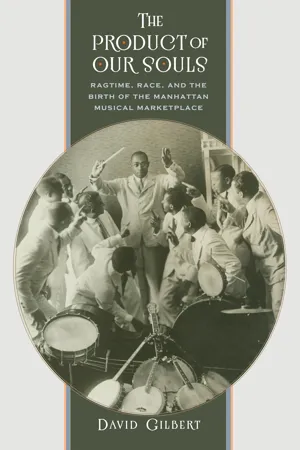
In 1912 James Reese Europe made history by conducting his 125–member Clef Club Orchestra at Carnegie Hall. The first concert by an African American ensemble at the esteemed venue was more than just a concert — it was a political act of desegregation, a defiant challenge to the status quo in American music. In this book, David Gilbert explores how Europe and other African American performers, at the height of Jim Crow, transformed their racial difference into the mass-market commodity known as “black music.” Gilbert shows how Europe and others used the rhythmic sounds of ragtime, blues, and jazz to construct new representations of black identity, challenging many of the nation’s preconceived ideas about race, culture, and modernity and setting off a musical craze in the process.
Gilbert sheds new light on the little-known era of African American music and culture between the heyday of minstrelsy and the Harlem Renaissance. He demonstrates how black performers played a pioneering role in establishing New York City as the center of American popular music, from Tin Pan Alley to Broadway, and shows how African Americans shaped American mass culture in their own image.
eBook - ePub
The Product of Our Souls
Ragtime, Race, and the Birth of the Manhattan Musical Marketplace
- 312 pages
- English
- ePUB (mobile friendly)
- Available on iOS & Android
eBook - ePub
The Product of Our Souls
Ragtime, Race, and the Birth of the Manhattan Musical Marketplace
About this book
Information
Chapter One: A New Musical Rhythm Was Given to the People
Ragtime and Representation in Black Manhattan
At fifteen minutes before midnight on July 5, 1898, Will Marion Cook began conducting an orchestra of white musicians as his African American chorus pranced onto the rooftop stage above New York’s Casino Theatre, singing the jaunty introductory bars of Cook’s ragtime operetta Clorindy; or, The Origin of the Cakewalk. Born in 1869, just six years after Abraham Lincoln delivered the Emancipation Proclamation, Cook was one of only a few African Americans of his generation trained in both an American music conservatory and a German one. He inaugurated the first theater performance by African Americans on Broadway Avenue, a street just becoming synonymous with the American stage.
As the show began, Cook recalled, there were “only about fifty” people in the rooftop garden. But before his troupe had completed their first piece, the Casino Theatre’s main stage downstairs let out, and the “big audience heard those heavenly Negro voices and took to the elevators” to see what was happening upstairs. The rooftop theater became “packed to suffocation,” and as Cook concluded his ragtime-inflected overture, the applause and cheers grew “so tumultuous,” he wrote, “that I simply stood there transfixed, my hand in the air, unable to move.”1
Evidently, Cook really did freeze. Clorindy’s lead actor, Ernest Hogan, a seasoned African American blackface vaudevillian and accomplished Tin Pan Alley songwriter, had to walk across the stage, step over the lights, and peer into the orchestra pit to ask, “What’s the matter, son? Let’s go!” Startled, Cook counted off, and Hogan began his syncopated opening number, “Hottes’ Coon,” with such comedic grace that he captured the crowd for the entire forty-five-minute production.2 Cook and Hogan’s ragtime music enthralled the audience with its rhythmic ingenuity. When the operetta finished, the Casino audience cried for encores. They would not let Hogan leave the stage before repeating Cook’s sprightly “Who Dat Say Chicken in Dis Crowd?” ten times. Performing a pitch-perfect blend of the black “dialect” that dominated American popular song in the late 1890s and the practiced enunciation that allowed his voice to carry out of doors, Hogan swooned and shuffled across the stage as he sang:
Who Dat Say Chicken in Dis Crowd?
Speak de word agin’ and speak it loud
What’s de use of all dis talkin’
Let me hyeah a hen a squakin’
Who Dat Say Chicken in Dis Crowd?3
Speak de word agin’ and speak it loud
What’s de use of all dis talkin’
Let me hyeah a hen a squakin’
Who Dat Say Chicken in Dis Crowd?3
Years later, Cook recalled: “My chorus sang like Russians, dancing meanwhile like angels, black angels! When the last note was sounded, the audience stood and cheered for at least ten minutes. . . . It was pandemonium, but never was pandemonium dearer to my heart.”4
By the end of the night, Cook was ecstatic. Thinking that someone had handed him champagne, Cook got “gloriously drunk” off cold water and enjoyed the rest of the night high on adrenaline. Fifty years later, he still championed Clorindy, ending his short, unpublished memoir by highlighting its role in transforming American musical theater. “Negroes were at last on Broadway, and there to stay. Gone was the uff-dah of the minstrel! Gone the Massa Linkum stuff! We were artists and we were going a long, long way. . . . Nothing could stop us and nothing did for a decade.”5
Cook’s excitement about his success seems endearing, but it also proves disconcerting. How could a formally trained musician like Cook wind up performing blackface on Broadway, and why was he so thrilled about it? And how, in any stretch of the imagination, could singing “Who Dat Say Chicken in Dis Crowd?” be considered a departure from the “uff-dah of the minstrel”? How, indeed, could an African American musician imagine that Clorindy ended the “Massa Linkum stuff” that defined late-nineteenth-century black stage performance? In Clorindy, caricatured African Americans sang about their unquenchable desires and danced the racially marked cakewalk—a slave innovation from the antebellum era—on Broadway for a white audience. So why did Cook believe he had ushered in a transformation in American culture? If Clorindy marks a milestone because of African Americans’ introduction to Broadway, it seems a severely compromised one.
Cook’s rarefied middle-class upbringing in Washington, D.C., his Oberlin College education, his violin and composition training in Germany, and his tutelage with the Czech master Antonín Dvořák prepared him to create symphonies and large-scale musicals. He could have written his libretto in German or Italian, but he chose black dialect. In 1890s America, Cook’s most promising professional opportunities depended on commercial music and performance stylings that owed more to blackface minstrelsy than European opera. Because few performance stages commensurate with Cook’s race and background existed, he had to choose between the formal styles of the concert hall and informal arts of popular vaudeville. In Clorindy, African Americans arrived on Broadway only by enacting lively embodiments of black stereotypes that Cook and Hogan hoped to transcend. Even as Clorindy symbolizes black performers’ early interventions into American commercial culture markets, it calls attention to the circumscribed nature of black performance and the limits American society foisted on African Americans.
At the end of the nineteenth century, black musicians, educators, and intellectuals debated the best ways to represent African Americans as U.S. citizens. Many agreed that advancing blacks’ development of “culture”—a term that in the late nineteenth century implied aristocratic breeding and manners as much as the arts—presented a key strategy.6 Black critics’ evaluations of “Negro music,” however, seemed in constant flux, so that ideas of “folk,” “formal,” “concert,” and “modern” black music rarely cohered; these categories often seemed to imply class distinctions rather than aesthetic ones. Regardless of the adjectives they used, most black commentators agreed on a strict difference between “high” and “low.” But while high, cultured, or “only the purest and best in music” (as one black music critic wrote in 1902) meant classically trained and formalized along the lines of European art music, low could mean anything from barely remembered slave music, refined slave spirituals, or any variation of popular music: from minstrel songs to vaudeville tunes, “coon songs” to ragtime.7 For musicians like Will Cook, family expectations and community obligations often took the form of a racial “politics of representation,” wherein black art and cultural development were tethered to the political aims of racial uplift and African American citizenship.8
Cook and Hogan’s collaboration on Clorindy dramatizes a moment when a generation of young African Americans began to cultivate alternative representations of themselves as popular entertainers and modern U.S. citizens. Musicians like Hogan and Cook were sharply attuned to the ways black intellectuals and music educators of the post-Reconstruction era fashioned uplifting representations of middle-class blacks as “respectable,” “civilized,” and “cultured” to prove their fitness for American citizenship. Even as Cook and Hogan broke with the elitism of the Talented Tenth, the Broadway entertainers understood their goals, and largely agreed with them. Yet rather than upholding Eurocentric notions of respectable culture and formal music, both men imagined that wider, more pluralistic notions of black culture would help African Americans become accepted as full-fledged Americans.
Many of the debates encircling Hogan and Cook dealt with conflicting ways to present African Americans as modern U.S. citizens. To embody modernity, some black culture workers and critics imagined a premodern past—something from which to distinguish themselves. For many, the music of the black slaves, and the spirituals especially, came to represent the primitive artistry of a folk people. The formal development of African American music through classical training and a studied mastery of the European art music canon, many elite African Americans hoped, would embody both their modernity and place in American society. While debates about black modernity and public representation most often took place between the diametric poles of folk and formal music, entertainers like Hogan and Cook increasingly demonstrated the power of a third path: popular music.
At the turn of twentieth century, the Manhattan musical marketplace shimmered up electricity-lighted Broadway, sang along Tin Pan Alley, and triggered the arrival of Times Square. It also crossed over into spaces of black leisure. More than just a site of economic transactions, New York City’s cultural marketplace was a space where ideas about race, class, and modernity took form, where native-born Americans negotiated the meaning of U.S. citizenship with immigrants, and the engines of industrial capitalism manufactured new distinctions among elite, folk, and mass culture. Cook, Hogan, and an entire host of driven, talented, and savvy African American entertainers used the opportunities New York City offered to enter into the United States’ most thriving and inventive marketplace. They began a cultural revolution that would outlast the twentieth century.
Two contradictory political and aesthetic currents gave rise to these entertainers’ desegregation of Broadway Avenue. First, new cultural expressions of ragtime song, dance, and comedy became Hogan’s vehicles into the Manhattan musical marketplace. The ways he embedded himself into American popular culture industries demonstrate both the unprecedented professional opportunities and pernicious racial stereotypes African Americans encountered as they intervened in mainstream American society. Second, raised by college-educated African Americans, Cook had studied art music in Europe and learned the attitudes and responsibilities of uplift ideology at a young age. Instead of growing into an artist in the classical mold, however, Cook’s education and formal training actually undermined the directives of the professional-class blacks of his parents’ generation and pushed him to revaluate the music of the black “masses,” both in the antebellum past and in the modern moment of the preset. Hogan and Cook met on New York’s Casino Garden Theatre stage and, together, began a revolution in American culture and society.
WALKING THE MANHATTAN MUSICAL MARKETPLACE
Will Marion Cook, worldly, educated, and no bumpkin, must have walked up Broadway Avenue in awe of Manhattan’s electric lights, brash noise, and immense architecture—hallmarks of American modernity at the turn of the twentieth century.9 In 1900, Broadway’s theater district ran from about Twenty-third Street to Forty-second, not yet stretching too far past the intersection that would be known as Times Square when the New York Times opened its new headquarters on New Year’s Eve 1904. Day and night, tall, soft-roofed automobiles competed with horse carriages for rights-of-way in the street, and pedestrians packed Broadway sidewalks. Although only a few yet sprinkled Manhattan, the skyscrapers along Broadway seemed to rise high enough to live up to their names. Completed in 1895, the three hundred-foot American Surety Building at Broadway and Forty-third Street initiated the trend in tall buildings.
Even more shocking than skyscrapers must have been the thousands of glass windows full of color and light. The vibrant electric lights on nearly every first floor of every building seemed to battle for sidewalk strollers’ attention. They called out, demanded notice, and enticed commuters and tourists alike to stop a moment and, perhaps, make a purchase. At the turn of the century, Manhattan boasted more electric lights and window displays than any other place in the world, turning its commercial districts into what one ad executive admiringly referred to as “the phantasmagoria of the lights and electric signs.”10 Even as Midtown Manhattan glowed long into the night, nothing boasted electric lights like Broadway theaters.
At night, the Casino Theatre where Cook produced Clorindy glimmered, its twenty-foot sign in large bulbs adding to the electric allure that gave Broadway its recent nickname, “The Great White Way.”11 “Broadway was one long can[y]on of light,” wrote Robert Hughes in 1904. “Even the shops that were closed displayed brilliantly illuminated windows. In some of them all the trickeries of electricity were employed and rhapsodies of color glittered in every device or revolved in kaleidoscopes of fire.”12 Completed in 1892, the Casino sported an eight-story red brick turret with a wide, circular roof made from concave red clay shingles, making the southeastern corner of Broadway and Thirty-ninth Street look like a medieval castle in daylight. One of the largest and most popular theaters in New York, it was surrounded by vaudeville houses like Koster and Bial’s on West Thirty-fourth Street and the Empire Theatre up Broadway on Fortieth, rendering the corner one of the brightest in the district. Although Broadway became the most conspicuous site of the revolution in American advertising and technological innovation, it merely reflected wider trends happening in New York and other American cities at the turn of the twentieth century.
Advertising made tremendous advances at the end of the nineteenth century. Propelled by new developments in print and visual media, New York City in the 1890s saw some of the earliest picture advertisements, lithograph-screened color posters, painted billboards, electric signs, and glass shop windows. As recently as the late 1880s, arresting visual advertising seemed crude and materialistic to most Americans; the historian William Leach has shown that ads were “looked down on as linked to circuses and P. T. Barnum hokum.”13 A cursory glance at American newspapers before the mid-1890s confirms this: they were all black and white and covered in tiny typeface. The rise of color advertising around 1900 paralleled the creation of mass-market magazines and national newspapers, many of them produced in New York. But by 1900, American media and advertising firms had embraced the spectacular, eye-catching commercial notice. “The successful advertisement,” according to a leading ad broker of the era, “is obtrusive. It continually forces itself upon the attention.” Using the same active verb, adman O. J. Gude celebrated electric sings because they “literally forced their announcements on the vision of the uninterested as well as the interested passerby.”14 As New York advertising agencies multiplied and advertisements cropped up anywhere there was free space—on the side of buildings, inside and outside public transportation, and within print media—Manhattan became the testing ground for a new type of consumer culture, and city spaces turned into high-profile studies in color, light, and electricity.
Yet New York City modernity manifested in more than spectacular visuals. When Will Cook explored Broadway Avenue, the sonic reverberations pouring out of Midtown leisure spaces must have intrigued him most. Alongside the tall buildings and their glittering facades, Cook would notice the strange amalgamations of music emerging from the scores of restaurants and hotel dining rooms. He would hear small string trios and quartets of Eastern Europeans, Italians, and Jews performing classical music, many specializing in what New Yorkers termed “Gypsy music”—those exotic minor strains accented in strange time signatures.15 Although less conspicuous in white-owned dining rooms in 1900, Cook almost certainly also heard a few black musicians performing ragtime, both “ragging” the classics by adding unusual rhythmic syncopations to well-known compositions by Mozart and Handel, and performing original music in an exciting, seemingly frenetic but highly controlled style similar to the one made popular by the Missourian Scott Joplin.16 Due to ragtime’s growing popularity on New York vaudeville stages, both approaches to ragtime we...
Table of contents
- Cover Page
- The Product of Our Souls
- Copyright Page
- Dedication
- Contents
- Map and Figures
- Acknowledgments
- Introduction
- Chapter One: A New Musical Rhythm Was Given to the People
- Chapter Two: Do All We Could to Get What We Felt Belonged to Us by the Laws of Nature
- Chapter Three: Appreciate the Noble and the Beautiful within Us
- Chapter Four: The Piano Man Was It! The Man in Charge
- Chapter Five: To Promote Greater Efficiency among Its Members
- Chapter Six: Rhythm Is Something That Is Born in the Negro
- Chapter Seven: A New Type of Negro Musician
- Epilogue
- Notes
- Bibliography
- Index
Trusted by 375,005 students
Access to over 1.5 million titles for a fair monthly price.
Study more efficiently using our study tools.
Frequently asked questions
Yes, you can cancel anytime from the Subscription tab in your account settings on the Perlego website. Your subscription will stay active until the end of your current billing period. Learn how to cancel your subscription
No, books cannot be downloaded as external files, such as PDFs, for use outside of Perlego. However, you can download books within the Perlego app for offline reading on mobile or tablet. Learn how to download books offline
Perlego offers two plans: Essential and Complete
- Essential is ideal for learners and professionals who enjoy exploring a wide range of subjects. Access the Essential Library with 800,000+ trusted titles and best-sellers across business, personal growth, and the humanities. Includes unlimited reading time and Standard Read Aloud voice.
- Complete: Perfect for advanced learners and researchers needing full, unrestricted access. Unlock 1.5M+ books across hundreds of subjects, including academic and specialized titles. The Complete Plan also includes advanced features like Premium Read Aloud and Research Assistant.
We are an online textbook subscription service, where you can get access to an entire online library for less than the price of a single book per month. With over 1.5 million books across 990+ topics, we’ve got you covered! Learn about our mission
Look out for the read-aloud symbol on your next book to see if you can listen to it. The read-aloud tool reads text aloud for you, highlighting the text as it is being read. You can pause it, speed it up and slow it down. Learn more about Read Aloud
Yes! You can use the Perlego app on both iOS and Android devices to read anytime, anywhere — even offline. Perfect for commutes or when you’re on the go.
Please note we cannot support devices running on iOS 13 and Android 7 or earlier. Learn more about using the app
Please note we cannot support devices running on iOS 13 and Android 7 or earlier. Learn more about using the app
Yes, you can access The Product of Our Souls by David Gilbert in PDF and/or ePUB format, as well as other popular books in Social Sciences & Jazz Music. We have over 1.5 million books available in our catalogue for you to explore.