eBook - ePub
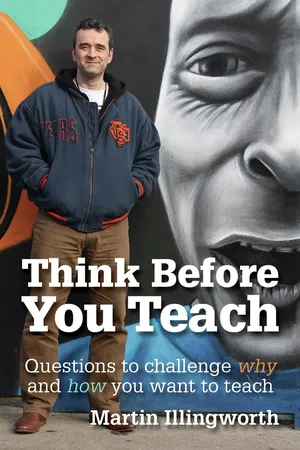
Think Before You Teach
Questions to challenge why and how you want to teach
- 192 pages
- English
- ePUB (mobile friendly)
- Available on iOS & Android
eBook - ePub
About this book
When was the last time you took a moment to pause and really think about your teaching? Think Before You Teach is purposefully full of questions: the openings of discussions to have, first with yourself and then, maybe later, with your colleagues. It doesn't promise all the answers. And it doesn't tell you what to teach. But it will ask you to think about why you want to teach and how you are going to teach. Arrive at school in the morning armed with a clear sense of why you are there and how you will have an impact on the hopes of your students. Regardless of government policies or school initiatives you remain the most important factor in the learning of your students. The students know it and they are looking to you for a lead. You are the key resource in the room; thinking about how to employ this resource is vital. Take a moment and give yourself that time and space to think. Teachers think about a lot on a daily basis: the curriculum, classroom practice, assessment, tests and exams, data, lesson planning etc. They think about Ofsted and policy and pressure. There are also the big things to think about. In a changing world what is our purpose as educators? Technology and the internet have changed the knowledge/skills debate. How do we equip digital natives for the future? What is your personal philosophy? To tackle these questions, teachers need hope, humour, imagination and motivation: Martin offers this in scores.For anybody thinking of entering the teaching profession, student teachers, teacher trainers, NQTs and teachers of all levels of experience. The book explores the various teacher training routes - School Direct, Teach First, PGCE - and the questions teachers should be asking about the path they have taken and their continuing professional development (CPD) needs. By raising questions about pedagogy, good practice, values and responsibilities, to name but a few, Martin encourages all teachers to become reflective practitioners and rediscover their passion.
Information
Topic
EducationSubtopic
Education GeneralPart One:
Your classroom
practice
1
Being a teacher
Are the things that are important to you just as important to the children?
Where do these things fit in with their lives and with the society changing around them?
Schools are coercive institutions (children have to go!) and children understand the ‘game’ of schooling. When they first meet you, children know you are the teacher. They know that the school is on your side. You are the one at the front, trusted to lead the students through their learning. And, until you prove to be a threat to that learning, the students will let you be the teacher.
It is your behaviour that will generally set the tone for the room. Teaching is not a noun, it is something that you do: looking, chatting, smiling, praising and telling stories. Your positivity and energy are infectious. Children will believe in you simply because you are the teacher. Your word will be taken as truth in any dispute.
‘Miss, how do you spell … See, told you!’
The bare bones of being the teacher are this: if you look as though you know what you are doing, and you look as if you care, then you can be the teacher. Children will believe in you. This confident aura is not easy to adopt all the time, and it is based on thoughtful training, on developing experience and on personal reflection. Teaching is a set of proactive responses to the needs of your students.
The lessons themselves are ephemeral. Your words disappear into the air. It is important that you find ways to activate long-term memories by making clear the importance and relevance of your lessons. Engaging and motivating children is your business.
Most schools seem to stick to rigid lesson timings.
‘Sir, can I just finish my poem?’
‘No. The bell has gone. Pack away. You are off to play hockey. We will come back to your poem next week.’
This adds another whole layer to your art: being purposeful in units of an hour!
And (I hope all these sentences that start with ‘and’ aren’t too irritating. They are supposed to be telling you that educating children is complex and that there is always something else to consider) while you have important things to tell the children, you need to be mindful of the needs of those children. Are the things that are important to you just as important to the children? Where do these things fit in with their lives and with the society changing around them? If you can be relevant, you will be doing yourself a big favour. Your students will always be searching for the value in what they are learning.
2
Becoming a teacher
What should your training year add to the passion you bring to teaching?
How good were you at driving after your first driving lesson? Already outstanding across all areas of the test?
I have interviewed people who want to become school teachers for over fifteen years now, and there is one thing they all agree upon. They want to become teachers to pass on their passion and enthusiasm for their subject. I bet you said that as well.
There is no general consensus from these interviews about whether discipline should be firm or whether it is more important that the teacher establishes a positive relationship with his class. There is little agreement about whether a school uniform is a healthy approach to indicating community or whether it leads to conformity. These entrants to the profession can’t agree on what is the most important factor about a lesson – knowledge or skills. When asked to characterise great teaching or their hopes for their own practice, again the range of opinions offered is vast. But all are sure that they have something important to say about a subject close to their hearts.
This is a very healthy place to start.
To add to this, let’s begin by thinking about the basics that you need to feel comfortable with as you begin to take responsibility for your own classroom practice.
So what should your training year add to the passion you bring to teaching? You will need to acquire a good number of skills and attributes very quickly if you are to make a successful beginning that will inspire you to carry on.
I think that a good teacher training programme will provide you with the following opportunities:
You will have been supported to feel confident about standing in front of classes of children. This can be more nerve-wracking than you think.
- You should have discussed the challenges that this presents for you personally. You might be the type that is shy or you might be the type that can’t stop talking. It is not an easy thing to contemplate.
- Perhaps you will have had a practice run at this by teaching a lesson in front of your fellow student teachers. No one enjoys this activity much at the time, but its benefits are quickly realised.
- Perhaps you have had the opportunity to video-record this ‘lesson’ and reflect on what you see. You should try to video your lessons throughout your career. Keep the old ones as well, so that you can see how you are progressing.
You should have been shown how to plan a lesson (short-term planning). You must understand how you will connect lessons to make a purposeful scheme of work (medium-term planning). You must work out how your sequences of lessons will form a whole year plan (long-term planning).
- You should have worked with a tutor to construct a lesson plan. In schools, you should have experienced a mix of using your own plans and also those that exist in your department.
- You should have worked with your fellow student teachers to construct a medium-term plan, thinking about how individual lessons are part of a sequence. Once you have grasped this, lesson planning becomes clearer and less onerous. You no longer see the planning of a lesson in isolation. It becomes less of an ‘event’ each time.
- Perhaps you could consider the place of individual plans across the subject curriculum for a year.
- Perhaps you could think through how your subject/lesson might be cross-curricular in nature and the potential of your lesson and scheme for creating opportunities to work collaboratively with other departments. This is a great way to meet other staff across the school, and to be quickly accepted as an important player in the school.
You should have had the opportunity to reflect on the fact that your students have different learning styles and learning needs in the classroom.
- You should have been taught about teaching styles and theories of learning. As teacher training moves away from universities, there appears to be less attention paid to this aspect of developing as a teacher. It is important: you may have to take responsibility for it yourself.
- You should have worked with fellow student teachers to think about differentiation and Special Educational Needs (SEN) and how these factors might impact on the process of planning your initial lessons.
You must work out how to sequence a lesson so that your students are actively engaged and that the tasks during the lesson mean that learning is achieved.
- Perhaps you spent time thinking about the difference between occupying children and engaging children in activities in the classroom.
- Perhaps time was set aside to think through the purposes behind the activities that we offer to children.
You need to think about how to assess the work that the children produce. You must work out how to use the data available about children to support you in making judgements about the lessons that you might need in future. You must decide how and when to mark the children’s books.
- I’d like to think that you had time to think through the reasons behind marking.
- Perhaps you were able to consider the difference between formative and summative assessment.
- Practising the marking of exemplar scripts and discussing how you have awarded grades and listening to advice about feedback is hugely important. Student teachers often feel very nervous about awarding grades to written pieces.
All of these requirements so far are about the pedagogy of teaching. In the old-style PGCE, you would receive this type of support at your university. If you are working on/worked on a School Direct route into teaching, then you might have to think about where these opportunities presented themselves, and perhaps where any gaps in your experience might lie.
Then there is the need for some subject and curriculum expertise (that passion I spoke of earlier).
- Before you go anywhere near a classroom, you need to practise reading out loud.
- You should be planning your choice of reading material for your classes.
- You should look at your subject curriculum and think about how you are going to deliver the content in passionate and engaging ways.
Schools will, no doubt, provide schemes of work and will take various views on how much freedom you will be given in choosing what to teach. Timetables will be organised and the demand of the timetable will increase until student teachers have a timetable that is two-thirds that of a regular teacher – and then, in your NQT (newly qualified teacher) year, a full timetable!
- Before you begin teaching, you should be encouraged to think about the physical and intellectual demands of a day’s teaching.
- Perhaps you should plan the construct of a week’s timetable to make allowances for marking of books, planning of lessons, preparing resources, etc.
- Hopefully, you are able to meet regularly with other studen...
Table of contents
- Cover
- Title Page
- Dedication
- Contents
- Acknowledgements
- Foreword
- Introduction
- Part One: Your classroom practice
- Part Two: Your school and the wider teaching community
- Index
- Copyright
- Advertisement
Trusted by 375,005 students
Access to over 1.5 million titles for a fair monthly price.
Study more efficiently using our study tools.
Frequently asked questions
Yes, you can cancel anytime from the Subscription tab in your account settings on the Perlego website. Your subscription will stay active until the end of your current billing period. Learn how to cancel your subscription
No, books cannot be downloaded as external files, such as PDFs, for use outside of Perlego. However, you can download books within the Perlego app for offline reading on mobile or tablet. Learn how to download books offline
Perlego offers two plans: Essential and Complete
- Essential is ideal for learners and professionals who enjoy exploring a wide range of subjects. Access the Essential Library with 800,000+ trusted titles and best-sellers across business, personal growth, and the humanities. Includes unlimited reading time and Standard Read Aloud voice.
- Complete: Perfect for advanced learners and researchers needing full, unrestricted access. Unlock 1.5M+ books across hundreds of subjects, including academic and specialized titles. The Complete Plan also includes advanced features like Premium Read Aloud and Research Assistant.
We are an online textbook subscription service, where you can get access to an entire online library for less than the price of a single book per month. With over 1.5 million books across 990+ topics, we’ve got you covered! Learn about our mission
Look out for the read-aloud symbol on your next book to see if you can listen to it. The read-aloud tool reads text aloud for you, highlighting the text as it is being read. You can pause it, speed it up and slow it down. Learn more about Read Aloud
Yes! You can use the Perlego app on both iOS and Android devices to read anytime, anywhere — even offline. Perfect for commutes or when you’re on the go.
Please note we cannot support devices running on iOS 13 and Android 7 or earlier. Learn more about using the app
Please note we cannot support devices running on iOS 13 and Android 7 or earlier. Learn more about using the app
Yes, you can access Think Before You Teach by Martin Illingworth in PDF and/or ePUB format, as well as other popular books in Education & Education General. We have over 1.5 million books available in our catalogue for you to explore.