- 256 pages
- English
- ePUB (mobile friendly)
- Available on iOS & Android
eBook - ePub
About this book
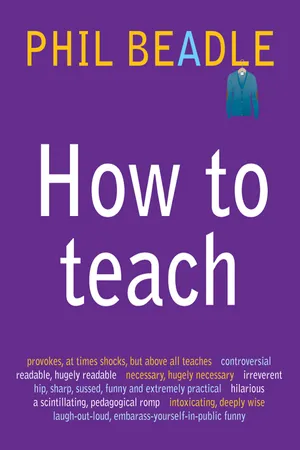
How to Teach is the most exciting, most readable, and most useful teaching manual ever written. It is not the work of a dry theorist. Its author has spent half a lifetime working with inner city kids and has helped them to discover an entirely new view of themselves. This book lets you into the tricks of the trade that will help you to do the same, from the minutiae of how to manage difficult classes through to exactly what you should be looking for when you mark their work. How to Teachcovers everything you need to know in order to be the best teacher you can possibly be.
Information
Topic
EducationSubtopic
Education GeneralCHAPTER 1
MANAGEMENT OF STUDENTS
AaaaaaaAarGhhH!
How on earth are you ever going to manage thirty knife-wielding psychos on your own? What happens if they don’t do what you say? What if they go completely hat-stand? Carroty even? Completely mental? My God, you’re under-prepared. You’re über-under-prepared. They’ll kill you. You’re not cut out for this. You’re not in the right job. You’re not in the right profession. Best you resign before it all gets too bloody.
The beginner teacher’s fear of the unruly class is similar to the turkey’s fear of Christmas, in that, not only is it entirely warranted, but also neither teacher nor turkey are anywhere near properly prepared for the full horror of what it is they are to face. PGCEs rarely give much more than a day’s training on how to manage behaviour, and that generally consists of sitting mute, watching Antipodean behavioural guru, Bill Rogers, effortlessly controlling a class of miniature, compliant Aussies, as a room full of adults think, as one, “Well that’s got to be a piece of cake, hasn’t it? The kids in the Bill Rogers video are all well fed, clearly middle class and obviously easy to manage. I don’t think there’s going to be too many of those in the school that I’ve just signed on for.”
This proved to be true in my first year of teaching. I thought I’d manage them purely on the basis of having nice(ish) hair for a thirty-two-year-old and being able to read books aloud in the stentorian, actorly manner of an amateur Kennneth Bran-argh. Wrong.
In my first year of teaching I was shuffled into a classroom far away from the rest of the English department and left to get on with it.
In no way did my PGCE prepare me for Rod freaking out and sobbing; for Lee threatening to chuck a chair at me; for the whole of 8M point-blank refusing to do anything I asked, nay begged, them to do, ever; for Mick pushing me; for 8S winding me up something chronic; for Mick pushing me again; for JK punching Cookey in the mouth in the first five seconds of my first Ofsted observed lesson; for Tammy and her mate to write me really scary love letters; for the whole sorry mess that was my desire to be a good teacher to teeter and threaten to topple into the abyss on a near daily basis.
It would have been much easier if I’d had some of the pieces of information, of which you will be in possession within a couple of minutes. Managing behaviour is actually fairly easy provided you observe a few rules (also provided that you haven’t been gifted the most difficult class in the borough on your first day in the profession). You must observe them religiously though. Fail to do any of the following and you’ll find that you are not in control of the class. And this is key: it’s your classroom. You are the teacher. If you are not in control it’ll all go to cock, the kids will learn nothing and, what is more, they’ll have a deeply unpleasant experience, as they won’t feel at all safe.
RULE 1 – TURN UP
One of the most difficult classes I’ve ever taught was in my first year as a teacher: En10a2. The worst you would think on seeing this seemingly innocuous set of letters and numbers is that they are slightly oddly capitalised. To me, in 1997, the merest flash of this set of signifiers would be enough to reduce me to shuddering, silent screams of, “Please. Don’t make me go in that room with them. They are savages.” It was in En10a2 that Mick, a bulky fifteen-year-old, pushed me, with substantial force, full in the chest, in front of the rest of the class. (He was taken to internal inclusion and told off. I was left to teach the rest of the class, hands shaking and pale as a sheet as I held grimly to the piece of paper I was reading to them in a quivering voice). And it was in En10a2 that the same kid performed the same feat two weeks later. It was in En10a2 that Tammy and her mate wrote the love letters, that JK punched Cookey when Ofsted were in, that Christelle informed me in front of a senior manager that she, “Didn’t give a fuck” about my lesson, that the whole class came in sobbing after a funeral they’d attended that no one thought I should be told about and called me an, “Insensitive tosser” for trying to teach them afterwards. And it was in En10a2 that I was given the gift of being Coops’s teacher, (which, if you’d met Coops, you’d understand is the kind of gift that would make you believe a brain tumour to be a birthday present).
In my first year as a teacher, every lesson with En10a2 was fretted about before, dismal and depressing during and, afterwards, often left me as a shell-shocked wreck, strung together with string and masking tape, barely suppressing the tears lining my lower eyelids, which were threatening to make me even more of a laughing stock in the staffroom than I already thought I was.
By the end of year 10 they were my favourite class. I adored them. And it was, they were fairly fond of telling me, one of the rare moments in my life where such affection was, at least partially, reciprocated. The next year, when HMI were in, En11a2 organised their own séance in class when my lesson was being observed, Coops taking his group and leading them brilliantly. My head of department witnessed a conversation between an inspector and the Principal, in which she pointed out Coops to be about the most challenging young man in the school, and that I had him, “Wrapped around my little finger.” En10a2 were eventually the first step to me getting recognised as being alright in the classroom, as opposed to the borderline pass I’d been regarded as in my NQT year. But it was not always thus …
In year 11, the class and I spoke about the early days. Oh, how we all laughed at how difficult it had been the year before. They remembered how horrific they had been in those first few half terms. They were sorry they’d been horrible but, as Danksy pointed out, I was about their fifteenth English teacher in the space of a year. They’d actually quite liked me (sort-of-ish-a-bit-but-not-really) from the first moment, but no English teacher had ever stayed around long enough to see their good side before and, quite reasonably, they saw no reason to think I’d be any different, and consequently, no cause for getting that good side off the mantelpiece and giving it a shine. They didn’t want to get too fond, because that’d result in them being all the more disappointed when I left them, as I was inevitably bound to do, particularly as they’d behaved so awfully!
It is a sad truth that you will teach many young people in your career who are all too used to adults letting them down. Sadder still, many are used to the adults they care for the very most leaving them. Put yourself in their shoes. Would your response to experiencing such loss at such an early age be sane? In behaving appallingly in the first few half terms, En10a2 could at least draw some power from their teacher’s inevitable chucking in of the towel. They had caused it. They were the hardest, the toughest and the meanest. Adults leaving them was entirely in their control. They were not helpless, or vulnerable, or any of the other things they feared they might be in their darker moments. They were captains of their own fate.
You may think you’re a crap teacher doing a crap job when you are in front of the class, but you’re worse when you’re not there. Turn up. Take the punches. Smile back. Within six months you’ll have achieved what some teachers refer to as the ‘bowling ball effect’. You pick them off one by one. You’ll notice a couple of kids initially (in the case of En10a2 it was Kelly and Sam) who are less resistant to learning, and to you, than the others. After a while a couple more might join them. Then you pick them off like pins at a bowling alley, until such point as you have a critical mass in favour of both you and your lesson. Eventually, even the hardest nut cracks and you have that profound moment of epiphanic teaching joy: the first good lesson with the truly hard class, in which you begin to see it is possible. You can do this.
The reason this is in the section regarding behaviour management is that kids like teachers who are there every day. One of my most weirdly proud moments came when, halfway through the spring term, Big Isaac (a charming and vastly proportioned naughty boy, who couldn’t write that well, but was a very promising boxer) cried out to me, giving vent to an exasperation that had obviously troubled him for a while, “Christ! Beadleman,” he exhaled, “Don’t you ever take any time off? When are we going to get a break from you?” This, I think, was Isaac’s backhanded way of saying that he appreciated my attendance record. (From my perspective I was very grateful he didn’t punch me even once during our years together). If you get a reputation with the children as a good attender, it will pay dividends in terms of behaviour. You will always be on top of what happened yesterday, and the children will respect the commitment you show to them by always being there.
RULE 2 – SORT YOUR SEATING
A teacher without a seating plan is a dunce and is asking for it. Other than your own ability to charm, cajole and sometimes even confront, the seating plan is the single most important piece of behavioural modification equipment you have in your toolbox.
There are different schools of thought on this. I have a particular methodology, which I’ll explain later, but first, a bit on why classroom organisation is the most important philosophical decision you will make in your career and why you should turn your face away from the darkness and towards the light.
Here’s a shock. You are not necessarily the cleverest person in your classroom. You may not even be in the top ten. Yes, you are the one with a degree. You are the bigshot, for now. But, let’s face it, you have no idea what the children in front of you may one day become. Something altogether more impressive than a piffling, cardiganclad, Cornish-pasty-shoe-wearing schoolteacher, perhaps?
Any survey of students that asks them the important question, “How do you learn best?” finds the same answer at the top of the list. “Groups,” their replies will scream, with one impassioned voice. “We learn best in groups. WHY WON’T ANYONE LISTEN TO US?” Having your desks set out in groups is the right way to organise your classroom. Period. No discussion. No arguing. Having the tables in groups allows you to set them the grouped speaking and listening activities that are the way in which they learn most effectively. Having your tables in groups lets them learn from each other. And having your tables in groups is a spatially symbolic move away from the Dickensian notion of the teacher standing at the front talking cobblers about really hard sums all day, every day.
Having your tables in five groups of six is the optimum classroom layout, in that it allows you to mix up the activities. You can do a paired activity, then one in threes, then one in groups without so much as a single moved chair. Not only is it convenient, but it is good use of the classroom space. If you ensure that each group of tables is positioned as near to the boundaries of the classroom as is possible, whilst still allowing the kids at the edge to be able to breathe, you are left with a space in the middle of the classroom in which kids can do exciting kinaesthetic activities, or you can stand in the spotlight declaiming your own shockingly bad poetry in a fruity RSC bombast.
Having your tables in groups also allows you to implement a quite interesting piece of methodology, which I’ll explain now. Many years ago, when doing some work on boys’ achievement, I chanced upon Ofsted’s report on the same issue, and actually read the bloody thing. In it there was a fascinating section about the seating plan (Christ! I really, really must do something about my work/lack of anything anywhere near resembling a life balance). Ofsted suggest that the best way of getting serious work out of boys in a mixed school is getting them to sit with slightly lower ability girls. If they are sat with higher ability girls then they just go into learned helplessness mode and get the girls to do their work for them. If they are sat with girls of the same ability range they go all stupid and competitive. But if you sit them with girls they can help, they change character immediately: becoming nurturing, gentle, supportive and interested in their own attainment and that of others. I use this method now for every class I teach and, you know, it kind of works.
There are teething issues with implementing any new seating plan. This methodology doesn’t take account of existing relationships, for instance, and it may be that you’ve sat people on the same table who pathologically detest each other or, worse still, are the best of friends. But with the odd tweak it can be made to work. It has, at its base, the important basic that boys and girls must always be sat next to each other, and is a defensible methodology in terms of Ofsted or senior management asking probing questions of you. Of course, it’s useless in single-sex schools, and it relies on there being a critical mass of relatively high-attaining males in the class, which is not always so. It also condemns the highest ability girls to sit on a table with the three lowest attaining males. But this too has benefits, which you’ll find out once you implement it.
The implementation of a seating plan can be bloody however, and you must be both rigourous and intractable, as the kids will seek to circumvent it. Any request from a student must be resolutely refused. “But Miss, I don’t like …” or, “We don’t get on …” must be treated as the irrelevant impertinence that it is. You decide where they sit, and you have arranged the seating plan to maximise their attainment not so they can sit gossiping with their best mate. You will find that within a lesson or so, they will attempt to just go and sit back in the place that they want to occupy, you have to call them on this immediately. Acceding to even a single request regarding where they sit will lead to chaos, and chaos is not what we’re after.
RULE 3 – SWEAT THE SMALL STUFF AND THE BIG STUFF DON’T HAPPEN
There are certain ‘tells’ regarding behaviour management that will give any person observing that lesson a pretty well immediate sense of whether the teacher knows what they are doing or not. The first of these is obvious from the moment the observer walks into the class: if there are kids’ coats and bags on the desks then the teacher is clueless and the lesson is likely to be a disaster. If the kids’ coats are on their backs then the same applies, only more so.
The reason for this is that there are certain rules that children won’t bother reacting against or calling into question, such as putting their bags on the floor and their outside wear on the back of a chair. I don’t recall a situation in my many years standing in front of a class talking twaddle, in which a child has defended to the death their right to have their coat sprawled out on the desk. All children will obey this instruction. It is therefore senseless to bottle it because you are scared of an adverse reaction from them that they can’t be arsed to summon up.
As soon as the children enter your class, insist that their bags are off the table and their coats hung up or chucked, gently, wherever those coats go. Insisting that this routine is followed without question at the beginning of every lesson does so much more for you, as a teacher, than just keeping the coats and bags orderly. It gives out a message: this is a classroom in which the rules are to be followed, and your insistence on such a routine sets the tone for the rest of the lesson. Because you have laid down the law first thing, you have asserted that you are not the sort of teacher who ignores behavioural infractions and, having established this with the class, you will find that there are fewer infractions. They don’t bother committing them because they know you are going to call them on it.
RULE 4 – BECOME EXPERT IN THE TECHNICALITIES OF DEALING WITH CHEWING GUM
It’s repulsive stuff, chewing gum. It performs no useful function other than allowing kids to believe themselves mini-versions of James Dean, ‘rebels without an idea of how to mark off a subordinate clause’. It gets everywhere – into carpets, onto your best teaching trousers, and often into Hermione, the Pre-Raphaelite kid’s, hair. Upturn any school desk and you’ll find a ‘tribble’ of them nestling like guilty, germridden, rock-hard glob-bogeys, festering and sneering at your utter impotence and inability to stop more of their cousins joining them next lesson. There are few things in British schools that bring out this teacher’s inner fascist quicker than the wanton cud-chewer.
Some schools seem to have bigger problems with this issue than others. And if you are to teach in one of the schools in which gum chewing is endemic then, trust me, you will get heartily sick of instructing children to, “Spit it in the bin.”
The same thing applies with the gum rule as with the coats and bags. If you ignore the fact that a child is chewing gum then you are setting a precedent for the whole class – giving them the message that it is OK to break school rules in your lesson. It may seem slightly petty dispensing summary justice to those who break the gumchewing rule (see also packets of crisps, toffees, etc.) but, again, it sends a message that since the smaller infracti...
Table of contents
- Cover
- Praise For How To Teach
- Title Page
- Copyright
- Acknowledgements
- Contents
- Foreword
- Introduction
- Chapter 1. Management of Students
- Chapter 2. Knowledge and Understanding
- Chapter 3. Methods and Organisation
- Chapter 4. Lesson Planning
- Chapter 5. Assessment
- About the Author
- Recommended Reading
- Index
Trusted by 375,005 students
Access to over 1.5 million titles for a fair monthly price.
Study more efficiently using our study tools.
Frequently asked questions
Yes, you can cancel anytime from the Subscription tab in your account settings on the Perlego website. Your subscription will stay active until the end of your current billing period. Learn how to cancel your subscription
No, books cannot be downloaded as external files, such as PDFs, for use outside of Perlego. However, you can download books within the Perlego app for offline reading on mobile or tablet. Learn how to download books offline
Perlego offers two plans: Essential and Complete
- Essential is ideal for learners and professionals who enjoy exploring a wide range of subjects. Access the Essential Library with 800,000+ trusted titles and best-sellers across business, personal growth, and the humanities. Includes unlimited reading time and Standard Read Aloud voice.
- Complete: Perfect for advanced learners and researchers needing full, unrestricted access. Unlock 1.5M+ books across hundreds of subjects, including academic and specialized titles. The Complete Plan also includes advanced features like Premium Read Aloud and Research Assistant.
We are an online textbook subscription service, where you can get access to an entire online library for less than the price of a single book per month. With over 1.5 million books across 990+ topics, we’ve got you covered! Learn about our mission
Look out for the read-aloud symbol on your next book to see if you can listen to it. The read-aloud tool reads text aloud for you, highlighting the text as it is being read. You can pause it, speed it up and slow it down. Learn more about Read Aloud
Yes! You can use the Perlego app on both iOS and Android devices to read anytime, anywhere — even offline. Perfect for commutes or when you’re on the go.
Please note we cannot support devices running on iOS 13 and Android 7 or earlier. Learn more about using the app
Please note we cannot support devices running on iOS 13 and Android 7 or earlier. Learn more about using the app
Yes, you can access How To Teach by Phil Beadle in PDF and/or ePUB format, as well as other popular books in Education & Education General. We have over 1.5 million books available in our catalogue for you to explore.