This volume combines ethnographic accounts of fieldwork with overviews of recent anthropological literature about the region on topics such as Islam, gender, youth, and new media. It addresses contemporary debates about modernity, nation building, and the link between the ideology of power and the production of knowledge. Contributors include established and emerging scholars known for the depth and quality of their ethnographic writing and for their interventions in current theory.
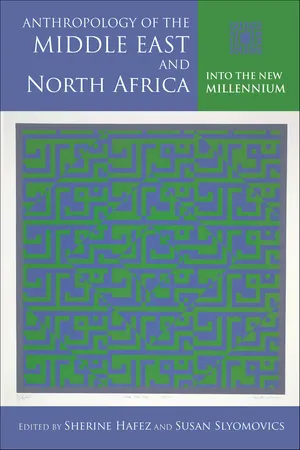
eBook - ePub
Anthropology of the Middle East and North Africa
Into the New Millennium
- 396 pages
- English
- ePUB (mobile friendly)
- Available on iOS & Android
eBook - ePub
Anthropology of the Middle East and North Africa
Into the New Millennium
About this book
Information
PART 1.
KNOWLEDGE PRODUCTION IN THE ANTHROPOLOGY OF THE MIDDLE EAST AND NORTH AFRICA
1.
STATE OF THE STATE OF THE ART STUDIES: AN INTRODUCTION TO THE ANTHROPOLOGY OF THE MIDDLE EAST AND NORTH AFRICA
Susan Slyomovics

In the present state of the art, this is all that can be done.
—H. H. Suplee, Gas Turbine
In both everyday and academic discourse, as noun or adjective, the phrase “state of the art” has come to mean “incorporating the newest ideas and most up-to-date features” (Oxford English Dictionary online). The first usage, dated to 1910 according to the Oxford English Dictionary, was recorded in Gas Turbine, an engineering manual authored by H. H. Suplee, who issued this laconic observation: “In the present state of the art, this is all that can be done.” Wikipedia’s definition is:
The state of the art is the highest level of development, as of a device, technique, or scientific field, achieved at a particular time. It also applies to the level of development (as of a device, procedure, process, technique, or science) reached at any particular time usually as a result of modern methods. (Wikipedia, 1 October 2011)
At least in legal parlance, the semantic range of the phrase extends beyond the implication of a definitive overview of what came before toward something new in order to establish the originality of an invention in patent law. Similarly, in state-of-the-art surveys in the social sciences, the understanding has been that the disciplinary terrain is to be surveyed primarily for the purpose of relegating known and disseminated research to the past in order to ask what’s new. My version of the “state-of-the-art” definition, by contrast with this forward-looking focus, is a past-oriented survey of what’s been accomplished and what’s missing. It must be excellent and comprehensive, publicly available for scrutiny, and used to assess the originality of future projects; these were the three goals of a 2010 UCLA conference titled “State of the Art: The Anthropology of the Middle East and North Africa,” and of this volume which it inspired.
Critically reviewing critical reviews enables me to engage shamelessly and explicitly with issues of hindsight bias, or roads taken and not taken. This is because decades of essays about the state of the art are characterized by negative assessments of the anthropology of the Middle East and North Africa (MENA). Discourses about the state of the art have been organized around the oppositional figure of antithesis, a Janus-faced methodology that looks backward then forward, not only echoing and presaging the underlying shared enterprise of hindsight bias but inevitably embedding the particular biases of the author and his times (most authors were male). We could go so far as to label the “state of the art” as a genre, meaning a productive category of social science criticism with a specific set of conventions alluded to above, notably negative assessment, hindsight bias, and a dialectic of proposition and counter-propositions. Timothy Mitchell, in his 2003 state-of-the-art review, “The Middle East in the Past and Future of Social Science” provides examples of hindsight bias, the trope endemic to state-of-the-art studies. In so doing, he underscores the ways in which the genre of the state of the art begins by and depends on reciting a litany of failures attributed to Middle East studies and the social science of the region. Mitchell’s prime example is Leonard Binder’s sweeping condemnation of the field in his 1973 article, “Area Studies: A Critical Reassessment”: “The fact is that Middle East studies are beset by subjective projection, displacements of affect, ideological distortion, romantic mystification, and religious bias, as well as a great deal of incompetent scholarship” (Binder 1976, 16). Another example is an essay by anthropologist John Gulick (1969), “State of the Art III: The Anthropology of the Middle East,” which depicted the Janus-like face of Middle East anthropology poised between the negative and the positive, faced with two potential opposing directions:
The state of art of anthropology in the Middle East is a state of growth like Topsy.1 We continue to be faced with the dilemma of either filling subregional gaps in descriptive knowledge (so that we can make generalizations more confidently) or of focusing much research on a few sub-regions (so that we can generate more sophisticated hypotheses). Unable to resolve the dilemma, some of us continue to make hypotheses and generalizations which are always subject to summary rejection, while others of us appear to remain either very narrowly focused or inarticulate, or both. Whether the anthropology of the Middle East will develop into a cumulative discipline or a congeries of mostly unreliable parts is difficult to say. The potentialities for development in either direction are definitely present. (Gulick 1969, 13)
Evidently a retelling of past regressive academic practices is insufficient, although necessary, to the genre. Mitchell warns that if, as he claims, the state-of-the-art formula must begin retrospectively with “regular statements of failure,” then we must also beware of its polar opposite, which is the countervailing upswing of upbeat optimism that touts the latest novel combinations of social science and Middle East area studies (Mitchell 2004, 71). In the spirit of Mitchell’s caveat, but oscillating like a pendulum gone berserk between negative and positive reviews, I now resurrect a range of prior state-of-the-art writings about anthropology of the MENA as a systematic review to introduce this volume. In this chapter, I emphasize the 1949 American Council of Learned Societies’ (ACLS) A Program for Near Eastern Studies report; Louise Sweet’s surveys (1969–1971); Morroe Berger’s 1967 article, “Middle Eastern and North African Studies: Development and Needs,” published in the first issue of the Middle East Studies Association Bulletin; the 1976 article by Leonard Binder, “Area Studies: A Critical Reassessment”; three Annual Review of Anthropology articles (Robert Fernea and James Malarkey in 1975; Abdul Hamid el-Zein and Erik Cohen in 1977; and Lila Abu-Lughod in 1989); Richard Antoun’s 1976 chapter on “Anthropology” in The Study of the Middle East: Research and Scholarship in the Humanities and Social Sciences; R. Bayly Winder’s 1987 “Four Decades of Middle Eastern Study” in the Middle East Journal; and finally Timothy Mitchell’s 2002 “The Middle East in the Past and Future of Social Science.” One conclusion from all of this is to be foreshadowed: the fact that any statement about the state of the art is not about the past, but how to recreate the future. We are all pursuing the retrospective in search of the prospective.
Carleton Coon (1904–1981): MENA’S First American Anthropologist?
It is remarkable now to read the early 1949 state-of-the-art report entitled A Program for Near Eastern Studies issued by the Committee on Near Eastern Studies of the ACLS in which it was noted in passing that “only one anthropologist is known to have begun to concentrate on the area” (emphasis added). Almost forty years later, R. Bayly Winder’s 1987 state-of-the-art report covering Middle East studies 1947–1987 speculates that this sole American anthropologist was Carleton Stevens Coon (Winder 1987, 45 cited in Mitchell 2004, 6). The figure of Coon lurks throughout this chapter, popping up as a foil and a cautionary tale, a progenitor and precursor, in unexpected ways. Coon, who completed his Harvard doctorate in anthropology with fieldwork in northern Morocco, belonged to the swashbuckler school of intrepid fieldworkers, archeologists, and undercover agents. Frequently inhabiting the contradictory roles of spy, scholar, and adventurer simultaneously, he lived among and wrote extensively about Berbers, Albanians, and other hardy mountain people. Coon’s A North Africa Story: The Anthropologist as OSS Agent, 1941–1943 recounts the effective deployment of his anthropological and archeological skills on behalf of the North Africa station of the Office of Strategic Services (the OSS was the precursor to the CIA). He writes as if fully prepared to raise up armies of his beloved Rifian Berber tribes against Hitler’s Afrika Corps during World War II, especially since such an uprising could do double duty by confounding the resident French and Spanish colonial powers. Coon was by no means anti-colonialist; he wholeheartedly assimilated the French colonial “Kabyle myth” that pitted Berber against Arab to the latter’s perennial disadvantage.2 Berbers were white folks, or so Coon averred:
The lightest pigmentation recorded is that of the Rifians, the most European-looking Berbers. They have a 65 percent incidence of pinkish-white unexposed skin color. This goes as high as 86 percent in some tribes. Twenty-three percent are freckled. Ten percent have light brown or blond hair; in some tribes, 25 percent do. In beard color, 45 percent of Rifians are reddish, light brown, or blond bearded; in some tribes the figure rises to 57 percent, with 24 percent completely blond. (Coon 1965, 177)
Coon’s racial theories have been largely discredited. He held that five primordial species preceded the evolution of Homo sapiens, with each race evolving separately and at different speeds. Coon’s subsequent physical anthropology battles were as much about turf disputes with his rivals, whom he called the “Boasinine” Columbia school of anthropology, as they were disagreements over scientific authority. In 2001, an article in the Journal of the History of Biology revisited the controversy surrounding his 1962 book, The Origin of Races, demonstrating the ways in which Coon’s theories had been transformed by others into a political weapon. The article concluded:
Coon’s thesis was used by segregationists in the United States as proof that African Americans were “junior” to white Americans, and hence unfit for full participation in American society…. The paper concludes that Coon actively aided the segregationist cause in violation of his own standards for scientific objectivity. (Jackson 2001, 247)
Coon’s additional claim to anthropological fame is as the precursor case of our discipline’s current imperative to grapple with militarized anthropology and the “embedded anthropologist,”3 activities that seemed benign during World War II but are topics of intense debate as they continue to play out today in Middle Eastern and North African crisis and war zones such as Iraq and Afghanistan. Moreover, Coon exemplifies for me successive generations of misguided American foreign policies that willfully failed to engage major political movements then and now. Read (and weep over) Coon’s assessment of the Moroccan nationalist movement that successfully led the country to independence from France by 1956. In his 1980 memoir, Coon restated his wartime predictions:
I came to the conclusion that the Nationalists, however honorable they might be and however worthy their ambitions and ideals, were not men of action. They were great talkers and mystics, hard to pin down to facts. They had had enough European education to make them restless, but not enough to let them know how to act in either a native or a modern sense. Since we were interested only in action, we would do much better to confine our attention to the men from the hills, the men who knew how to handle not the inkpot but the rifle. Therefore we concentrated on our friends in the North and left the dreamers alone. (Coon 1980, 23)4
Coon may have been America’s first practicing Middle East sociocultural anthropologist in the field, but it is worth noting a fascinating earlier example of America’s imperative to understand the Arabic and Berber-speaking world, one cited by Morroe Berger, professor of sociology at Princeton University and the Middle East Studies Association’s first president. Berger’s state-of-the-art article, “Middle Eastern and North African Studies: Development and Needs,” published at the Association’s founding in 1967, opens with the case of William Brown Hodgson (1801–1871), dispatched by President John Quincy Adams to Algiers and the Barbary States of North Africa for language training. Adams’ diary entry was dated 16 January 1830, a mere six months before the French army invasion of Algeria, and illustrates linguistic lacunae still evident during America’s twenty-first century war in Iraq: “We were in this country [Barbary States] so destitute of persons versed in the Oriental languages that we could not even procure a translation of any paper which occasionally came to us in Arabic” (Berger 1967, 1–2, citing Adams vol. 3, 1877, 412–413). Earlier, when Hodgson was America’s first consul in Tunis, in the 1840s, he authored Notes on Northern Africa, the Sahara, and Soudan: In Relation to the Ethnography, Languages, History, Political, and Social Condition of the Nations of those Countries. Like Coon, Hodgson remained fascinated by the language and people known as Berber, who in contrast to the Arabs were recognized even in Roman times as a race “unconquerable in war” (genus insuperabile bello). His thesis is familiar, reprising Samuel Huntington’s “clash of civilizations” model, with presuppositions that simply update old wine in new political science bottles:
On the Mediterranean coast of Africa, there are in progress, at this moment, great political and commercial revolutions. There exists in that region, a sanguinary and unceasing conflict of Christianity and Mohammedanism, of civilization with semi-barbarism…. The result of a conflict, between undisciplined hordes, and the science of European warfare, cannot be doubtful. (Hodgson 1844, 2)
I have embraced Coon for his originary role as Middle East anthropology’s early ethnographer, but anthropologist Louise Sweet, author of a handbook and reader in the anthropology of the Middle East, proposes a different choice for the first “classic” and “watershed” publication of Middle East ethnology. In her 1969 state-of-the-art review entitled “A Survey of Recent Middle Eastern Ethnology,” Sweet opines:
Up to-date anthropological research in the Middle East began with the publication in 1949 of E. E. Evans-Pritchard’s The Sanusi of Cyrenaica. This account of the rise of the Sanusiyyah order and its structural relation to the Cyrenaican Bedouin tribal system, its political changes and decline over a century (1843–1943), was a major step away from folklorism and trait distribution surveys of a more naïve anthropology. It is, I think, the watershed of modern Middle East ethnology. It rests upon, in part, foundations laid by such distinguished predecessors as the French students of Moroccan and Algerian Arabs (in particular, the works of Robert Montagne) and on the Italian ethnographers. It rests also on informed knowledge of Islamic religious history and movements. But, independently of these, it rests upon Evans-Pritchard’s own deep experience in field research among African “tribal” peoples, seen in their ecological contexts, and viewed “holistically,” i.e. as whole cultural systems in adaptation to their geographical, and cultural environments over time, in economy, social and political dynamics and ideology. (Sweet 1969, 222)
Nonetheless, since Evans-Pritchard was British, Carleton Coon’s status as America’s unique Middle East anthropologist in wartime North Africa is secure. He was replaced not by another lone researcher abroad but by the phenomenal postwar growth of United States–based Middle East area studies in American universities. Formerly, the subjects of Middle East studies had been couched academically as oriental studies, biblical studies, and Semitic philology. In 1958, a new financial powerhouse for the academy was launched by the government passage of the National Defense Education Act along with the associated Fulbright-Hays programs in 1961. The Title VI section of the NDEA plowed federal funds into “language development” of less commonly taught languages, targeting in the first phase Urdu-Hindi, Arabic, Chinese, Russian, Japanese, and Portuguese. Avowed goals were to educate and send scholars from what John F. Kennedy called in 1961 the “first anti-colonial nation” to the “third world’s” newly independent countries. UCLA’s Center for Near Eastern Studies, founded in 1956, was among the original nineteen centers established during that first year (Hines 2001, 6–11).5 But how were the students in the burgeoning network of Middle East university language classes speaking to anthropology’s pursuits? Characteristic of the 1970s state-of-the-art genre was the lament voiced by anthropologists Robert Fernea and James Malarkey (then Fernea’s student) in their Annual Review of Anthropology assessment: “[Not only has there been no] appreciable development of a fruitful dialogue between MENA anthropologists and Orientalists … [but,] in addition, anthropological studies from the MENA have largely failed to attract an audience of scholars beyond those devoted to the undertaking of such studies themselves” (Fernea and Malarkey 1975, 183). Despite large numbers of available bibliographies, ethnographies, and reviews of the field, by 1975 the authors deemed Anglo-American anthropology of the region parochial and without vitality, a field that discouraged debate and critical reflection; in their own words, “a set of speakers without listeners” (201).6 Consequently, Fernea and Malarkey, joining many others including Louise Sweet in her 1969 survey, proposed a radical practical solution: Anglo-American anthropologists should read French. They cited the francophone ethnographic literature of the 1960s and 70s written by Franz Fanon, Jacques Berque, Pierre Bourdieu, and Jean Duvignaud, all researchers profoundly marked by the experience of French colonialism in the Maghrib, and included Claude Levi-Strauss and the French Annales School of social history, specifically Marc B...
Table of contents
- Cover
- Title Page
- Copyright
- Dedication
- Contents
- Acknowledgments
- Introduction: Power and Knowledge in the Anthropology of the Middle East and North Africa
- Part 1. Knowledge Production in the Anthropology of the Middle East and North Africa
- Part 2. Subjectivities: Youth, Gender, Family, and Tribe in the Middle Eastern and North African Nation-State
- Part 3. Anthropology of Religion and Secularism in the Middle East and North Africa
- Part 4. Anthropology and New Media in the Virtual Middle East and North Africa
- References
- List of Contributors
- Index
Trusted by 375,005 students
Access to over 1.5 million titles for a fair monthly price.
Study more efficiently using our study tools.
Frequently asked questions
Yes, you can cancel anytime from the Subscription tab in your account settings on the Perlego website. Your subscription will stay active until the end of your current billing period. Learn how to cancel your subscription
No, books cannot be downloaded as external files, such as PDFs, for use outside of Perlego. However, you can download books within the Perlego app for offline reading on mobile or tablet. Learn how to download books offline
Perlego offers two plans: Essential and Complete
- Essential is ideal for learners and professionals who enjoy exploring a wide range of subjects. Access the Essential Library with 800,000+ trusted titles and best-sellers across business, personal growth, and the humanities. Includes unlimited reading time and Standard Read Aloud voice.
- Complete: Perfect for advanced learners and researchers needing full, unrestricted access. Unlock 1.5M+ books across hundreds of subjects, including academic and specialized titles. The Complete Plan also includes advanced features like Premium Read Aloud and Research Assistant.
We are an online textbook subscription service, where you can get access to an entire online library for less than the price of a single book per month. With over 1.5 million books across 990+ topics, we’ve got you covered! Learn about our mission
Look out for the read-aloud symbol on your next book to see if you can listen to it. The read-aloud tool reads text aloud for you, highlighting the text as it is being read. You can pause it, speed it up and slow it down. Learn more about Read Aloud
Yes! You can use the Perlego app on both iOS and Android devices to read anytime, anywhere — even offline. Perfect for commutes or when you’re on the go.
Please note we cannot support devices running on iOS 13 and Android 7 or earlier. Learn more about using the app
Please note we cannot support devices running on iOS 13 and Android 7 or earlier. Learn more about using the app
Yes, you can access Anthropology of the Middle East and North Africa by Sherine Hafez,Susan Slyomovics in PDF and/or ePUB format, as well as other popular books in History & African History. We have over 1.5 million books available in our catalogue for you to explore.