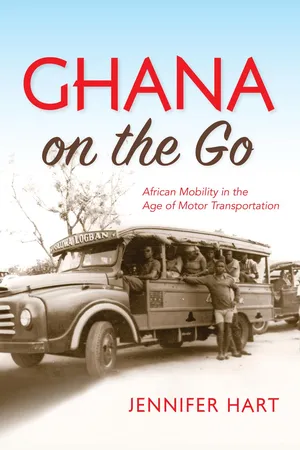
As early as the 1910s, African drivers in colonial Ghana understood the possibilities that using imported motor transport could further the social and economic agendas of a diverse array of local agents, including chiefs, farmers, traders, fishermen, and urban workers. Jennifer Hart's powerful narrative of auto-mobility shows how drivers built on old trade routes to increase the speed and scale of motorized travel. Hart reveals that new forms of labor migration, economic enterprise, cultural production, and social practice were defined by autonomy and mobility and thus shaped the practices and values that formed the foundations of Ghanaian society today. Focusing on the everyday lives of individuals who participated in this century of social, cultural, and technological change, Hart comes to a more sensitive understanding of the ways in which these individuals made new technology meaningful to their local communities and associated it with their future aspirations.
- 266 pages
- English
- ePUB (mobile friendly)
- Available on iOS & Android
eBook - ePub
About this book
Information
1 | “All Shall Pass”: Indigenous Entrepreneurs, Colonial Technopolitics, and the Roots of African Automobility, 1901–1939 |
ON JANUARY 28, 1930, Lord Passfield, the head of the Colonial Office, sent a circular dispatch to the “Officers Administering the Governments of Britain’s Colonies” expressing grave concern about increasing reports of “road vs. rail competition.”1 Colonial governments throughout the British Empire had invested heavily in rail transportation as a symbol and tool of the ideological underpinnings of colonial rule in the late nineteenth century—the often-conflicting goals of resource extraction and development.2 However, as Passfield noted, “the introduction of the internal combustion engine has resulted in direct competition for similar traffic between road and rail which did not exist at the time when the main lines of communication were originally laid down in many territories.”3
In ordering colonial administrations to report on the development of internal communications in their colonies and to propose strategies for responding to the new challenges to the railways that resulted from the rise of motor transportation, Passfield’s circular represented the apotheosis of anxiety that had been growing throughout the administrative offices of the British Empire since the early twentieth century. Hundreds of files on “road vs. rail competition” highlight the degree to which the growing importance of motor transportation at the turn of the twentieth century presented a fundamental challenge for colonial governance in African colonies like the Gold Coast and throughout the empire. Colonial attempts to control infrastructure were part of what Bissell calls an “imperial impulse: the will to power and pursuit of mastery in situations marked by high degrees of complexity, fluidity, and unpredictability.”4 It was a form of technopolitics, through which colonial officials hoped to establish their hegemony in the Gold Coast and, by extension, throughout the empire. And yet, as Passfield’s concern about competition suggests, the goal of hegemonic control over circulation and exchange was much more distant than most colonial policies and rhetoric would publicly acknowledge.
The parameters and practices of colonial technopolitics were shaped by British conceptions of mobile modernity. Officials in both Britain and the colonies understood railways as the material and technological symbol of British dominance. Passfield, Chamberlain, and the succession of governors and other officials who circulated through the Gold Coast Colony in the early part of the twentieth century were the products of a British industrial age that had been indelibly reshaped by railway technologies. Entrepreneurs invested in railways, constructing tracks and moving trains through the British countryside in the late eighteenth and nineteenth centuries. Those trains introduced a new speed and scale of movement, transporting raw materials and manufactured goods to facilitate the country’s growing industrial economy and expanding the wealth-generating potential of industrial development into the British countryside. But trains also produced psychic and social changes among the British populace, who were both awestruck and anxious about the changes that this new technology wrought. Women fainted at the rapid pace of movement, authors described the ways in which passing scenery abstracted individuals from the landscape, and painters depicted romanticized images of an idyllic, pastoral rural landscape increasingly scarred by the infrastructure of mechanized mobility.5 New cultures developed around the railways, which seemingly erased distance and brought ever-greater numbers of citizens together in a system of modern, mobile interaction.6 More than ever before, the British population of both city and countryside moved as “travelers,” moving through the landscape while removed from the surrounding environment, focused on the endpoint rather than the spaces between.7 By the end of the nineteenth century, the British railway was the preeminent symbol and infrastructure of a modern culture and economy.
It is no surprise, then, that European colonial officials at the beginning of the twentieth century viewed the railway as a “mobile memorial to British power.”8 Like the railways, that power was far from static. As Aguiar notes, the rhetoric of nineteenth-century modernity “connoted by a moving train pointed always towards a possible future, a destination toward which one ideally moved quickly.”9 Such a future required imperial expansion. New colonies would simultaneously project and reinforce the social, cultural, and economic authority of the British state as it expanded across the globe. Within colonies, railways served as the infrastructure of a highly centralized political and economic system, defined by an extractive command economy and a hierarchical bureaucratic state. Railways were central to both communications and transportation, moving goods between production zones and coastal ports, and enabling the efficient administration of far-flung territories by facilitating the movement of administrators (or, at least, news of their directives).
Colonial officials sought to reshape the social and economic landscape of the colony through investments in railway construction. In moving goods and people through rather than in local communities, railways represented the expansion of what Tilley calls the “development state,” which “viewed African populations less as prospective political actors and more as potential producers.”10 The development state sought to simultaneously disrupt old systems of social and economic exchange and implement new networks of extraction that channeled the efforts of African producers away from local and regional economies into the imperial networks of global capital. In this context, colonial investment in railways was a “technopolitical strategy,”11 which sought to undermine the power of African producers and traders while consolidating British control over the resources of African colonies like the Gold Coast.
Viewed through the lens of colonial technopolitics, Passfield’s concern about road vs. rail competition highlights the centrality of railways to both the symbolic and material expressions of colonial authority and the significant and varied challenges to railway construction and administration in Britain’s colonies. Engineers debated the more material or technical challenges of adapting railway construction techniques to new environments, and the British engineering community adapted quickly to the new realities of imperial construction and development.12 The political, social, and cultural roadblocks to railway expansion proved much more difficult to overcome. In the Gold Coast, colonial leaders insisted that the state finance and construct railways as part of an effort to control the colony’s economic development. Obtaining consistent profits from the railways proved much more difficult to achieve. Challenges to colonial railway profits were, in part, the result of inefficient and ineffective government planning. Railway construction was slow to respond to the development of new production zones, and roads were often built in parallel with major railway lines.
These mundane debates about financial investment and economic development dominated administrative reports and public statements from the offices of colonial administrators in the Gold Coast. But in the minutes of those files and in internal memos, colonial officials also expressed frustration over their inability to reshape African social, cultural, and economic lives. The frustrations of Gold Coast colonial officials and imperial bureaucrats like Passfield were symptoms of “the incapacity of legal and bureaucratic instruments to reorder the totality of everyday life.”13 British policies of indirect rule limited resources available to colonial governments throughout the empire. Sara Berry characterizes this limited government as “hegemony on a shoestring”;14 however, Berman, Bissell, and others argue that the skeletal presence and limited resources of British indirect rule undermined the ability of these colonial states to achieve their goals of capitalist transformation in the colonies and effectively project and police hegemonic control.15 Certainly in the Gold Coast, colonial officials viewed road vs. rail competition as a symbol of larger failures in this capitalist transformation. But, when we look beyond the narratives presented by British administrators in the files of the colonial archive, we see that African investment in road transport did not represent a challenge to capitalism, but rather its widespread embrace. By embracing motor transportation, Africans certainly challenged the supremacy of the railway as a symbol of mobile modernity and the infrastructural technology of trade. But African entrepreneurs also used motor transport technology to expand participation in the global capitalist system, connecting even the most remote villages and farms to global networks of circulation and exchange. In other words, auto/mobile Africans used new technology to extend participation in the capitalist system even as they operated outside of the structures and expectations of colonial capitalism or rejected the technological infrastructure of industrial capitalist development.
Road vs. rail competition, then, was about more than the colonial railways. It was also about the persistence of African mobility systems and the emergence of an African automobility. African entrepreneurs exploited “cracks in the imperial façade,”16 using economic resources obtained through the expanding cocoa economy to pursue alternative infrastructural and mobile technologies like motor transportation. The earliest motor vehicles were considered novelties, owned by elites and politicians as symbols of status and imported by European trading firms to transport goods between railway stations and commercial facilities. By the 1920s, however, indigenous entrepreneurs in the Gold Coast had fully embraced the new technology, transporting goods between rural production zones, regional markets, and urban ports. Africans utilized colonial trunk roads constructed in parallel with railway lines to bypass railways and transport their produce directly to the coast via increasingly accessible motor vehicles. Even when the colonial state sought to limit African access to roads, road users including drivers, chiefs, traders, and farmers simply ignored colonial regulations, empowered by their own economic power as producers and traders as well as the skeletal police and military personnel’s limited ability to enforce regulations and punish offenders.
In the context of colonial technopolitics, African embrace of motor transport technologies had insurrectionary potential. African drivers, farmers, traders, urban residents, and chiefs petitioned the colonial state for the right to roads and circumvented colonial regulations and stagnant infrastructure by constructing and maintaining their own roads. Colonial officials created policies that assumed Africans were incapable of guiding their own development; however, in harnessing their economic power and technological ingenuity to demonstrate otherwise, Africans challenged not only colonial economic control but also the very ideologies that undergirded colonial assertions of power and the right to rule. In other words, auto/mobile Africans acted outside of colonial expectations. In doing so, these entrepreneurs challenged colonial attempts to control African production and trade, undermining the profitability and power of the railway and raising important questions about the limits of colonial authority and the autonomy of African subjects.
But African embrace of motor transport technologies cannot be understood as a mere reaction to colonial power (or its failure) or a simple extension of technological hegemony. Rather, African automobility emerged out of the interstices and tensions of overlapping concerns: the colonial technopolitics of railway construction and economic hegemony, the social and economic possibilities of technological innovation, and the cultures and practices of indigenous entrepreneurs. In constructing their own roads and creatively adapting motor transport technologies to suit their own social and economic agendas, African entrepreneurs engaged in a form of grassroots development that provided powerful alternatives to colonial models. African networks, practices, and cultures of automobility, which emerged in the first decades of the twentieth century, were built on much older systems of social and economic exchange. African farmers and traders invested in motor transport technologies as a way to ensure the survival of these networks while also enhancing the profitability and efficiency of production and trade. Roads often followed the paths of head carriers and cask rollers, connecting farms and villages with coastal ports through a series of regional markets and trading networks. The flexibility of the automobile allowed farmers, traders, and chiefs in the most remote villages or farms to engage directly in the world of global commerce and modern technology. In doing so, African entrepreneurs did not merely appropriate the cultures and values associated with the Western technologies.17 Rather, motor transport technologies gave rise to a uniquely African culture and practice of automobility that provided a new language for African aspirations.
In this context, the arrival of the first motor vehicles in the Gold Coast represented both a threat and a promise in the first decades of the twentieth century. The debate over “road vs. rail competition” was shaped not only by colonial economic agendas symbolized by the railway, but also by indigenous practices of cash crop production and trade and the technological advancements of motor transportation in the first decades of the twentieth century. Furthermore, “road vs. rail competition” was not merely an issue of infrastructural development and trade. It was also a debate about the fundamental ideals and practice of the colonial project itself: the nature of colonial governance, the limits of African autonomy, and the meaning of auto/mobility in the Gold Coast. By asserting control over their movements and the transportation of their own produce, entrepreneurs in the Gold Coast embraced the lorry slogan “All Shall Pass,” evoking the demand for freedom of movement along colonial roads and expressing faith in a more prosperous (and less contentious) future.
Indigenous Entrepreneurs and Mobility in the Southern Gold Coast
British colonial authorities and European merchants arriving on the Gold Coast in the late nineteenth century encountered thriving local markets in the port cities that dotted the Atlantic coast. These new arrivals were certainly not the first to note the significance of urban markets. In the early seventeenth century, European traders like Pieter de Marees noted the vigor of trade in coastal ports. Writing of women in a market near Elmina, de Marees remarked that:
These women are very eager traders: they are so industrious in their trade that they come here every day, walking five, some of them even six miles to the place where they do their trade, laden like Asses; she carries her child tied to her back and in addition a heavy load of fru...
Table of contents
- Cover
- Title Page
- Copyright
- Contents
- Acknowledgments
- Introduction: Auto/Mobile Lives
- 1 “All Shall Pass”: Indigenous Entrepreneurs, Colonial Technopolitics, and the Roots of African Automobility, 1901–1939
- 2 “Honest Labor”: Public Safety, Private Profit, and the Professionalization of Drivers, 1930–1945
- 3 “Modern Men”: Motor Transportation and the Politics of Respectability, 1930s–1960s
- 4 “One Man, No Chop”: Licit Wealth, Good Citizens, and the Criminalization of Drivers in Postcolonial Ghana
- 5 “Sweet Not Always”: Automobility, State Power, and the Politics of Development, 1980s–1990s
- Epilogue: “No Rest for the Trotro Driver”: Ambivalence and Automobility in Twenty-First-Century Ghana
- Notes
- Bibliography
- Index
Trusted by 375,005 students
Access to over 1.5 million titles for a fair monthly price.
Study more efficiently using our study tools.
Frequently asked questions
Yes, you can cancel anytime from the Subscription tab in your account settings on the Perlego website. Your subscription will stay active until the end of your current billing period. Learn how to cancel your subscription
No, books cannot be downloaded as external files, such as PDFs, for use outside of Perlego. However, you can download books within the Perlego app for offline reading on mobile or tablet. Learn how to download books offline
We are an online textbook subscription service, where you can get access to an entire online library for less than the price of a single book per month. With over 1.5 million books across 990+ topics, we’ve got you covered! Learn about our mission
Look out for the read-aloud symbol on your next book to see if you can listen to it. The read-aloud tool reads text aloud for you, highlighting the text as it is being read. You can pause it, speed it up and slow it down. Learn more about Read Aloud
Yes! You can use the Perlego app on both iOS and Android devices to read anytime, anywhere — even offline. Perfect for commutes or when you’re on the go.
Please note we cannot support devices running on iOS 13 and Android 7 or earlier. Learn more about using the app
Please note we cannot support devices running on iOS 13 and Android 7 or earlier. Learn more about using the app
Yes, you can access Ghana on the Go by Jennifer Hart in PDF and/or ePUB format, as well as other popular books in History & African History. We have over 1.5 million books available in our catalogue for you to explore.