This exploration of African adaptations of global pop culture is "a genuinely innovative book unlike most others in either anthropology or African studies" (
American Ethnologist).
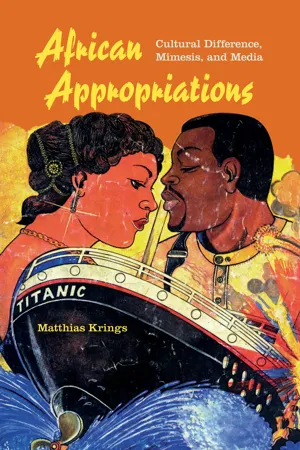
Why would a Hollywood film become a Nigerian video remake, a Tanzanian comic book, or a Congolese music video? Matthias Krings explores the myriad ways Africans respond to the relentless onslaught of global culture. He seeks out places where they have adapted pervasive cultural forms to their own purposes as photo novels, comic books, songs, posters, and even scam letters.
These African appropriations reveal the broad scope of cultural mediation that is characteristic of our hyperlinked age. Krings argues that there is no longer an "original" or "faithful copy," but only endless transformations that thrive in the fertile ground of African popular culture.
"The text is jargon free, a pleasure to read, remarkably well researched, and enriched by 40 illustrations . . . Highly recommended." —
Choice
- 328 pages
- English
- ePUB (mobile friendly)
- Available on iOS & Android
eBook - ePub
About this book
Information
Topic
SozialwissenschaftenSubtopic
Kultur- & Sozialanthropologie1

The Wicked Major
EMBODYING CULTURAL DIFFERENCE
IT WAS GETTING close to midnight when the musicians finally intoned the hymn of Magajiyar Jangare. The amplified sound of the garaya, a two-stringed lute, distorted and cracking through the megaphones that served as loudspeakers, sent shivers down my spine. I had witnessed a number of public bori possession dances before and knew that this was the sign for the spirit mediums to begin their preparations. On that night in December 1992, Idi and his group had been performing in Unguwa Uku, one of the bustling quarters outside the old city of Kano, Nigeria, since the last prayer, at about eight that evening. For hours, Idi had sweetly praised women and men among the audience with words sung to the tunes of the spirit hymns. Those who were praised had reciprocated with cash, thus expressing their close relationship to particular spirits as well as their acknowledgement of Idi’s praise. Now Idi sang the lines which prompted those willing to come forward to serve as the spirits’ “horses,” or mediums, on that very night: “Children of bori, come forward, your mother has arrived, the one with the large zane-wrapper.” The six-gourd rattle players sitting in front of Idi gave their best and sped up the rhythm. Clad only in single cloths tied around their waists or above their chests, the nine “children of bori,” six men and three women, came up and sat down in the middle of the makeshift dance floor, an open space surrounded by more than 300 people. Soon some of the mediums began to yawn. With trembling bodies and bulging eyes, groaning and frothing from their mouths, they produced the physical signs of possession trance. The scene grew wilder by the minute. As if violently thrown across the dance floor by invisible hands, some mediums traversed the open space half-crawling, half-jumping—raising clouds of dust. Finally, when the spirits had fully mounted their horses, the scene calmed down again. Each medium now moved and spoke according to the personality of the particular spirit he or she embodied.
Two of the mediums, whose spirits had treated their bodies with particular harshness, stood erect—their legs apart, hands on their hips—and announced who they were by shouting their kirari, a form of self-praise, in a wild mixture of French, English, and corrupted Hausa:
What’s up, Monsieur spirits!? Come forward, Monsieur spirits! Only we of the governor, the lads of the governor! We conquer the town; we pass the town; we go into hiding as if we weren’t there! One wants us to come; one wants us to leave! We come to town; the town falls empty; we leave the town, and the town falls empty! We are pagans who go to sleep at half past ten and rise at ten! We are pagans who turn the next day into “tomorrow”! We are killing. People say it’s Allah—Allah is killing. People say it’s us! Ocho!
When they had finished, the two mediums were led outside the circle and got dressed. When they came back, one of them was wearing a red uniform, the other a green one with red applications; both men also wore sashes across their chests, as well as berets and heavy boots. While one of them used his whip and Thunderer whistle to push back the audience and rearrange the dance floor, the other greeted the dignitaries among the audience with military salutes and handshakes. As I learned from someone standing next to me, the one in red was Kafaran, the “Corporal,” and the one in green Komanda Mugu, the “Wicked Major.” Both belonged to the family of Babule spirits who are said to be of European descent.
The two Europeans, who temporarily occupied the bodies of their African mediums, were almost naturally drawn to the only other European present, the one “who occupied the body of an anthropologist”—to borrow a phrase from Paul Stoller (1994: 646). They came over to me. After we shook hands and someone translated the greetings the spirits had uttered in corrupt Hausa, Kafaran ordered a bench to be brought for his superior and himself, and they sat down next to me. Together we watched the dance of the other spirits, who belonged to different families, including hunters, aristocrats, Fulbe, Tuareg, and Maguzawa, or pagan Hausa. Not only were the three of us among the few who had been offered a bench to sit on, but as I soon discovered, we had a number of other things in common, such as smoking cigarettes, drinking bottled soft drinks, and taking notes.
My new friends were the last to be called on to perform in front of the musicians. “Black ones, lads of the governor, one can see your whiteness, one can see your blackness,” sang Idi in their praise, exclaiming, “Let’s drink fire, let’s taste the whip! Come forward, the one of Halima, owner of a thousand bullets!” Marching more than dancing in their heavy boots, they transformed the dance floor into a military parading ground. Their performance climaxed in a powerful demonstration of their superhuman invulnerability to fire. By stroking their bare chests with burning torches, they “washed [themselves] with fire,” and when they “drank fire” like fire breathers, they lit up the surroundings by sending large balls of fire up into the night sky. Soon after they had finished their performance, the music stopped and the audience began to disperse. The spirits, however, far from swiftly leaving the bodies of their mediums, stayed on for a while outside in the dark, where people consulted them about their personal problems. Suddenly, I was approached by one of the Babule’s helpers, who told me that Kafaran wanted to see me. I followed him to a dimly lit spot where Kafaran, about to leave his medium, was waiting. “Did you get what you came looking for in Nigeria?” he asked me, and I said, “Yes, almost.” “What about maganin kwarjini, a ‘medicine’ which will ensure you the respect of others?” I had to confess that I had not come across it yet, and he offered: “I will give it to you!” However, he made clear that he expected something in return: “What will you give me?” “Twenty naira,” I replied. He took a deep, roaring breath and said, “Fifty naira!” We made a deal, and he asked me to give the money to his “horse,” who would prepare the “medicine” for me and from whom I should collect it the next day. I handed the money to his helper, shook hands with the spirit, and watched him dismount his medium. The moment he left, the medium fell to the ground. Gradually regaining control over his body, the medium, a young man called Isa, inspected himself and the scene around him, and then he asked us in astonishment what had happened and how he had gotten to where he found himself now in the early hours of the morning.
In this chapter, I focus on spirit possession as a primary technology for the mediation of cultural difference in Africa, which is based on the conception that the human body can serve as a medium for spirits. Recollecting my own experiences from 1992 to 1994 with Babule spirits in northern Nigeria (Krings 1997), I trace the origin of these ritual copies of Europeanness to French colonial West Africa in 1925. The spirits that first manifested themselves during possession rituals in the Hausa-speaking regions of southwestern Niger embodied the essence of colonial power and European alterity. “We copy the world to comprehend it through our bodies,” writes Stoller (1994: 643) in his discussion of Michael Taussig’s take on spirit possession and Cuna healing figurines. With reference to Adeline Masquelier (2001), who further developed this argument with regard to the Babule, I argue that the early Babule mediums did not only copy to comprehend but also to acquire some of the qualities of those on whom their ritual copies were modeled. The power thus acquired, however, was not used against its source to mock or resist the French colonial regime, as has been contended both by contemporary observers and some more recent interpreters (Stoller 1984), but against forms of amoral power and illegitimate authority—that is, witchcraft and local chiefs installed by the colonizers. I argue that the Babule spirits, far from being ritual caricatures of colonial Europeans, rather, have to be conceptualized as embodied pastiches, as particular spiritualized copies of powerful others, who transferred some of the qualities of the colonial Europeans to those possessed by the Babule spirits.
What becomes obvious by following the traces of the Babule spirits to the present, as I set out to do, is that they change their meaning according to respective historic contexts and the social functions of the rituals of possession they are associated with. What began as a revitalization movement inspired by embodied pastiches that formed its spiritual backbone, in Niger in 1925, became a religious institution around which Nigerien immigrants to southern Ghana organized their communities and social life in the 1950s. In northern Nigeria, where the Babule had been integrated into the pantheon of bori spirits early on, they acted according to the logic of a typical cult of affliction: during the 1990s, they were the source as well as the remedy for serious afflictions and mundane problems alike, which were somehow associated with local modernity, and they enabled their adepts to make a living by performing as their vessels during public possession dances and administering “medicines” to clients during private consultations. What these different forms have in common is that they make use of alterity to articulate and legitimize certain functions of the self.
REWIND: NIGER 1925–1927
The early Babule spirits manifested themselves in southwestern Niger during a period marked by the intensification of French colonial rule. Since the turn of the century, Kurfey and Arewa, the two neighboring Hausaphone regions that were to produce particular strongholds of Babule followers, had each experienced dramatic political and economic changes. In search of traditional rulers who would help govern the peasant population, the French had installed “district chiefs,” or chefs de canton, among people who hitherto had had no dealings whatsoever with centralized political institutions, such as the egalitarian Kurfeyawa, or expanded the power of traditional political authorities which had formerly been checked by a fragile system of power sharing, such as in Arewa (Fuglestad 1975; Latour 1992). In both regions, the new local authorities had proven to be particularly efficient helpers of the French. They had helped fight revolts, forcefully recruited men to serve in the French army during World War I and as laborers for construction work, exacted aliments, and levied taxes (Echard 1992: 96; Fuglestad 1975: 211). In 1925, such coercions became even more burdensome when the French decided to develop Niamey, which would become Niger’s administrative capital. To realize their plans they needed manpower, foodstuffs, and animals for transportation, all of which they exacted particularly from the regions near Niamey. The Babule spirits first made their presence felt in Tudu Anza, a village of the Arewa region (Echard 1992) during the dry season of 1925.
In that village, a woman called Shibo became possessed by an unknown female spirit who turned out to be Batura (female European). Nothing is known about the immediate context in which this happened. It is also unclear why Shibo, daughter of the chef de village of Shikal in the neighboring canton of Kurfey, went to that particular Arewa village. The spirit, however, must have struck a chord with the villagers who flocked to the séances Shibo began to organize. Soon, more villagers, especially young people, became possessed, and the number of spirits grew. Embodying spirits such as the Governor, Commandant de Cercle, and Capitaine, the possessed “became invulnerable, swallowing cinders, flogging each other with torches and so on” (Fuglestad 1983: 129). When Shibo and her followers began to agitate against the chef de canton, Tassao Gao, the French stepped in with a number of unsuccessful disciplinary measures. The spirits and their cult then spilled over into neighboring regions, and by May 1926, had already spread among the Hausa-speaking Mawri of the subdivision of Dogondoutchi. Meanwhile, Shibo, who had returned together with a number of followers and musicians to Shikal, her home village in Kurfey, continued to initiate new adepts into the cult of the strange spirits. By February 1927, the cult had spread across the whole of Kurfey. Like before in Arewa, they also began to agitate against the chef de canton of Kurfey, Gado Namailaya. A French official described the situation as follows: “A woman of Shikal, Shibo, and her father, Ganji, have invented a sect that copies our administration. Young boys and girls come together, found villages, name governors, commanders, doctors, exercise with wooden rifles, arrest the native guards. . . . Shibo enters into trance, preaches insubordination, urges people to stop paying taxes and to refuse to work” (Scheurer, in Olivier de Sardan 1984: 282; my translation). To reassert their presence among the peasants, the French decided to carry out a population census of the Kurfey canton. Led by a young and inexperienced official keen to break the passive resistance of the population, this census turned into a punitive expedition. However, the administration at Niamey disapproved of this development and decided to compensate the victims, among them also followers of the Babule spirits (Echard 1992; Fuglestad 1975). The Babule adepts and their followers claimed this success as their own and as proof of the power of their spirits. According to Fuglestad (1983), two further events must have contributed to a growing conviction among the peasants that the tables were beginning to turn: the death of the chef de canton, Gado Namailaya, who was the most proximate symbol of colonial rule and who died in March 1927, and the assault on the military post of Tessaoua in June of the same year, which went unatoned. When the cult started spreading among the Songhay-Zerma and Tuareg of the neighboring cantons later that year, the colonial administration arrested Shibo and several hundred of her followers.
On the orders of the French commandant de cercle, Horace Croccichia, Shibo, and about sixty of her followers were brought to Niamey and imprisoned. According to Jean Rouch (1960), who in the 1940s conducted research into the Hauka (as the Babule spirits were called by their Songhay-speaking adepts), Croccichia locked up the spirit mediums without food for three days and three nights. When he called them out of their cells, they danced and became possessed by their spirits, and Croccichia slapped them one after another until each admitted that there was no such thing as Hauka spirits. Rouch reports on a second version of this incident as well:
“Dance, I want to speak with Hauka!” said Croccichia. So they performed a ceremony in front of him. They became possessed, and he asked the gods to weep and to take their tears and put them on the Hauka. The possession crisis stopped immediately, of course, and the commissioner said, “You see, there are no more Hauka, I am stronger than the Hauka.” Then he put them all in jail. When they were in jail, one man became possessed and said, “I am a new Hauka, I’m Corsasi (The Wicked Major)” . . . , and the man said, “I’m stronger than all the other Hauka, we have to break out of jail.” (Rouch 1978: 1008)
Some of Rouch’s interlocutors believed that this jailbreak was actually successful and that the spirit mediums were able to flee to the Gold Coast. Adeline Masquelier (2001) recorded a similar version from Nigerien Babule adepts in the 1990s, who turned the historical defeat into a success. In this version, Croccichia “never had a chance to display his power by beating the troublemakers,” for the mediums became possessed soon after their imprisonment and “in a matter of minutes” knocked down the prison walls with their bare fists and escaped “before anyone realized what was happening” (175). The historical facts, however, read much more prosaically. The majority of the Babule mediums were discharged after two months and allowed to return to their villages. But Shibo and some other prominent figures of the “sect” were deported to Upper Volta and Ivory Coast, where Shibo was to return to Kurfey only after nine years (Echard 1992; Fuglestad 1975). Though the so-called Babule movement has since lost its political implications, the veneration of the foreign spirits never ceased to exist. Migrant workers from Niger took them to the colonial Gold Coast where the cult was further elaborated and its pantheon expanded. Back in Niger, the spirits were integrated into the pantheon of two older cults of spirit possession—the holey of the Songhay-Zerma and the bori of the Hausa (Echard 1992; Krings 1997; Rouch 1960).1
IMAGES OF PASSIONES AND EMBODIED PASTICHES
Faced with distorted images of themselves and a ritual display of military routines that looked like parodies, French colonial officers felt ridiculed by colonial subjects who “aped” their colonial masters (Fuglestad 1975: 205). The Annual Political Report for Niamey County of 1925 thus talks about “young people who under the influence of bori spirits . . . have formed groupings that parody our military institutions,” and adds that “the imposition of some punishments . . . suffice[d] to restore the calm” (in Olivier de Sardan 1993: 172; my translation). Perhaps the French officers experienced the unsettling moment referred to by Michael Taussig (1993), when the boundaries between self and other collapse and “the self enters into the alter against which the self is defined and sustained” (273). On top of this psychologically disquieting experience, French officials soon began to sense a political motive behind the activities of Shibo and her followers. Thus, the “movement” was banned in 1927, demonstrating that the colonial administration took the potential threat to colonial order quite seriously. This interpretation, later adopted by Paul Stoller (1984) on the basis of his early encounters with the Babule/Hauka as a young Peace Corps volunteer in Niger during the late 1960s, is both right and wrong. I argue that Babule adepts likened themselves to the colonizers not to ridicule them but to become like them. Although Jean-Pierre Olivier de Sardan (1993) has cautioned us about taking the reports of colonial officials too literally and also warns against political “over-interpretation” of the Babule, I find it difficult not to call the Babule follower’s actions political (173). What else, if not political, is the refusal to pay taxes, the refusal to lend one’s body to forced labor, and the audacity to “openly declare that the rifles [of the French] are only good enough to shoot water, that there are no chiefs in the Kurfey any longer, and finally that the moment has come for Gandji and Shibo to take over their places” (Annual Political Report for Niamey County, 1927, in Olivier de Sardan 1984: 283; my translation)? While such actions were just one aspect of the Babule adept’s activities, they were the biggest worry for the French, and for that reason colonial observers may have exaggerated their frequency and effect. Equally important were activities that might be viewed as religious, such as the Babule follower’s witch-hunting, which according to Nicole Echard (1992), took place every night.
The Babule followers were in fact far more concerned with the effects of colonial rule on their immediate social environment and personal lives than with the European colonizers as such. The colonizers were at a distance. The effects of their power, however, were mediated by local African authorities—the chefs de canton and the gardes de cercle (police), who shared a certain amount of power with the French and used it not just to enforce French orders but also for personal gain (Echard 1992). And these locally accessible and highly visible agents of colonial hegemony were the main targets of Babule actions. For example, the Babule were said to have arrested the guards de cercle or kept them out of their villages (Fuglestad 1975). Likewise, witches, whose activities were felt to have increased immensely since the advent of colonial rule, were experienced as agencies of dangerous and amoral power that needed to be contained for the common good. In my view, this suggests that despite its political effects, the so-called Babule movement is not to be regarded as a political revolt but rather a “doctrine of resistance and hope” (Worsley 1957: 26), which included utopian attempts at building a new society based on a radically different social order in the face of social crisis. Intrinsically considered, it has much in common with revitalizati...
Table of contents
- Cover
- Half title
- Title
- Copyright
- Contents
- Acknowledgments and Preface
- Introduction
- 1. The Wicked Major: Embodying Cultural Difference
- 2. Lance Spearman: The African James Bond
- 3. Black Titanic: Pirating the White Star Liner
- 4. Vice and Videos: Kanywood under Duress
- 5. Dar 2 Lagos: Nollywood in Tanzania
- 6. Branding bin Laden: The Global “War on Terror” on a Local Stage
- 7. Master and Mugu: Orientalist Mimicry and Cybercrime
- 8. “Crazy White Men”: (Un)doing Difference in African Popular Music
- Coda
- Notes
- References
- Films
- Index
- About the Author
Trusted by 375,005 students
Access to over 1.5 million titles for a fair monthly price.
Study more efficiently using our study tools.
Frequently asked questions
Yes, you can cancel anytime from the Subscription tab in your account settings on the Perlego website. Your subscription will stay active until the end of your current billing period. Learn how to cancel your subscription
No, books cannot be downloaded as external files, such as PDFs, for use outside of Perlego. However, you can download books within the Perlego app for offline reading on mobile or tablet. Learn how to download books offline
Perlego offers two plans: Essential and Complete
- Essential is ideal for learners and professionals who enjoy exploring a wide range of subjects. Access the Essential Library with 800,000+ trusted titles and best-sellers across business, personal growth, and the humanities. Includes unlimited reading time and Standard Read Aloud voice.
- Complete: Perfect for advanced learners and researchers needing full, unrestricted access. Unlock 1.5M+ books across hundreds of subjects, including academic and specialized titles. The Complete Plan also includes advanced features like Premium Read Aloud and Research Assistant.
We are an online textbook subscription service, where you can get access to an entire online library for less than the price of a single book per month. With over 1.5 million books across 990+ topics, we’ve got you covered! Learn about our mission
Look out for the read-aloud symbol on your next book to see if you can listen to it. The read-aloud tool reads text aloud for you, highlighting the text as it is being read. You can pause it, speed it up and slow it down. Learn more about Read Aloud
Yes! You can use the Perlego app on both iOS and Android devices to read anytime, anywhere — even offline. Perfect for commutes or when you’re on the go.
Please note we cannot support devices running on iOS 13 and Android 7 or earlier. Learn more about using the app
Please note we cannot support devices running on iOS 13 and Android 7 or earlier. Learn more about using the app
Yes, you can access African Appropriations by Matthias Krings in PDF and/or ePUB format, as well as other popular books in Sozialwissenschaften & Kultur- & Sozialanthropologie. We have over 1.5 million books available in our catalogue for you to explore.