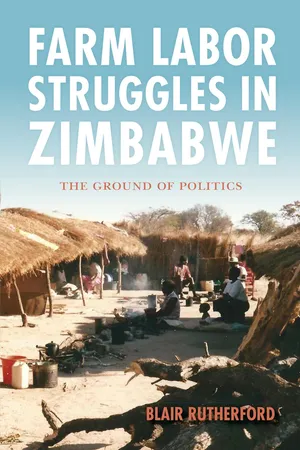
In the early twenty-first century, white-owned farms in Zimbabwe were subject to large-scale occupations by black urban dwellers in an increasingly violent struggle between national electoral politics, land reform, and contestations over democracy. Were the black occupiers being freed from racist bondage as cheap laborers by the state-supported massive land redistribution, or were they victims of state violence who had been denied access to their homes, social services, and jobs? Blair Rutherford examines the unequal social and power relations shaping the lives, livelihoods, and struggles of some of the farm workers during this momentous period in Zimbabwean history. His analysis is anchored in the time he spent on a horticultural farm just east of Harare, the capital of Zimbabwe, that was embroiled in the tumult of political violence associated with jambanja, the democratization movement. Rutherford complicates this analysis by showing that there was far more in play than political oppression by a corrupt and authoritarian regime and a movement to rectify racial and colonial land imbalances, as dominant narratives would have it. Instead, he reveals, farm worker livelihoods, access to land, gendered violence, and conflicting promises of rights and sovereignty played a more important role in the political economy of citizenship and labor than had been imagined.
- 294 pages
- English
- ePUB (mobile friendly)
- Available on iOS & Android
eBook - ePub
About this book
Trusted by 375,005 students
Access to over 1.5 million titles for a fair monthly price.
Study more efficiently using our study tools.
Information
CHAPTER 1
OPPRESSION, MARAITI, AND FARM WORKER LIVELIHOODS: SHIFTING GROUNDS IN THE 1990S
October 20, 1999
Harare
Office of ZimfarmEast
I MET WITH Mr. Chapunga at his company’s headquarters on the edge of the manufacturing district in south-central Harare. It was not until near the end of this interview that he came closest to the topic he had told me he would not broach—the ongoing labor dispute on Upfumi farm, which was the very topic I had arranged to meet Mr. Chapunga about in his capacity as acting group human resources manager of ZimfarmEast. The farm’s pack-shed and agricultural operations were owned and run by ZimfarmEast, which was then the agro-based division of Zimfarm Limited, the highly profitable Zimbabwean agro-industrial company.
Looking at me directly, his tone serious, he said, “There are two English sayings that are pertinent here: ‘blood is thicker than water,’ and ‘home is best.’” Keeping his eyes on me, he said no more. After a few awkward seconds, I asked for clarification. Somewhat contemptuously, he said that I should recognize what he was saying. “Even if you move and your dad dies,” he said, “you still remain identified with your home. If someone as white as you are says, ‘Stay on, you will win,’ it is Dutch confidence.” I asked for further clarification, and he explained that the phrase “Dutch confidence” refers to the tendency of “the Dutch to drink before they go to a war they can’t win to give them courage. You should conclude what this means,” he said abruptly, folding up papers on his desk, signaling the interview’s end, “on your own.”
“As for the second saying?” I pushed further, as I hastened to gather up my notebook and bag.
“That simply means,” he commented firmly but more quietly as he escorted me to the door, “people will say that some people belong to this area and some don’t. Remember the old days when we fought against whites.”
As I left the ZimfarmEast office and emerged into the humid, busy streets of midday Harare, I knew I had just been told to butt out of this labor dispute. I understood that my occasional visits to the fired Upfumi farm workers who were staying at the musososo—the not-so-temporary camp next to the short gravel road leading to Upfumi farm on the Harare–Mutare highway—during the previous two months, were being watched and assessed by the company’s point man in this dispute. And moreover, I knew that racial identification and belonging were factors in how Mr. Chapunga saw me. Yet I did not fully understand his somewhat cryptic remarks, the illocutionary force of his discussion of the “two English sayings.” By noting the “Englishness” of these phrases, he clearly wanted to suggest a familiarity with what he perceived as my “world,” indexed by my racialized coding as “white” and my first language of English more than by my Canadian citizenship. Nonetheless, since the main managers of Zimfarm and of Upfumi farm itself were, at that time, white Zimbabweans, it was unclear how he saw his own positioning as a black Zimbabwean working under this order, given his invocation of race and belonging as a bedrock of identity. Subsequently, the fired farm workers staying at the musososo and I discussed this interview several times, conjecturing different possible meanings. Although we never settled on a single explanation of its semantics, we agreed that the aim of Mr. Chapunga’s “English sayings” was to warn and unsettle me.

The ambivalence and lingering unease of this interview was an incidental example of the marked uncertainty of discursive intent and audiences, mingled through assertions and sentiments of defining who belongs and who does not. This lengthy labor dispute was intertwined with a diverse range of social forces, including electoral politics, gendered regimes of labor, legal domains, preternatural realms, and icons of potential power from Harare to Marondera, Europe to Canada. These are just some of the divergent threads that entangled these farm workers. It was an unease that became increasingly visceral and volatile for these mainly women farm workers, located as they were in precarious livelihood activities, as this twenty month labor dispute drew to a close in June 2000. The labor battle was energized by the momentous, charged, and highly ambivalent political and economic struggles vigorously agitating on the national scale in the late 1990s, with audiences and networks ranging from very local to international, and with a number of economic, social and bodily repercussions. The ongoing uncertainty of the labor dispute often meant that the farm workers involved in it were not always certain of the ongoing status of their case, let alone what the presence or changing intensity of one of these social forces meant for them.
The manager’s reference to “war” was commonly deployed by the farm workers engaged in the dispute and by many of those who offered support as well. Many even referred to the camp where some of them stayed outside of Upfumi, the musososo, as “DRC,” (Democratic Republic of Congo, the central African country that was in the midst of war at that time and to which Zimbabwean troops were controversially sent in August 1998 to help prop up its new government).1
“War” was also an appropriate metaphor as these farm workers drew on a repertoire of songs and other signifying practices associated with the liberation struggle of the 1970s. This struggle had acquired importance on the national scale as ZANU (PF) had sought to legitimize its rule and power since winning the 1980 national election, and every subsequent one until 2008 by, in part, privileging the “patriotic memories” and citizenship claims of those who were part of the guerrilla armies during the 1970s war over those of other Zimbabweans (Werbner 1998; Kriger 2006; Ranger 2004). These Upfumi farm workers were apt to view their labor struggle as having momentous consequences for others. They were buoyed by generally supportive, although infrequent, national media coverage, the occasional interest of international groups and individuals, and by recognizing their own endurance for taking part in such a lengthy labor struggle, extraordinary in its duration in the history of agricultural labor relations in Zimbabwe.
As I spent time with them in the last half of 1999, these workers increasingly saw their struggle, their war, as having import on the national scale. They viewed it as part and parcel of the wider mobilization occurring in the name of workers and change signaled by the widespread strikes and stay-aways, occasional urban riots as well as the contentious processes of constitutional change playing out in the late 1990s up to February 2000 (Raftopoulos and Sachikonye 2001; Raftopoulos and Mlambo 2009). The focal point of this mobilization was the emergence of the Movement for Democratic Change (MDC), which many initially saw as a “workers’ party” (e.g., Alexander 2000a). Formally launched in September 1999, this new political party was strongly associated with the main national trade union congress, the Zimbabwe Congress of Trade Unions (ZCTU), through its organizational role in the party’s formation and because its secretary general since 1988, Morgan Tsvangirai, became the MDC’s leader. The ruling ZANU (PF) party itself was not untouched by these debates for democratization and change in 1999, in part as younger members were calling for a greater role in the decision-making of the ruling party and questioning the wisdom of their aging leaders.
During speeches at rallies and in conversations they had with each other and with me, those in this labor struggle frequently drew on narrative forms and signs that are found in the dominant Zimbabwean nationalist repertoire such as those coming from Marxist and Christian traditions (e.g., Brand 1977; Sylvester 1991; Ranger 1995; Scarnecchia 2008). Such tropes were clearly drawn upon in a speech made by Councillor Banda, the then ZANU (PF) councillor to the Goromonzi Rural District Council for the ward in which Upfumi was located. He gave it during an August 1999 rally held at the musososo and attended by more than one hundred people; participants who by their sheer numbers helped to signal the sense of national import assumed by many. Although the majority at the rally were predominantly the women farm workers involved in the labor dispute, there were also the male executives of the workers’ committees of neighboring farms, and Harare male representatives of International Socialist Organization (ISO) of Zimbabwe, who were mobilizing for the launch of the MDC, and of the Zimbabwe Federation of Trade Unions (ZFTU), a rival trade union federation to the ZCTU supported and promoted by ZANU (PF). Facing this politically diverse audience, the ZANU (PF) councillor declared:
I think the time has arrived for you workers of Upfumi to be the light of the workers on the farms in Zimbabwe. Your story is being broadcast in the newspapers, so your story is being understood everywhere. You are like Christians who were told in the Bible that you are the light of the world, so you must light the whole country. . . . Comrades, the time has come so that you can liberate your fellow workers, and you too, must liberate yourselves when you are liberating others. You are hearing people saying that you are so oppressed, you are not supposed to be here [at this type of meeting], yet by being here shows that you know your rights [maraiti] and where you are going!
The discursive background, the unsaid, with which Councillor Banda engaged in dialogue, was the assumption that farm workers do not agitate for their rights, do not attend union meetings, and thus are passive and simply subject to the will of their (white) employers. It was one of the assumptions examined in my earlier work on farm workers in Zimbabwe (e.g., Rutherford 2001a, 2001b) and also by the other limited work focusing on farm workers in the 1980s and 1990s (e.g., Loewenson 1988; Mugwati and Balleis 1994). It was also a key entailment of the representation of farm workers as a “community” in national-scale discourses.
How did these maraiti come to mean so much to the farm workers? Why did they imagine their struggle to have national import? How was this struggle predicated on, yet worked against, the conditional mode of belonging that situated the vast majority of commercial farm workers since the colonial period? Why were representatives of both organizations that were soon to be visibly against each other in a very violent political contestation (as ZANU [PF] sought to crush the MDC starting in early 2000), and with varying levels of involvement during the Upfumi struggle, present at this rally? How did gender inform the dynamics of this struggle, given that the leaders in this struggle—including most of those on the Upfumi workers’ committee who were leading the workers in this war, the management team of Upfumi and Zimfarm, the lawyers, politicians, as well as interveners like myself—were men, yet the vast majority of the Upfumi farm workers were women? In what ways did this struggle resemble the heroic plotline portrayed by the councillor and the media of the oppressed being conscientized into action in the name of their rights; a plot that resonates in many social science narratives as well as political discourse elsewhere? And how did I understand and contribute, in very modest ways, to this struggle, so that Mr. Chapunga felt obliged to obliquely, but firmly, declare that I need to disengage as I did not belong to the farm, let alone to Zimbabwe?
This chapter outlines the dominant mode of belonging that existed on Upfumi farm until the mid-1990s, when its particular dependencies began to face challenges through social projects of localized leadership. This leadership drew on translocal resources and networks that were caught up in the exciting ferment of change on the national scale, particularly through the idiom of rights. Since this was a struggle that drew on performative styles and narratives that resonated widely, but also had to assist in the social mobilization of the workers, audiences were key. Examining how this labor dispute found traction among different constituencies and how it became entangled in multiple and competing scale-making projects with varied effects is, however, the aim of the following chapters. In this chapter, I lay out the particular gendered power/sovereignty dynamic of the dominant mode of belonging and its performative practices from which this labor struggle emerged and that it squarely challenged, thus contributing to a fraying of the authority relations that had already begun.
“You Are No Better than Dogs”: Domestic Government in Independent Zimbabwe
All workers who had been working on the farm before Zimfarm purchased it in February 1997 described the mode of belonging, similar to “domestic government” as discussed in the introduction: a territorialized project pivoting on racialized and gendered rule and performative styles implemented through bodily disciplining techniques of surveillance, work rhythms, rewards, and, on occasion, corporal punishment. Racialized and gendered codes of respect for the farmer and his management hierarchy were the most relevant bodily styles workers needed to learn as a way to minimize problems for themselves and acquire whatever resources were permissible for them to acquire (e.g., wages, rations, fields to grow food, credit).
Until 2000, commercial farms were, for the most part, an effective and largely profitable form of territorialized power for the owner(s)—a means of seeking to act on the actions of others by delimiting and asserting control over a geographical area. Given the racialized colonial history of these farms, many analysts concentrate on particular attributes associated with the resulting identification of the owners and workers. This focus is typically the whiteness of the farmers, which putatively marks either the modernity and capitalist orientation of the enterprise or as a sign of colonial brutality and privilege over the blackness and relative poverty of the workers (see Rutherford 2001a; Selby 2006; Hughes 2010; Pilossof 2012). But there tends to be less attention paid to how commercial farms have operated as a form of governance, how control over land has also meant particular forms of control over people who have worked and often have lived on it, and how labor relations cannot be separated from a range of dependencies and identifications that shape life during and outside working hours; that is, how landed property here as elsewhere2 entailed forms of power over people that have been closely imbricated in the state formation of the colony and the nation-state.
In regards to landed property in British-controlled Egypt, Timothy Mitchell (2002) has observed that European legal theory commonly has contrasted the right of property with sovereignty, or rule over people. Yet, in practice, state arrangements in Europe and European colonies have frequently made landed property a “realm of exception, within which power operated without rights” as the “architecture that formed the enclosed agricultural colony, a microcolonialism within a larger colonial domain, went hand in hand with a legal architecture that constructed territories of arbitrary power within the larger space of legal reason and abstraction” (Mitchell 2002, 70–71).
Commercial farms in colonial and postcolonial Zimbabwe formed a microcolonialism that entailed a range of power relations particular to its territorialized domain—as well as those that cut across it—defining comportment, rule, and claims. In other words, it entailed a particular “mode of belonging” where forms and modalities of recognition other than rights operated on the farm, although white farmers and their associations had previously cited property rights in their typically efficacious claims for assistance and other forms of recognition by institutions and organizations at national and international scales of action. It was a mode of belonging deeply resonant with racialized practices and sentiments.
White farmers had long used their status as the archetypical “settler citizens” (Mamdani 1996, 2001) in the (Southern) Rhodesian nation to acquire a range of governmental support for their production and marketing, including ensuring a cheap and relatively pliable workforce (Clarke 1977; Rubert 1998; Rutherford 2004). Their rights relied on the absence of workers’ rights. Colonial legislation such as the Masters and Servants Act provided the legal architecture, while the routinized social projects imbricated in state practices of racial rule aimed at establishing an economically productive and civilized colony for white settlers helped to lay out the contours of social and power arrangements of what Rhodesian nomenclature defined as “European farms.” In these social territories, many of those recognized as European farmers became adroit at forming organizations to demand and build on their racialized rights at varied scales of action—from localized to national to international—including ensuring a cheap labor force with no rights recognized by governmental authorities (e.g., Clarke 1977; Phimister 1988; Rubert 1998; Selby 2006). The success of these practices, however, was not guaranteed.
Domestic government was not a seamless colonial process because its politics of recognition were influenced by political and economic conjunctures, including state policies, markets, and accumulation dynamics. Broader competing factions of capitalist entities (manufacturing, mining, etc.), agricultural sectors, regions, missionaries, varied governmental policies, the British colonial office, gendered notions of self and respectability, ethnicity, farming practices, and kinship—to name but a few of the key social dynamics—all interacted in shaping these broad contours and the particular constellation of power and possibility on individual farms at different points in time. Nonetheless, there were a number of common features.
The mode of belonging on these white-owned commercial farms, this domestic government, pivoted around the farmer. For many of the white farmers, it generated an identification with an environmental belonging to the landscape (Hughes 2006), a strong sense of the propriety of private property, and a paternalistic responsibility over the comportment, if not edification, of the farm workers (Rutherford 2004; Hartnack 2015). The mode of belonging generated a series of dependencies in which workers had to comport themselves properly, in a gendered and racialized way, to the farmer and management—for example, being obsequious and waiting for an acknowledgement before speaking to the boss or madam, circumscribed in the spaces they can travel and the times in which they can be seen—in order to raise any questions, seek any favor, or provide any explanations. Such dependence was nicely summed up in what a farmer near Upfumi reportedly used to tell his workers. As recalled by a worker who had left work on that farm in August 2000 and was living beside Upfumi in 2001, this neighboring farmer “sometimes told us [farm workers] that we are dogs and do not deserve any bonus on this farm. He said that we are dogs because he is looking after us—looking after us by giving us the work to do while listening to and occasionally attending to our requests and complaints.” His was a power that operated without rights. Rather, it rested on forms of recognition resting on the hierarchical dependencies anchored around the sovereign commands and actions of the white farmer and his or her management workers, of the operations of what can be seen as a distinct power/sovereignty nexus in the microcolonialism.
As a type of microcolonialism, commercial farms largely operated as a very circumscribed public space for those living and working there. On commercial farms the authority of commercial farmers was very much a territorialized power, enabling their claims over and actions on the workers’ actions in the living and working spaces. The extent and depth differed from farm to farm and, over time, with the farmer’s power on some farms being more intimately involved in workers’ lives than others. The workers and those who lived with them recognized that this paternalistic power was a form of rule (Du Toit 1993), mitemo yemurungu or the “rules/laws of the farmer,” and that transgressors could be, and often were, judged by the farmer or by those he (or, less commonly, she) delegated. This domestic governm...
Table of contents
- Cover
- Half title
- Title
- Copyright
- Contents
- Abbreviations
- Preface
- Introduction
- 1. Oppression, Maraiti, and Farm Worker Livelihoods: Shifting Grounds in the 1990s
- 2. The Traction of Rights, the Art of Politics: The Labor “War” at Upfumi
- 3. The Drama of Politics: Dissension, Suffering, and Violence
- 4. Politics and Precarious Livelihoods during the Time of Jambanja
- Conclusion: Representing Labor Struggles
- Notes
- Bibliography
- Index
Frequently asked questions
Yes, you can cancel anytime from the Subscription tab in your account settings on the Perlego website. Your subscription will stay active until the end of your current billing period. Learn how to cancel your subscription
No, books cannot be downloaded as external files, such as PDFs, for use outside of Perlego. However, you can download books within the Perlego app for offline reading on mobile or tablet. Learn how to download books offline
Perlego offers two plans: Essential and Complete
- Essential is ideal for learners and professionals who enjoy exploring a wide range of subjects. Access the Essential Library with 800,000+ trusted titles and best-sellers across business, personal growth, and the humanities. Includes unlimited reading time and Standard Read Aloud voice.
- Complete: Perfect for advanced learners and researchers needing full, unrestricted access. Unlock 1.5M+ books across hundreds of subjects, including academic and specialized titles. The Complete Plan also includes advanced features like Premium Read Aloud and Research Assistant.
We are an online textbook subscription service, where you can get access to an entire online library for less than the price of a single book per month. With over 1.5 million books across 990+ topics, we’ve got you covered! Learn about our mission
Look out for the read-aloud symbol on your next book to see if you can listen to it. The read-aloud tool reads text aloud for you, highlighting the text as it is being read. You can pause it, speed it up and slow it down. Learn more about Read Aloud
Yes! You can use the Perlego app on both iOS and Android devices to read anytime, anywhere — even offline. Perfect for commutes or when you’re on the go.
Please note we cannot support devices running on iOS 13 and Android 7 or earlier. Learn more about using the app
Please note we cannot support devices running on iOS 13 and Android 7 or earlier. Learn more about using the app
Yes, you can access Farm Labor Struggles in Zimbabwe by Blair Rutherford in PDF and/or ePUB format, as well as other popular books in Politics & International Relations & Agricultural Public Policy. We have over 1.5 million books available in our catalogue for you to explore.