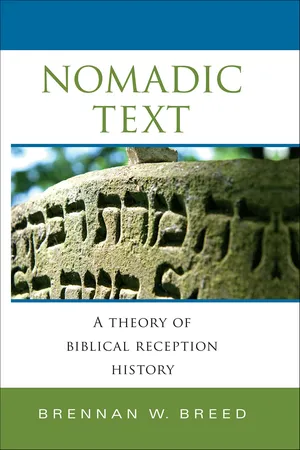
Brennan W. Breed claims that biblical interpretation should focus on the shifting capacities of the text, viewing it as a dynamic process rather than a static product. Rather than seeking to determine the original text and its meaning, Breed proposes that scholars approach the production, transmission, and interpretation of the biblical text as interwoven elements of its overarching reception history. Grounded in the insights of contemporary literary theory, this approach alters the framing questions of interpretation from "What does this text mean?" to "What can this text do?"
- 320 pages
- English
- ePUB (mobile friendly)
- Available on iOS & Android
eBook - ePub
About this book
Information
ONE
The Miltonesque Concept of the Original Text
Wyman’s overpopulated universe is in many ways unlovely. It offends the aesthetic sense of us who have a taste for desert landscapes, but this is not the worst of it. Wyman’s slum of possibles is a breeding ground for disorderly elements…. I feel we’d do better simply to clear Wyman’s slum and be done with it.
—W. V. O. Quine
You know, I like to walk in the slums. I can breathe when I walk through the slums.
—Jorge Luis Borges
Introduction: What is an Original Text?
According to many biblical scholars, biblical critics study original texts and contexts, while reception historians are responsible for studying later versions of texts and their meaning in later contexts.1 The reception historian looks beyond the original text, while the traditional biblical scholar looks at the original text itself. Thus, in order to begin a thorough study of the later texts and contexts that constitute the field of reception history, one must know what the original is, where it begins, and where it ends.2 Textual criticism is the field entrusted with discovering the original text of the Bible, so one might look to text critics to learn where, exactly, reception begins. However, the field of textual criticism has yet to give a definitive answer about what constitutes the original text, and in this chapter I argue that, ultimately, it never can. Yet textual criticism can offer the means to rethink the concept of reception history in a systematic manner.
Some recent biblical critics object to the language of origin, because the concept of the original text ignores the various source and redaction layers that one may analyze as parts of the history of a text’s composition.3 As John Barton claims, there are many origins in every biblical text, and thus there is a variety of possible original texts.4 On the other hand, Emanuel Tov argues that the word “original” does not necessarily denote a moment of creation. Rather, Tov claims that “original” can signify a moment of “correctness” that stood at the end of a complicated history of production.5 The object of textual criticism, according to Emanuel Tov, can thus be understood as that single text that stood at the beginning of the process of transmission. Tov adds that “those who claim that a certain reading is preferable to another actually presuppose one original text,” since preference for any particular text as the right text—or even the somewhat more right text—assumes at least a moment of relative correctness that existed in the biblical text’s history.6 Preference for a particular reading over another is, in this way, tantamount to a belief in a text that at least functions as if it were an original text.
Other scholars object to the search for the original text because it sounds too similar to outmoded discussions of authorial autographs. Even B. B. Warfield hedged that there were biblical texts whose exact autographic wordings were not within “direct reach.”7 Thus, almost all textual critics use qualifiers that concede that their search cannot recover the presumably lost original manuscripts. Scholars who reject the notion of autograph entirely, since it implicitly denies a complicated and redactional composition history, distance their text-critical goal from a presumed original text by claiming to seek an archetype or hyparchetype. These terms are used to admit an epistemic humility, since only an ideal later version of the original text based on sometimes spotty data, not the original text itself, can be reconstructed.
For example, Ronald Hendel seeks what E. J. Kenny refers to as “earliest inferable textual state” of each extant edition of a given biblical text, such as the proto-MT and the proto-OG, both of which present different literary editions.8 Hendel still holds that there was, at one point, an original text that was the basis of each subsequent edition, but the original texts are themselves on the whole unrecoverable. Thus the goal of Hendel’s text-critical work is necessarily archetypes that are a “step toward the original text” but not the original text itself.9 The concept of the original text thereby remains part of the schema, but it is rendered as an asymptotic ideal at a remove from the “actual” original, which may be approached, but never fully attained.
Despite these objections to the term “origin” on the grounds of either the diverse histories of composition of any biblical text or the necessarily limited modern scholarly abilities to locate precisely any pristine text form, the underlying concept of the original text still remains ensconced within biblical criticism. I seek to understand how textual criticism defines the separation it effects between the object of its study and the object of reception historical analysis, regardless of the particular terms used to do so. In order to focus the discussion of this chapter, I examine the work of several prominent text critics who are also in some way are responsible for major biblical text-critical projects: Emanuel Tov, Ronald Hendel, Moshe Goshen-Gottstein, and Eugene Ulrich. My hope is to critique what I see as unhelpful elements within their methodologies.
Telos and Authority
It is difficult to overstate Emanuel Tov’s scholarly contributions to the field of textual criticism, as his prodigious learning and prolific output have forever enriched the biblical studies community. Tov has, among other things, served as the editor in chief of the Dead Sea Scrolls Publication Project, as an editor of the Hebrew University Bible (HUB), and as the managing editor of the HUB edition of Jeremiah. He has also written what is currently the most comprehensive and prominent introduction to textual criticism, Textual Criticism of the Hebrew Bible, which provides a conspicuous index of the broader field of textual criticism.10 For this reason, I focus my critique on the conception of the original text presented in this book, though Tov has begun to question this approach in recent years.11
Since the discovery of the manuscript collections near Qumran, scholars have become keenly aware that the texts of the Hebrew Bible exhibited significant textual diversity several centuries before the common era.12 Thus, various large-scale differences between the OG and the MT, for example, are not only due to translation divergences and sloppily transmitted manuscripts. Instead, it seems that the MT is a late, expanded form of several books, while the OG reflects some later versions as well as some Hebrew texts that likely indicate an earlier version of the text than the MT.13 The manuscripts at Qumran also testify to the early existence of textual forms of biblical books that were later edited by the Samaritan community, from whence came the Samaritan Pentateuch, biblical texts written in a particularly late scribal mode, and biblical texts exhibiting variants heretofore unknown.14 Tov labels the latter group “nonaligned” texts, since they do not agree with any previously known form of the biblical text. This hefty chunk of the biblical manuscripts found at Qumran do not form a coherent textual group but rather testify to a theoretically unlimited number of alternative text forms.15 At least some of these variant editions date from a time before the developments that led to the proto-MT, and thus there was never a moment at which the proto-MT offered the only version of biblical texts.16 In spite of Qumran’s snapshot of irreducible textual pluriformity, however, Tov has generally argued in favor of the urtext theory of textual criticism, claiming that the proper objective of textual criticism is to locate the original text of the Bible.17
In light of the synchronic pluriformity discovered in the Qumran manuscripts and the diachronic diversity within each textual tradition, how might one argue that one manuscript of one textual tradition is naturally privileged as the original? Tov does so by relying on the concepts of telos and authority. Tov posits that one particular manuscript of the biblical text functioned briefly as both the telos of a long, complex process of textual production and as the origin of a long, complex history of transmission. Among the various versions that coexisted at all points in the Second Temple period, one was chosen as authoritative by a particular community at a particular point in time that, Tov claims, carries universal force.
According to Tov, textual criticism describes the “external conditions” and “procedure” of the text’s transmission and evaluates the variants in order to discover which one was “most likely to have been contained in the original text,” but it ignores “readings included in textual witnesses” that were produced “at an earlier stage, that of the literary growth of the biblical books.”18 At first glance, this logic seems unimpeachable: when faced with a group of medieval and ancient witnesses to an even more ancient text, the textual critic must discern the relationships between the manuscripts and evaluate which readings most closely represent the text that stands at the source of the tradition of transmission. With respect to the central task of text criticism, Tov thus consciously follows in the footsteps of Paul de Lagarde, who first proposed an overarching theory of the biblical urtext, or “original text.”19
Tov defines the original text, the goal of his methodology, in the following manner: “At the end of the process of the composition of a biblical book stood a text which was considered authoritative (and hence also finished on the literary level), even if only by a limited group of people, and which at the same time stood at the beginning of a process of copying and textual transmission…. All the textual witnesses—except those that reflect an early literary stage of the book—developed from the final authoritative copy which it is the object of textual criticism to reconstruct.”20 Thus, Tov claims that the original text is both the text that began the process of transmission and the final text that was the capstone of the compositional process. This delineation of the textual process well describes modern compositional practices: an author composes a text by means of drafts and then subsequently the corrected text is published. But does this model account for the data in the case of biblical texts?
The Paradoxical Moment of Final Origin
Tov claims that the authoritative edition of each biblical text was the text that was both finished and deemed authoritative. How does one discern a point of completion from a stage along the path to completion, or even from a point of corruption?
Though he does not mention a precise date, Tov places the moment of textual originality/finality soon after the events of 70 CE: “Those who fostered [the MT] probably constituted the only organized group which survived the destruction of the Second Temple. Thus, after the first century CE a description of the transmission of the text of the Hebrew Bible actually amounts to an account of the history of M.”21 Tov claims that only one “organized group” that used biblical texts continued to exist post-70 CE and that this hegemony coincides with the relative textual stabilization of the proto-MT. But contrary to Tov’s presumption, rabbinical adherents of the proto-MT were not the only organized group occupying the post-70 CE landscape. The Samaritan Pentateuch continued to be the base text for the Samaritans, and the variant editions presented by the OG became, at least for a time, the base text for Christians. The history of the transmission of the biblical text only amounts to a history of the MT if one does not mention the other forms of the text and their own authority-granting communities. Thus, Tov admits the existence of multiple literary editions of biblical texts but defines them as nonfinal and nonauthoritative. He defines the variant edition of Jeremiah presented by the proto-OG, for example, as an early literary stage, something premature that nevertheless continued to function as an authoritative text and be copied as such.
Yet Ulrich points to the telic problem underlying this argument and the entire vocabulary of “proto-MT” and “proto-OG”: these two supposedly discernible groups of texts exhibit no global typological similarities and thus did not undergo any definitive recension before being admitted into various communities as sacred texts.22 In other words, the “proto-MT” texts exhibit no common recensional traits, since some so-called proto-MT texts contain “midrashic expansions” (e.g., Jeremiah) and others are textually problematic (e.g. Samuel) relative to the versions that ended up being translated and used in the Greek Bible. Calling a text “proto-MT” only makes sense in retrospect, since these texts were not grouped together over against other editions; thus the names “proto-MT,” “proto-OG” and “proto-Samaritan Pentateuch” treat an essentially contingent series of developments as if they were entirely necessary. Tov here claims that the essence of these texts, unbeknownst to the people who wrote and rewrote them, was only to be fulfilled in their future canonical actualization. In Armin Lange’s words, this classificatory scheme is a “retro-projection.”23
Moreover, Tov defines stages of the text’s development that occur later than the MT as something else entirely: “Literary stages preceding the literary editions included in M are taken into consideration, but later ones are not…. Thus the recensionally different Hebrew texts behind various sections in G in 1 Kings (3 Reigns in G), Esther, and Daniel, in our mind all later than the edition of M, and probably reflecting late midrashic developments, need not be taken into consideration.”24 According to Tov, developments that occur before the final stage of the MT are thus considered “early literary stages” that precede the “final” form, while later alterations are considered “midrashic” and thus are in a different class from changes associated with the composition of the text itself. Again, Tov asserts a definition assuming an ontological difference—here literary versus midrashic—and then proceeds to argue for the distinction based on the definition.
Diachronic categories of “earlier” or “later” also prove difficult to sustain, since each textual form was used without interruption throughout the ancient world. For texts such as Jeremiah, which he admits paradoxically “reached a final status not just once, in M, but also previously,” Tov seems to allow that the previous stage of Jeremiah reflected in the proto-OG was authoritative, at least for a particular community.25 Yet how can OG Jeremiah be “previous” to MT Jeremiah, since both proto-OG Jeremiah and proto-MT Jeremiah coexist at Qumran, as in 4QJera,c,e and 4QJerb,d, and since later derivative editions of both continue to function as sacred scripture for different communities post-70 CE?26 It would be more historically precise to claim that there was a multiplicity of textual forms circulating simultaneously at the earliest stages for which we have textual evidence.
Yet Tov is very clear that for him textual multiplicity does not reflect the original text: “If w...
Table of contents
- Cover
- Title
- Copyright
- Contents
- Acknowledgments
- List of Abbreviations
- Introduction: The Constitutive Divide of Reception History
- 1. The Miltonesque Concept of the Original Text
- 2. Living in Pottersville: An Alternate Approach to Textual Criticism
- 3. Anchor or Spandrel: The Concept of the Original Context
- 4. On Tigers and Cages: Rethinking Context
- 5. Mapping the Garden of Forking Paths: A Nomadic Reception History
- 6. Justice, Survival, Presence: Job 19:25–27
- 7. Trajectories of Job 19:25–27: The Example of Survival
- Conclusion: Nomadology and the Future of Biblical Studies
- Notes
- Bibliography
- Index
Trusted by 375,005 students
Access to over 1.5 million titles for a fair monthly price.
Study more efficiently using our study tools.
Frequently asked questions
Yes, you can cancel anytime from the Subscription tab in your account settings on the Perlego website. Your subscription will stay active until the end of your current billing period. Learn how to cancel your subscription
No, books cannot be downloaded as external files, such as PDFs, for use outside of Perlego. However, you can download books within the Perlego app for offline reading on mobile or tablet. Learn how to download books offline
Perlego offers two plans: Essential and Complete
- Essential is ideal for learners and professionals who enjoy exploring a wide range of subjects. Access the Essential Library with 800,000+ trusted titles and best-sellers across business, personal growth, and the humanities. Includes unlimited reading time and Standard Read Aloud voice.
- Complete: Perfect for advanced learners and researchers needing full, unrestricted access. Unlock 1.5M+ books across hundreds of subjects, including academic and specialized titles. The Complete Plan also includes advanced features like Premium Read Aloud and Research Assistant.
We are an online textbook subscription service, where you can get access to an entire online library for less than the price of a single book per month. With over 1.5 million books across 990+ topics, we’ve got you covered! Learn about our mission
Look out for the read-aloud symbol on your next book to see if you can listen to it. The read-aloud tool reads text aloud for you, highlighting the text as it is being read. You can pause it, speed it up and slow it down. Learn more about Read Aloud
Yes! You can use the Perlego app on both iOS and Android devices to read anytime, anywhere — even offline. Perfect for commutes or when you’re on the go.
Please note we cannot support devices running on iOS 13 and Android 7 or earlier. Learn more about using the app
Please note we cannot support devices running on iOS 13 and Android 7 or earlier. Learn more about using the app
Yes, you can access Nomadic Text by Brennan W. Breed in PDF and/or ePUB format, as well as other popular books in Theology & Religion & Biblical Criticism & Interpretation. We have over 1.5 million books available in our catalogue for you to explore.