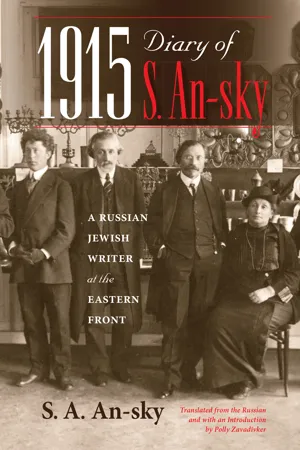
The WWI diary of the Russian Jewish activist and author of
The Dybbuk presents "an unforgettable portrait of life, culture, and destruction" (Eugene Avrutin,
author of Jews and the Imperial State).
By the outbreak of World War I, S. An-sky was a well-known writer, a longtime revolutionary, and an ethnographer who pioneered the collection of Jewish folklore in Russia's Pale of Settlement. In 1915, An-sky took on the assignment of providing aid and relief to Jewish civilians trapped under Russian military occupation in Galicia. As he made his way through the shtetls there, close to the Austrian frontlines, he kept a diary of his encounters and impressions.
In his diary, An-sky describes conversations with wounded soldiers in hospitals, fellow Russian and Jewish aid workers, and Jewish civilians living on the Eastern Front. He recorded the brutality and violence against the civilian population, the complexities of interethnic relations, the practices and limitations of philanthropy and medical care, Russification policies, and antisemitism. In the late 1910s, An-sky used his diaries as raw material for a lengthy memoir in Yiddish, published under the title
The Destruction of Galicia.
Although most of An-sky's original diaries were lost, two fragments are preserved in the Russian State Archive of Literature and Art. Translated and annotated here by Polly Zavadivker, these fragments convey An-sky's vivid perceptions and enlightening insights.
eBook - ePub
1915 Diary of S. An-sky
A Russian Jewish Writer at the Eastern Front
- 208 pages
- English
- ePUB (mobile friendly)
- Available on iOS & Android
eBook - ePub
About this book
Information
ONE
Winter 1915
Galicia
JANUARY 1, ROVNO1
The new year was born in profound melancholy. Neither desires nor hopes, as though you were standing before a corpse. I spent the day in a miserable state. At night I went to the “Yiddish Theater.” They were offering a senseless operetta, Khontse in America. The most untalented of the untalented performed. But the theater was packed and the audience was in ecstasy.
Met a friendly military doctor, Kon, whose wife is working as a nurse in the field hospital. They invited me to visit the hospital tomorrow and see how it was set up.
JANUARY 2
I didn’t feel well. At night I went to the hospital. A huge hospital with many beds, superbly equipped. Clean, spacious. There are paintings of battle scenes plastered across all of the walls. A number of wounded Austrians are lying on beds mixed in among the Russians.
“But how did you get along with the Austrians, don’t you quarrel?” I asked a wounded Russian.
“Why should we quarrel? All of us are cursed,” he replied with profound sorrow.
I went to the dressing station. They were dressing wounds on 218 Austrians who had just arrived. The wounds are something terrible. The entry wound is small; the exit wound is huge. These are our hollow-point bullets. Upon striking a target, they begin to spin in all directions.
They showed me a man who had been stabbed by a bayonet eleven times. He is recovering.
There was an Austrian lying on the dressing table whose leg had been amputated at the knee. The leg was exposed in preparation for bandaging. The bone was sticking out, with a chunk of nervously twitching red meat. Nothing so terrible about it. Meat. But then, a hand, from which all the skin between the fingers and wrist had been ripped away, made an impression on me? That isn’t a piece of protruding flesh, but a wound surrounded by the body’s healthy parts.
JANUARY 3
I visited the hospital again. Such suffering! The dressing of wounds alone elicits so much agony. Here, for example, is someone who was “lightly wounded”: the bullet tore through the flesh of his leg, scrotum, and flesh of the other leg. Gauze must be drawn through the whole wound.
I walked among the beds. There was a wounded Austrian lying on a bed. He was no older than a boy, with a red button-shaped nose and swollen eyes. He has a broken leg and a gunshot wound in the chest. And apart from that he has a broken jaw and his lower teeth were knocked out. He talks in a feverish manner and his speech is not altogether intelligible. He addresses the nurse like an offended child, complains. The bed is too hard; it chafes his sides. And the food. . . . They are supposed to serve him different food, it seems.
“Yes, yes,” the nurse consoles him, “you’ll get milk, kasha.”
“I’m not allowed to eat the meat that you give all of them,” the wounded boy goes on, ignoring her. “The doctor said. But I am allowed to eat cutlets. And they should be made with onion—with onion! Viel Zwiebel, viel Zwiebel.2 Doctor’s orders . . .”
A few hours later his wounds were dressed, and it seems that when the nurses bandaged his leg five days ago they put in a splint that was too long, and it left a palm-sized sore on his side and nearly punctured his stomach. And here with such injuries, with a splint eating away at a festering wound, he thinks about viel Zwiebel—even alleges that the doctor prescribed them. He must have associated the relief of his misery with this favorite food.
Had dinner with Dr. Kon. His wife told me that Andre, a local marshal of the nobility, is organizing a medical transport to Galicia and would probably agree to take me with him. Mrs. Kon promised to find out about it tomorrow and put in a word on my behalf.
I came back to the hotel at about eight o’clock and found a telegram from Naidich3 in Moscow: “Come to Moscow. Demidov’s division departs for Kiev and beyond on January 7. There is a spot for someone.”
Can it be that my affairs are finally falling into place and my ordeals will come to an end?
I left for Moscow at eleven o’clock at night. An announcement was hanging in the train station: “Reward for capture of spies: 10 to 150 rubles, and gratitude from His Majesty and country.”
JANUARY 4
There was a lieutenant riding in the train with me who was just returning from a post at the Prussian Front.4 He was quiet, modest, as are most of the heroes who have been in combat. He recounted many interesting things.
The men grew so accustomed to cannon fire that when it was quiet they felt frightened and anxious. They got to know the places where the bombs landed because the other side always fired at specific spots. Bombs that fell at close range gave off gasses that caused terrible vomiting in some of the men. The most terrible thing, though, is that the wounded must remain in the trenches the whole day; they can only be moved at night, and sometimes not even then.
“Before their new year we wrote greeting cards on scraps of paper, freed up a shrapnel shell, stuffed it with the papers, and shot it over.5 The shell didn’t explode, but it seems they found the cards. But then we were angry with them because on Christmas they shot at us like the damned, so at midnight of the new year we started firing at them with all of our guns.
“Our artillery works well, but their side is better equipped. They’ll go up in an airplane, find our battery and shoot a rocket. With that rocket they can precisely pinpoint the location of our battery from a distance, within two degrees. For some reason our side doesn’t do this.
“Theft and looting are scourges of war. When the soldiers enter a city or town they start to rob the locals. I know of one case in Galicia: an officer entered a house and saw the soldiers looting. They took off running. He ordered them to stop. They disobeyed. He shot and killed two of them. The other three stopped. He ordered that one hundred lashes be given to each of them and sent them to the trenches. The medical orderlies are constantly being searched, but it doesn’t help. Sometimes they even kill our officers and rob them.
“Some of the nurses work selflessly, of course. But most of the ones in the rear behave indecently; they sleep with doctors, wreak debauchery, depravity. They aren’t called sisters of mercy, but rather ‘whores of mercy.’ ”
The lieutenant also recited the legend about the Grand Duke6 and Rennenkampf,7 how the latter seemingly wounded the former.
It seems the Grand Duke summoned his quartermasters, came to them darker than a storm cloud, and said, “If you keep secrets, I will hang you.”
One encounters strange sights. A soldier comes to ask for a stretcher so he can be evacuated on it. He was shot in the head. Another in the trenches asks for permission to go to the dressing clinic. “Where were you wounded?” “In the head,” he replies, and points to his crown. “From where did the bullet emerge?” “From the buttocks, your Excellency.”
JANUARY 5, MOSCOW
Naidich told me how simply my trip had been arranged. Igor Platonovich Demidov,8 a deputy to the State Duma, is stationed with a division in Galicia, in Tarnów. If I had been in Moscow a few days earlier I could have left with him. Now Igor Platonovich’s brother, Lev Platonovich,9 who directs the Moscow division, is sending several train cars with hospital supplies and linens to the Tarnów division. And here they are assigning me to be the plenipotentiary who is responsible for delivering these train cars. Another plenipotentiary, an assistant barrister named B. E. Ratner10 will travel with me, along with an artel11 worker, who will look after the cars.
I went to see L. P. Demidov; he makes a wonderful impression, as a man of profound, sensitive, and cultured ideals, and is fanatically devoted to the cause. We arranged all of the details. I will of course pay my own way, but the committee12 will supply my train fare. The train cars depart on the 9th, not the 7th, so I’ll have time for a trip to Petrograd.
I telephoned Nikolai Aleksandrovich Popov.13 He promised to connect me with Vladimir Ivanovich Nemirovich-Danchenko14 in a few days, and arrange for me to read him the play.15
JANUARY 6, PETROGRAD
I gave a report about what I saw and heard in Poland. In light of the short notice there wasn’t time to assemble a significant number of people. Bramson,16 Braudo,17 Bikerman,18 Brusilovskii, Levin, Pozner,19 and a few others were there. It seems the report made a very strong impression, especially the facts. These were my conclusions: 1) To set up as few soup kitchens as possible, and instead give more aid to each individual refugee, to help him get back on his feet; 2) To appoint two or three people in Warsaw who can manage activities there; 3) To urgently organize a large (Russian-language) newspaper in Warsaw.
S. V. Pozner told me what has been happening lately in Petrograd. The most interesting and important thing is the creation by the finest representatives of Russian literature of a league to fight for Jewish emancipation.20 Gorky,21 Andreev,22 and Sologub23 are its leaders and have passionately taken up the cause.
The conference of December 19 resulted merely in a declaration. The people who gathered at the conference were mostly anemic and didn’t introduce any initiatives.
At the editorial office of The Day,24 I found out that all of my articles were received, and that the censor crossed all of them out, which is why they weren’t printed.
I obtained copies for the museum25 of Austrian propaganda for Jews that was thrown from planes and written in Yiddish and Hebrew.
JANUARY 8
I spent yesterday and today in Petrograd; saw Sliozberg,26 Vinaver,27 and others. Everyone seems to believe that agitation against Jews in Poland is quieting down. A relative of Vinaver’s even reasoned that in Warsaw the Poles’ attitudes have greatly changed. But all of this strikes me as complacency.
JANUARY 9, MOSCOW
The train cars depart on the 11th.
Naidich told me a curious thing.
The Ministry of Foreign Affairs summoned Rozov28 as a representative of Zionism. Since Rozov wasn’t in Petrograd at the time, they invited Idelson.29 In Turkey, demands were issued that Russian Jews must adopt Turkish citizenship or else face expulsion.30 Because the Russian government doesn’t wish to lose the element in Palestine that has ties to Russia, the ministry asked Idelson to inform the colonists in a telegram that he advises them to become Turkish subjects. If they do so, the ministry promises to reinstate them after the war as sub...
Table of contents
- Cover
- Half title
- Title
- Copyright
- Dedication
- Contents
- Acknowledgments
- Note on Translation
- Introduction
- S. An-sky’s 1915 Diary
- Notes
- Index
Trusted by 375,005 students
Access to over 1.5 million titles for a fair monthly price.
Study more efficiently using our study tools.
Frequently asked questions
Yes, you can cancel anytime from the Subscription tab in your account settings on the Perlego website. Your subscription will stay active until the end of your current billing period. Learn how to cancel your subscription
No, books cannot be downloaded as external files, such as PDFs, for use outside of Perlego. However, you can download books within the Perlego app for offline reading on mobile or tablet. Learn how to download books offline
Perlego offers two plans: Essential and Complete
- Essential is ideal for learners and professionals who enjoy exploring a wide range of subjects. Access the Essential Library with 800,000+ trusted titles and best-sellers across business, personal growth, and the humanities. Includes unlimited reading time and Standard Read Aloud voice.
- Complete: Perfect for advanced learners and researchers needing full, unrestricted access. Unlock 1.5M+ books across hundreds of subjects, including academic and specialized titles. The Complete Plan also includes advanced features like Premium Read Aloud and Research Assistant.
We are an online textbook subscription service, where you can get access to an entire online library for less than the price of a single book per month. With over 1.5 million books across 990+ topics, we’ve got you covered! Learn about our mission
Look out for the read-aloud symbol on your next book to see if you can listen to it. The read-aloud tool reads text aloud for you, highlighting the text as it is being read. You can pause it, speed it up and slow it down. Learn more about Read Aloud
Yes! You can use the Perlego app on both iOS and Android devices to read anytime, anywhere — even offline. Perfect for commutes or when you’re on the go.
Please note we cannot support devices running on iOS 13 and Android 7 or earlier. Learn more about using the app
Please note we cannot support devices running on iOS 13 and Android 7 or earlier. Learn more about using the app
Yes, you can access 1915 Diary of S. An-sky by S. A. An-Sky, Polly Zavadivker in PDF and/or ePUB format, as well as other popular books in Social Sciences & Social Science Biographies. We have over 1.5 million books available in our catalogue for you to explore.