"A well-written, nicely comprehensive, and inclusive social history of Alabama before and immediately after statehood."—
H-AmIndian
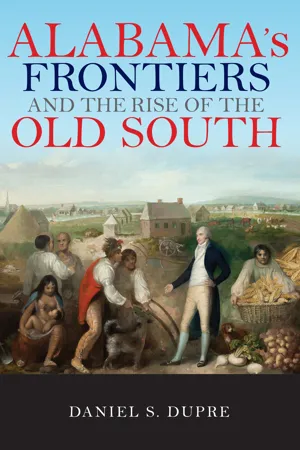
Alabama endured warfare, slave trading, squatting, and speculating on its path to becoming America's twenty-second state, and Daniel S. Dupre brings its captivating frontier history to life in
Alabama's Frontiers and the Rise of the Old South.
Dupre's vivid narrative begins when Hernando de Soto first led hundreds of armed Europeans into the region during the fall of 1540. Although this early invasion was defeated, Spain, France, and England would each vie for control over the area's natural resources, struggling to conquer it with the same intensity and ferocity that the Native Americans showed in defending their homeland. Although early frontiersmen and Native Americans eventually established an uneasy truce, the region spiraled back into war in the nineteenth century, as the newly formed American nation demanded more and more land for settlers. Dupre captures the riveting saga of the forgotten struggles and savagery in Alabama's—and America's—frontier days.
"An introduction to the interaction of European powers, the United States, and Indian tribes in Alabama and the Southeast."—
Western Historical Quarterly
- 288 pages
- English
- ePUB (mobile friendly)
- Available on iOS & Android
eBook - ePub
Alabama's Frontiers and the Rise of the Old South
About this book
Information
PART ONE
Beginnings
1
La Florida and the Center of the World
By the time he met Chief Tascaluza in the town of Atahachi, somewhere near the confluence of the Coosa and Tallapoosa Rivers, in October 1540, Hernando de Soto knew how to use the rituals of diplomacy and threats of violence to get what he wanted. Since early spring, when his forces left their winter camp in Florida and pushed north, de Soto’s entrada had passed through numerous towns, always with the same goals in mind: food, tribute, bodies, and information. He appropriated venison, bear fat, nuts, fruit, and maize to sustain his soldiers on their long march. He accepted gifts of deerskins, pearls, and craft goods. He transformed Indian men into porters, or tamemes, shackling and chaining them together to carry the heavy burdens of the expedition, and he impressed Indian women into sexual servitude to satisfy the desires of his men. Information was a more elusive commodity. Did the locals have gold or just the freshwater pearls prized by so many whom de Soto encountered? How fruitful was the land? Could it be settled and could the Indians be subjugated and put to labor? Since it was pearls and not gold to be found and since it was other Spaniards, not these soldiers, who would do the settling, de Soto always came to the final question: where did the next chiefdom lie where he could continue his pursuit of wealth and power as he traversed La Florida, this new land that he now claimed to govern?
The chiefs confronted by these demands often acquiesced. Some understandably were intimidated by horsemen holding lances and armored soldiers wielding crossbows, and might have calculated that the sooner they agreed to provide for the needs of the entrada the sooner those strange men would leave their land. De Soto’s ruthlessness reinforced that sentiment. This was a man who, when angered by the misdirection of an Indian guide in Florida, threw him to the greyhounds and wolfhound, war dogs trained to disembowel their victims.1 But other chiefs might have calculated that they could turn the conquistador’s military power to their advantage in their struggles against neighboring chiefdoms. Gifts of food, labor, and women were part of long-standing rituals of diplomacy designed to cement those sorts of alliances. Still others might have viewed de Soto as a visiting paramount chief and pledged fealty through the payment of tribute.2
Hernando de Soto’s encounters with the Indians of the Southeast reflected an uneasy relationship between the Spaniards’ sense of superiority over the local people and their abject dependence on them. He had led his men north and west, deep into the Appalachian highlands in search of gold, which the Spanish associated with mountainous terrain. The way was rugged and food was scarce since there were few towns with stores of maize. As the soldiers trudged over the final range and began moving down the Tennessee River valley, the horsemen on mounts that “were tired and thin” and near starvation, they met a welcoming party that led them to Chiaha, a town situated on an island in the French Broad River. There they stayed for a couple of restorative weeks, filling their bellies with cornmeal porridge, walnut and acorn oil, and bear fat, and living with the residents “in peace,” according to one chronicler of the de Soto expedition. He wrote that the Indians “played with them.… They swam in the company of the Christians, and in all they served them very well.”3 That idyll ended when de Soto demanded women for his men, prompting the Indians to flee into the surrounding countryside. De Soto responded as he had done at other places in La Florida and earlier in his career as a conquistador in the Incan Empire of Peru: he captured the chief and held him hostage. The townspeople returned and the chief granted de Soto the labor of five hundred tamemes to help carry the supplies to the next chiefdom. The chronicler noted that de Soto softened his demand by agreeing “to leave off collars and chains,” but made no mention of whether women were part of the deal.4
The Spaniards followed much the same pattern of coercion in the next chiefdom. Coosa was the heart of a paramountcy centered along the Coosawattee River in northwest Georgia that encompassed perhaps as many as ten individual chiefdoms stretching into Tennessee and Alabama. “It was a charming and fertile land,” one chronicler wrote, “with good cultivated fields stretching along the rivers. In the open fields were many plums … and grapes along the rivers on vines climbing up into the trees.”5 When they reached the principal town of Coosa the chief came out to greet the soldiers, carried on a platform or litter by “sixty or seventy of his principal Indians” who “took turns from time to time, with great ceremony in their manner.”6 A large crowd of Indians accompanied this procession, many playing instruments and singing. The chief, or cacique, as the Spanish called Indian leaders, wearing “a robe of marten skins” and “a crown of feathers on his head,” welcomed de Soto and ordered that food and lodging be provided to the visitors.7 Whether he mistrusted the intentions of the people of Coosa or simply followed his usual practice of coercing compliance, de Soto responded to this hospitality by placing a guard over the chief. This effort to ensure the cooperation of the people initially backfired; leaders within the chiefdom, angered by this affront to chiefly authority, “revolted and went away to hide themselves in the woods.” De Soto sent his captains off on horseback to round up the deserters and “they seized many Indians, men and women, who were put in chains.” The rest returned, “saying that they wished to serve in whatever might be commanded of them.” Some of the captured men were released, but the captains kept many in chains as slaves, “without allowing them to go to their lands.”8 After establishing his dominance, de Soto and his men rested and enjoyed the fruits of Coosa for almost a month. When they finally left to continue their southwestward march, they took the cacique and his sister with them.
After traveling for a month, the Spaniards reached Talisi, a border town between the chiefdoms of Coosa and Tascaluza near present-day Childersburg. Here de Soto commandeered food supplies, deerskins, porters, and women and decided to release the Coosa chief, keeping his sister, an important figure in her own right in the matrilineal Mississippian culture. The cacique “was very angry and tearful” over that loss “and because they had brought him so far from his land.”9 It was here, as well, that emissaries from Chief Tascaluza, including his eighteen-year-old son, met de Soto to lead him to the chiefdom’s principal town of Atahachi.10
When the Spaniards arrived in Atahachi, Tascaluza welcomed them from a position of power, sitting with his retinue on a balcony of his house atop a large ceremonial mound. He wore “a certain headdress,” like a turban, “which gave him an appearance of authority, and a pelote or blanket of feathers down to his feet.”11 The chief was seated on two cushions surrounded by “his most principal Indians” with “one holding a sort of fan of deerskin which kept the sun from him, round and the size of a shield, quartered with black and white, with a cross made in the middle.”12 The entrada’s chroniclers agreed that Tascaluza was a very large man who radiated authority. One claimed that the cacique was “very tall of body, large limbed, lean, and well built” and “was greatly feared by his neighbors and vassals.”13 When de Soto entered the plaza next to the mound, dismounted, and walked toward Tascaluza, the chief “did not rise but rather was quiet and composed, as if he were a king, and with much gravity.”14 Even a display of horsemanship that surely was meant to intimidate the chief and his people failed to disturb his calm. The Spaniards “galloped their horses in front of” Tascaluza, “turning them from one side to the other, and at times toward the cacique. He with great gravity and unconcern from time to time raised his eyes and looked as if in disdain.”15
Tascaluza might have been more imposing in build and character than other chiefs he had encountered, but de Soto did not hesitate to make his usual demands. After the feasting and dancing had been completed, he got down to the business at hand and called for Indian men to serve as porters and for one hundred Indian women.16 When Tascaluza replied “that he was not accustomed to serving anyone, rather that all served him before,” de Soto ordered him to be confined.17 Tascaluza acquiesced, rounded up some porters, and offered to lead the entrada to the town of Mabila, where he would hand over more tamemes and the women. De Soto rewarded Tascaluza’s cooperation with boots and a red cloak, and found a horse for the chief to ride, a difficult task given the man’s height.18 And so the Spaniards journeyed on to Mabila with the great cacique Tascaluza on horseback, his feet almost scraping the ground, “and always the Indian with the sunshade in front of his lord, and another with a cushion” following behind.19
Dressing Tascaluza in European clothes and placing him on horseback might have reinforced de Soto’s sense of command over the man and the situation, but a little tickle of doubt could have intruded had he paid attention to that sunshade and cushion. Capture and co-optation did not erase Tascaluza’s authority, which was rooted in a complex social structure of clans and a cosmological belief system that linked political leadership to the spiritual world. Tascaluza’s people, like those of Chiaha and Coosa, and others along the entrada’s route, responded to the Spanish intruders in a variety of ways, including submission, out of necessity, but they did not belong to La Florida. They lived at the center of the world, balanced between the supernatural beings that inhabited the four cardinal directions and the realms above and below, alongside the bones of their ancestors buried in the ceremonial mounds that anchored their towns.20 De Soto was used to getting what he wanted and he had the military power to enforce compliance, but he would find when he reached Mabila that ultimately he could not govern this land.

Beginning a history of frontier Alabama with Hernando de Soto’s entrada runs the risk of reinforcing false divisions between prehistory and history by suggesting that the appearance of Europeans awakened the indigenous people from a static, timeless past. Certainly the Indians who watched the armored men, horses, and pigs pass by understood that something new had entered their very old world, a world where the everyday routines that sustained life and the spiritual beliefs that gave meaning to those lives evolved slowly over centuries. But archaeologists are increasingly aware of just how fluid the chiefdoms of the fifteenth and sixteenth centuries were before the arrival of Europeans, and just how much the stuff of history—trade, diplomacy, migration, and war—contributed to rapid shifts in the polities of the region. That history shaped the Indians’ world long before de Soto’s arrival and influenced their reactions to the intrusion of those strangers.21
The people whom the Spanish encountered in the Alabama region led very localized lives on scattered farms, or in small hamlets, or perhaps in towns with a few hundred residents, but their chiefdoms were part of a broader culture that stretched through most of the Midwest and the Southeast. The Mississippian culture first emerged in the eleventh century in central Illinois just east of present-day Saint Louis, built on a foundation of intensive maize cultivation that allowed denser settlements. By the thirteenth century at least six thousand and perhaps as many as forty thousand people lived in the city of Cahokia, supported by the surrounding farming villages. Large central plazas and massive ceremonial mounds became symbols of chiefly authority and of hierarchy, both of which were reinforced by prestige goods crafted from nonlocal materials that attested to expanding trade networks. The palisaded walls surrounding the town suggested that diplomacy and war were part of Cahokia’s expansion. Central features of the Mississippian culture that began at Cahokia—specific building methods, mounds and plazas, palisades, artistic motifs, and religious iconography—spread throughout the Ohio River valley and the interior of the Southeast, reaching the Alabama region by the thirteenth century.22
Alabama, with its relatively mild climate and rich variety of environments, was particularly well suited to sustaining the denser populations of Mississippian chiefdoms. There were five broad physiographic regions in Alabama: the East Gulf Coastal Plain, the Piedmont Upland, the Valley and Ridge, the Cumberland Plateau, and the Highland Rim. The Coastal Plain comprised most of the southern half of modern-day Alabama. Close to the coast the sandy soil supported primarily pine forests, and there were few Indian settlements except for the southwestern corner of the future state. But the interior regions of the Coastal Plain boasted a richer environment, including the Black Belt prairies and oak-hickory-pine forests, especially along the floodplains of the Chattahoochee, Alabama, Black Warrior, and Tombigbee Rivers. The northeastern third of the state had two distinct regions. The Tallapoosa River passed through the rolling hills of the Piedmont Upland in east-central Alabama, cutting narrow valleys through the crystalline bedrock before passing across the fall line hills to the softer sedimentary rock of the Coastal Plain. There the river’s flow slowed and broadened in the alluvial floodplain valley before meeting the Coosa River to form the Alabama. To the north of the Piedmont lay a series of southwestward-sweeping ridges that ran along the western edge of the Appalachian Mountains, bisected by broad valleys. The Coosa River was the principal waterway of this region. The Tennessee River in the north flowed through the two remaining physiographic regions, first passing through the more mountainous Cumberland Platea...
Table of contents
- Cover
- Title Page
- Copyright
- Dedication
- Contents
- Acknowledgments
- Introduction
- Part One: Beginnings
- Part Two: The Imperial Frontier
- Part Three: The Settlers’ Frontier
- Epilogue
- Index
Trusted by 375,005 students
Access to over 1.5 million titles for a fair monthly price.
Study more efficiently using our study tools.
Frequently asked questions
Yes, you can cancel anytime from the Subscription tab in your account settings on the Perlego website. Your subscription will stay active until the end of your current billing period. Learn how to cancel your subscription
No, books cannot be downloaded as external files, such as PDFs, for use outside of Perlego. However, you can download books within the Perlego app for offline reading on mobile or tablet. Learn how to download books offline
Perlego offers two plans: Essential and Complete
- Essential is ideal for learners and professionals who enjoy exploring a wide range of subjects. Access the Essential Library with 800,000+ trusted titles and best-sellers across business, personal growth, and the humanities. Includes unlimited reading time and Standard Read Aloud voice.
- Complete: Perfect for advanced learners and researchers needing full, unrestricted access. Unlock 1.5M+ books across hundreds of subjects, including academic and specialized titles. The Complete Plan also includes advanced features like Premium Read Aloud and Research Assistant.
We are an online textbook subscription service, where you can get access to an entire online library for less than the price of a single book per month. With over 1.5 million books across 990+ topics, we’ve got you covered! Learn about our mission
Look out for the read-aloud symbol on your next book to see if you can listen to it. The read-aloud tool reads text aloud for you, highlighting the text as it is being read. You can pause it, speed it up and slow it down. Learn more about Read Aloud
Yes! You can use the Perlego app on both iOS and Android devices to read anytime, anywhere — even offline. Perfect for commutes or when you’re on the go.
Please note we cannot support devices running on iOS 13 and Android 7 or earlier. Learn more about using the app
Please note we cannot support devices running on iOS 13 and Android 7 or earlier. Learn more about using the app
Yes, you can access Alabama's Frontiers and the Rise of the Old South by Daniel Dupre in PDF and/or ePUB format, as well as other popular books in History & Early American History. We have over 1.5 million books available in our catalogue for you to explore.