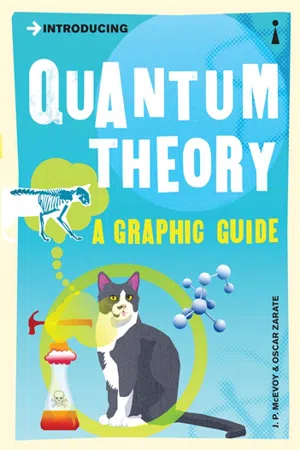
Quantum theory confronts us with bizarre paradoxes which contradict the logic of classical physics.
At the subatomic level, one particle seems to know what the others are doing, and according to Heisenberg's "uncertainty principle", there is a limit on how accurately nature can be observed. And yet the theory is amazingly accurate and widely applied, explaining all of chemistry and most of physics.
Introducing Quantum Theory takes us on a step-by-step tour with the key figures, including Planck, Einstein, Bohr, Heisenberg and Schrodinger. Each contributed at least one crucial concept to the theory. The puzzle of the wave-particle duality is here, along with descriptions of the two questions raised against Bohr's "Copenhagen Interpretation" - the famous "dead and alive cat" and the EPR paradox. Both remain unresolved.
- 176 pages
- English
- ePUB (mobile friendly)
- Available on iOS & Android
eBook - ePub
About this book
Information
Topic
Physical SciencesSubtopic
Science HistoryWhat is Quantum Theory?
Quantum theory is the most successful set of ideas ever devised by human beings. It explains the periodic chart of the elements and why chemical reactions take place. It gives accurate predictions about the operation of lasers and microchips, the stability of DNA and how alpha particles tunnel out of the nucleus.
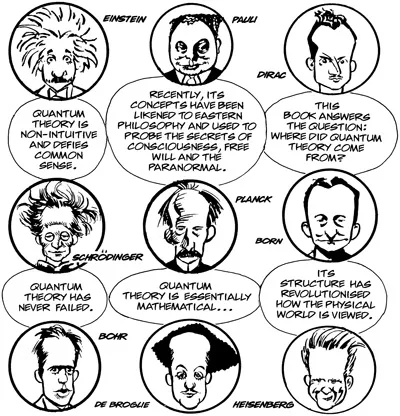
QUANTUM THEORY IS NON-INTUITIVE AND DEFIES COMMON SENSE.
RECENTLY, ITS CONCEPTS HAVE BEEN LIKENED TO EASTERN PHILOSOPHY AND USED TO PROBE THE SECRETS OF CONSCIOUSNESS, FREE WILL AND THE PARANORMAL.
THIS BOOK ANSWERS THE QUESTION: WHERE DID QUANTUM THEORY COME FROM?
QUANTUM THEORY HAS NEVER FAILED.
QUANTUM THEORY IS ESSENTIALLY MATHEMATICAL. . .
ITS STRUCTURE HAS REVOLUTIONISED HOW THE PHYSICAL WORLD IS VIEWED.
RECENTLY, ITS CONCEPTS HAVE BEEN LIKENED TO EASTERN PHILOSOPHY AND USED TO PROBE THE SECRETS OF CONSCIOUSNESS, FREE WILL AND THE PARANORMAL.
THIS BOOK ANSWERS THE QUESTION: WHERE DID QUANTUM THEORY COME FROM?
QUANTUM THEORY HAS NEVER FAILED.
QUANTUM THEORY IS ESSENTIALLY MATHEMATICAL. . .
ITS STRUCTURE HAS REVOLUTIONISED HOW THE PHYSICAL WORLD IS VIEWED.
Niels Bohr’s presentation of quantum theory in 1927 remains today’s orthodoxy. But Einstein’s thought experiments in the 1930s questioned the theory’s fundamental validity and are still debated today. Could he be right again? Is there something missing? Let’s begin at the beginning . . .
Introducing Quantum Theory
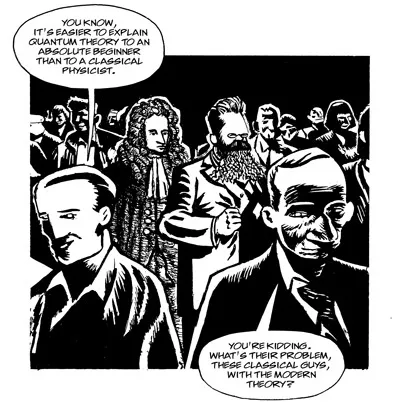
YOU KNOW, IT’S EASIER TO EXPLAIN QUANTUM THEORY TO AN ABSOLUTE BEGINNER THAN TO A CLASSICAL PHYSICIST.
YOU’RE KIDDING. WHAT’S THEIR PROBLEM, THESE CLASSICAL GUYS, WITH THE MODERN THEORY?
YOU’RE KIDDING. WHAT’S THEIR PROBLEM, THESE CLASSICAL GUYS, WITH THE MODERN THEORY?
The problem is this. Just before the turn of the century, physicists were so absolutely certain of their ideas about the nature of matter and radiation that any new concept which contradicted their classical picture would be given little consideration.
Not only was the mathematical formalism of Isaac Newton (1642–1727) and James Clerk Maxwell (1831–79) impeccable, but predictions based on their theories had been confirmed by careful detailed experiments for 4 many years. The Age of Reason had become the age of certainty!
Classical Physicists
What is the definition of “classical”?
By classical is meant those late 19th century physicists nourished on an academic diet of Newton’s mechanics and Maxwell’s electromagnetism – the two most successful syntheses of physical phenomena in the history of thought.
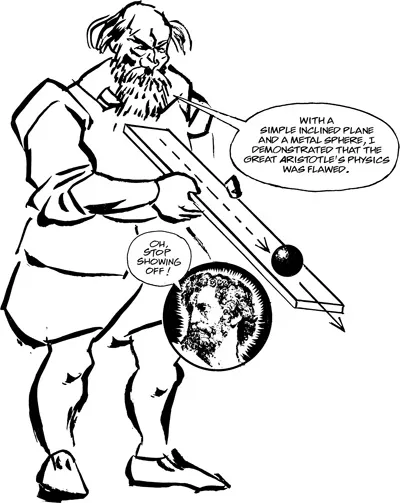
WITH A SIMPLE INNCLINED PLAVE AND A METAL SPHERE, I DEMONSTRATED THAT THE GREAT ARISTOTLE’S PHYSICS WAS FLAWED.
OH, STOP SHOWING OFF!
OH, STOP SHOWING OFF!
Testing theories by observation had been the hallmark of good physics since Galileo (1564–1642). He showed how to devise experiments, make measurements and compare the results with the predictions of mathematical laws.
The interplay of theory and experiment is still the best way to proceed in the world of acceptable science.
It’s All Proven (and Classical). . .
During the 18th and 19th centuries, Newton’s laws of motion had been scrutinized and confirmed by reliable tests.
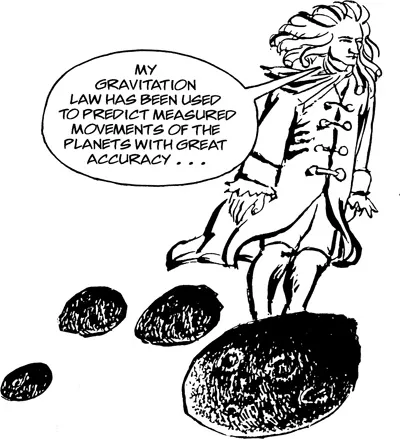
MY GRAVITATION LAW HAS BEEN USED TO PREDICT MEASURED MOVEMENTS OF THE PLANETS WITH GREAT ACCURACY.
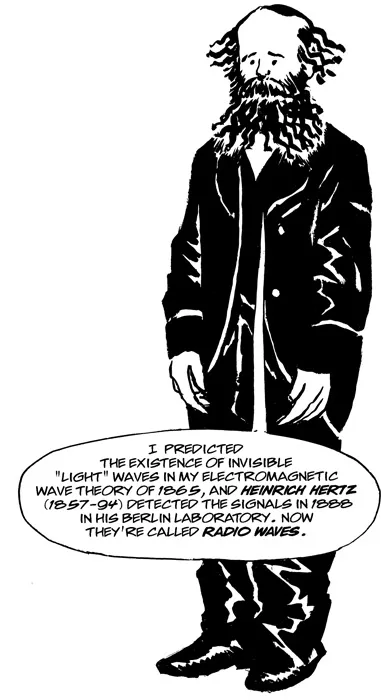
I PREDICTED THE EXISTENCE OF INVISIBLE “LIGHT” WAVES IN MY ELECTROMAGNETIC WAVE THEORY OF 1865, AND HEINRICH HERTZ (1857–94) DETECTED THE SIGNALS IN 1888 IN HIS BERLIN LABORATORY. NOW THEY’RE CALLED RADIO WAVES.
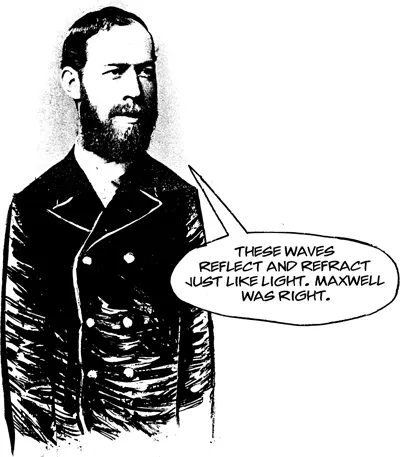
THESE WAVES REFLECT AND REFRACT JUST LIKE LIGHT. MAXWELL WAS RIGHT.
No wonder these classical physicists were confident in what they knew!
“Fill in the Sixth Decimal Place”
A classical physicist from Glasgow University, the influential Lord Kelvin (1824–1907), spoke of only two dark clouds on the Newtonian horizon.
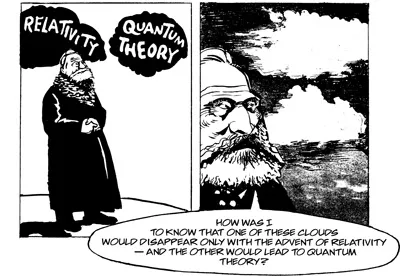
HOW WAS I TO KNOW THAT ONE OF THESE CLOUDS WOULD DISAPPEAR ONLY WITH THE ADVENT OF RELATIVITY – AND THE OTHER WOULD LEAD TO QUANTAM THEORY?
In June 1894, the American Nobel Laureate, Albert Michelson (1852–1931), thought he was paraphrasing Kelvin in a remark which he regretted for the rest of his life.
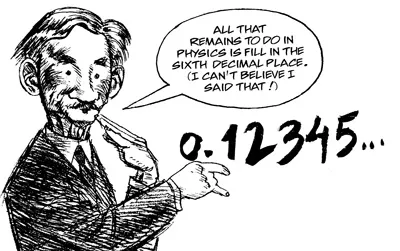
ALL THAT REMAINS TO DO IN PHYSICS IS FILL IN THE SIXTH DECIMAL PLACE. (I CAN’T BELIEVE I SAID THAT!)
The Fundamental Assumptions of Classical Physics
Classical physicists had built up a whole series of assumptions which focused their thinking and made the acceptance of new ideas very difficult. Here’s a list of what they were sure of about the material world . . .
1) The universe was like a giant machine set in a framework of absolute time and space. Complicated movement could be understood as a simple movement of the machine’s inner parts, even if these parts can’t be visualized.
2) The Newtonian synthesis implied that all motion had a cause. If a body exhibited motion, one could always figure out what was producing the motion. This is simply cause and effect, which nobody really questioned.
3) If the state of motion was known at one point – say the present – it could be determined at any other point in the future or even the past. Nothing was uncertain, only a consequence of some earlier cause. This was determinism.
4) The properties of light are completely described by Maxwell’s electromagnetic wave theory and confirmed by the interference patterns observed in a simple double-slit experiment by Thomas Young in 1802.
5) There are two physical models to represent energy in motion: one a particle, represented by an impenetrable sphere like a billiard ball, and the other a wave, like that which rides towards the shore on the surface of the ocean. They are mutually exclusive, i.e. energy must be either one or the other.
6) It was possible to measure to any degree of accuracy the properties of a system, like its temperature or speed. Simply reduce the intensity of the observer’s probing or correct for it with a theoretical adjustme...
Table of contents
- Cover
- Title Page
- Copyright
- Contents
- What is Quantum Theory?
- Further Reading
- Acknowledgements
- Index
Trusted by 375,005 students
Access to over 1.5 million titles for a fair monthly price.
Study more efficiently using our study tools.
Frequently asked questions
Yes, you can cancel anytime from the Subscription tab in your account settings on the Perlego website. Your subscription will stay active until the end of your current billing period. Learn how to cancel your subscription
No, books cannot be downloaded as external files, such as PDFs, for use outside of Perlego. However, you can download books within the Perlego app for offline reading on mobile or tablet. Learn how to download books offline
Perlego offers two plans: Essential and Complete
- Essential is ideal for learners and professionals who enjoy exploring a wide range of subjects. Access the Essential Library with 800,000+ trusted titles and best-sellers across business, personal growth, and the humanities. Includes unlimited reading time and Standard Read Aloud voice.
- Complete: Perfect for advanced learners and researchers needing full, unrestricted access. Unlock 1.5M+ books across hundreds of subjects, including academic and specialized titles. The Complete Plan also includes advanced features like Premium Read Aloud and Research Assistant.
We are an online textbook subscription service, where you can get access to an entire online library for less than the price of a single book per month. With over 1.5 million books across 990+ topics, we’ve got you covered! Learn about our mission
Look out for the read-aloud symbol on your next book to see if you can listen to it. The read-aloud tool reads text aloud for you, highlighting the text as it is being read. You can pause it, speed it up and slow it down. Learn more about Read Aloud
Yes! You can use the Perlego app on both iOS and Android devices to read anytime, anywhere — even offline. Perfect for commutes or when you’re on the go.
Please note we cannot support devices running on iOS 13 and Android 7 or earlier. Learn more about using the app
Please note we cannot support devices running on iOS 13 and Android 7 or earlier. Learn more about using the app
Yes, you can access Introducing Quantum Theory by J.P. McEvoy,Oscar Zarate in PDF and/or ePUB format, as well as other popular books in Physical Sciences & Science History. We have over 1.5 million books available in our catalogue for you to explore.