'An ideal introduction [to Stephen Hawking]' -
Independent
'Astonishingly comprehensive - clearer than Hawking himself' -
Focus
Stephen Hawking was a world-famous physicist with a cameo in
The Simpsons on his CV, but outside of his academic field his work was little understood. To the public he was a tragic figure - a brilliant scientist and author of the 9 million-copy-selling
A Brief History of Time, and yet spent the majority of his life confined to a wheelchair and almost completely paralysed.
Hawking's major contribution to science was to integrate the two great theories of 20th-century physics: Einstein's General Theory of Relativity and Quantum Mechanics.
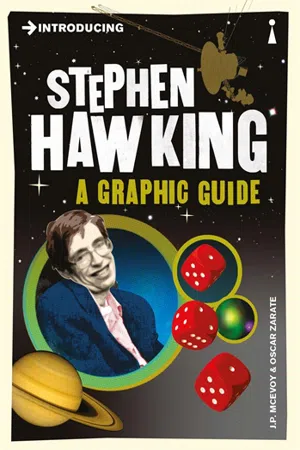
J.P. McEvoy and Oscar Zarate's brilliant graphic guide explores Hawking's life, the evolution of his work from his days as a student, and his breathtaking discoveries about where these fundamental laws break down or overlap, such as on the edge of a Black Hole or at the origin of the Universe itself.
- 176 pages
- English
- ePUB (mobile friendly)
- Available on iOS & Android
eBook - ePub
About this book
Information
The Luckiest Man in the Universe
On 19 October 1994, the author of this book interviewed Stephen Hawking. He began with a question that might seem daring, if not impertinent. Did Hawking consider himself lucky?
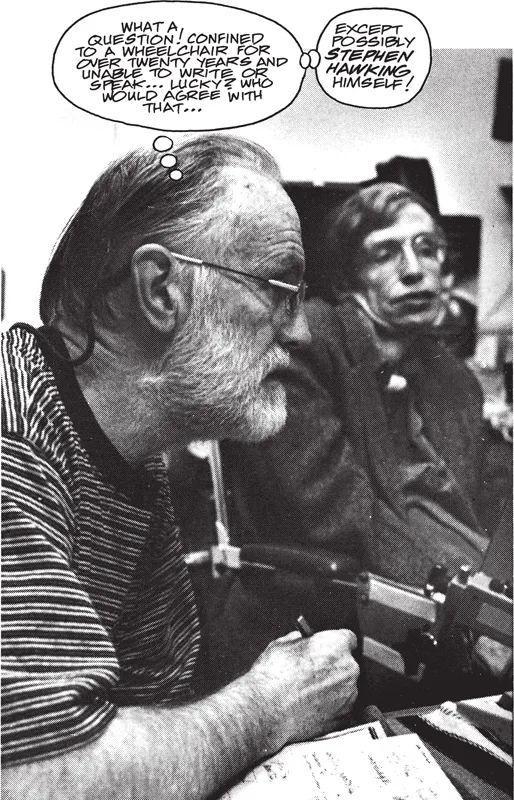
WHAT A QUESTION! CONFINED TO A WHEELCHAIR FOR OVER TWENTY YEARS AND UNABLE TO WRITE OR SPEAK… LUCKY? WHO WOULD AGREE WITH THAT… EXCEPT POSSIBLY STEPHEN HAWKING HIMSELF!
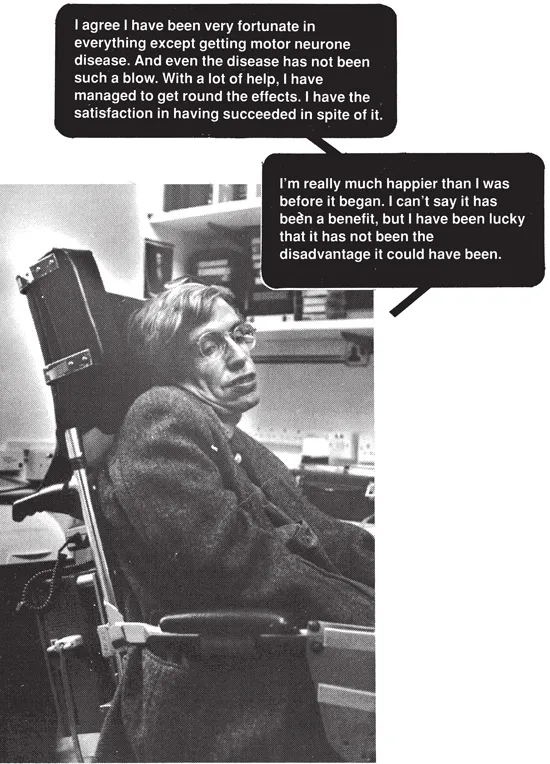
Let’s go back a bit…
Everyone knows of Hawking’s bad luck. It began one afternoon in the spring of 1962 when he found it very difficult to tie his shoelaces. He knew something was drastically wrong with his body. That year he had talked his way into a first degree at Oxford University and was accepted as a postgraduate student at Cambridge. But he had contracted amyotrophic lateral sclerosis, ALS for short, the motor neurone disease. It is incurable and fatal. Doctors gave him two years to live.
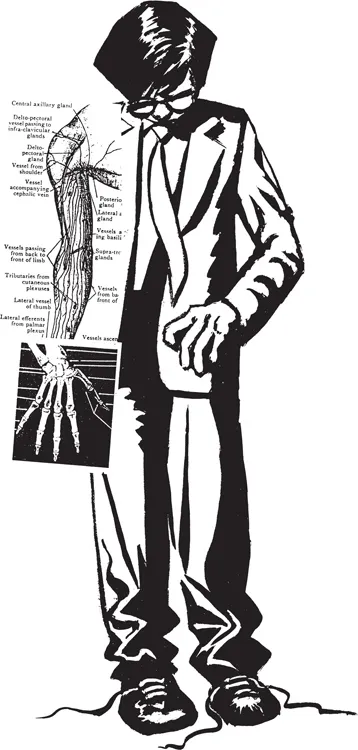
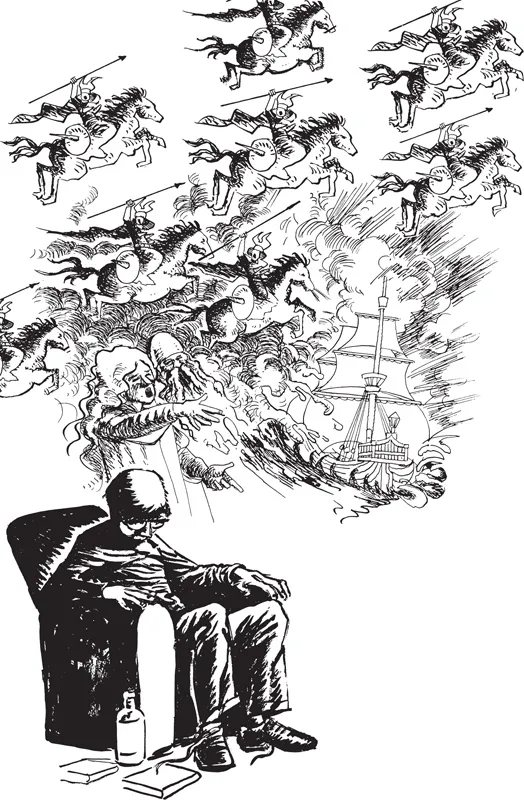
As the tabloid press and the paperback biographies would have us believe, Hawking spent the next several months in deep depression in his university digs, drinking and listening to Wagner. To add to his bitterness, he was told that he would not have the famous cosmologist Fred Hoyle (b. 1915) as his research adviser, the reason he chose Cambridge in the first place.
But immediately his luck began to change. A young woman, Jane Wilde, he met on New Year’s Eve 1962 had taken a genuine interest in him, and the Cambridge Physics Department had assigned him to Dennis Sciama (b. 1926), one of the best-informed and most inspiring research advisers in the world of relativistic cosmology.

Once it is accepted that Stephen William Hawking’s physical capabilities were severely limited by the tragic disease of ALS, a whole series of fortunate events seemed to have taken place in the early 1960s which enabled him to fulfil his destiny as one of the leading cosmologists of modern times.
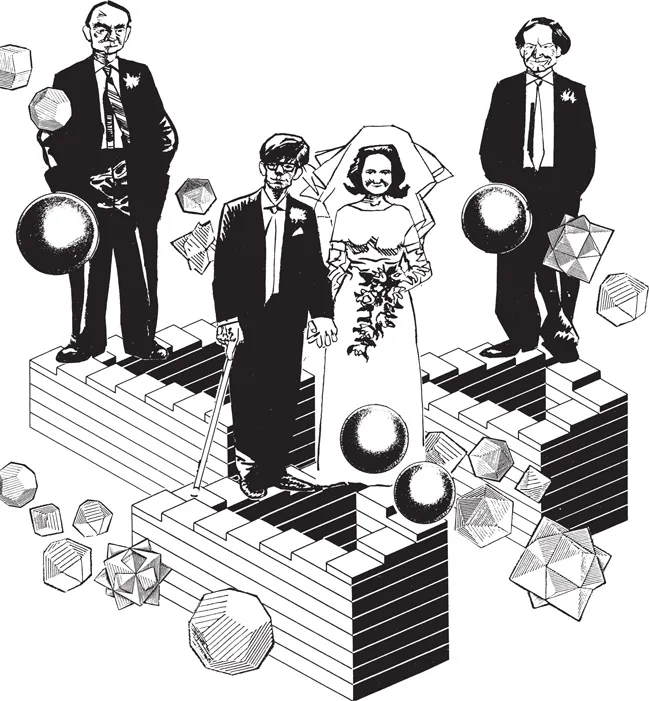
First of all, for the profession he had chosen – theoretical physics – the only facility he absolutely needed was his brain, which was completely unaffected by his illness. He had met a helpful partner in Jane Wilde and been presented with a sympathetic thesis adviser, Sciama.
Soon he would meet Roger Penrose (b. 1931), a brilliant mathematician working on black holes, who would teach him radically new analytical tools in physics. Penrose would help him solve a research problem that would not only save his doctoral dissertation but also bring him directly into mainstream theoretical physics.
The help of these three people at such a critical time in Hawking’s life is perhaps more than anyone can hope for.
He had another appointment with destiny at about the same time. A theory which had been developed almost fifty years earlier – Einstein’s general theory of relativity – was only just being widely applied to practical problems in cosmology. It seems that predictions based on this theory were so bizarre that it had taken decades for it to be accepted. Now in the early 1960s, a golden age of research in cosmology based on general relativity was about to begin. Fate had waited for Stephen Hawking. The secretly ambitious – though by then slightly crippled – theoretical physicist was ready. He didn’t know how long he had to live … but he was certainly in the right place at the right time.
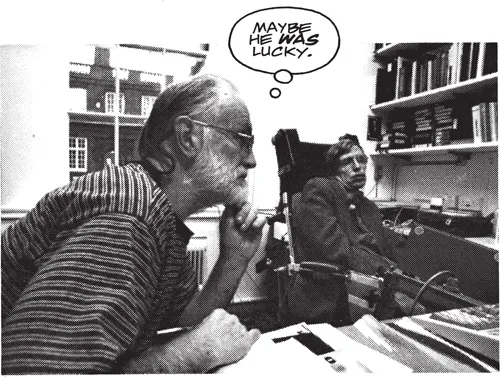
MAYBE HE WAS LUCKY.
Stephen Hawking is called a relativistic cosmologist. This means he studies the Universe as a whole (cosmologist) and uses mainly the theory of relativity (relativistic).
As Hawking has spent his entire career as a theoretical physicist – from the early 1960s to the mid 1990s – working with Einstein’s general relativity, it might be a good idea to know what it’s about.
The General Theory of Relativity
Berlin, November 1915. Albert Einstein (1879-1955) had just completed his theory of general relativity, a mathematical structure in which curved space and warped time are used to describe gravitation. All modern cosmology began two years later, when Einstein published a second paper called Cosmological Considerations in which he applied his new theory to the entire Universe.
General relativity is difficult to master, but the relatively few people who understand the theory agree it is an elegant, even beautiful theory of gravitation.
Describing a set of equations as beautiful doesn’t help much in understanding how Einstein’s theory differs from that of Isaac Newton (1642-1727). But an example of how each of the two theories describes gravity in the same physical situation might do the trick.
Why does a, cosmologist have to study gravitation?
Cosmology is the study of the whole Universe and much of the subject is based on wide-sweeping hypotheses. Gravitation determines the large-scale structure of the Universe or, more simply, keeps the planets star and galaxies together. It is the most important concept for work in this field.
Until recently, the subject of cosmology was considered to be a pseudo-science reserved for retired emeritus professors. But in the last three decades, more or less coinciding with Hawking’s career, two major developments have changed the subject dramatically.

THE COMPLETE STORY TAKES IN NEWTON, THEN EINSTEIN, THEN HAWKING FIRST, NEWTON.
- First, major breakthroughs in observational astronomy – reaching out to the most distant galaxies – have made the Universe a laboratory to test cosmological models
- Second, Einstein’s general relativity has been proven over and over again to be an accurate and reliable theory of gravitation throughout the entire Universe.
Remember, physics is a cumulative subject. New theories are built on previous ones, keeping the ideas that stand up to experimental test and discarding those that don’t. Our final goal is to understand the contributions of Stephen Hawking who has taken Einstein’s gravitation theory to its ultimate limit.
It is important to understand the notion of partial theories. For example, Newton’s Law of Gravitation is very accurate only when gravity is weak – and must be replaced by Einstein’s general relativity in strong gravitational fields. Similarly, relativity must be replaced by quantum mechanics when examining interactions on a microscopic scale,...
Table of contents
- Cover
- Title Page
- Copyright
- Contents
- The Luckiest Man in the Universe
- The General Theory of Relativity
- Newton: The Concept of Force
- Four Kinds of Force in the Universe
- The Principia: Describing Newton’s Universe
- Newton and Hawking
- The Concept of Mass
- Albert Einstein, the Saviour of Classical Physics
- Einstein and Hawking
- Einstein’s Happiest Thought
- Finding the Right Equation
- The Field Equations – What do they mean?
- Visualising Curved Space: the Rubber Sheet Model
- The Bending of Starlight: Eclipse of 29 May 1919
- Solving Einstein’s Equations: Hawking’s Starting Material
- 1) The Schwarzschild Geometry
- The Critical Radius
- 2) Friedmann: the Expanding Universe
- Precursor to the Big Bang: Lemaître’s Primordial Aim
- 3) Oppenheimer: on Continued Gravitational Collapse, 1939
- 1 September 1939
- 1942 … A Turning Point in the Story
- The Death of Einstein
- The Hawking Era
- The Unselfish Thesis Supervisor
- Something You Need to Know: What is a Singularity?
- The Evolution of the Universe
- 1965: a Big Year for Hawking
- An Unstoppable Mind
- The Sixties Revolution
- Dallas 1963
- Something You Need to Know: the Electro Magnetic Spectrum
- 1963: Quasars
- 1965: the Cosmic Background Radiation
- Something You Need to Know — Thermal Radiation
- History of the Universe
- Black Holes — Wheeler Gives the Media a Buzz Word
- The Age of Black Holes
- What is a Black Hole ?
- The Birth and Death of Stars
- The Laws of Thermodynamics
- How Stars Collapse to Form White Dwarfs, Neutron Stars & Black Holes
- Observational Evidence for Black Holes
- The 1970s: Hawking and Black Holes
- Hawking’s Eureka Moment
- Now Back to Black Holes …
- Controversial Birth of a New Idea
- August 1972, Les Houches Summer School on Black Hole Physics
- The Uncertainty Principle & Virtual Particles
- February 1974, The Rutherford- Appleton Laboratory, Oxford
- Hawking and the Vatican – a Modern Day Galileo
- Hawking and the Early Universe
- Why Do We Need Quantum Theory?
- Quantum Cosmology
- Quantum Gravity or TOE
- Quantum Cosmology and Complex Time
- Waves and Particles: Nature’s Joke on the Physicists
- The Strange World of Quantum Mechanics
- Quantum Cosmology: Applying Schrödinger’s Equation to the Universe
- DAMTP: 17 February 1995
- Inflation
- Inflation and Quantum Fluctuations
- The Anthropic Principle
- Hawking’s Nobel Prize
- COBE: the Greatest Discovery of All Time (?)
- Further Reading
- Acknowledgements
- Index
Trusted by 375,005 students
Access to over 1.5 million titles for a fair monthly price.
Study more efficiently using our study tools.
Frequently asked questions
Yes, you can cancel anytime from the Subscription tab in your account settings on the Perlego website. Your subscription will stay active until the end of your current billing period. Learn how to cancel your subscription
No, books cannot be downloaded as external files, such as PDFs, for use outside of Perlego. However, you can download books within the Perlego app for offline reading on mobile or tablet. Learn how to download books offline
Perlego offers two plans: Essential and Complete
- Essential is ideal for learners and professionals who enjoy exploring a wide range of subjects. Access the Essential Library with 800,000+ trusted titles and best-sellers across business, personal growth, and the humanities. Includes unlimited reading time and Standard Read Aloud voice.
- Complete: Perfect for advanced learners and researchers needing full, unrestricted access. Unlock 1.5M+ books across hundreds of subjects, including academic and specialized titles. The Complete Plan also includes advanced features like Premium Read Aloud and Research Assistant.
We are an online textbook subscription service, where you can get access to an entire online library for less than the price of a single book per month. With over 1.5 million books across 990+ topics, we’ve got you covered! Learn about our mission
Look out for the read-aloud symbol on your next book to see if you can listen to it. The read-aloud tool reads text aloud for you, highlighting the text as it is being read. You can pause it, speed it up and slow it down. Learn more about Read Aloud
Yes! You can use the Perlego app on both iOS and Android devices to read anytime, anywhere — even offline. Perfect for commutes or when you’re on the go.
Please note we cannot support devices running on iOS 13 and Android 7 or earlier. Learn more about using the app
Please note we cannot support devices running on iOS 13 and Android 7 or earlier. Learn more about using the app
Yes, you can access Introducing Stephen Hawking by J.P. McEvoy,Oscar Zarate in PDF and/or ePUB format, as well as other popular books in Sciences physiques & Biographies de sciences et technologies. We have over 1.5 million books available in our catalogue for you to explore.