eBook - ePub
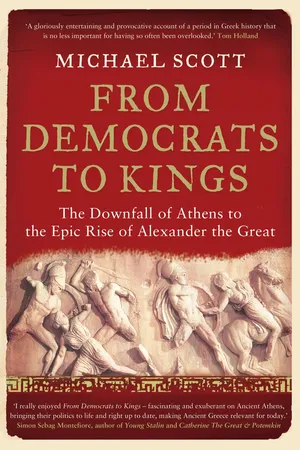
From Democrats to Kings
The Downfall of Athens to the Epic Rise of Alexander the Great
- 320 pages
- English
- ePUB (mobile friendly)
- Available on iOS & Android
eBook - ePub
About this book
Athens, 404 BC. The Democratic city-state has been ravaged by a long and bloody war with neighbouring Sparta. The search for scapegoats begins and Athens, liberty's beacon in the ancient world, turns its sword on its own way of life. Civil war and much bloodshed ensue. Defining moments of Greek history, culture, politics, religion and identity are debated ferociously in Athenian board rooms, back streets and battlefields. By 323 BC, less than 100 years later, Athens and the rest of Greece, not to mention a large part of the known world, has come under the control of an absolute monarch, a master of self-publicity and a model for despots for millennia to come: 'megas alexandros', Alexander the Great. Michael Scott, Finley Fellow in Ancient History at Darwin College, Cambridge, explores the dramatic and little-known story of how the ancient world was turned on its head from Democratic Athens to King Alexander the Great in this superb example of popular history writing. "From Democrats to Kings" also gives us a fresh take on the similar challenges we face today in the 21st century - a world in which many democracies - old and new - fight for survival, in which war-time and peace-time have become indistinguishable and in which the severity of the economic crisis is only matched by a crisis in our own sense of self.
Information
Subtopic
Greek Ancient HistoryIndex
HistoryCHAPTER 1

Flute Players and Pick Axes
In the year 404 BC, when Isocrates was 32 years of age, the democratic city of Athens and its great empire lay in the final throes of a slow and painful death. Athens had been at war for almost the entirety of Isocrates’ life. The reason for this epic struggle was simple enough. After the cities of Greece had resisted the Persian invasion (and the 300 – in reality 301 – Spartans had fought so gloriously at Thermopylae) at the beginning of the century, the city of Athens had slowly moved to dominate much of ancient Greece. In the 440s BC, roughly 30 years after the heroic actions of the 301, as construction work on the great Parthenon temple in Athens was beginning and almost a decade before Isocrates was born, Athens’ empire had grown to span much of the Greek world. Its unbeatable navy patrolled the Aegean and the Black Sea and often visited violent retribution on cities unwilling to accept its leadership, its taxes and its garrison outposts. Eventually the strain had become too much and the one city which had the strength to oppose Athens’ stranglehold grip on Greece, Sparta, with its famous warrior citizens, had declared war in order to deliver what it called freedom once more to the Greeks. Athens, the celebrated democracy, was denounced as the tyrant of Greece by Sparta – a city, ironically enough, itself ruled by two kings. Gathering allies as it went, Sparta faced up against Athens in a war, which eventually enveloped much of mainland Greece, the islands of the Aegean and the coast of modern-day Turkey. This war, known as the Peloponnesian war, raged across Greece for much of the next 30 years. It consumed Isocrates’ early life and wiped out his family’s fortune, not to mention the lives of thousands.
Throughout those 30 long years, neither side could deliver the fatal blow. Yet by 404 BC, Athens was on its knees. Why? Partly, it was to do with factors beyond Athens’ control. In an effort to protect its citizens, it had encouraged many who lived out in the vulnerable countryside to move into the city where they would be protected by Athens’ stout city walls. But the effect of so many people crowded into a city, not best known for its public hygiene, was plague. Severe bouts of the plague struck the city three times, killing perhaps a third of its population. The plague bled the morale of the city, causing social and religious order to break down and taking the life of its most illustrious general, Athens’ version of Winston Churchill, a man called Pericles. Without a clear leader, surrounded by funeral pyres whose scattered ashes seemed to symbolise the crumbling state of the once-proud city, Athens was ill prepared to continue fighting this debilitating conflict.
Yet Athens’ fall from power was also due to its own mistakes. Too often, Athens’ over-eager democratic assembly voted in haste for a particular mission which, not going to plan, they sought to blame on somebody else. The worst case was that of a sea battle at Arginusae in 406 BC, just two years before Athens’ final defeat. Following the battle, in which they had actually been victorious, the Athenian admirals had been unable to pick up their dead from the water for fear of a storm, which threatened to take more Athenian lives in pursuit of those already dead. They returned home without the bodies of their compatriots, a serious breach of Athenian custom and religious obligation, but perhaps understandable given the circumstances. The Athenian assembly, standing together in session on the assembly hill, called the Pnyx, in the centre of the city (see Map 1), did not see it that way and voted to put on trial and eventually execute the offending admirals. In the midst of war, Athens killed its own successful military leaders. Athens left itself without a head, and with such a vengeful mob seemingly calling the shots, it’s not surprising that it had difficulty finding talented men willing to take the place of the dead admirals.
But perhaps the final nail in the coffin for Athens during this great war was the Spartans’ (perhaps surprising) willingness to think the unthinkable. For much of the current century, the cities of Greece had been at war with the great empire across the Aegean sea, Persia. Persia was the antithesis of everything Greek, and the successful repudiation of Persia’s attempt to take over the cities of ancient Greece back in 490 and 480–479 BC secured not only the legendary status of Spartan warriors in the ancient world, but also Greece’s freedom and the growing glory of the city of Athens. A Spartan could not even consider alliance with Persia. Yet the long years of the Peloponnesian war, and the fact that it was now the Greek city of Athens, not Persia, that was threatening Greece’s freedom, seem to have prompted the Spartans to make a deal with the Persians. In return for military and financial aid, the Spartans promised the Persians control over the Greek cities dotted along the coast of modern-day Turkey (the borderlands of the Persian and Greek worlds), which had been a constant thorn in the Persian king’s side. The Spartans, the descendants of the 301 who had held to their death the pass at Thermopylae against the invading Persian army, were now in bed with their one-time enemy. Against the combined army of Sparta and the financial and naval muscle of Persia, Athens didn’t stand a chance.
In 404 BC, following a siege of the city of Athens and the blockade of its port, Piraeus (Map 1), which had provided the arterial life-blood of edible grain into the city, Athens accepted its defeat. The Athenian empire was dead. The Spartan general responsible for masterminding this final humiliation, Lysander, accepted Athens’ peace envoy with great generosity, but also kept him waiting for an excruciating three months to agree terms. Three months in which exhausted Athenians waited to hear what lay in store for their battered city, like a victim of the guillotine waiting interminably for the sound of the blade sliding towards their neck. The terms that finally emerged were bludgeoning. Athens had to surrender its crown jewel – its navy – except for a paltry twelve triremes (the ancient version of the battle-cruiser). It had to allow all supporters of oligarchy – rule by the few, the antithesis of democracy – back into the city. It had to become a friend and ally of Sparta and follow wherever it led. And if this wasn’t enough, Athens had to pull down its own city walls, leaving itself naked to the world around it. Like a prisoner of war stripped naked in front of his captors, this was the final humiliation for the city that had been the glory of Greece.
In some ways, however, the peace agreement could have been much worse. It didn’t, for instance, demand that Athens get rid of its system of democracy. In fact, Athens did that all by itself. In the assembly meeting on the Pnyx to hear the peace terms, some Athenians stepped forward to say that democracy had had its day and that what was needed now was strong, stable government by a small number of experienced men. This wasn’t a new idea, since Athens had briefly tried a somewhat similar system of government seven years earlier but had thrown it out just as quickly as it had been brought in. This time, however, the movement was more serious. The man who had been sent by Athens to negotiate the peace terms (and, it was rumoured, enjoyed far too much the generosity of Sparta during those long three months of waiting) spoke in favour of appointing a board of 30 men to lead Athens in its dark hour. The victorious Spartan general himself, Lysander, sat on the platform in front of the Athenian assembly and suggested that, for Athens’ good, the proposal be accepted. The opponents of the scheme, the die-hard democrats, walked out of the assembly in disgust at what they saw as the subversion of normal democratic procedures (fair enough, since Lysander’s presence, and that of his army not far away, wasn’t particularly conducive to democratic debate). In their absence, however, the motion’s supporters continued the debate and won the day. On the same day as, 76 years earlier, democratic Athens with its allies had won its own famous victory against the Persians at the sea battle of Salamis, democratic Athens (somewhat) democratically voted itself out of existence.
In the nights following the adoption of Sparta’s demands, its terms were brutally enforced. The most heart-rending of these was the destruction of the stout city walls that had defined and protected Athens. Every Spartan, every hater of Athens, was called on to hack down the walls with anything they could lay their hands on. In contrast to the tearing down of the Berlin Wall in 1989, which heralded the birth of unity in a splintered city, this tearing down signified a city’s destruction. By day in the blistering sun and by night in the flicker of torch-fire, the rhythmic beat of metal against stone could be heard ringing out around the city. The Spartans, who marched to the tune of the flute, even installed flute players around the city to co-ordinate the work. The sad, rhythmical tune of the flute and the accompanying beat of the pickaxes heralded the final humiliation of a once proud city and, supposedly, the freeing of Greece from its tyrant.
The rule of the 30 (who would themselves later be branded the ‘30 Tyrants’) was initially fairly mild and temperate. But one of their most controversial actions was to rebuild the Athenian assembly on the Pnyx. Since its inception, this open-air assembly area on top of one of the central hills of Athens had been structured so as to have the assembly members facing towards Athens’ port, Piraeus, and the sea. The 30 Tyrants had it reversed so that the members now faced towards the land. Why? It is said that the 30 believed that Piraeus and the sea reminded the Athenians of democracy and empire (because rowing aboard Athens’ fleet of triremes had been one of the great supports for democratic thinking in Athens: if you can defend the city by powering its warships, you should have a say in how the city is run). Pointing people towards the land, the thinking went, instead reminded people of landowners, aristocracy, and the ‘traditional’ order of things in which only the elites had a say. Putting the sea to their backs, the 30 Tyrants hoped that the Athenians would forget their love affair with democracy. You still can still visit the Pnyx today in Athens, set out in the same orientation as the 30 Tyrants left it in 403 BC (see Figure 2).
The 30’s reign was fairly short, not simply because of their cosmetic attempts to eradicate many Athenians’ deep-seated regard for democracy. By the winter of the same year in which they had come into power, competition between the 30 men chosen to lead Athens had led to a hardening of their positions. Theramenes, the man who had brokered the peace with Sparta and supported the 30’s rule in the assembly, now questioned their motives and actions; he was exiled and a list of 3,000 people who were ‘in’ the club of Athenian citizenship was drawn up. Though always restrictive in who it gave citizenship to, democratic Athens, in the course of a couple of months, had now become an extremely exclusive members-only club. Supporters of the democracy and those not on this exclusive list fled the city to plot their revenge in neighbouring Greek cities like Thebes, Argos and Megara. By the end of the year, a revolutionary band of 70 men – both Athenian exiles and non-Athenians – was gathering in Thebes under the leadership of a man called Thrasyboulus. They struck out to occupy the town of Phyle on the border between the territories of Athens and Thebes. From there they moved to take Athens’ port, Piraeus. This hotbed of democratic support had smouldered since the overthrow of democracy, despite the assembly men literally turning their backs to it, and was ignited by the arrival of Thrasyboulus and his heroic band. On the Munychia hill in Piraeus, Thrasyboulus and his by now vastly swollen numbers of resistance fighters met the advancing (and still larger) supporters of the 30 and the ‘list of 3,000’ in open battle for the future of Athens.
The result was inconclusive, but the insurrection did succeed in killing Critias, the most hard-line of the 30 Tyrants, and forced constitutional change. The exclusive list of 3,000 dispatched the 30 Tyrants, and, in an off-hand move to placate the democrats, installed ten people to govern the city of Athens and ten to govern Piraeus instead. Such moves only further angered the leaders of the rebellion, who threatened further military action. The ten and the 3,000 appealed in desperation and a good degree of panic to Sparta for more military help. But what would Sparta do?
We are more aware than ever today of the dangers and difficulties of interfering with another city or country’s internal political affairs. Sparta too, despite its prominent position as de facto controller of Greece, was split in how to respond. The two sides of the debate were summed up by two of the city’s leading figures. On the one hand, Lysander, the original architect of victory over Athens, wished to move in and crush the democratic rebellion once and for all. But one of Sparta’s kings (Sparta had two of them at any one time) argued for restraint. The king pulled rank on the general Lysander. It was but another irony of Athens’ history that its democracy, voted out of existence by its own democratic assembly, was reinstated by a settlement negotiated by the king of the city which had brought Athens to its knees just a year before.
Athens had been through turbulent times. In a single year, it had lost its empire, its pride, its city walls, its democracy, been reorganised into an oligarchic state, suffered internal civil war and had its democracy restored. In the summer of 403 BC, it was left with the gigantean task of rebuilding and healing itself – physically, politically and morally. The problem was this: how should Athens restore the democracy and punish those opposed to it, without making clear just how weak democracy had been? How should the city celebrate its victory without making clear how close it had come to defeat? Like Germany after the fall of Nazism, Athens had to work out how to move on from such a dark part of its history without forgetting the lessons that needed to be learnt from it.
The settlement the city struck on was one that brilliantly combined a selective remembering of the heroic moments and an equally important selective forgetting of the embarrassing ones. Athens allowed an amnesty to everyone except the 30 Tyrants, who were hunted down and punished. Athens, pushed by Sparta, offered a very attractive deal to anyone who didn’t want to be part of a democratic Athens to go and live at Eleusis, a hugely important religious cult site about a day’s walk from the city (Map 1). But most important of all, it agreed that no one would remember past wrongs: not just an amnesty from prosecution, but a deliberate wiping clean of the slate in the collective memory. The past never happened. The last year was nothing more than a hiccup in the graceful dance of democracy at work.
But before such a blanket could be drawn over the affair, democracy’s heroes had to be honoured. With tacit acknowledgement of degrees of heroism, Athens reserved the ultimate honours for those brave few who had been willing to stand up to the 30 at the very beginning – the 70 men who had set out from Thebes under Thrasyboulus and occupied Phyle – with lesser honours for the larger numbers who had responded to Thrasyboulus’ call at his arrival in Piraeus, and lesser honours still for the hordes who had flocked to Piraeus once it looked like he was a sure bet to win. The rewards for each were inscribed on a stone set up on the sacred hill at the centre of ancient Athens that dominated the city then as it does today, its Acropolis. Placed near the world-famous Parthenon temple, which sits astride this towering rock, the stone inscribed with the list of Athens’ saviours, like the Parthenon itself, survives in part for us to read today.
The foreigners among the original heroes, the ‘men of Phyle’ as they became known, were granted the ultimate prize: citizenship of Athens for them and their descendants. In contrast, the non-Athenians who had only helped out in Piraeus were granted exemption from the tax imposed on foreigners by the city – to be considered a great honour but not quite such an honour as citizenship itself. The name of every man in each group was recorded with his employment for all to see. It reads like an inspiring report of a true, bottom-up, democratic revolution by the little man. ‘Leptines the cook’ and ‘Hegesias the gardener’, among others, fought for their democratic rights that day. Immortalised in stone, these humble cooks and gardeners became the heroes of Athens. Yet the inscription also reveals that, before anyone got onto that list, whether from Phyle or Piraeus, they all first had to provide witnesses to prove that they really had been where they claimed to have been. Athenian democracy, quite rightly, wanted proof of who its heroes really were.
After honouring the heroes, both in the inscription on the Acropolis and with graves in Athens’ public cemetery, the Cerameicus (which was located in a highly visible position around the main entrance gate to the city so that you had to travel through the cemetery to reach Athens), the crucial task now was to paper over the gaps in war-torn Athenian society and to rebuild the democracy stronger than before. The men of Phyle and Piraeus were allowed one victory march to the Acropolis before they had to take their place anonymously with everyone else in the assembly and begin the slow process of rebuilding the offices of democracy. That process crucially involved a review of the laws of the city, many of which had been discarded by the 30 Tyrants. Soon enough, Athens would feel the result of this new underpinning of the rule of law. Its citizens were able to read the city’s laws for themselves, set up on stone in the public space of the city’s political market-place, the Agora, and to implement the law in new courtrooms also built in the same area. Athens moved quickly after 403 BC to make the democracy stronger, and more visible, than it had ever been before. The ultimate proof of this was the oath that all Athenians were forced to swear in the weeks after the settlement. Standing in the Agora, as one voice, they swore: ‘I shall kill by word and by deed and by vote and by my own hand, if I can, anyone who overthrows the democracy at Athens.’
Every Athenian democratic citizen no longer just supported democracy with their voice and vote. They were now obliged by an oath, made before their gods, to go as far as killing anyone who attempted to overthrow it. An Athenian’s allegiance was now ultimately not to friends or family but to the city. Democratic Athens, after the upheaval and revolution of 404–403 BC, was now a militant force of would-be killers.
It all seems a little too perfect: democracy faltered, was restored by the cooks and gardeners of Athens and returned stronger than ever before, with all past wrongs forgotten, and everyone lived happily ever after. In reality, of course, it didn’t work like that. Whatever the official line, people could not forget so easily who had been supporters of the democracy and who had not. Partly this was to be expected. The settlement had laid out the bare bones of how post-revolution Athenian society was going to work, but it was up to the Athenians themselves to put nerves, ligaments and muscle on this skeleton framework. Here the law courts became paramount. They acted as the sites of discussion and debate for what was and what was not permissible to remember and to pursue. Slowly Athenian society groped its way towards a working political settlement. But there were casualties along the way. Even Thrasyboulus, the great hero who had led the revolution from Thebes and captained the men of Phyle and Piraeus, was not above the judicio-political intrigue of those difficult days after 403 BC. He was accused of illegally requesting too many honours for the revolutionary heroes (particularly the foreigners among them). ‘Steady on’, was the veiled call from the old guard, even for this hero of the democracy.
But the worst injustice of those turbulent years was reserved for a man who has kept on provoking history, thought and debate ever since. Athenian citizens could not accuse other citizens directly of supporting the 30 Tyrants in the newly built law courts (it was all forgive and forget, remember), but they could find some trumped-up charge to accuse them of and then load their speeches for the prosecution with thinly-veiled references to their past misdemeanours. Even as the mortar was drying in the law-court walls, Athens in 399 BC bore witness to an out-pouring of vengeful double entendre and dubious accusation directed against one man: Socrates.
You probably already know what Socrates looked like, so iconic has his philosopher image become – short, tubby, with a receding hairline, an ugly face like that of a goat, pudgy eyes and a wagging finger. He had roved around Athens for many years, engaging high-flying politicians and citizens of all trades in discussion of what they thought they were doing. Among the close companions of Socrates was our future political commenta...
Table of contents
- Copyright Page
- Contents
- About the author
- Dedication Page
- Acknowledgements
- List of Illustrations
- Maps
- Introduction: One Man’s Dream
- Chapter 1: Flute Players and Pick Axes
- Chapter 2: The City of (Crass) Long-Haired Warriors
- Chapter 3: Dancing with the Persian King
- Chapter 4: ‘Serious Business for Tomorrow’
- Chapter 5: The Vegetarian Philosopher and the Body-Building Philanthropist
- Chapter 6: The Slippery Fish
- Chapter 7: The Clash of Philosopher and Tyrant
- Chapter 8: The Implosion of Greece
- Chapter 9: The Cow’s Bladder, the Love Curse and the Caricature
- Chapter 10: Ten Years That Changed the Ancient World: 362–352 BC
- Chapter 11: Survival Strategies
- Chapter 12: Saviour or Tyrant?
- Chapter 13: The Final Showdown
- Chapter 14: From Father to Son
- Chapter 15: Ruling the Ancient World
- Chapter 16: You’ve Never Had it So Good
- Chapter 17: A New World
- Epilogue: From Democrats to Kings
- Select Bibliography
- Timeline
- Index
Trusted by 375,005 students
Access to over 1.5 million titles for a fair monthly price.
Study more efficiently using our study tools.
Frequently asked questions
Yes, you can cancel anytime from the Subscription tab in your account settings on the Perlego website. Your subscription will stay active until the end of your current billing period. Learn how to cancel your subscription
No, books cannot be downloaded as external files, such as PDFs, for use outside of Perlego. However, you can download books within the Perlego app for offline reading on mobile or tablet. Learn how to download books offline
Perlego offers two plans: Essential and Complete
- Essential is ideal for learners and professionals who enjoy exploring a wide range of subjects. Access the Essential Library with 800,000+ trusted titles and best-sellers across business, personal growth, and the humanities. Includes unlimited reading time and Standard Read Aloud voice.
- Complete: Perfect for advanced learners and researchers needing full, unrestricted access. Unlock 1.5M+ books across hundreds of subjects, including academic and specialized titles. The Complete Plan also includes advanced features like Premium Read Aloud and Research Assistant.
We are an online textbook subscription service, where you can get access to an entire online library for less than the price of a single book per month. With over 1.5 million books across 990+ topics, we’ve got you covered! Learn about our mission
Look out for the read-aloud symbol on your next book to see if you can listen to it. The read-aloud tool reads text aloud for you, highlighting the text as it is being read. You can pause it, speed it up and slow it down. Learn more about Read Aloud
Yes! You can use the Perlego app on both iOS and Android devices to read anytime, anywhere — even offline. Perfect for commutes or when you’re on the go.
Please note we cannot support devices running on iOS 13 and Android 7 or earlier. Learn more about using the app
Please note we cannot support devices running on iOS 13 and Android 7 or earlier. Learn more about using the app
Yes, you can access From Democrats to Kings by Michael Scott in PDF and/or ePUB format, as well as other popular books in History & Greek Ancient History. We have over 1.5 million books available in our catalogue for you to explore.