eBook - ePub
Introducing Aesthetics Introducing Aesthetics
A Graphic Guide
- 176 pages
- English
- ePUB (mobile friendly)
- Available on iOS & Android
eBook - ePub
About this book
What is beauty, and what is truth? These are some of the questions which aesthetics tries to answer. In our everyday life, we talk about the 'aesthetics' of an artwork or a piece of design. But aesthetics goes beyond the simple experience of art. It is also a branch of philosophy concerned with the whole nature of experience itself, explored through our perceptions, feelings and emotions.
Information
Topic
ArtSubtopic
Art Theory & Criticism
“BEAUTY IS TRUTH, TRUTH BEAUTY”, – THAT IS ALL YE KNOW ON EARTH, AND ALL YE NEED TO KNOW.
So the Romantic poet John Keats (1795–1821) wrote in his celebrated meditation upon mortality and immortality, “Ode on a Grecian Urn” of 1820. But what is beauty, and what is truth? These are some of the questions which aesthetics tries to answer …
What is Aesthetics?
Aesthetics (the plural form of aesthetic) is derived from the Greek word aisthētikos, from aisthēta, meaning things perceptible by the senses. In the 18th century aesthetics became a branch of philosophy. The German philosopher Alexander Gottlieb Baumgarten (1714–62) first used the word in his Reflections on Certain Matters Relating to Poetry of 1735. Then, in 1750, Baumgarten entitled an unfinished treatise Aesthetica.

AESTHETICS IS A SPECIALIST AREA OF INQUIRY CONCERNED WITH PERCEPTION AND SENSORY EXPERIENCE.
Today, the word “aesthetic” is frequently encountered in its negative form: “anaesthetic”, which refers to a substance that induces an absence of sensation and an inability to feel pain.
Aesthetics has come to be used not just in relation to philosophy, but also in connection with design and fashion (e.g. the designer of a car will refer to its aesthetics, or an interior designer will use the word to refer to the look and style of their designs). In a similar way, “aesthetic” is used in connection with art to describe the sensibility and style of an artist’s work.

BARNETT NEWMAN’S PAINTINGS HAVE A MINIMALIST AESTHETIC … ANDY WARHOL’S HAVE A COOL AESTHETIC. JACKSON POLLOCK’S HAVE AN EXPRESSIONIST AESTHETIC …
Having the same root as aesthetic, the word “aesthete” refers to a person who professes a superior appreciation of what is beautiful. Oscar Wilde, who dedicated his life and work to a love of art and beauty, is often cited as an aesthete. Wilde believed that art should be valued for itself alone and not for any purpose or function.
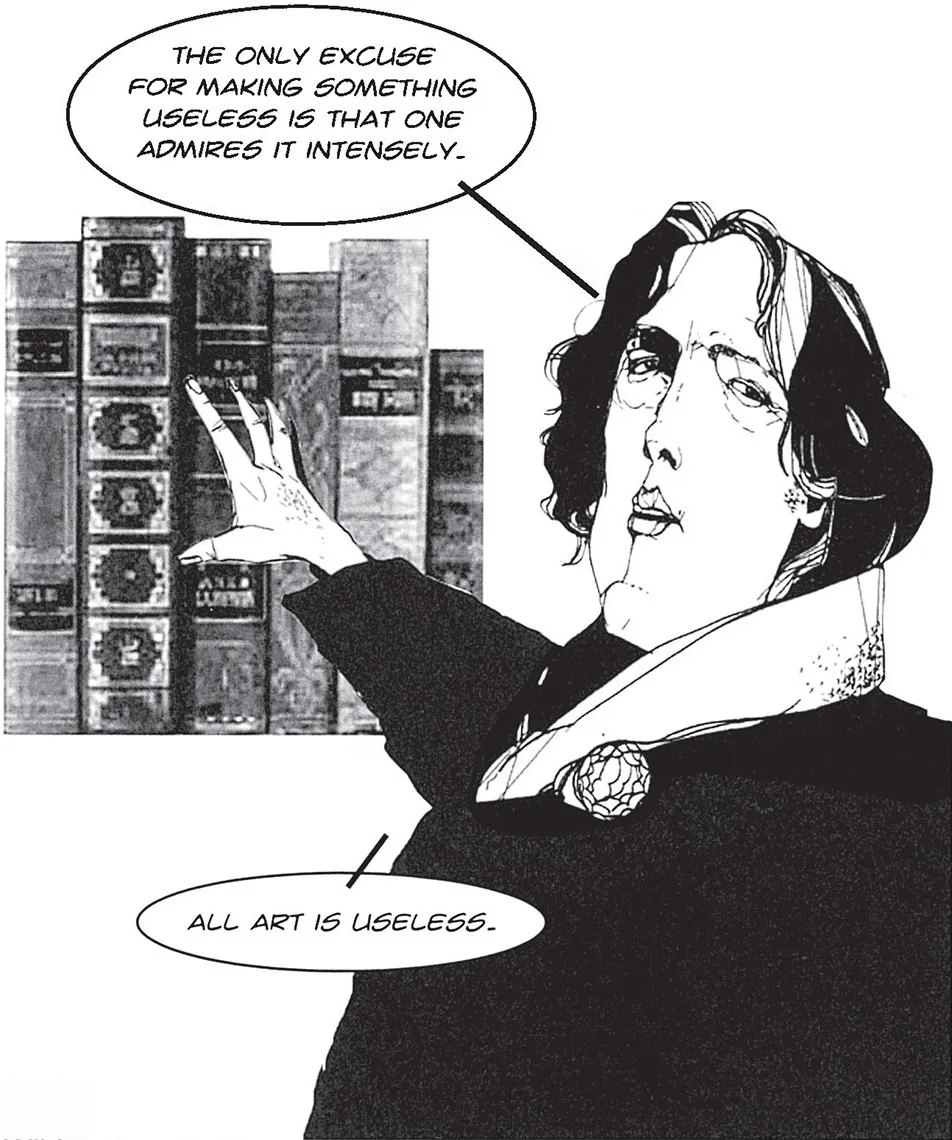
THE ONLY EXCUSE FOR MAKING SOMETHING USELESS IS THAT ONE ADMIRES IT INTENSELY. ALL ART IS USELESS.
Wilde attempted to preserve an area of aesthetic experience – the appreciation of beauty – apart from utilitarian values fostered by Capitalist economics. The tradition of philosophical aesthetics on the Continent went further than Wilde by questioning whether experience could be represented or assigned a moral value. This tradition had its origins in the 18th century.
The Nature of Experience
Following Baumgarten, aesthetics as a philosophical activity became concerned not just with the question of beauty but with the whole nature of experience in terms of perceptions, feelings and emotions. Philosophers, however, quickly realized that this inquiry opened out onto issues of subjectivity and identity and the potential for transforming values and beliefs. This is because the issue of experience relates to the question of consciousness and, by implication, the role of unconscious experience in shaping identity. So, while aesthetics began as a specialist branch of philosophy, it was actually in the right position to form the kernel for nearly all future philosophical inquiry.

THE SUBJECT OF EXPERIENCE BECAME BOUND UP WITH QUESTIONS OF POLITICS, PSYCHOANALYSIS AND ART … … AND, MORE WIDELY, WITH THE VITAL ISSUES OF MODERNITY AND POSTMODERNITY.
Prior to Baumgarten, aesthetics did not exist in name as such. Nevertheless, there existed a long-standing and important tradition in philosophy which was concerned with the meaning and significance of perception and sensory experience. This tradition stretches back to Plato and classical philosophy, in which issues of beauty and truth were first coupled together.
Socrates and Plato
It is important to bear in mind that, in the classical period, truth was associated with religious and ethical ideas. Plato’s philosophy was based on the teachings of his mentor, the itinerant philosopher Socrates (470–399 BC). In common with the rest of Greek society, Socrates held religious beliefs which were metaphysical in character. Metaphysics is a dualistic system – the gods exist in a higher transcendent realm and the world down below, inhabited by humans, is a pale imitation of it.

THERE EXISTS AN UNDERLYING, TRANSCENDENT ORDER TO THE UNIVERSE. THIS ORDER IS COMPOSED OF ETERNALLY EXISTING FORMS FROM WHICH WE DERIVE ABSOLUTE VALUES OF JUSTICE, BEAUTY AND TRUTH.
In addition, Socrates stated that these Forms contained the inherent structures to be found within all existing objects. However, he differed from the majority of Greek society by valuing wisdom and virtue in contrast to the warrior’s attributes of bravery and strength, which were thought to find favour with the gods.
Following Socrates, Plato (c. 427–347 BC) argued that philosophers, such as himself, were uniquely in possession of the correct virtue – namely, wisdom – for attaining knowledge of the higher Forms of the universe. By defying currently held views, Socrates and Plato embarked on a power struggle with the state and religious hierarchy of Athens. As a way of defining his position, Plato contrasted philosophy with both art and poetry, which he stated were immoral and untruthful.

ART AND POETRY ARE “MIMETIC”, IN OTHER WORDS, MERELY IMITATIVE. THEY PLAY UPON PEOPLE’S EMOTIONS.
On account of their dangerous influence, Plato in The Republic (c. 375 BC) banned artists and poets from his ideal state.
The Power of Poetry
The idea of poetry’s power to affect the viewer was a loaded issue in Plato’s time. Poets were believed to have access to the muses, the daughters of memory who possessed historical knowledge and insight into the gods’ motives. Furthermore, po...
Table of contents
- Cover
- Title Page
- Copyright
- Contents
- What is Aesthetics?
- Author’s Acknowledgements
- Index
Trusted by 375,005 students
Access to over 1.5 million titles for a fair monthly price.
Study more efficiently using our study tools.
Frequently asked questions
Yes, you can cancel anytime from the Subscription tab in your account settings on the Perlego website. Your subscription will stay active until the end of your current billing period. Learn how to cancel your subscription
No, books cannot be downloaded as external files, such as PDFs, for use outside of Perlego. However, you can download books within the Perlego app for offline reading on mobile or tablet. Learn how to download books offline
Perlego offers two plans: Essential and Complete
- Essential is ideal for learners and professionals who enjoy exploring a wide range of subjects. Access the Essential Library with 800,000+ trusted titles and best-sellers across business, personal growth, and the humanities. Includes unlimited reading time and Standard Read Aloud voice.
- Complete: Perfect for advanced learners and researchers needing full, unrestricted access. Unlock 1.5M+ books across hundreds of subjects, including academic and specialized titles. The Complete Plan also includes advanced features like Premium Read Aloud and Research Assistant.
We are an online textbook subscription service, where you can get access to an entire online library for less than the price of a single book per month. With over 1.5 million books across 990+ topics, we’ve got you covered! Learn about our mission
Look out for the read-aloud symbol on your next book to see if you can listen to it. The read-aloud tool reads text aloud for you, highlighting the text as it is being read. You can pause it, speed it up and slow it down. Learn more about Read Aloud
Yes! You can use the Perlego app on both iOS and Android devices to read anytime, anywhere — even offline. Perfect for commutes or when you’re on the go.
Please note we cannot support devices running on iOS 13 and Android 7 or earlier. Learn more about using the app
Please note we cannot support devices running on iOS 13 and Android 7 or earlier. Learn more about using the app
Yes, you can access Introducing Aesthetics Introducing Aesthetics by Christopher Kul-Want,Piero Pierini in PDF and/or ePUB format, as well as other popular books in Art & Art Theory & Criticism. We have over 1.5 million books available in our catalogue for you to explore.