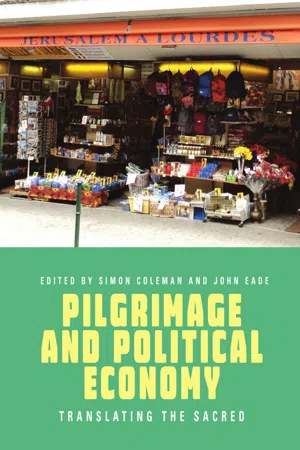
Pilgrimage has always had a tendency to follow—and sometimes create—trade routes. This volume explores how wider factors behind transnational and global mobility have impacted on pilgrimage activity across the world, and examines the ways in which pilgrimage relates to migration, diaspora, and political cooperation or conflict across nation-states. Furthermore, it brings together case studies that explore forms of mobility where pilgrimage is juxtaposed, complements, or is in intimate association with other forms of movement.
eBook - ePub
Pilgrimage and Political Economy
Translating the Sacred
- 222 pages
- English
- ePUB (mobile friendly)
- Available on iOS & Android
eBook - ePub
Pilgrimage and Political Economy
Translating the Sacred
About this book
Trusted by 375,005 students
Access to over 1.5 million titles for a fair monthly price.
Study more efficiently using our study tools.
Information
Chapter 1
From the Indian Ganges to a Mauritian Lake
Hindu Pilgrimage in a ‘Diasporic’ Context
Mathieu Claveyrolas
At first glance, ‘Hinduism in diaspora’ sounds like an oxymoron. Only in the second half of the nineteenth century did the term Hinduism first appear in a political context when anti-British Indian nationalists were eager to unify all Hindus, and to promote a reformed version of Hinduism able to compete with monotheist religions (Vertovec 2000). Hinduism was then invented as coterminous with the Indian national territory. Hindu fundamentalists have constantly argued that one could only be truly Hindu while living in India (hence the sometimes-violent campaigns against India’s Muslims and Catholics). Conversely, this meant that one could not be Hindu outside India’s sacred territory (dharmabhumi). Such an argument was all the more problematic since it was developed roughly during the same period (from 1850 to 1950) when half a million mainly Hindu Indians left India for Mauritius and settled down there quite successfully.
If India is the paramount reference for Hinduism, how can Hindu pilgrimage develop outside this country? This chapter will seek to answer this question by studying the role of Hindu pilgrimage in the Mauritian context, both as a paradigm for domesticating displacement (when Mauritian pilgrimage is built on continual references to India) and a tool to promote emplacement (when Mauritian pilgrimage echoes Indo-Mauritians’ rise to power). We will also explore the way in which this pilgrimage case study parallels the changing institutional links between Mauritius and India.
The Transnational Context of Indenture to Mauritius
Mauritius is an island in the Indian Ocean, some five hundred miles east of Madagascar. This young nation, uninhabited until the seventeenth century, is now densely populated (1.2 million inhabitants for 787 square miles). It was first briefly colonized by the Dutch (1658–1710) and then the French (1715–1810). The latter imported slaves from Africa and Madagascar but also from India, before developing a plantation society around the sugarcane industry at the turn of the nineteenth century. The British eventually took over the island in 1810 and ruled it until 1968, while the abolition of slavery in Mauritius was declared on 1 February 1835. The subsequent demand by the French sugar barons, who still controlled the booming industry, for a cheap workforce was met through indentured labour.
Indentured workers were recruited as ‘volunteers’ in British India and were brought to Mauritius to replace the former slaves, who either refused to work for their former masters or asked for decent wages. According to available estimates, from 1835 to 1907, five hundred thousand Indians were brought to Mauritius. Even if a five-year contract was signed that guaranteed a wage and free passage back to India, work and living conditions were very close to slavery, at least during the 1837–53 period (Tinker 1974).
Mauritius is often described as a ‘world centre’, given its position at the ‘crossroads of the three continents’. True enough: a quarter of the Mauritian population come from Africa and Madagascar, while two-thirds come from India and the remainder originate from France and China. Hinduism, Islam and Catholicism (but also Chinese religious traditions and various Charismatic traditions) are all practised, and you can hear Creole, English, French but also Bhojpuri and other Indian or Chinese languages fluently spoken in Mauritius. The island is often described as a ‘rainbow nation’ in tourist brochures as proof of cultural richness and general tolerance, even if these realities are more endured than accepted with enthusiasm. Indeed, the ‘world centre’ denomination matches a historical fact: Mauritius has more than anywhere else been embedded in globalized contexts. Let us mention, chronologically, the naval rivalry between the French and the British for control of the sea route to India; the slave trade and sugar monoculture meant for export; the transfer of half a million Indians between two British colonies; the current emigration of Mauritians looking for better opportunities in North America, Europe, India, South Africa or Australia; the successive development of textile manufacturing, tourism and ‘global finance’; or the newly revived links between India and its Indo-Mauritian ‘diaspora’. Globalization means far more than a catch-all, fashionable phrase from the Mauritian point of view.
In less than 150 years, the Indian indentured labourers and their descendants have experienced a remarkable collective success story, from a quasi-enslaved (or lumpen proletariat) status to national political and cultural hegemony. Let me mention a few stages of this success story.
First: demographic majority. As early as 1861, Indians accounted for two-thirds of the colony’s population and, before the end of the nineteenth century, Mauritius-born Indians outnumbered those who were born in India. Second: access to the land. Around 1880, economic difficulties led planters to sell their lands and the richest among Indian labourers (the sirdar overseers) started acquiring sugarcane plots, became small planters and soon emerged as important economic agents. Third: political power. Thanks to a new constitution and voting system established in 1948, Indians finally became a political majority. Afterwards, the only ‘fight’ for independence involved a struggle between the British and the colonized population that pitted pro-independence Indo-Mauritians (confident that the democratic majority law would ensure their political future) against anti-independence Creoles and Franco-Mauritians, who feared that Mauritius would become totally Indianized. As a matter of fact, the rainbow nation image of a harmonious multicultural society conceals the Indo-Mauritians’ hegemony and their temptation to disengage from a Mauritian identity born out of the plantation and shared with slave descendants (Claveyrolas 2012).
These emplacement processes and strategies within the country are best analysed through religious transfer. Hinduism (a religion declared by half the population in the last census) has rapidly taken root in Mauritius. This happened first in the plantation, where small popular shrines (kalimai) but also bigger temples were installed soon after the first labourers arrived (1860–80), and then at the edge of the plantations, when the first villages were set up by Indian small planters, who rapidly financed Hindu temples (1880–1920). More recently, with labourers being easily able to leave the plantation premises, Hindu celebrations (mainly village processions during calendar festivities) have grown steadily. Impossible to miss thanks to their recurrence and easily identifiable Indian characteristics, they are sometimes perceived as an aggressive claim on village public spaces that reflect a wider (national) communalist development (Claveyrolas 2010b).
The reasons behind the Indo-Mauritian communities’ success story lie first and foremost in the island’s history of sugar plantations and not back in India or in some Indian cultural genius, as is often argued locally. However, the links with India have indeed been instrumentalized by Indo-Mauritians to galvanize or legitimize their historical rise to power. One of the best-known examples of India’s influence on Mauritius is the day chosen to celebrate Mauritian national independence – 12 March – since this was the very day of Gandhi’s Salt March in India.
Early in the twentieth century, the new Indo-Mauritian elites forged links with Indian nationalists. Gandhi himself had stopped in Mauritius when sailing from South Africa to India, and met with local elites before sending his emissary, Manilal Doctor, to represent them in court and promote their empowerment. Even recent Hindu reformist movements such as the Arya Samaj, founded in India in 1875, were implanted in Mauritius at the beginning of the twentieth century, and have had a major influence on the island’s religious and political life, by promoting religious reform and a revival of Indian-ness. Anouck Carsignol’s study of the Indian diaspora perfectly illustrates how the indentured labourers or their descendants were a major lever for the nationalist movement in India. It was a matter of solidarity between colonized victims of the British, forged through the ability of indentured labourers to focus nationalist protest on behalf of those who were being abandoned and ill-treated.
Some of the influential political individuals among the Indo-Mauritians were born in India (Manilal or Gandhi), while others were from Mauritius (the Bisoondoyal brothers – Basdeo Bisoondoyal having been influenced by a trip to India), and some (like Ramgoolam, the ‘father of Independence’) met Indian elites while studying in London. Besides individuals, Indian institutions, whether religious such as the Arya Samaj reformists or political such as the young Indian Congress Party, were deeply invested in the Mauritian situation. When the centenary of indenture was celebrated in 1935, for instance, members of Indian elites helped their Indo-Mauritian counterparts to organize a staging of their history that culminated in the erection of an obelisk in the courtyard of the Mauritian Arya Samaj building commemorating, according to the written text, the first hundred years of ‘Indian colonization’ (Carsignol 2011: 211ff.).
Yet relations between India and Mauritius loosened during the following decades (1950–70). On the one hand, Indo-Mauritians had to secure their place on the island and prove their loyalty towards this new nation they were going to rule. On the other hand, Nehru, who became Prime Minister in a recently independent India, did not want to interfere in the fate of emerging nations or abandon his vision of India as a nation-state defined by a territory that excluded Mauritius. Note that Indian nationalists also tended to criticize indentured workers as ‘traitors’ since they left when the country most needed them (Carsignol 2011: 65ff.).
Only in the 1990s did the links with India flourish again, culturally, politically and economically. This was mainly the result of a reciprocal instrumentalization: India was discovering again and enhancing the assets of its worldwide diaspora (in terms of financial flows and of diplomatic ‘soft power’), while Indo-Mauritians strengthened their political legitimacy and their perception of belonging to a civilization made all the more prestigious through its emergence as a worldwide political and economic power (Carsignol 2011: 203ff).
From the 1990s we also note an ever-growing institutionalization of Mauritian Hinduism (Claveyrolas 2014). All over the island, Hindu temples were built or renovated, according to an ‘orthodox’ Indian model. This Indianization of local Hinduism was monitored by national temple federations, which called for a Sanskritization of temples and practices that sharply contrasted with popular non-institutionalized Hinduism linked to the plantations. These federations, financed by the Mauritian secular state as ‘socio-cultural associations’, have brought priests, architects and craftsmen from India in order to counter or ‘correct’ local forms of Hinduism. Even the ritual statues installed in these renovated temples are now made in India and contrast with the stones ‘discovered’ or ritually installed in plantation temples. Temple federations are also powerful political actors, promoting an Indian-ness that often encourages communalism. They have become more and more concerned with political issues outside the country, such as the Ayodhya affair in 1989 when they joined the Hindutva1 worldwide campaign to send consecrated bricks to India to rebuild god Rama’s temple, supposedly destroyed and replaced by a mosque (Eisenlohr 2006: 36). Furthermore, South Indian Mauritian Tamil authorities have regularly protested against the ‘genocide’ of Tamils in Sri Lanka, forcing the Mauritian government to boycott official meetings held in that country. On a general level, the institutionalization of Indian links has been promoted by Mauritian para-governmental organizations (temple federations, the Hindu House, the Voice of Hindus) in support of the Hindutva agenda as ‘provider of [nationalistic] values for overseas Hindus’ (ibid.: 37).
The Political Economy of the Indenture Journey: From Trauma to Pilgrimage
Given India’s standing as the true home of Hinduism, the Indian Ocean came to symbolize a space where Indian roots were severed or transferred. Once in Mauritius, Hindu labourers built their own sacred places that were deeply rooted in local plantation structures. Finally, during the twentieth century when the descendants of these labourers progressively left the plantations, Hindu communities began to claim the entire Mauritian national territory, most of all through an ever-growing network of sacred places and religious circulations.
In the globalized, transnational context of Mauritius, the concept of territory is far from obsolete. Indeed, I will argue, along with Gupta and Ferguson (1997: 3–4), that mass migrations and transnational cultural networks oblige the anthropologist to explore ‘place-making’ and ‘people-making’ processes. In other words, Mauritius, as a territory and nation born out of migrations and typical of a globalized world, urges us to study both displacement and emplacement processes.
Religion (its loss, transfer and reconstruction) has played a major part in the Indian indentured experience, just as in most other migratory trajectories (Bava and Capone 2010). As so often, analysis hesitates between the creation, via religion, of hybrid identities, and the reaffirmation or hardening of identities perceived as authentic (Claveyrolas 2010b). In the Mauritian context, the stakes are particularly high. Indeed, within the young nation, which only became independent in 1968, there is still a precarious balance between different communities whose identities are strongly associated with particular religions. Moreover, the Mauritian communities that originated from Indian indentured migrants are not a diasporic minority dependent on their country of origin but a majority community that has been in charge of the concrete and symbolic construction of the Mauritian nation. Given this hegemony, the temptation to focus on a ‘pure’ identity rooting the Indo-Mauritian community in a distant India is very conflictual (Claveyrolas 2012).
Before turning to a case study of a Mauritian Hindu pilgrimage, it is important to note the importance and characteristics of the local reference for mobility, i.e. the original displacement of indentured labourers. Such a detour is all the more necessary since we will see that quasi-coerced labour migration can be reformulated into an ideal frame shared with pilgrimage mobility.
In a famous quote, William Crooke (1897) describes the Hindus as having no ‘migratory instinct’. While pilgrimage has been widely acknowledged as part of the Hindu tradition for centuries, analysing the general context of mobility and migration among Hindus remains hindered by the cliché that Crooke’s comment illustrates. On the contrary, those who became indentured labourers must be seen as constituting a workforce in a rapidly changing world. They were certainly not living in harmonious self-sufficient villages that were suddenly confronted with strange, entirely new worlds full of violence and alienation. Such an image of an India made of static villages hides a profusion of circulations, whether religious or economic, that has been the rule from at least the beginnings of the colonial period (Markovitz, Pouchepadass and Subrahmaniam 2003).
Let us take the example of the Bhojpuri world from which most of the Mauritian indentured labourers originated. It is specifically renowned for its migratory traditions which, well before indenture, encouraged Bhojpuri merchants, soldiers and agricultural labourers to leave their homeland. Their travel along rivers and across oceans, initially as far as Nepal and Burma (Myanmar), resulted in popular traditions, such as song repertoires, often focusing on exile (Servan-Schreiber 2001, 2010). In fact, the so-called inability of Hindus to travel and the taboos linked with leaving India and crossing the ocean only concerned orthodox high castes, which were very poorly represented among indentured labourers. As a consequence, the debates regarding indenture would benefit by digressing from displacement issues and focusing on emplacement issues in the ‘host society’.
In Mauritius, as in most societies based on slavery, the ocean is closely related with the original trauma of the crossing that followed the uprooting. Many narratives draw on the comparison between indenture and slavery. Crossing the Indian Ocean can get close to the slaves’ Middle Passage experience in Mauritian literature. It can also be embedded in competing victimization strategies between contemporary communities of the descendants of slaves and indentured labourers.
Yet, among the Indo-Mauritian elites, many promoted a break away from the history of slavery. The Mauritian historian Hazareesingh, who was involved in the Mauritian independence movement, for instance, insisted on a vision of indenture that radically promoted Indian culture. According to this reading, rightfully tagged as ‘revisionist’ by Marina Carter (1995: 6), poverty could never have sufficed to explain the decision to leave India. Only the desire to bring to distant lands ‘India’s message and the light of its culture’ (Hazareesingh 1973: 21) could help a ‘true’ understanding of indenture.
Indeed, like the ‘colonization’ associated with the process of indenture migration, the displacement from India has gradually come to be seen as a glorious process of emplacement in Mauritius. One of the most obvious demonstrations of this reversal is the date generally (not only in Mauritius) associated with indenture: whereas 1 February commemorates the abolition of slavery, 2 November celebrates the arrival of the first indentured pioneers.
In parallel with the Middle Passage of African slavery, the crossing of the Indian Ocean can also draw on specifically Hindu paradigms, such as the kala pani (dark waters) taboo, that added a cultural trauma to the harsh conditions of the experience. Catherine Clémentin-Ojha (2016) precisely explains what is at stake behind the idea of kala pani, and what the crossing involved, at least for nineteenth-century orthodox Hindus. In her novel about indenture, Les Rochers de Poudre d’Or, Nathacha Appanah (2003) also describes the tearing apart of Hindu cultural markers on the boat, where socializing is not only forced (separation, suffering, humiliation) but also transgressive vis-à-vis Hindu ideology. Piled into the boat and cut off from village society that was organized according to Hindu ritual purity requirements (endogamy, avoidance of contact and commensality), the indentured labourer was directly exposed to a dangerous anonymity incompatible with caste identity.
Even if it seems highly doubtful that lower (or even middle) caste indentured labourers ever shared the taboo against crossing the kala pani, the Mauritian literature constantly us...
Table of contents
- Cover
- Title Page
- Copyright Page
- Contents
- Illustrations
- Introduction - Pilgrimage and Political Economy: Introduction to a Research Agenda
- Chapter 1 - From the Indian Ganges to a Mauritian Lake: Hindu Pilgrimage in a ‘Diasporic’ Context
- Chapter 2 - Transnational Courting through Shakyamuni Buddha: Japanese Pilgrimage and Geographical Dowries in North India
- Chapter 3 - Sufism and the Pilgrimage Market: A Political Economy of a Shrine in Southern Pakistan
- Chapter 4 - Allah Always Hears the Prayers of a Traveller: Nationalized Shrines and Transnational Imaginaries in Bukhara
- Chapter 5 - ‘Pilgrimage Capital’ and Bosnian Croat Pilgrimage Places: Bosnian Croat Pilgrimages and Transnational Ties through Time and Space
- Chapter 6 - Translating Catholic Pilgrimage Sites into Energy Grammar: Contested Spiritual Practices in Chartres and Vézelay
- Chapter 7 - A Pentecostal Shrine in Mexico: Ethnography of Migration and Pilgrimage
- Chapter 8 - The Paths of Saint James in Brazil: Body, Spirituality and Market
- Afterword - Going beyond the Elusive Nature of Pilgrimage
- Index
Frequently asked questions
Yes, you can cancel anytime from the Subscription tab in your account settings on the Perlego website. Your subscription will stay active until the end of your current billing period. Learn how to cancel your subscription
No, books cannot be downloaded as external files, such as PDFs, for use outside of Perlego. However, you can download books within the Perlego app for offline reading on mobile or tablet. Learn how to download books offline
Perlego offers two plans: Essential and Complete
- Essential is ideal for learners and professionals who enjoy exploring a wide range of subjects. Access the Essential Library with 800,000+ trusted titles and best-sellers across business, personal growth, and the humanities. Includes unlimited reading time and Standard Read Aloud voice.
- Complete: Perfect for advanced learners and researchers needing full, unrestricted access. Unlock 1.5M+ books across hundreds of subjects, including academic and specialized titles. The Complete Plan also includes advanced features like Premium Read Aloud and Research Assistant.
We are an online textbook subscription service, where you can get access to an entire online library for less than the price of a single book per month. With over 1.5 million books across 990+ topics, we’ve got you covered! Learn about our mission
Look out for the read-aloud symbol on your next book to see if you can listen to it. The read-aloud tool reads text aloud for you, highlighting the text as it is being read. You can pause it, speed it up and slow it down. Learn more about Read Aloud
Yes! You can use the Perlego app on both iOS and Android devices to read anytime, anywhere — even offline. Perfect for commutes or when you’re on the go.
Please note we cannot support devices running on iOS 13 and Android 7 or earlier. Learn more about using the app
Please note we cannot support devices running on iOS 13 and Android 7 or earlier. Learn more about using the app
Yes, you can access Pilgrimage and Political Economy by Simon Coleman, John Eade, Simon Coleman,John Eade in PDF and/or ePUB format, as well as other popular books in Social Sciences & Religion. We have over 1.5 million books available in our catalogue for you to explore.