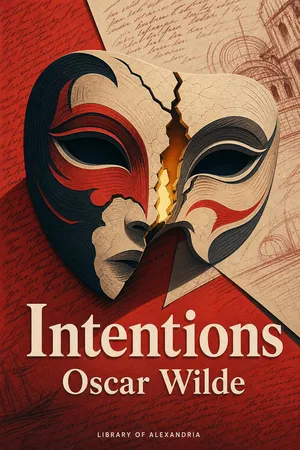
Does art imitate life-or does life learn how to look from art? Oscar Wilde makes the question both a provocation and a pleasure.
Published in 1891, Intentions brings together four essays that turn familiar assumptions about beauty, truth, and criticism upside down. In The Decay of Lying and The Critic as Artist, Wilde uses dialogue, wit, and paradox to argue for the independence of art and the imaginative power of the critic. Rather than treating a painting, poem, or play as a simple mirror of reality, he asks what artistic invention allows us to see.
The collection also includes Pen, Pencil and Poison, a study of the writer, artist, and poisoner Thomas Griffiths Wainewright, and The Truth of Masks, an exploration of costume and theatrical illusion in Shakespeare. Together, these pieces reveal the range of Wilde's aesthetic thought: his resistance to reducing art to moral instruction, his delight in artifice, and his conviction that interpretation can itself be creative. His arguments remain engaging because they challenge readers to examine their own habits of judgment rather than merely accept his.
What readers find inside:
- Creative criticism - The critic emerges as an imaginative participant in art, not simply a judge of its merits.
- Life and illusion - Wilde questions realism and celebrates invention as a source of artistic vitality.
- Beauty and morality - The essays test the boundaries between aesthetic judgment and ethical expectation.
- An unsettling portrait - Wainewright's artistic pursuits and criminal reputation complicate the relationship between a life and its work.
- Theatrical artifice - Shakespearean costume becomes a way to consider historical detail, stagecraft, and dramatic effect.
For readers of literary essays, students of aesthetics, and artists curious about the purpose of criticism, Intentions offers a lively encounter with ideas that still shape how we discuss culture.
Begin with Wilde's questions, and discover how much there is to reconsider in the act of looking.