An eye-opening and essential tour of the vanishing world What if Atlantis wasn't a myth, but an early precursor to a new age of great flooding? Across the globe, scientists and civilians alike are noticing rapidly rising sea levels, and higher and higher tides pushing more water directly into the places we live, from our most vibrant, historic cities to our last remaining traditional coastal villages. With each crack in the great ice sheets of the Arctic and Antarctica, and each tick upwards of Earth's thermometer, we are moving closer to the brink of broad disaster.By century's end, hundreds of millions of people will be retreating from the world's shores as our coasts become inundated and our landscapes transformed. From island nations to the world's major cities, coastal regions will disappear. Engineering projects to hold back the water are bold and may buy some time. Yet despite international efforts and tireless research, there is no permanent solution-no barriers to erect or walls to build-that will protect us in the end from the drowning of the world as we know it. The Water Will Come is the definitive account of the coming water, why and how this will happen, and what it will all mean. As he travels across twelve countries and reports from the front lines, acclaimed journalist Jeff Goodell employs fact, science, and first-person, on-the-ground journalism to show vivid scenes from what already is becoming a water world.Jeff Goodell is a contributing editor for Rolling Stone and a frequent contributor to the New York Times Magazine. He is the author of the New York Times bestseller Our Story: 77 Hours That Tested Our Friendship and Our Faith. Goodell's memoir, Sunnyvale: The Rise and Fall of a Silicon Valley Family, was a New York Times Notable Book. The New York Times called his most recent book, Big Coal, "a compelling indictment of one of the country's biggest, most powerful and most antiquated industries... well-written, timely, and powerful."
eBook - ePub
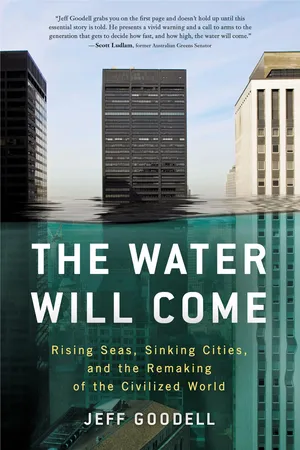
The Water Will Come
Rising Seas, Sinking Cities, and the Remaking of the Civilized World
- 352 pages
- English
- ePUB (mobile friendly)
- Available on iOS & Android
eBook - ePub
The Water Will Come
Rising Seas, Sinking Cities, and the Remaking of the Civilized World
About this book
Information
1. THE OLDEST STORY EVER TOLD
_______________
THE R/V KNORR was a storied ship in the annals of science, known for its ability to take a pounding in rough seas and its unusual arrangement of propellers in the bow and stern that made it highly maneuverable. Scientists had used the Knorr, a 244-foot steel-hulled research vessel that was operated by Woods Hole Oceanographic Institution, for thousands of research expeditions around the world, including one that led to the discovery of the wreck of the RMS Titanic. A few years ago, I spent a month aboard the Knorr. On my trip, we were looking for nothing more glamorous than good, thick mud on the floor of the North Atlantic. By drilling cores in the mud and analyzing the shells of creatures buried within it, researchers can better understand past ocean temperature and salinity, which are important as scientists attempt to reconstruct the history of the Earth’s climate.
Most of our time was spent cruising around the Bermuda Rise, a cluster of extinct underwater volcanos near Bermuda, pausing to take core samples of the mud whenever the conditions looked good. At one point, we were about a hundred miles off the coast of New York City when we drifted over a place known to scientists as the Hudson Canyon, which is where the Hudson River used to drop over the continental shelf twenty thousand years ago when seas were lower. From the ship, a device called an acoustic echo machine painted colorful real-time images of the canyon as we passed over it. It was a remarkable sight: you could see where the Hudson had cut a path through the shelf, creating terraces and high walls. The canyon extends over 450 miles across the shelf, eventually reaching a depth of over 10,000 feet. “It’s bigger than the Grand Canyon,” Lloyd Keigwin, the chief scientist on the trip, told me as I looked down in wonder.
Twenty thousand years ago, near the peak of the last ice age, the world was a very different place than it is today. Temperatures were about seven degrees Fahrenheit cooler and the climate was, in most places, drier. In North America, all the ice-age creatures we know and love from Ice Age, the movie — mammoths, sloths, saber-toothed tigers — roamed through the plains and forests. In the West, you could walk from what’s now San Francisco to the Farallon Islands. The Laurentide ice sheet, thousands of feet thick in places, covered most of Canada and the Upper Midwest and spread along the East Coast all the way to New York City. In Europe, it was dry land from London to Paris, and up north, from Scotland all the way over to Sweden. In Asia, you could walk from Thailand to Indonesia, and then take a boat down to Australia.
And people did. One wave of migration, as every American kid learns in middle school, brought humans across the land bridge between Asia and North America, thus laying the groundwork for the birth of Hollywood, Silicon Valley, and Ben & Jerry’s ice cream. Exactly why and when human beings made the trip across the land bridge in the first place is much debated. Until recently, the best guess for the date of the arrival of humans in North America was 13,200 years ago. Many anthropologists believed it couldn’t have been much earlier than that because although the land bridge was open, much of North America was covered in an ice sheet until then, making it virtually impossible for even the most intrepid early explorers to travel down into the interior of the continent.
But that narrative has been challenged. In 2012, Jessi Halligan, a young anthropologist at Florida State University, led a team of divers to explore the Aucilla River about seventy-five miles from Tallahassee. The Aucilla is a slow, dark, mysterious river that winds across northern Florida’s limestone plateau toward the Gulf of Mexico. Earlier archaeologists had pulled up boatloads of bison bones, saber-toothed tiger bones, and mastodon bones and tusks, some with markings that looked like humans could have made them. During the ice age, the sea had met the land a hundred miles farther out, and the area where the Aucilla now flows was high savannah. Springwater bubbled and pooled in the limestone, creating watering holes where animals gathered to drink. As the seas rose and the water backed up, these watering holes filled with sediment, covering and preserving the bones of the animals that had died along the waterholes.
In May of 2013, Halligan’s team made one of those scientific finds that change the way we view the world. In a sinkhole in the river, surrounded by mastodon dung, they found a two-faced knife that could only have been made by humans. More important, Halligan was able to precisely carbon-date the knife to 14,500 years ago.
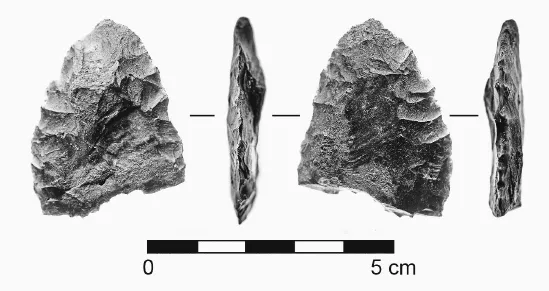
14,500-year-old knife found in Florida’s Aucilla River. (Photo courtesy of the Center for the Study of the First Americans, Texas A&M University)
That finding is important in a number of ways. First, it is indisputable proof that humans were hanging around in Florida a thousand years earlier than had been previously understood. There was other evidence that humans had been in North America earlier, including artifacts at archaeological sites in places as far-flung as Oregon and Chile, but none were as solid as this one. Second, it suggests that these early immigrants were more creative and resourceful than researchers had previously understood. “We know that until about twelve thousand, six hundred years ago, the route from Alaska down to the interior of the continent was blocked by ice,” said Halligan. “The only way people could have gotten from Asia to this spot in Florida fourteen thousand, five hundred years ago that doesn’t involve time travel or teleporting is if they came by boat.” Halligan suggested they might have come down the West Coast, perhaps to Central America, then across the Gulf to Florida. If this is true, then these Paleolithic hunter-gatherers were building boats, understanding currents, navigating coastlines, and storing food and water. Of course, looking for evidence of this path down the coast is nearly impossible — many artifacts and campsites are now under three hundred feet or so of Pacific Ocean.
What is most important about this discovery — at least for the purposes of this book — is that the date of the double-sided knife corresponds with the sudden disintegration of the ice sheets at the end of the last ice age.
Scientists refer to the event as Meltwater Pulse 1A. It occurred just as the Earth was warming at the end of the last ice age. In coral reefs and other geologic sites around the world, scientists have seen that in the space of about 350 years, starting 14,500 years ago, the oceans began rising at a dramatic rate — more than a foot per decade. They know that this kind of sudden rise could only come from the collapse of a very big chunk of ice; the most likely candidates are the Laurentide ice sheet that covered North America and the glaciers of Antarctica. Scientists don’t know the mechanism for the collapse, whether it was the sudden breaking of a giant ice dam in North America that was holding back meltwater from the Laurentide, or warm ocean water getting up under the ice sheets of West Antarctica. But the geological evidence for the event itself is indisputable. It happened.
Due to the flat topography of coastal Florida, the rising seas would have been particularly dramatic to anyone living there. Halligan estimates that the seas moved inland at a rate of five hundred to six hundred feet a year. That’s a mile of coastline lost per decade — fast enough that you could almost watch the water come in while you gutted fish on the beach.
Halligan doubts that sea-level rise was the reason people abandoned the watering hole, since evidence so far suggests that the butchery at the site occurred over a very short period (they left no written accounts, which isn’t surprising, since writing hadn’t been invented yet). But whatever happened, it’s clear that rising seas were radically reshaping the world they lived in. And they weren’t the only ones who were dealing with it. At the time of Meltwater Pulse 1A, there were about three million people living on the Earth — nearly the population of Los Angeles today. They were living in small groups, making tools, hunting game, taking baby steps on the long ladder to modern life. What did they think about? What did they fear? Researchers can only make inferences from campsites, tools, and stray artifacts.
The most revealing clues, however, may come from the stories they left behind.
Nicholas Reid is an Australian linguist who studies the dying languages of Australian aborigines. Back in the 1970s, during his undergraduate days, he read a book called A Grammar of Yidiɲ, about a nearly extinct aboriginal language spoken in northern Australia. For years, one particular sentence in the book stuck with him: “It is, however, worth noting that a theme running through all the coastal Yidinji myths is that the coastline was once where the barrier reef now stands (as in fact it was some 10,000 years ago), but the sea then rose and the shore retreated to its current position.” The idea lingered with Reid over the years. Was it possible that a ten-thousand-year-old event such as sea-level rise could be the basis for aboriginal myths?
In 2014, Reid mentioned the idea to a colleague, Patrick Nunn, a marine geologist who had studied sea-level rise in the Pacific. Nunn suggested that if the specifics in the myths were clear enough and detailed enough, they could be corroborated with geological data, allowing him and Reid to essentially date the origins of the myths.
Aboriginal societies have existed in Australia for around sixty-five thousand years, isolated until the European colonization of the continent in 1788. Australia was undoubtedly a hard environment to live in, and survival through the generations depended on passing down information about food, the landscape, and the climate. But that didn’t necessarily mean the stories the Aboriginals told were, after thousands of years of retelling, in any sense “precise.”
“It had long been assumed by linguists that the oldest oral stories are eight hundred years old — after that, any specific references in the stories are lost,” Reid explained to me. “How could a story be told accurately, over and over again, for ten thousand years?”
Still, it was a fascinating possibility. Reid began reading aboriginal myths, many of them collected in the late nineteenth and early twentieth centuries by Western researchers. Without trying too hard, he found twenty-one examples of stories about sea-level rise. Each one was different, but they seemed to be chronicling a time when the sea was rising and the people who lived on the coasts and the islands were grappling with how to deal with it. In regions of Australia where the coastal land had a low topography, even a small rise in sea level would have claimed large chunks of land relatively quickly. “People must have been aware that every year the sea was getting higher,” Reid said. “And they must have had stories from their fathers and grandfathers, and great-grandfathers, that the sea used to be out even further.”
Here is one example:
In the beginning, as far back as we remember, our home islands were not islands at all as they are today. They were part of a peninsula that jutted out from the mainland and we roamed freely throughout the land without having to get in a boat like we do today. Then Garnguur, the seagull woman, took her raft and dragged it back and forth across the neck of the peninsula, letting the sea pour in and making our homes into islands.
This story is about the origin of the Wellesley Islands off the northern coast of Australia, and it parallels other stories from other parts of Australia. Along the south coast, stories written down early in colonial times told about when these areas were dry, a time when people hunted kangaroo and emu there, before the water rose and flooded them, never again to recede.
“There are numerous Aboriginal stories from this area about a time when the shoreline was further out ‘where the barrier reef now stands,’ ” Reid told me. According to one of the stories, the barrier reef was the original coast at a time when a man called Gunya was living there. Gunya consumed a customarily forbidden fish, which made the gods angry. To punish him, they caused the sea to rise in order to drown him and his family. “He evaded this fate by fleeing to the hills but the sea never returned to its original limits,” Reid said.
Another story collected from the Yidinji people of the Cairns area — now a coastal town that is a frequent jumping-off point for expeditions to the Great Barrier Reef — recalls a time when Fitzroy Island, which is now a mile or so off the coast, was part of the mainland. The story describes several named landmarks with remembered historical-cultural associations that are now underwater. According to Nunn and Reid, based on the details in the story, researchers can be almost certain that the people of this area occupied the coast “where the Great Barrier Reef now stands” during the last ice age, when it was a broad floodplain with undulating hills, bordered by steep cliffs — which are now islands like Fitzroy.
“Our expectation originally was that the sea level must have been creeping up very slowly and not been noticeable in an individual’s lifetime,” Reid told me. “But we’ve come to realize through conducting this research that Australia must in fact have been abuzz with news about this. There must have been constant inland movement, reestablishing relationships with the country, negotiating with inland neighbors about encroaching onto their territory. There would have been massive ramifications of this.”
Still, the idea that these stories were a chronicling of actual events was remarkable. “If you are talking about ten thousand years, you are really talking about three hundred to four hundred generations,” Reid said. “The idea that you can transmit anything over four hundred generations is extraordinary.” But Reid believes a key feature of Australian Aboriginal storytelling culture — a “cross-generational cross-checking” process — could explain the stories’ endurance through the millennia. In this process, a father will pass down the story to his sons — and the son’s nephews and nieces will be responsible for ensuring that their uncle knows those stories correctly.
These stories, of course, tell us nothing about what these aboriginal tribes thought or felt about the seas rising around them. But they do capture how deeply significant and strange this experience must have been, how inexplicable.
* * *
The best-known flood story in the Western world, of course, is Noah’s. In the Old Testament, the story is told of how Noah builds an ark and loads all the animals into it so they can survive the flood that God sends to cleanse the Earth. In God’s view, there is just too much corruption and debauchery going on in his lovingly created paradise, and he has to do something about it. It’s a powerful story of sin and redemption, but it’s not original to the Old Testament. Most Biblical scholars believe that the story of Noah is based on an even earlier flood story in The Epic of Gilgamesh, which is the tale of the adventures of a Mesopotamian king that was written two thousand years before the Bible.
There is nothing in the Bible itself — or in Gilgamesh — that suggests these stories have anything to do with sea-level rise ten thousand years ago — or any other time. In both cases, the flood is caused by epic rains.
But two scholars think it’s more complex than that. William Ryan and Walter Pitman, both geologists at Columbia University, argue that Gilgamesh, as well as the later Noah flood story, are based on a real event that occurred in the Black Sea about seven thousand years ago, when the seas were still rising at the end of the last ice age. At the time, the Black Sea was an isolated freshwater lake, cut off from the Mediterranean Sea by a high, narrow strip of land in what is now Turkey. Small groups of people lived on the fertile land around it, fishing from small boats and experimenting with growing crops for food.
As the ice melted, the Mediterranean rose higher and higher, and by about 5600 BCE, it had risen to a point where it was 500 feet above the Black Sea. Then the strip of land between them collapsed, and the seawater flowed o...
Table of contents
- Cover Page
- Praise for The Water Will Come
- Also by Jeff Goodell
- Title Page
- Copyright
- Dedication
- Contents
- Prologue: Atlantis
- 1. The Oldest Story Ever Told
- 2. Living with Noah
- 3. New Climate Land
- 4. Air Force One
- 5. Real Estate Roulette
- 6. The Ferrari on the Seafloor
- 7. Walled Cities
- 8. Island States
- 9. Weapon of Mass Destruction
- 10. Climate Apartheid
- 11. Miami Is Drowning
- 12. The Long Goodbye
- Epilogue: Condo Diving
- Acknowledgments
- Notes
- Selected Bibliography
- Index
- Back Cover
Trusted by 375,005 students
Access to over 1.5 million titles for a fair monthly price.
Study more efficiently using our study tools.
Frequently asked questions
Yes, you can cancel anytime from the Subscription tab in your account settings on the Perlego website. Your subscription will stay active until the end of your current billing period. Learn how to cancel your subscription
No, books cannot be downloaded as external files, such as PDFs, for use outside of Perlego. However, you can download books within the Perlego app for offline reading on mobile or tablet. Learn how to download books offline
Perlego offers two plans: Essential and Complete
- Essential is ideal for learners and professionals who enjoy exploring a wide range of subjects. Access the Essential Library with 800,000+ trusted titles and best-sellers across business, personal growth, and the humanities. Includes unlimited reading time and Standard Read Aloud voice.
- Complete: Perfect for advanced learners and researchers needing full, unrestricted access. Unlock 1.5M+ books across hundreds of subjects, including academic and specialized titles. The Complete Plan also includes advanced features like Premium Read Aloud and Research Assistant.
We are an online textbook subscription service, where you can get access to an entire online library for less than the price of a single book per month. With over 1.5 million books across 990+ topics, we’ve got you covered! Learn about our mission
Look out for the read-aloud symbol on your next book to see if you can listen to it. The read-aloud tool reads text aloud for you, highlighting the text as it is being read. You can pause it, speed it up and slow it down. Learn more about Read Aloud
Yes! You can use the Perlego app on both iOS and Android devices to read anytime, anywhere — even offline. Perfect for commutes or when you’re on the go.
Please note we cannot support devices running on iOS 13 and Android 7 or earlier. Learn more about using the app
Please note we cannot support devices running on iOS 13 and Android 7 or earlier. Learn more about using the app
Yes, you can access The Water Will Come by Jeff Goodell in PDF and/or ePUB format, as well as other popular books in Biological Sciences & Global Warming & Climate Change. We have over 1.5 million books available in our catalogue for you to explore.