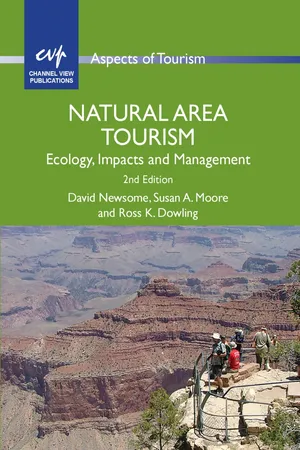
Natural Area Tourism provides a comprehensive description of tourism in natural areas allowing readers to understand the scope of, complexities arising from, and possibilities of undertaking successful tourism developments in natural areas. Furthermore, the second edition contains an overview of recent developments, such as mountain biking, adventure activities in protected areas and geotourism. There is new content and examples from the Asian region on managing the tourism industry and management effectiveness. The book also considers important new developments in monitoring, such as remote sensing and the use of GIS, as well as the use of electronic educational resources in delivering interpretation. Attention is given to the implications of climate change, inadequate protected area security and the ever-increasing influence of the landscape matrix. Moreover, the second edition includes a comprehensive review of the new literature that has emerged since the publication of the first edition more than a decade ago. Accordingly this book will remain an invaluable resource and account of natural area tourism for many years to come.
eBook - ePub
Natural Area Tourism
Ecology, Impacts and Management
- 504 pages
- English
- ePUB (mobile friendly)
- Available on iOS & Android
eBook - ePub
About this book
Information
1 Introduction
Tourism and the Natural Environment
Natural areas have always attracted people. A visitor writing in a guest book at a destination run by Conservation Corps Africa (CC Africa, now named &Beyond Africa) stated:
My journey to Africa has been the odyssey of a lifetime. I have crossed great, beautiful landscapes and stood on, what seemed to me, the edge of the world as I knew it … and seen my heart soar into its ancient sky, somehow humbler than I have ever felt. Somehow part of eternity. (CC Africa, nd)
This quote from a guest, evokes a feeling that many people share: the desire to see, touch, feel and connect with, and be inspired by, natural areas. The tourist visiting such areas is often passionate about the conservation of natural areas and the people and wildlife who inhabit these regions. A growing number of such tourists are seeking authentic, inspiring, transformational experiences in nature as they search for a greater sense of self and connection to planet Earth. This search for natural experiences is taking place around the planet, whether it is seeking solitude in the wilderness of the Antarctic, observing the migration of hundreds of thousands of herbivores cross the Serengeti in Tanzania into the Masai Mara in Kenya, or seeing the Iguazu Falls separating the Brazilian state of Paraná and the Argentine province of Misiones. All such experiences evoke powerful connections with nature and this is the essence of natural area tourism.
The United Nations World Tourism Organization (UNWTO) estimated that, in 2011, there were 990 million international tourist arrivals and tourism receipts generated US$1030 billion (UNWTO, 2012a). This represented a rise of 4.7% in tourist numbers over the previous year. According to the UNWTO, tourism has experienced continued expansion and diversification over the past six decades, becoming one of the largest and fastest-growing economic sectors in the world. The number of tourists grew from 25 million in 1950 to 277 million in 1980, 435 million in 1990, 675 million in 2000, to 990 million in 2011. A number of new destinations have emerged alongside the traditional ones of Europe and North America and in the world’s emerging tourist regions the share in international tourist arrivals grew from 31% in 1990 to 47% in 2010.
Following the global financial crisis and economic recession of 2008–09, worldwide tourism recovered remarkably quickly. While the advanced economies had an average annual growth in international tourist arrivals of 1.8% for the period 2000–10, the world’s emerging economies had a growth of 5.6%, with the Middle East (14%) and Asia and the Pacific (13%) UNWTO regions being the strongest growing (UNWTO, 2011). Overall, the fastest-growing region for international tourism was North East Asia, with growth in Japan and Taiwan being 27%. According to the UNWTO’s Tourism 2020 Vision project, international arrivals are expected to reach 1.6 billion by the year 2020, with the fastest-growing regions predicted to be East Asia, the Pacific, South Asia, the Middle East and Africa (UNWTO, 2010).
The key tourist attractors possessed by many of these emerging economies are natural areas, and tourism to them is booming. It has been estimated that nature tourism has risen from approximately 2% of all tourism in the late 1980s (Ecotourism Society, 1998; Weaver & Oppermann, 2000) to approximately 20% today (Buckley, 2009). Thus, natural area tourism is undergoing explosive growth and, as such, it has the capability to change both natural areas as well as tourism itself. In this book we explore this phenomenon from the standpoint that natural area tourism can be beneficial to individuals, regions and countries – provided it is planned, developed and managed in a responsible manner.
The growing interest in conservation and the wellbeing of our environment over the last two decades has moved far beyond the realms of a concerned few and into the wider public arena. At the same time there has been a corresponding upsurge in tourism all over the world, leading to the phenomenon referred to as ‘mass tourism’. With this unparalleled growth of the two it was inevitable that one day they would meet and interact. In natural areas, where tourism either already exists or is proposed, there is the potential for both beneficial and adverse environmental and socio-cultural impacts. Thus, there are two streams of thought regarding the environment–tourism relationship. The first is that the natural environment is harmed by tourism and hence the two are viewed as being in conflict. The second is that the two have the potential to work together in a symbiotic manner.
The environment–tourism relationship has been the subject of debate for the last three decades. The International Union for the Conservation of Nature and Natural Resources (IUCN; now known as the World Conservation Union) first raised the nature of the relationship when its director general posed the question in a paper entitled ‘Tourism and environmental conservation: Conflict, coexistence, or symbiosis?’ (Budowski, 1976). Thirteen years later the question appeared to remain unanswered when Romeril (1989a) posited the question ‘Tourism and the environment – accord or discord?’ Thus the environment–tourism relationship may be viewed from one of two standpoints – that it is one of either conflict or symbiosis. Either standpoint may be adopted and defended but it is argued here that, no matter which is espoused, the way to reduce conflict or increase compatibility is through understanding, planning and management, grounded in knowledge and understanding of environmental concepts. Such an approach will foster sustainable development.
The environment–tourism relationship is grounded in the sustain able use of natural resources, as fostered by the World Conservation Strategy (IUCN, 1980) and the sustainable development strategy of the World Commission on Environment and Development (WCED, 1987). This environment–development link often includes tourism as a bridge. The base of this partnership is resource sustainability and tourism must be fully integrated with the resource management process. This will require the adoption of resource conservation values, as well as the more traditional development goals. Central to the goals of environmental conservation and resource sustainability is the protection and maintenance of environmental quality. This primary goal in turn requires an awareness of environmental protection and enhancement while fostering the realisation of tourism potential. According to Shultis and Way (2006), tourism management in protected areas normally followed a reductionist, deterministic, linear view of nature and conservation research. However, they argue:
Land managers need to adapt to a new paradigm that reflects and supports this philosophical change in conservation principles; this shift is also reflected in science itself, manifested by a move from normal to ‘post-normal’ science which embraces these new principles. This approach should link visitor expectations with dynamic, non-linear, self-organising natural processes in order to meet conservation objectives. (Shultis & Way, 2006: 223)
Natural Areas as a Focus for Tourism
At its core the word ‘environment’ simply means our surroundings. However, the environment is defined as including all aspects of the surroundings of humanity, affecting individuals and social groupings. At a broad scale, the environment may classified on a continuum between two major divisions, the natural and built environments. These two different aspects of the environment are not exclusive and can be viewed as being interrelated by human influence. Natural environments, on the whole, tend to retain their natural characteristics and are not modified to any large extent by human interference with the landscape or ecological processes. Such areas include patches of natural vegetation that either are found naturally in the landscape or are more likely to be conserved in protected areas. On the other hand, built environments are human altered areas where the natural environment has been modified to such an extent that it has lost its original characteristics. Such areas include urban landscapes.
Natural areas are regions that have not been significantly altered by humankind and this equates to intact natural landscapes that contain original vegetation, are unspoilt, are wild, are maintained by natural processes and the original biodiversity is present. Such areas contrast with areas that have a significant human imprint on the natural environment, through past and/or present use. A natural area, then, is one where the natural forms and processes have not been materially altered by human exploitation and occupation. Thus, the wildlife and ecological processes are largely in their natural state and the area comprises largely unmodified landscapes that preserve the integrity of natural vegetation, wildlife and landforms.
Nature and Naturalness
Many national parks were originally established with the dual mandate of fostering the protection of natural areas and the human enjoyment of them. However, modern approaches to their establishment and use through landscape ecology and conservation biology have ‘demonstrated that parks are not the protected islands of virgin wilderness they were constructed to represent; rather than protecting these areas from disturbance, we now recognise that disturbance is a major component in ecological integrity’ (Shultis & Way, 2006: 223). However, in an examination of the ecological integrity of Canada’s national parks over the past decade, it was found that while there appeared to be some commitment to this approach, ‘only time will tell whether management plans will focus on ecological integrity as the first priority in practice’ (Wilkinson, 2011: 353).
Thus, the argument is now made to shift the focus of management on to a park’s ecological integrity, in order to re-engage with landscape-level processes which have important outcomes in relation to both protected areas and sustainable tourism. Managing for naturalness is a complex concept for managers of such areas and the case can be made to move beyond this approach. Central to any approach is the need to investigate ways of managing such areas for conservation, and/or for human visitation, such as through tourism. A number of guiding concepts for park and wilder ness stewardship in an era of global environmental change have been suggested by Hobbs et al. (2010). They argue that the major challenge to the steward ship of protected areas is to decide what interventions we should undertake to conserve their values. This is a value-laden concept which involves choices around preservation, conservation and sustainable development. It includes the maintenance and restoration of biodiversity, having regard to ecological integrity and resilience. In the quest for the management of ecological integrity, an understanding of environmental thresholds, monitoring and the measurement of impacts is essential. To achieve these ends Hobbs et al. (2010: 483) ‘advocate a pluralistic approach that incorporates a suite of guiding principles, including historical fidelity, autonomy of nature, ecological integrity, and resilience, as well as managing with humility. The relative importance of these guiding principles will vary depending on management goals and ecological conditions.’
Protected natural areas are attractive for visitors because their protected status ensures their naturalness. They usually contain areas of exceptional natural qualities and their designation as protected national parks or World Heritage Areas confers a special status. For these reasons protected natural areas are now among the most sought after tourist attractions (Butler & Boyd, 2000). Today, a key focus of natural area tourism development is on enhancing the visitor’s experience of nature. This has given rise to the increase in ‘green’ travellers, volunteer tourism or ‘volun tourism’, and a spectrum of ecotourist typologies along a continuum from casual or ‘soft’ ecotourists to hard-core or ‘hard’ ones (Weaver, 2008).
Human Approaches to Nature
People differ over their environmental views according to the different perspectives of the world they hold (Miller & Spoolman, 2008). Such views come in many forms but one basic distinction concerns whether or not we put humans at the centre of things. Two examples are the human-centred or anthropocentric view that underlies most industrial societies and the ecocentric or life-centred outlook. Key principles of the human-centred approach are that humans are the planet’s most important species and we are apart from, and in charge of, the rest of nature. It assumes the Earth has an unlimited supply of resources, to which we gain access through the use of science and technology. Other people believe that any human-centred worldview, even stewardship, is unsustainable (Rowe, 1994). They suggest that our worldviews must be expanded to recognise inherent or intrinsic value to all forms of life, that is, value regardless of their potential or actual use to us. The life-centred or ecocentric view recognises the importance of biodiversity. The ecocentric perspective encompasses the belief that nature exists for all of Earth’s species and that humans are not apart from, or in charge of, the rest of nature. In essence it posits that we need the Earth, but the Earth does not need us. It also suggests that some forms of economic growth are beneficial and some are harmful. In an ideal world our goals should be to design economic and political systems that encourage sustainable forms of growth and discourage or prohibit forms which cause degradation or pollution. A healthy economy depends on a healthy environment.
There are a number of major principles underlying the ecocentric or Earth-centred view (Miller & Spoolman, 2008). These are interconnectedness, intrinsic value, sustainability, conservation, intergenerational equity and individual responsibility. The first principle, of interconnectedness, focuses on the fact that humans are a valuable species. The second principle, of intrinsic value, is that every living thing has a right to live, or at least to struggle to live, simply because it exists; this right is not dependent on its actual or potential use to us. This principle includes the notion that it is wrong for humans to cause the premature extinction of any wild species or the elimination or degradation of their habitats. This focuses on the need for the third principle, conservation – the preservation of wildlife and the biodiversity principle. Conservation is one principle most understood by people in general. It recognises that resources are limited and must not be wasted. The fourth principle, sustainability, means that something is ‘right’ when it tends to maintain the Earth’s life-support systems for us and other species, and ‘wrong’ when it tends to do otherwise (Miller & Spoolman, 2008). The fifth principle, intergenerational equity, suggests that we must leave the Earth in as good a shape as we found it, if not better. Inherent in the notion is that we must protect the Earth’s remaining wild eco systems from our activities, rehabilitate or restore ecosystems we have degraded, use ecosystems only on a sustainable basis, and allow many of the ecosystems we have occupied and abused to return to a wild state. The sixth and final principle is individual responsibility. We must ensure that we do not do anything that depletes the physical, chemical and biological capital which supports all life and human economic activities; the Earth deficit is the ultimate deficit. All pe...
Table of contents
- Cover
- Title
- Copyright
- Contents
- List of Figures
- List of Tables
- List of Boxes
- Acknowledgements
- Preface
- 1 Introduction
- 2 The Ecological Perspective
- 3 Environmental Impacts
- 4 Visitor Planning
- 5 Management Strategies and Actions
- 6 Interpretation for Nature Tourism
- 7 Monitoring
- 8 Conclusion
- Index
Trusted by 375,005 students
Access to over 1.5 million titles for a fair monthly price.
Study more efficiently using our study tools.
Frequently asked questions
Yes, you can cancel anytime from the Subscription tab in your account settings on the Perlego website. Your subscription will stay active until the end of your current billing period. Learn how to cancel your subscription
No, books cannot be downloaded as external files, such as PDFs, for use outside of Perlego. However, you can download books within the Perlego app for offline reading on mobile or tablet. Learn how to download books offline
Perlego offers two plans: Essential and Complete
- Essential is ideal for learners and professionals who enjoy exploring a wide range of subjects. Access the Essential Library with 800,000+ trusted titles and best-sellers across business, personal growth, and the humanities. Includes unlimited reading time and Standard Read Aloud voice.
- Complete: Perfect for advanced learners and researchers needing full, unrestricted access. Unlock 1.5M+ books across hundreds of subjects, including academic and specialized titles. The Complete Plan also includes advanced features like Premium Read Aloud and Research Assistant.
We are an online textbook subscription service, where you can get access to an entire online library for less than the price of a single book per month. With over 1.5 million books across 990+ topics, we’ve got you covered! Learn about our mission
Look out for the read-aloud symbol on your next book to see if you can listen to it. The read-aloud tool reads text aloud for you, highlighting the text as it is being read. You can pause it, speed it up and slow it down. Learn more about Read Aloud
Yes! You can use the Perlego app on both iOS and Android devices to read anytime, anywhere — even offline. Perfect for commutes or when you’re on the go.
Please note we cannot support devices running on iOS 13 and Android 7 or earlier. Learn more about using the app
Please note we cannot support devices running on iOS 13 and Android 7 or earlier. Learn more about using the app
Yes, you can access Natural Area Tourism by David Newsome,Susan A. Moore,Ross K. Dowling in PDF and/or ePUB format, as well as other popular books in Business & Hospitality, Travel & Tourism Industry. We have over 1.5 million books available in our catalogue for you to explore.