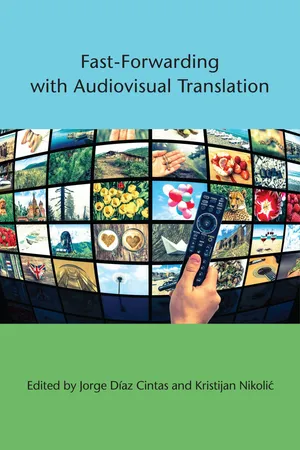
This edited collection offers a rounded vision of some of the ways in which audiovisual translation (AVT) can be approached from an academic, professional and educational point of view. The studies provide a stimulating and thought-provoking account of some of the most representative themes that are currently being researched in the field of AVT, while also highlighting new directions of potential research from a cognitive perspective. A conscious effort has been made to cover not only cultural and linguistic approaches to traditional domains of AVT (such as dubbing and subtitling), but also to look into lesser known areas of research that are attracting substantial interest from various stakeholders and gradually becoming part of the remit of AVT (including subtitling for the deaf and audio description for the blind). In this respect, the chapters of this book tackle the field of AVT from a plural, comprehensive and up-to-date perspective; speak of a rich and complex academic subject in the making; broaden our existing knowledge on AVT; reflect the many crossroads and junctions it currently faces and outline some of the issues that will become topical in the near future in this fascinating, flourishing discipline.
eBook - ePub
Fast-Forwarding with Audiovisual Translation
- English
- ePUB (mobile friendly)
- Available on iOS & Android
eBook - ePub
Fast-Forwarding with Audiovisual Translation
About this book
Information
Part 1
Transferring Language and Culture in AVT
1Globalising Bollywood: My Name Is Khan from India to Italy through Hollywood
Vincenza Minutella
Introduction: Multilingual Films and Audiovisual Translation
The translation of multilingual films is a growing area of research within audiovisual translation (De Bonis, 2014a, 2014b, 2014c; De Higes Andino, 2009, 2014a, 2014b; Delabastita & Grutman, 2005; Dwyer, 2005; Federici, 2009; Heiss, 2004; Şerban & Meyelaerts, 2014). Several studies have analysed the Italian versions of multilingual films, in particular films dealing with migrant identity and describing the diasporic experience of South-Asian immigrants living in the UK or the US, where the speakers are often bilingual and tend to switch and mix languages (Antonucci, 2011; Bonsignori, 2011, 2012; Bonsignori & Bruti, 2014; Minutella, 2012a, 2012b; Monti, 2009, 2014; Russo, 2016). However, most of the research has focused on films made by diasporic, UK- or US-based directors such as Mira Nair (Monsoon Wedding, The Namesake) or Gurinder Chadha (Bend it Like Beckham, Bride and Prejudice), or by British directors such as Danny Boyle (Slumdog Millionaire) and Ken Loach (Ae Fond Kiss). A Western cinematic eye and aesthetics tend to filter the foreign elements in these films, and although they contain language contact and alternation, English is their main language since their primary audience is Western and international. On the other hand, the translation and reception of Indian Bollywood Hindi films is still under-researched, especially in the language combination Hindi–English–Italian, and very few studies have been devoted to ‘truly’ Indian films (Antonucci, 2011; Minutella, 2012b; Russo, 2016). However, since Indian films seem to be gaining in popularity both internationally and in Italy, the way in which they are translated deserves closer attention.
Aims and Methodology
The aim of this chapter is to investigate how the multilingual Bollywood film My Name Is Khan (Karan Johar, 2010) has travelled from its Indian source culture to the Italian target culture. In particular, it examines language use in this Indian multilingual film and tries to understand how languages and the film itself are manipulated in the production, distribution and translation-adaptation-dubbing processes. In other words, My Name Is Khan is used as a case study to describe, in order to understand, the phenomena and agents involved in the process of translating this film for Italian-speaking audiences. The screenplay, the film dialogue, the master English subtitle/spotting list, the Italian dialogue and the Italian dubbed version are analysed. Moreover, we draw on interviews with the screenplay writer, the dubbing director and the dialogue writer. As a result, the chapter aims to shed some light on the production, translation, adaptation and distribution of this Indian film and on the constraints that are at play from a linguistic and cinematic perspective. In doing so, we also unveil the processes of writing, rewriting, manipulation and domestication that this Indian film has undergone before reaching its Italian audience. On a purely linguistic level, the chapter investigates the role of language(s) in representing the hybrid, bilingual identity of the Indian characters, and tries to understand how the Italian dubbing professionals have tackled the challenges posed by this film. We try to ascertain how the linguistic and cultural ‘otherness’ of the film as well as the ethnic and religious identity of the Indian characters have been tackled by the US distributors and by Italian dubbing professionals.
My Name Is Khan
My Name Is Khan (MNIK, 2010) is an Indian Hindi film directed by Karan Johar – one of India’s most successful young directors and producers – starring Bollywood’s big stars Shah Rukh Khan and Kajol. The screenplay was written by Shibani Bathija, with dialogues in Hindi and English by Bathija and Niranjan Yiengar, who was also the author of the song lyrics. MNIK was produced by Johar’s Dharma Productions, Khan’s Red Chillies Entertainment and Fox Star Studios – a joint venture between Twentieth Century Fox and STAR India – and distributed by Twentieth Century Fox. It is thus an Indian film co-produced with Hollywood, and it represents a successful attempt to take Bollywood to the world. As Jim Gianopulos, CEO of Twentieth Century Fox, explained in an interview, My Name Is Khan ‘is still the biggest Bollywood film around the world in history and we are very proud of that fact, […] we were able to take a film made in Bollywood with the greatest of talent and introduce that talent to more parts of the world’ (Ahuja, 2012: online). The film enjoyed considerable international distribution and success: it was screened at the Berlin and Rome Film Festivals and it broke several box office records in India, the UK and the US, becoming one of India’s highest grossing films in both the domestic market and overseas (Mahmood & Mitra, 2011).
My Name Is Khan follows the life of Rizvan Khan, an Indian Muslim affected by Asperger’s syndrome, from his youth in India to his migration to the multicultural US, where he lives with his brother Zakir and his sister-in-law Hasina. There, he works, gets married to a Hindu single mother, Mandira Rathod, and lives a happy successful life with her and her son Sameer until tragedy hits their family, when Sameer is killed by a group of teenagers during a racially motivated fight. To win Mandira’s love back, and interpreting her words literally, Rizvan embarks on an extraordinary journey across the US, as he must tell the President of the United States: ‘My name is Khan and I’m not a terrorist’. During this journey, he faces several obstacles, he is arrested on suspicion of being a terrorist, and finally he becomes a hero by reporting a group of Muslim extremists to the FBI and by helping the people of a village hit by a hurricane. MNIK may be seen to represent the diasporic experience of Asian Indians and Muslims in the US before and after the 9/11 terrorist attacks, since it portrays the change of attitude towards the Islamic community and South Asians and displays ethnic prejudice, fear and racist attacks. However, the film is also, and especially, the story of an unconventional hero, who overcomes a series of obstacles in order to regain the love of his life. It is a Bollywood drama and romance, a fairytale whose hero reminds us of Forrest Gump and Rain Man.
This film is an example of Indian Middle Cinema (Aime, 2007; Antonucci, 2011; Restelli, 2010) because it addresses a number of serious topics and global issues – a behavioural syndrome, ethnic and religious prejudice, terrorism, inter-faith marriage – and it occupies a mid-position between a commercial, popular Bollywood masala movie and an Indian art film. It is also a combination of Indian and Western cinematic features. It contains elements typical of Bollywood films such as romance, drama, the expression of strong feelings, melodramatic and overtly sentimental scenes, the presence of music and song-and-dance numbers that describe feelings, the casting of famous actors as idealised heroes, the filming style with close-up shots of the protagonists and images of rain, and a lack of realism. The film also draws on features of Hollywood or European cinema in its narrative structure, the serious issues dealt with, and the fact that compared to Indian popular masala films it is more realistic in style and topics. My Name Is Khan can thus be seen as an example of ‘a new kind of cinema, a hybrid cultural product that fuses the language of Hollywood with the accent, slang, and emotions of India’ (Thussu, 2009: 107). In this sense, the film caters for a wider, international audience by addressing important global issues and using dialogues in Hindi, English and Hinglish (a mixture of Hindi and English).
Language Use in MNIK
This section describes some aspects that are representative of the use of language(s) in this film, paying particular attention to language alternation, occurrences of code-switching (CS) and code-mixing (CM) – which are natural phenomena in the life of an Indian bilingual – as well as to the presence of borrowings. CS refers to the change of language within discourse among bilinguals (Gumperz, 1982: 59), while CM refers to intra-sentential CS, that is, language alternation within a single sentence (Sridhar & Sridhar, 1980: 408–409). Borrowing takes place when foreign words are used in a recipient language.
The languages spoken in My Name Is Khan are mainly Hindi and English, with the insertion of some lexical items borrowed from Arabic. The Indian characters speak Hindi in the scenes set in India, while they tend to speak English when they interact with non-Indians in the US. First-generation non-resident Indians (NRIs) tend to communicate in Hindi, with some English mixed in and some CS, while second-generation NRIs speak a hybrid language – the mixed variety called Hinglish – and their colloquial speech often resorts to CS and CM. English is, however, their dominant language. In interactions between first- and second-generation NRIs, CS and CM appear to be the norm (Minutella, 2012b). In the film under analysis, CS and CM are used to specify the addressee, to reiterate a message, to establish closeness (through ...
Table of contents
- Cover-Page
- Half-Title
- Series
- Title
- Copyright
- Contents
- Acknowledgements
- Contributors
- Fast-Forwarding with Audiovisual Translation
- Part 1: Transferring Language and Culture in AVT
- Part 2: Reception and Process
- Part 3: The Professional Environment
- Part 4: The Pedagogical Value of AVT
- Index
Trusted by 375,005 students
Access to over 1.5 million titles for a fair monthly price.
Study more efficiently using our study tools.
Frequently asked questions
Yes, you can cancel anytime from the Subscription tab in your account settings on the Perlego website. Your subscription will stay active until the end of your current billing period. Learn how to cancel your subscription
No, books cannot be downloaded as external files, such as PDFs, for use outside of Perlego. However, you can download books within the Perlego app for offline reading on mobile or tablet. Learn how to download books offline
Perlego offers two plans: Essential and Complete
- Essential is ideal for learners and professionals who enjoy exploring a wide range of subjects. Access the Essential Library with 800,000+ trusted titles and best-sellers across business, personal growth, and the humanities. Includes unlimited reading time and Standard Read Aloud voice.
- Complete: Perfect for advanced learners and researchers needing full, unrestricted access. Unlock 1.5M+ books across hundreds of subjects, including academic and specialized titles. The Complete Plan also includes advanced features like Premium Read Aloud and Research Assistant.
We are an online textbook subscription service, where you can get access to an entire online library for less than the price of a single book per month. With over 1.5 million books across 990+ topics, we’ve got you covered! Learn about our mission
Look out for the read-aloud symbol on your next book to see if you can listen to it. The read-aloud tool reads text aloud for you, highlighting the text as it is being read. You can pause it, speed it up and slow it down. Learn more about Read Aloud
Yes! You can use the Perlego app on both iOS and Android devices to read anytime, anywhere — even offline. Perfect for commutes or when you’re on the go.
Please note we cannot support devices running on iOS 13 and Android 7 or earlier. Learn more about using the app
Please note we cannot support devices running on iOS 13 and Android 7 or earlier. Learn more about using the app
Yes, you can access Fast-Forwarding with Audiovisual Translation by Jorge Díaz Cintas, Kristijan Nikolić, Jorge Díaz Cintas,Kristijan Nikolić in PDF and/or ePUB format, as well as other popular books in Languages & Linguistics & Translating & Interpreting. We have over 1.5 million books available in our catalogue for you to explore.