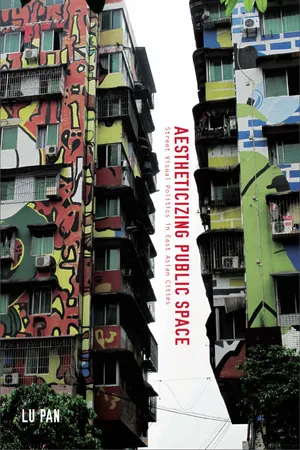
A photo-collage of past and present street visuals in Asia, Aestheticizing Public Space explores the domestic, regional, and global nexus of East Asian cities through their graffiti, street art, and other visual forms in public space. Attempting to unfold the complex positions of these images in the urban spatial politics of their respective regions, Lu Pan explores how graffiti in East Asia reflects the relationship between aesthetics and politics. The book situates itself in a contested dynamic relationship among human bodies, visual modernity, social or moral norms, styles, and historical experiences and narratives. On a broader level, this book aims to shed light on how aesthetics and politics are mobilized in different contested spaces and media forms, in which the producer and the spectator change and exchange their identities.
Frequently asked questions
Yes, you can cancel anytime from the Subscription tab in your account settings on the Perlego website. Your subscription will stay active until the end of your current billing period. Learn how to cancel your subscription.
No, books cannot be downloaded as external files, such as PDFs, for use outside of Perlego. However, you can download books within the Perlego app for offline reading on mobile or tablet. Learn more here.
Perlego offers two plans: Essential and Complete
Essential is ideal for learners and professionals who enjoy exploring a wide range of subjects. Access the Essential Library with 800,000+ trusted titles and best-sellers across business, personal growth, and the humanities. Includes unlimited reading time and Standard Read Aloud voice.
Complete: Perfect for advanced learners and researchers needing full, unrestricted access. Unlock 1.4M+ books across hundreds of subjects, including academic and specialized titles. The Complete Plan also includes advanced features like Premium Read Aloud and Research Assistant.
Both plans are available with monthly, semester, or annual billing cycles.
We are an online textbook subscription service, where you can get access to an entire online library for less than the price of a single book per month. With over 1 million books across 1000+ topics, we’ve got you covered! Learn more here.
Look out for the read-aloud symbol on your next book to see if you can listen to it. The read-aloud tool reads text aloud for you, highlighting the text as it is being read. You can pause it, speed it up and slow it down. Learn more here.
Yes! You can use the Perlego app on both iOS or Android devices to read anytime, anywhere — even offline. Perfect for commutes or when you’re on the go. Please note we cannot support devices running on iOS 13 and Android 7 or earlier. Learn more about using the app.
Yes, you can access Aestheticizing Public Space by Lu Pan in PDF and/or ePUB format, as well as other popular books in Art & Art Theory & Criticism. We have over one million books available in our catalogue for you to explore.
Carnival on the Street—Visual Order and its (Pseudo-)Reversion
Chapter 1
A Twisted Carnival: State-Sponsored Graffiti in China1
Graffiti and Public Visual Environment in post-1989 China
This chapter uses State-sponsored graffiti campaigns to illustrate the contradictory status of the Chinese urban governing body amid the increasingly ambiguous expression of current Chinese ideology in visual culture. Although commercial advertising occupies the majority of public visual imagery in the cities of post-1989 China, the State maintains strict control over what should and should not be seen. Government slogans still enjoy the privilege of displaying themselves in the most obvious places. Anne-Marie Brady argued that western influence on China’s theorization of modern propaganda has been considerably strong. She states that Harold Lasswell’s 1927 book, Propaganda Technique in the World War, “has become a key text in modern propaganda studies in China”.2 In post-Mao China, his idea, that propaganda provides a better choice than “its alternative, popular democracy, [which] is too chaotic and lofty an ideal for the complexities of the modern world”, is highly popular. According to Brady, it is welcomed by the “communication/journalism scholars and Party policymakers in China, since the concept that only the elite are fit to rule has become a mainstream view among Chinese intellectuals since 1989”.3 Meanwhile, when the core idea of propaganda and thought work shredded the ultra-leftist and revolutionary tone, the legitimacy and management of the Chinese Communist Party (CCP)’s political power is largely secured by the propaganda of persuasion.4
More precisely, the continuation of the Mao era was not totally abandoned. Instead, it has been modernized and updated to suit the needs of the current period […] the use of culture and entertainment as a vehicle for the political message is one noticeable example of this. […] Guides on propaganda and thought work published in the 1990s aimed to make China’s propaganda “attractive, entertaining and inspiring.”5
On top of this State control, “the content of the Chinese visual and print media is increasingly similar to that found in most other countries” and the State’s promotion of consumption among the “Chinese people to make money and spend it in large quantities has been one of the key propaganda messages coming from the Central Government in the post-1989 period”.6 The problem with this parallel between political propaganda and a commercial interest-driven system is not unimaginable. Apart from political needs that come into conflict with commercial interests, there is also a problem wherein “concerns of central authorities are frequently at odds with those local officials and individuals”.7 This process of (mis)communication can be well illustrated in the public’s “deconstructive” vandalism of these official posters. In The Last Days of Old Beijing, Michael Meyer describes how vandalistic interplay communicates a sense of black humor with a play of words. In the demolition process of the Qianmen Street restorative project, for example, a
billboard that covered the destruction of a building, a slogan promised:
(The ancient capital reappears.)
When I crossed the street […] I noticed that the propaganda had been altered. Someone had neatly excised part of the second character, so it read:
(Farewell, ancient capital.)
By afternoon, the altered sign had been pulled down, as had all of the road’s slogans.8
Having this picture in mind, how do we understand China’s officially sanctioned and sponsored graffiti projects? Noticeably, graffiti campaigns began to emerge as a new form of propaganda in China’s large-scale cultural mega-events in recent years, including the Beijing Olympics in 2008; the three-year national-level graffiti exchange program between Germany and China between 2007 and 2010 (largely based on a series of cooperation and communication programs for a sustainable urbanization process); and the Shanghai World Expo in 2010 (featuring its slogan “Better City, Better Life”), all of which hosted different forms of graffiti competitions or graffiti wall campaigns. Another graffiti painting campaign with official support is the Chongqing Huangjueping graffiti street. With an area of around 50,000m2 and a length of 1.25km, the local district proudly claims itself as China’s (if not the world’s) largest ever graffiti work. In fact, examples of the government’s endorsement to make legitimate spaces for graffitists, usually as a means of curbing rampant illegal vandalism, can also be found in western countries. In Philadelphia for example, “the Mural Arts Program began in 1984 as a component of the Philadelphia Anti-Graffiti Network, an effort spearheaded by then Mayor Wilson Goode to eradicate the graffiti crisis plaguing the city”.9 From the official point of view, this example serves as the most ideal compromise that can be achieved despite the fairly sharp antagonism between the two parties. However, the overall relationship between the government and graffitists in China requires careful distinction from that in the West.
Generally, the attitude of Chinese government or legal authorities toward graffiti is more tolerant for several reasons. First, for most of the “western-style” graffiti, their highly stylistic form and relatively unfamiliar language have rendered them as harmless doodles in China. Therefore, graffiti may also probably be seen by the authority and the public as something novel or mysterious, and are thus differentiated from other kinds of illegitimate visual pop-ups such as commercial mini-ads stickers (xiaoguanggao), which also surpass graffiti by considerable amounts.10 Second, the act of graffiti writing itself may be considered a misdemeanor (a minor offense) and has been less punishable because the legal environment in China is comparatively unconcerned with private property rights, as “public” space in China is usually understood as State-owned space. Zhang Dali mentioned in his interview about his negotiation with the police, which ended in a mutual agreement without penalty.11 The most plausible reason for the intervention of the police or other authoritative force may usually be caused by the graffiti’s politically sensitive content. Yet, what is the main point and what is being achieved with this intervention is still in dispute; furthermore, in many cases, it also has something to do with corruption.12
Therefore, without the often lengthy confrontation and negotiation between the authority and the graffitists in many other capitalist countries, all these campaigns and events in China take graffiti as an evident solution or advantage, rather than a problem, in relation to city life. It can easily be argued that the State-sanctioned graffiti projects exhibit the post-revolutionary China’s desire to “catch up” with the world’s trend of boosting creativity and market its cosmopolitan image to a global audience. Therefore, the underlying logic of the State, despite other controversial issues of China’s current progress in democratization, is to show the Chinese version of democratic openness, vibrancy, and tolerance of the subculture within controllable bounds. Thus, in this sense, graffiti can logically be regarded as a new form of propaganda in contemporary China. It is also easy to argue that graffiti can no longer be considered as graffiti, but as a mural.
However, we have to bear in mind though, that the term “mural” cannot be interchangeably used with “graffiti” (tuya) in all the cases mentioned above. We can further argue the extent to which this self-proclaimed graffiti is truly graffiti in its most accepted definition. What makes the phenomenon meaningful here is how and why the State insists on a linguistic genealogy that confirms graffiti’s style and nature. Brady’s point that we may have to think about “the potential capabilities of modern information communication technology to reach a wider audience outside of the official media have led Party propaganda experts to redefine the concept of the public sphere”.13 In this vein, State-sponsored graffiti campaigns divulge China’s effort to find ways to simultaneously accommodate the old propaganda practices to compete with the commercial visual system.
Olympic Games Graffiti Wall and Chongqing Graffiti Avenue
This domestic turn in national visual production, in my view, can best explain large-scale graffiti wall campaigns of two of the abovementioned cases, namely, the Chongqing Huangjueping Graffiti Avenue, completed in 2007, and the 2008 Olympic Games Graffiti Wall in 2008. In these two particular events, we can see a return of the narrative of mass participation in art production in the Communist vein. Co-sponsored by the Beijing Olympic Committee, the Beijing City 2008 Environmental Headquarters Office, and Beijing People’s Broadcasting Station, the “Beijing Olympic Cultural Wall Creative Design Campaign” presented itself with the hope that “[t]he Olympics evokes the creativity of the artists. Art lends further splendor to the Olympic culture”. Initiated in Beijing Foreign Studies University, the campaign was part of celebrations related to the country’s hosting of the 2008 Olympics in Beijing and aimed to mobilize and guide citizens from all walks of society to actively participate in the mega international event. Using the old socialist linguistic dogmas “Welcome Olympics, stress civilization and set up new ethos” (yingaoyun, jiangwenming, shuxinfeng,
), the purpose of the campaign was to encourage the people to participate in, contribute to, and benefit from the Olympics.
Moreover, as a focal program in the Olympics promotion, the graffiti wall was to be preserved as a long-term Beijing cultural landmark, exhibiting “New Beijing” and “New Olympics” to friends from all over the world during the Olympics.14 The murals I saw on the wall during my fieldtrip in May 2013 were largely in desolate condition: some paintings were apparently leftovers from 2008, such as the image of Fuwa (the Beijing Olympic mascot, literally meaning “good-luck doll”); the Olympic slogan “one world, one dream”; and the image of Liu Xiang, a national heroic figure who, for the first time in China’s history, won the Olympic golden medal in 110m hurdle in 2004. (See Figures 12.1 and 12.2).15 The images were apparently meant to evoke a sense of national pride and emotional attachment to the event.
In the case of Chongqing, as stated in the official reports, residents in the neighborhood actively supported the construction of the art street, and paint companies even provided free paint (see Figure 13). Adding to the color of the State’s concern on public consultation, with adequate mobilization job that had been done by the subdistrict office beforehand, around 1,500 households signed the letter of commitment, permitting graffiti painting on the façade of their buildings and allowing the graffiti production to begin ten days ahead of the original plan. More than 800 art academy students, school students, and hired workers participated in the painting process.16
Furthermore, there is also a 3m “legal wall” (
, “free creative zone”) in the adjunct area of the Railway Elementary School on the graffiti street.17 As one of the nine creative industry bases in Chongqing, the inauguration ceremony of the Graffiti Avenue was celebrated in the form of a joyous graffiti festival. There were parades, performances, and interactive art production activities involving local residents who were encouraged to share the joy.18 The graffiti styles that can be found in the streets were also similar to their counterparts in Beijing’s “Graffiti Wall”. Though the graffiti do not necessarily display a high value of art, these are largely colorful, encouraging, cute, and, therefore, safe and uncontroversial. According to these official representations of the campaigns, both cases share three common purposes: (1) mobilize the masses to participate in State-directed events, be it international sports event or urban revitalization project, in a festive atmosphere; (2) construct a new guidance of visual language and creativity in a more cosmopolitan context of global tourism and “spectacle economy”; and (3) target a certain actual or imagined public in order to meet the goals of these campaigns.
If we carefully examine how the semantic structure of the concept of graffiti (not mural) plays a central role in these campaigns, we immediately face an interesting dislocation. In the West, graffiti’s foray into the fashion industry for commercial reasons, or even its movement toward high art, is based specifically on the original spirit of criticism of mainstream values. In China, the State’s internaliza...
Table of contents
Cover Page
Title Page
Copyright
Contents
Acknowledgements
Introduction
Part I: Carnival on the Street—Visual Order and its (Pseudo-)Reversion
Chapter 1: A Twisted Carnival: State-Sponsored Graffiti in China
Chapter 2: Writing at the End of History: Reflections on Two Cases of Graffiti in Hong Kong
Part II: Aura on (and beyond) the Street—Body, Community, and Media
Chapter 3: Trans-spatial Images: Traveling Graffiti (Art) and the Possibility of Resistance in Chinese Urban Space
Chapter 4: Eloquence of Silent Speech: JR in East Asia
Part III: Dissensus on the Street—Aesthetics, Politics, and Public Space
Chapter 5: The Spectacle of Democracy: Violence, Language, and Dissensus in the Case of Anti-war Graffiti in Tokyo
Chapter 6: The Nation’s Shame? Seoul’s Rat Graffiti Incident at the 2010 G-20 Summit
Part IV: Creativity on the Street—Visual Narratives of East Asian Creative Cities
Chapter 7: Art, Urban Space, and Governance: Street Mural and “Legal Wall” in Japan
Chapter 8: Marginality as Centrality: The “Seoul Urban Art Project” and AGIT in Busan
Special Chapter: Voices from the Street—Interviews with Street Visual Producers in East Asia