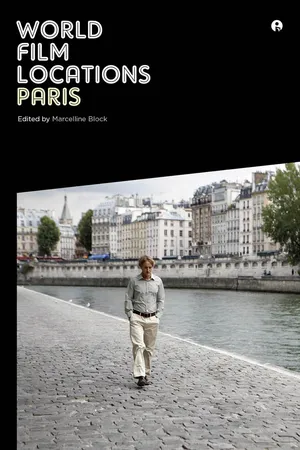
'We'll always have Paris,' Humphrey Bogart assures Ingrid Bergman in the oft-quoted farewell scene from Casablanca in which Bogart's character, hard-hearted restaurateur Rick Blaine, bids former lover Ilsa Lund goodbye. The backdrop against which they first fell in love, Paris later serves as a reminder of their deep mutual longings. And with a host of different realisations by filmmakers from Philip Kaufman to Julien Leclercq to Woody Allen, there is no question that Paris has likewise endured in the memories of cinephiles worldwide.
World Film Locations: Paris takes readers on an unforgettable tour of the City of Lights past and present through the many films that have been set there. Along the way, we revisit iconic tourist sites from the Eiffel Tower – whose stairs and crossbars inspired more than one famous chase scene – to the Moulin Rouge overlooking the famously seedy Place Pigalle. Other films explore lesser-known quarters usually tucked away from the tourist's admiring gaze. Handsomely illustrated with full-colour film stills and contemporary photographs, more than fifty scenes are individually considered with special attention to their use of Paris's topography as it intersects with characters, narrative and plot. A host of important genres and cinematic movements are featured, including poetic realism, the New Wave, cinéma-verité, the literary works of the Left Bank Group, and Luc Besson's slickly stylised cinéma du look. Meanwhile, essays foreground contributions from Francophone African directors and émigré filmmakers.
For centuries, Paris has reigned over the popular imagination. For those who have visited or those who have only imagined it through art, literature and film, World Film Locations: Paris presents a wonder-filled cinematic exploration of the mythical city that fans of French cinema – and new initiates – will appreciate.
Frequently asked questions
Yes, you can cancel anytime from the Subscription tab in your account settings on the Perlego website. Your subscription will stay active until the end of your current billing period. Learn how to cancel your subscription.
No, books cannot be downloaded as external files, such as PDFs, for use outside of Perlego. However, you can download books within the Perlego app for offline reading on mobile or tablet. Learn more here.
Perlego offers two plans: Essential and Complete
Essential is ideal for learners and professionals who enjoy exploring a wide range of subjects. Access the Essential Library with 800,000+ trusted titles and best-sellers across business, personal growth, and the humanities. Includes unlimited reading time and Standard Read Aloud voice.
Complete: Perfect for advanced learners and researchers needing full, unrestricted access. Unlock 1.4M+ books across hundreds of subjects, including academic and specialized titles. The Complete Plan also includes advanced features like Premium Read Aloud and Research Assistant.
Both plans are available with monthly, semester, or annual billing cycles.
We are an online textbook subscription service, where you can get access to an entire online library for less than the price of a single book per month. With over 1 million books across 1000+ topics, we’ve got you covered! Learn more here.
Look out for the read-aloud symbol on your next book to see if you can listen to it. The read-aloud tool reads text aloud for you, highlighting the text as it is being read. You can pause it, speed it up and slow it down. Learn more here.
Yes! You can use the Perlego app on both iOS or Android devices to read anytime, anywhere — even offline. Perfect for commutes or when you’re on the go. Please note we cannot support devices running on iOS 13 and Android 7 or earlier. Learn more about using the app.
Yes, you can access World Film Locations: Paris by Marcelline Block in PDF and/or ePUB format, as well as other popular books in Mezzi di comunicazione e arti performative & Film e video. We have over one million books available in our catalogue for you to explore.
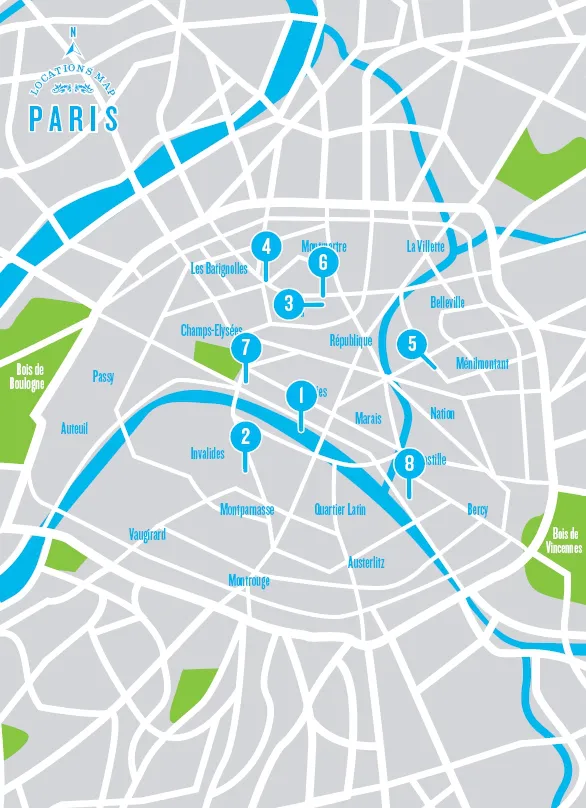
1. BOUDU SAVED FROM DROWNING/ BOUDU SAUVÉ DES EAUX (1932) Pont des Arts, 1st/6th arrondissements page 10
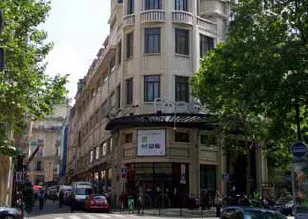
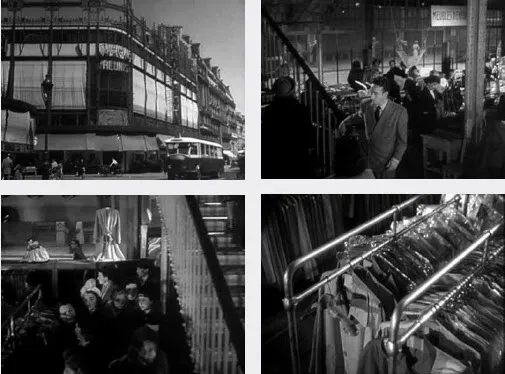
2. GUNMAN IN THE STRETS (1950) Magasins Réunis, 136 Rue de Rennes, 6th arrondissement page 12
3. DON'T TOUCH THE LOOT!/ TOUCHEZ PAS AU GRISBI (1954) Rue Frochot, Pigalle, 9th arrondissement page 14
4. RIFIFI/DU RIFIFI CHEZ LES HOMMES (1955) Place de Clichy, 8th/17th arrondissements page 16
5. THE RED BALLOON/LE BALLON ROUGE (1956) Ménilmontant, 20th arrondissement, including Rue des Envierges; Rue Chappe, 18th arrondissement page 18
6. BOB THE GAMBLER/BOB LE FLAMBEUR (1956) Place Pigalle, 9th arrondissement; Montmartre, 18th arrondissement page 20
7. GIGI (1958) Maxim's, 3 Rue Royale, 1st arrondissement page 22
8. PICKPOCKET (1959) Gare de Lyon, 20 Boulevard Diderot, 12th arrondissement page 24
BOUDU SAVED FROM DROWNING/BOUDU SAUVÉ DES EAUX(1932)
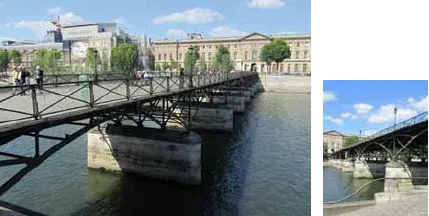
Pont des Arts, lst/6th arrondissements
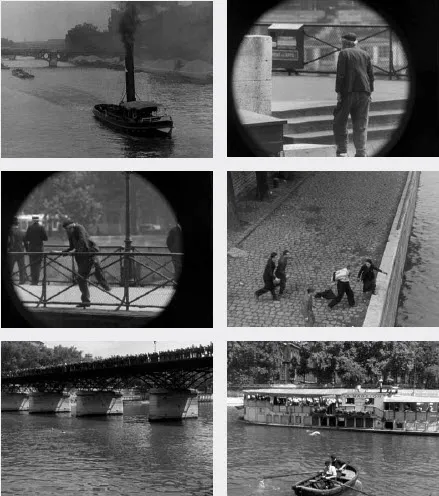
PROVIDING A PANORAMIC SURVEY of Paris circa 1932, Renoir's classic offers as comprehensive a picture of the French capital as the country's cinema has ever produced. It begins with relative tranquillity in the Bois de Boulogne on the western outskirts of the capital, which is presented as a space of leisure and a repository of bourgeois mannerisms wherein the titular tramp is disdainfully looked down upon. Here Boudu (Michel Simon) loses his dog and disturbs the peace before leaving for the heart of Paris on the bustling Quai Malaquais and the historic Pont des Arts — Paris's only pedestrian bridge and a refuge for the city's clochards. These locations, teeming with vibrant life and throbbing with people, offer an immediate contrast to the Bois de Boulogne, stressing another side of the city altogether by highlighting the centres of its intellectual, cultural and artistic life (the shots on the Quai take in the Institut de France and the Louvre across the Seine). These are disparate sites whose only link seems to be the anomalous presence of Boudu — something captured with groundbreaking, proto-vérité naturalism by Renoir's telephoto lens. Boudu's journey to the very centre of Paris, a return of the socially repressed, thus comments directly on the city in its entirety.
Adam Bingham
Directed by Jean Renoir
Scene description: Boudu's journey to the centre of Paris Timecode for scene: 0:05:26 – 0:21:29
Magasins Réunis, 136 Rue de Rennes, 6th arrondissement
FREED BY HIS GANG near the Palais de Justice, black marketeer Roback (Dane Clark) ducks into the Magasins Réunis at 136 Rue de Rennes. A single shot suggests the first of several narrow escapes from the dragnet closing in on him. He emerges from behind a display of children's furniture, exiting frame left just before the arrival of police cars outside, visible through the iron and glass wall of the store. As the police head for the nearest entrance, the camera tracks left following them. Suddenly it tilts down; our attention is redirected inside. A lone hanger swings on a rack of overcoats, an indexical trace of Roback's recently acquired disguise. This Franco-American co-production paired the American director of This Gun for Hire (1942) with cinematographer Eugen Schüfften, who had filmed documentaries, Kammerspielfilme, and expressionist blockbusters like Metropolis (Lang, 1927), before fleeing to France and then the United States in 1933. Visually, Gunman is all over the map, in terms of the city's geography and the way it is filmed. Night scenes shot with available light are interspersed with shots of sets whose wet pavement and looming streetlights recall Straβenfilme. The shot described above combines location shooting with the ‘unchained camera’ of 1920s German studio-bound cinema. This seemingly eclectic layering of styles creates a palimpsestic reminder of Paris' pivotal role in the transatlantic exchange of films and personnel that gave rise to film noir. Similarly, by 1950, 136 Rue de Rennes already had several layered façades.