This book is available to read until 23rd December, 2025
- 250 pages
- English
- ePUB (mobile friendly)
- Available on iOS & Android
eBook - ePub
Available until 23 Dec |Learn more
About this book
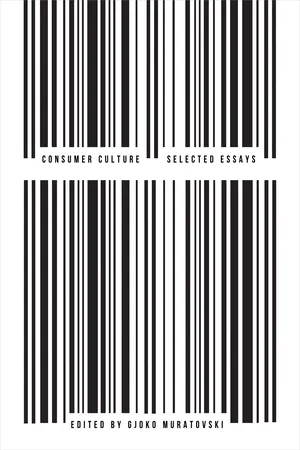
We live in a society that defines us by what we consume and how. Every day we make purchasing decisions that express our sense of belonging, our commitments to the environment and our systems of belief. We often choose to buy things, not necessarily because we need them, but because we believe that these things will help us express who we are – in our own eyes and in the eyes of others. Whether we like it or not, consumerism is the prevalent ideology of our time. Led by Gjoko Muratovski who has long been influential at the intersection of design and business, Consumer Culture is the ideal starting point for an investigation into the social construction of the global economy.
Frequently asked questions
Yes, you can cancel anytime from the Subscription tab in your account settings on the Perlego website. Your subscription will stay active until the end of your current billing period. Learn how to cancel your subscription.
No, books cannot be downloaded as external files, such as PDFs, for use outside of Perlego. However, you can download books within the Perlego app for offline reading on mobile or tablet. Learn more here.
Perlego offers two plans: Essential and Complete
- Essential is ideal for learners and professionals who enjoy exploring a wide range of subjects. Access the Essential Library with 800,000+ trusted titles and best-sellers across business, personal growth, and the humanities. Includes unlimited reading time and Standard Read Aloud voice.
- Complete: Perfect for advanced learners and researchers needing full, unrestricted access. Unlock 1.4M+ books across hundreds of subjects, including academic and specialized titles. The Complete Plan also includes advanced features like Premium Read Aloud and Research Assistant.
We are an online textbook subscription service, where you can get access to an entire online library for less than the price of a single book per month. With over 1 million books across 1000+ topics, we’ve got you covered! Learn more here.
Look out for the read-aloud symbol on your next book to see if you can listen to it. The read-aloud tool reads text aloud for you, highlighting the text as it is being read. You can pause it, speed it up and slow it down. Learn more here.
Yes! You can use the Perlego app on both iOS or Android devices to read anytime, anywhere — even offline. Perfect for commutes or when you’re on the go.
Please note we cannot support devices running on iOS 13 and Android 7 or earlier. Learn more about using the app.
Please note we cannot support devices running on iOS 13 and Android 7 or earlier. Learn more about using the app.
Yes, you can access Consumer Culture by Gjoko Muratovski, Doctor Gjoko Muratovski in PDF and/or ePUB format, as well as other popular books in Business & Consumer Behaviour. We have over one million books available in our catalogue for you to explore.
Information
Chapter 1
Icons of Popular Culture: Religious Dimensions of Branding
Gjoko Muratovski
Abstract
By standing for something greater than their products, leading brands aspire to establish their own ‘corporate religions’. Apple, Coca-Cola, McDonalds, Disney, Harley-Davidson, and Nike operate more like religious cults than commercial enterprises, converting their consumers into devoted believers and loyal followers. These brands have managed to replace a culture of needs with a culture of desire and worship. In this process of cultural transformation, the world of branding has taken refuge in the world of sacred and assumed almost religious dimensions. Brands have become modern-day totems – commercial idols around which a meaningful existence is formed. This, in return, has triggered the emergence of what has now been referred to as ‘consumer religion’. Unlike most people think, branding is not only a marketing concept, but also a system of belief that is integral to our culture.
Keywords
branding, religion, totems, icons, Apple, Coca-Cola, McDonalds, Disney, Harley-Davidson, Nike
Introduction
Regardless of its popularity, ‘branding’ is a term that resists clear definition. Etymologically, the term comes from the word ‘burn’, and as such, this term has been used in the context of marking one’s property with a heated iron (Pavitt, 2000: 19). While from a contemporary perspective it seems that branding has originated from the practice of trademarking, it can be argued that it was the other way around. A review of the literature suggests that branding evolved from the process of marking property and ownership, or from the process of identifying the origin and content of goods. However, if we try to look beyond its contemporary application, we will see that branding existed long before it was used in a commercial context. If we examine what branding stands for in a broader sociocultural context rather than commercial, then we can see that branding has a much longer history, and that the term itself is incorrect.
Despite the fact that trademarks were effectively used since the Middle Ages, and crude examples of trademarking can be found even before that, branding as a commercial concept emerged in the middle of the nineteenth century. This was a time when technology, combined with literacy and rising standards of living, created the first mass market. The idea behind this was simple: a producer would take a household product – a commodity, no different from any other made by someone else – and would give it distinctive characteristics through imaginative use of name, design, packaging, and advertising. Rather than simply marking the product in terms of origin or ownership, the producer would create a brand from this product by giving the product an identity and special features. In this way, the product would appear unique and different from its competitors (Moor, 2007: 15–18).
This technique proved to be highly successful. Branding increased the sales of products, or enabled producers to charge a premium for the same product over its generic competitors. This meant that when products became associated with powerful, complex, highly charged, and immediate symbolism, a strong and lasting effect on the consumers was inevitable. This seemingly new concept also demonstrated that ordinary, often irrelevant objects could become powerful emotive symbols, affecting how people that used them wanted to be seen by others. In time, branding managed to replace a culture based on needs with a culture driven by desires (Muratovski, 2010: 32). It was no longer a matter of rational thoughts arising out of sheer necessity, functionality, and practicality that moved people into changing their purchasing patterns – it was the irrational, emotional impulses that created new engagements between the masses and the products (Curtis, 2002). The apparent power that branding had over public opinion and collective behaviour did not go unnoticed. This idea was so strong that its applications have gone beyond consumer products and commercial establishments. It was not long before this concept was expanded and became widely adopted by political organisations, social movements, and by governments. For many organisations, regardless of their nature, status, and origin, branding became the orthodox way towards identity formation and promotion (Olins, 1990). However, the original form of branding appeared long before organised trading and commercial trademarks even existed. From a sociocultural perspective, branding can be traced all the way to the early days of human history when people cohabited in tribes and worshiped idols.
When early humans were faced with dramatic natural phenomena, as a way of coping with the new and the unknown, they began to create stories, myths, and legends in an attempt to explain the things that they could not understand. In doing so, they used themselves as a reference and imagined that all physical entities in nature are gifted with similar powers, including speech, desire, and thought. From such perspective, the wind and the river could speak and obviously travel; trees could articulate; and lower animals were perceived as equals. This way of observing the surrounding world has given rise to some of the earliest forms of religion: animism and naturism – the attribution of human features, a soul, or supernatural powers to animals, plants, objects, and natural phenomena; and totemism – a practice of marking out tribal relationship with certain animals or natural objects, and their veneration (for classical studies on this topic, see Hume, 1757: 10; Durkheim, 1912: 86–88; Freud, 1919: 128; Spence, 1921: 17).
A tribe would often have its own distinctive totem, or a series of totems, that they would identify with and worship. As such, the totems also acted as a form of differentiation among various tribes and tribal members (Freud, 1919: 4). Further, the tribal members would make some kind of objects and emblems that would bare the image of the totem, and even tattoo these emblems on their bodies. Further, they would carry the totem with them in a hope that the special characteristics of their ‘tribal god’ will be transferred to them (Freud, 1919: 174).
This idea is so strongly embedded in our subconsciousness that it persists even today. Contrary to the common belief that totemism ceased to exist as a system of belief, as a model it was never really abandoned. One example of this is heraldry – a system by which symbols such as national emblems, coats of arms, and armorial elements bearing animals, plants, and objects are devised, described, and regulated (Pastoureau, 1997). Such symbols have been in continuous use since medieval Europe. Today, they are used to a lesser extent, and perhaps not in the way they were originally envisioned. Heraldry still demarks European as well as Asian, African, Pacific, and South-American postcolonial ‘aristocracies’ of power, and is still applied, both in commercial branding and in the strongly renascent practice of establishing family history. Totems can still be found in the form of emblems of various townships, schools, universities, and far beyond this. The names and emblems of many sports teams complete with uniforms, memorabilia, club colours, emblems, supporter banners, mascots, and merchandised souvenirs are evident examples that we have never really abandoned totemism. Examples of this practice are numerous and can be frequently found around the world and in a range of sports – from the NBA to AFL and Rugby Union (e.g. NBA teams with totemic brand features: Atlanta Hawks, Chicago Bulls, Charlotte Bobcats, Dallas Mavericks, Memphis Grizzlies, New Orleans Hornets, etc.). In addition to this, we still give human names to cyclones, storms, and typhoons. We still call planets by the names of long forgotten gods. We continue to assign female gender roles to ships and yachts, and cars often bear trademarked names or emblems that depict animals. One thing is clear: we still live in a time when people idolise objects and concepts that are associated with natural and supernatural elements (Muratovski, 2010: 203).
What we can deduct from this empirical observation is that branding, in its purest form, has religious rather than commercial origins. That is why a more appropriate term to define brands would be ‘totems’ – sacred objects and emblems that particular communities identify with (Muratovski, 2013a). This idea, however, is not based on a new theory. The uneasy relationship between religion and branded goods has often been the topic of study for scholars coming from a range of disciplines, such as business, marketing, consumer behaviour, and communications (for example, see Belk, Walledorf, and Sherry, 1989; Schouten and McAlexander, 1995; Moraru, 2013). The similarities between branding and religion have also been noted and examined by theologian scholars such as David Chidester (1996, 2005), Tricia Sheffield (2006), and Vincent J. Miller (2009).
The key link that brings these seemingly disparate concepts – branding and religion – together is the notion of belief. Just as religion, the consumer culture in which we live in today is also formed around a set of beliefs. The key element of the ‘consumer religion’ is the belief that happiness can be achieved by a possession of branded goods (see Miller, 2009: 1; and also Jhally, 1998). For example, many people ‘believe’ that driving a particular brand of cars, wearing certain fashion labels, or using a particular type of mobile phone over another is a good thing, and that this is something worth pursuing. Such attitudes can be seen across all social groups and subcultures around the world.
Some businesses understand this type of behaviour better than others. In an attempt to fabricate a ‘simulacrum of credibility’, certain corporations have developed quasi-religious indoctrinations as sources of inspiration. They have established their own systems of belief by producing ‘credos of values’ in an effort to motivate and engage their employees and their clients. In doing so, they have been successful in uniting their constituencies with their own visions, myths, and symbols (de Certeau, 1984: 180). By standing for something greater than their products, these businesses have established their own ‘corporate religions’ (Kunde, 2000) and began to operate more like ‘religious cults’ than commercial enterprises (Atkin, 2004), converting their consumers into ‘devoted believers’ and ‘loyal followers’ (Lindstrom, 2008). Apple, Coca-Cola, McDonalds, Disney, Harley-Davidson, and Nike are some of the brands that employ such principles. These brands have stepped into a place where the power of the narrative has replaced the product, and the idea of the brand has become everything (see also Ritzer, 1993; Bryman, 1999, 2003).
Apple Inc.
There are very few commercial brands that can inspire the same level of commitment and dedication from its customers as Apple can. Whenever Apple opens a new store or launches a new product, it draws crowds in the thousands. Even for insignificant events, such as the opening day of their fifth store in Manhattan, Apple fans formed a waiting line of nearly one kilometre long. Over 2500 people were waiting in the line, including one retiree from California who already attended 30 store openings nationwide (Tibken, 2011). For the Apple fans, a new store opening is such an important occasion that some of them took advantage of the setting to propose marriages (Evans, 2006). This type of behaviour associated with new store openings is not only characteristic to the United States. The opening of their first store in Tokyo drew never before seen crowds with the waiting line exceeding eight city blocks (Mogg, 2011). The number of people that visit Apple’s stores in a single quarter exceeds 60 million, which is more than the number of people who visit Walt Disney’s four biggest theme parks in a year (Tibken, 2011).
This kind of consumer devotion, typically exhibited by religious followers, has prompted the media to refer to Apple as a ‘new religion’ that offers ‘divine instruments’ worth the effort of a ‘pilgrimage’ (Heussner, 2010; Rosenwald, 2011). With this in mind, it is not a surprise that some have even described Apple’s founder, Steve Jobs, as a ‘technological messiah’ (Jones, 2011), and the ‘high priest’ of Apple (Rosenwald, 2011). According to the New Statesman, Jobs blurred the line between salesmanship and evangelism; like a ‘religious revivalist’, he was selling not just consumer commodities, but also a ‘vision of life’ – their article states. His preacher-like appearance and quasi-religious product launches – as the commentary continues – were part of the ‘magic’ that allowed the ‘devotees’ to ignore that the products themselves were often ‘overpriced and underpowered’ (Jones, 2011). In what is essentially an article on the ‘church of Jobs’ and the ‘cult of Apple’, the following paragraph from the New Statesman sums up Jobs’s life story:
The Book of Jobs would, no doubt, begin with the company’s birth in the humble location of Jobs’s garage in 1976. The founder’s expulsion from Eden – his removal from the company in the mid-1980s – was followed by a long period of exile (the Pixar years). In Jobs’s case, the second coming – his return to Apple in 1997 – preceded the miracle of resurrection that he managed to perform, taking the company from near-bankruptcy to global dominance in the space of a decade. There’s even an antichrist in this gospel, in the shape of Bill Gates. For many years, there was just a small band of loyal followers holding off the darkness of Microsoft. But Apple’s final triumph was assured. And while he has now logged off for the last time, Jobs has left behind him a multitude of followers to preach the word unto whatever Windows-using heathens might still be out there. (Jones, 2011, para.3)
The religious aura that surrounds Apple inspired a team of BBC journalists to investigate why Apple fans exhibit such devotion. After consulting neuroscientists who conducted MRI scan tests on selected individuals, they have uncovered that Apple imagery activates the same parts of the brain in brand-loyal Apple ‘fanatics’ that religious imagery does in devoted followers of a religion. They have also confirmed that once a brand achieves this effect, there is no turning back for the devotees as they are becoming hooked to the brand’s products and corporate culture (Riley and Boome, 2011).1 Ironically, this comes at odds with advertising campaigns that were meant to portray Apple as a company that stands against conformity and corporate brainwashing and delivers technological liberation, individual creativity, and freedom of expression. These values were vividly presented in their Orwellian commercial 1984 (1984) directed by Ridley Scott, and later reinforced through their Think Different (1997–2002) campaign.
The Coca-Cola Company
Coca-Cola is a product that no one needs, but everyone wants. The drink that contains 99% sugar and water was invented in 1886 and sold for just 5 cents per glass in the first 70 years. Today, Coca-Cola is a US$74 billion brand and is marketed in more than 200 countries (Bhasin, 2011). Nevertheless, Coca-Cola was not an instant success. John Pemberton, the drink’s inventor, in the first year sold just nine glasses of the drink a day (The Coca-Cola Company, 2011). As a part of his sales pitch, Pemberton referred to Coca-Cola as “the greatest blessing to the human family, Nature’s (God’s) best gift in medicine” (cited in Chidester, 1996: 749, parentheses added by Chidester).
Coca-Cola’s success was achieved by what appears to be a religious zeal and great deal of perseverance that the company demonstrated since its inception. From the beginning, Coca-Cola company managers, advertisers, bottlers, and distributors displayed distinctively religious moods and motivations around their product. This can be seen by a range of public statements made by Coca-Cola executives over a course of many years. According to the religious studies scholar, David Chidester (1996), Asa Candler, the Atlanta entrepreneur who started the Coca-Cola empire, was described by his son as a person that regarded the drink with an almost ‘mystical faith’. Robert Woodruff, who became president of the company in 1923, demonstrated a devotion to Coca-Cola that many thought it resembled ‘idolatry’. Harrison Jones, the leading Coca-Cola bottler of the 1920s, often referred to the drink as ‘holy water’ and treated the iconic bottle as a ‘sacred object’. Archie Lee, Coca-Cola’s advertising executive in the 1920s, believed that Coca-Cola is a ‘new religion’, more important than the one promoted by the doctrines of the Church. Delony Sledge, the...
Table of contents
- Cover Page
- Title Page
- Copyright
- Contents
- Consumer Culture: An Introduction Gjoko Muratovski
- Chapter 1 Icons of Popular Culture: Religious Dimensions of Branding Gjoko Muratovski
- Chapter 2 Business, National Identities and International Politics: The Role of Built Environments and Architectural Propaganda in Nation Branding Gjoko Muratovski
- Chapter 3 Race, Advertisements and YouTube: Identity and Nationality Kathleen Connellan
- Chapter 4 The Use of Gold Rush Nostalgia on Wine Labels: Brief History of New Zealand’s Central Otago Wine Region Lloyd Carpenter
- Chapter 5 Mad Men and Women: Construction and Management of Advertising Executives in Popular Culture Anne Peirson-Smith
- Chapter 6 The Big Earn: A Study of Criminal Business Enterprises in Popular Culture Carolyn Beasley
- Chapter 7 Brand IKEA in a Global Cultural Economy: A Case Study Susie Khamis
- Chapter 8 The ‘Good’ Corporation: The Uneasy Relationship Between Reputation and Responsibility Robert Crocker
- Chapter 9 Acceleration in Consumerism, Technology and Sustainability Robert Crocker
- Notes on Contributors
- Back Cover