eBook - ePub
Available until 23 Dec |Learn more
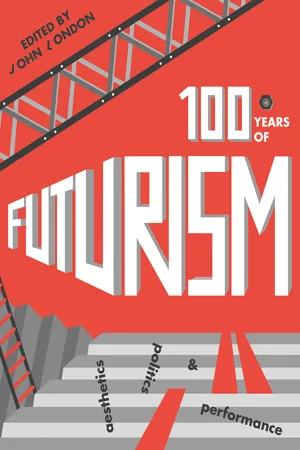
One Hundred Years of Futurism
Aesthetics, Politics and Performance
This book is available to read until 23rd December, 2025
- 300 pages
- English
- ePUB (mobile friendly)
- Available on iOS & Android
eBook - ePub
Available until 23 Dec |Learn more
About this book
More than one hundred years after Futurism exploded onto the European stage with its unique brand of art and literature, there is a need to reassess the whole movement, from its Italian roots to its international ramifications. In wide-ranging essays based on fresh research, the contributors to this collection examine both the original context and the cultural legacy of Futurism. Chapters touch on topics such as Futurism and Fascism, the geopolitics of Futurism, the Futurist woman, and translating Futurist texts. A large portion of the book is devoted to the practical aspects of performing Futurist theatrical ideas in the twenty-first century.
Frequently asked questions
Yes, you can cancel anytime from the Subscription tab in your account settings on the Perlego website. Your subscription will stay active until the end of your current billing period. Learn how to cancel your subscription.
No, books cannot be downloaded as external files, such as PDFs, for use outside of Perlego. However, you can download books within the Perlego app for offline reading on mobile or tablet. Learn more here.
Perlego offers two plans: Essential and Complete
- Essential is ideal for learners and professionals who enjoy exploring a wide range of subjects. Access the Essential Library with 800,000+ trusted titles and best-sellers across business, personal growth, and the humanities. Includes unlimited reading time and Standard Read Aloud voice.
- Complete: Perfect for advanced learners and researchers needing full, unrestricted access. Unlock 1.4M+ books across hundreds of subjects, including academic and specialized titles. The Complete Plan also includes advanced features like Premium Read Aloud and Research Assistant.
We are an online textbook subscription service, where you can get access to an entire online library for less than the price of a single book per month. With over 1 million books across 1000+ topics, we’ve got you covered! Learn more here.
Look out for the read-aloud symbol on your next book to see if you can listen to it. The read-aloud tool reads text aloud for you, highlighting the text as it is being read. You can pause it, speed it up and slow it down. Learn more here.
Yes! You can use the Perlego app on both iOS or Android devices to read anytime, anywhere — even offline. Perfect for commutes or when you’re on the go.
Please note we cannot support devices running on iOS 13 and Android 7 or earlier. Learn more about using the app.
Please note we cannot support devices running on iOS 13 and Android 7 or earlier. Learn more about using the app.
Yes, you can access One Hundred Years of Futurism by John London in PDF and/or ePUB format, as well as other popular books in Social Sciences & Art Theory & Criticism. We have over one million books available in our catalogue for you to explore.
Information
Chapter 1
Geographies of Futurism: Mapping the First Avant-garde
Andreas Kramer
Among the famous eleven points that constitute the programmatic middle section of the first manifesto of Futurism there is one that positions the Futurist group in relation to time and space: ‘We stand upon the furthest promontory of the ages! [...] Time and Space died yesterday! We are already living in the realms of the Absolute, for we have already created infinite, omnipresent speed’.1 The statement presents ‘speed’ as the successor to the old certainties of time and space. Operating beyond temporal and spatial concerns, ‘speed’ is emblematic for the acceleration of modernity and the changing experiences of time and space in the early twentieth century.
The powerful rhetoric, however, conceals a number of telling slips. Marinetti declares time and space dead, but uses a temporal indicator (‘yesterday’), and the metaphor ‘the furthest promontory of the ages’ renders time in spatial terms. The Futurist assault on time and space, is, it seems, unable to free itself from the languages of time and space. If anything, then, notions of space serve to undermine notions of time, pinpointing the fundamental problem of a movement that sought to construct itself as an absolute point of origin; as a movement not coming ‘after, but in place of' the culture which precedes it.2 In fact, the Futurists’ celebration of an accelerated and dynamic life-world, their attempt to align art and poetry with that modernity, and their fiercely nationalist politics are all aspects of an avant-garde project that took place in a specific historical time and in a specific cultural space. Instead of substituting ‘speed’ for ‘time’ and ‘space’, and falling for Marinetti’s rhetoric, it is perhaps more appropriate to position the Futurist project within a more complicated set of sometimes contradictory conceptions of time and space.
While Futurism’s intrinsic relation to time and history, and its ramification for Futurist art have received plenty of critical attention, much less work has been done regarding Futurism’s spaces.3 The avant-garde topos of being ahead of the mainstream entails not only the dimension of time, but of space, of exploration, and territorial conquest. This topos is also a point from which to survey, reconnoitre and ultimately conquer enemy territory. This essay, without wishing to separate space from time artificially, attempts to unpack some of the spaces that Futurism claimed for itself as its tactics and ideas spread across Europe, in many places becoming synonymous with the avant-garde itself. The axis along which Futurism was disseminated internationally, and the ways in which it was absorbed, modified or rejected in individual national cultures, have been well documented, and many commentators have noted the often uneasy combination of artistic internationalism and political nationalism that accompanied the emergence and the spread of Futurism.4 This essay asks whether questions of geography may help us understand such tensions better. It asks specifically what other geographical places and images, in addition to that avant-garde topos of ‘the furthest promontory’, the Futurists drew on or laid claim to, and it asks how such geographies influenced the Futurist imagination. Looking at Futurist writings and art, such geographical markers work, of course, on the level of the imagination, where they suggest a symbolic competition for command over space as well as perhaps a fundamental need for the exercise of symbolic power. Futurism’s use of national and international geographies overlapped with contemporary discourses of geopolitics and imperialism. My intention here is to explore how such tensions may be illuminated further by a renewed set of spatial and geographic contexts.
In turning to questions of space, I am also invoking what has been called the ‘spatial turn’, the reorientation of cultural and literary studies towards questions of space and geography. There are two main reasons why space and geography are important orientations in cultural studies today. One reason is the present theoretical concern with cultural globalization and a geopolitical aesthetic.5 Another reason can be found in history: these orientations are not entirely new, but recapitulate some of the concerns of modernism and the avant-garde movements within it.6 Yet relatively little work has been done to locate modernisms and the avant-garde movements within a renewed set of spatial or geographical contexts.7 Postcolonial criticism, for instance, is vitally concerned with questions of territory, land, location, and migration. Geography here becomes a contestation for command over space, politically and culturally. It investigates the consequences of geographical conquest by imperialism and colonization, the ways in which cultural texts in turn come to map empire or engage in an attempt to resist imposed cartographies. For Edward Said, much of culture is characterized by the ‘struggle over geography’, a struggle played out in an arena that is simultaneously political and cultural. In Said’s model, then, geographic conflict is ‘complex and interesting because it is not only about soldiers and cannons but also about ideas, about forms, about images and imaginings’.8 Soldiers and cannons obviously feature prominently in the Futurist imagination, where they become metaphors of a militant avant-garde at war with bourgeois culture. But Said’s point is about the specifically cultural forms, ideas, and images complicit in any struggle over geography. My argument here is that Futurism’s ‘colonizing intent’9 is closely bound up with those forms and images of an avant-garde struggle over geography. It is therefore hardly surprising that the language of the Italian Futurists is replete with echoes, not only of engaging in a military campaign and doing battle, but of territorial conquest and command over space as well. In a letter dated 1 December 1911, describing the preparations for the first Parisian exhibition of Futurist painting, Umberto Boccioni calls the Galerie Bernheim-Jeune ‘the battlefield where [...] we shall array our cannons’.10 Looking at Italian and other Futurisms, I consider the ways in which those spaces and geographies work on the level of the imagination, how they are represented rhetorically and visually, and what kinds of symbolic power in the field of the international avant-garde might be attached to such geographies.
Remapping the World: Geographies of Italian Futurism
Early Futurist manifestoes and texts often use the theme of the journey. As a structural and rhetorical device, the journey suggests movement across various kinds of space, and also the movement away from circumscribed social spaces. The first manifesto is a good example of how the trope functions. The confined domestic space, elaborately decorated with Oriental artefacts, has been identified as belonging to the ‘Casa Marinetti’ on Milan’s Via del Senato. This building backed onto an old canal, the Naviglio, allegedly designed by Leonardo.11 The contrast between these various elements of urban space, between the ‘tedious, mumbled prayers of the ancient canal’ lined by crumbling palazzi, and the ‘sudden roar of ravenous motorcars’ on the road adjacent to the canal, effectively assigns each space to its own time zone and pits old against modern, static against dynamic.12 The text of the first manifesto, however, develops its own spatiotemporal logic. The escape from the places associated with the past is not immediately successful, as the subsequent car journey is dependent on the availability of road space and it is only following the collision with the cyclist and the landing in a ditch filled with industrial waste, that the text can stage the bizarre parthenogenesis of Futurism, underscored by the shift from narrative past tense to Futurist demands. But the distinction between the closed space of confinement and the open road, between tradition and future, is a rhetorical one, as a number of motifs recur, such as the wish to overcome forms of confinement (even though the mode has changed from a static place to a mobile motorcar) and the peculiar dependency on the female or maternal Other (be it the Sudanese wet-nurse or the fetishized body of the car) as an agent of transgressive male desire. The spatial aspects of the manifesto suggest more of a struggle over geographic space, a revaluation of domestic space, urban environment and a collective kind of mobility within it that aims to overcome the blockages of tradition.
First published in French in autumn 1909, the ‘proclama futurista’ Let’s Kill Off the Moonlight also uses the trope of the journey to allegorize the Futurist battle against the stifling forces of tradition.13 But once again, this battle is staged in geographical terms, and this time it far exceeds the confines of suburban Milan to be played out on a vast intercontinental scale. The narrative tracks the construction of the ‘great Futurist railway’ from the allegorical cities of Paralysis and Podagra (‘Goutville’), past the ruins of classical Europe via the high plateaus of Persia to India, across the Ganges and towards the summit of ‘Gorisankar’ (really, Gaurishankar) in the Himalayas. The Gaurishankar – a holy site for both Buddhists and Hindus – was erroneously considered by Europeans well into the twentieth century to be the highest mountain on earth, and Marinetti draws on this to stage a violent fantasy in which the traditionalists are destroyed. Luca Somigli has pointed out that the endpoint of this Futurist journey is ‘not so much a location as a space between, a liminal place’ from which the victorious Futurists can hurl their defiance to the cosmic order.14
On the way to that liminal point, however, the text draws on a peculiar geographical imagination. The intercontinental railway under construction in this text defies the logic of capitalism, whereby railways connect cities for the purposes of trade and exchange of goods and people, and sometimes have a wider geopolitical aim as, for example, in the construction of the Baghdad railway at the time of Marinetti’s writing. Instead of following the features of natural geography and the flow of international capital, the Futurist railway in this text runs along extremely challenging terrain, symbolic of the limits Futurism is exploring. The railway here becomes a trope for Futurism itself: mobile, dynamic, and expansive, it goes on to conquer ever new spaces in the battle against tradition. Much like the discourse of contemporary geopolitics, Marinetti recognizes the significance of command over space for the exercise of power, in this text, a symbolic power exercised on ...
Table of contents
- Cover Page
- Title Page
- Copyright
- Contents
- List of Illustrations
- Notes on the Contributors
- Acknowledgements
- Introduction: Futurism, Anti-Futurism, and the Forgotten Century
- Aesthetics and Politics
- Performance
- Bibliography
- Index
- Back Cover