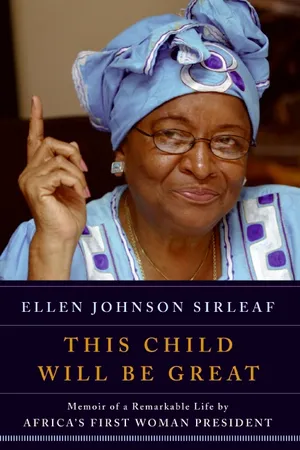
WHEN I was just a few days old, an old man came to visit my parents, to see the new baby and to offer his good wishes, as people did both then and now in my country and everywhere. My mother brought the old man into the room where I lay kicking and cooing on the bed. As the story goes, the old man took one look at me and turned to my mother with a strange expression on his face.
“Oh, Martha,” he said. “This child shall be great. This child is going to lead.”
My mother and sister and I used to laugh whenever my mother told this story. We would laugh and laugh and laugh, because at many of the junctures in which she recalled the words of the wise old man my life seemed anything but great. Perhaps I was watching all my friends go off to college abroad while I stayed at home in Monrovia, trapped with an abusive husband, four young sons, and no future in sight. Perhaps I was struggling to pursue my education, build my career, and divorce that husband without losing everything I had. Or perhaps I was being hauled off to prison by order of my nation’s president—or maybe even plotting an escape into exile to save my life.
“Where’s all this greatness that was predicted?” my mother would ask. Sometimes she laughed, sometimes she cried. Always she prayed. “Where’s that old man now?”
Over the years and as the path of greatness unfolded, whenever I reflected on the prophecy of the old man, my scientific orientation of self-determination would clash with the Presbyterian teachings of predestination I had received.
Which one, I have long wondered, is the way life really is?
EARLY ON during my historic 2005 campaign for the presidency of Liberia, rumors began to circulate about my ethnicity. My detractors began whispering that I was an Americo-Liberian, a descendant of one of those first American-born founders of our land—and thus a member of the elite class that had ruled our nation for long.
This was an explosive charge. Given the historic cleavage in our society and the long-standing divide between the elite settler and indigenous populations, many Liberians wanted nothing to do with another Americo-Liberian president. And although I was well known in my country—so well known that most people, including the swarms of children who would come out to greet me as I campaigned, simply called me “Ellen”—still, there was danger that the rumor would find traction. It could not be brushed off or ignored, not if I wanted to win. It was crucial that the people of Liberia know my background was not unlike their own. They needed to know where I was coming from.
In truth, my family exemplifies the economic and social divide that has torn our nation. But, unlike many privileged Liberians, I can claim no American lineage.
My paternal grandfather was a Gola chief of great renown. His name was Jahmale, sometimes called Jahmale the Peacemaker, and he lived, along with his eight wives, in the village of Julejuah, in Bomi County. Jahmale used to travel from his home village to the ocean, a distance of some twelve or fifteen miles that, in those days, took months and months of slow walking through the dense forests of coastal Liberia. During his travels he learned to speak the languages and dialects of the many peoples whose path he crossed and so became a kind of negotiator when troubles erupted between the indigenous people and the settlers in Monrovia.
In this way his reputation grew, and it was because of this renown that my grandfather was sometimes visited by Hilary Wright Johnson, Liberia’s eleventh president. Johnson was the first president of Liberia to be born in our country. He was also the son of Elijah Johnson, one of the original settlers.
At that time there were few roads in Liberia and none at all outside the capital. So when the president traveled into the hinterland to visit villages, he, along with his entourage, would be carried about in hammocks, welcomed with food and dance and celebration and perhaps the gift of a young woman as a wife. The president in turn brought excitement, gifts, and connection to the country’s power base back in Monrovia. It was President Johnson who encouraged Jahmale to send my father to the city as a ward.
As with many aspects of Liberian society, the ward system, its history and legacy, is not simple to parse. Its origins seem to lie in a complex combination of tradition, expediency, and need; the motivations of its participants varied greatly, as did the way in which it was executed.
In the simplest explanation, the ward system flourished in early Liberia because it met the settlers’ crucial need for cheap labor. Those early transplanted families, not having enough children themselves, needed help with the heavy housework of the nineteenth century: hauling water, collecting firewood and coal, cooking, cleaning, and tending crops.
At the same time, it was, in many villages, an African tradition for chiefs and wealthier villagers to have guardianship of children whose parents were either dead or too poor to care for them. The extended family system in Africa assumes that everyone is his brother’s keeper; it is one of our strengths. Likewise, it was common at the time for chiefs who formed alliances with other tribes or chiefs to offer women as wives and children as wards to validate the agreements.
The American Colonization Society, recognizing how the tradition could be used to spread Christianity among the indigenous population, encouraged the settlers to take local children into their homes. In many cases these young people, once accepted into the family, were treated equally and given the same duties, responsibilities, and opportunities as the family’s own biological offspring. Often settlers grew so fond of their wards that they provided for them in their wills, as did Samuel C. Coker, a settler farmer from Bensonville, who gave generous grants of lands to three of his wards—provided, he wrote, they remain “among the civilized elements.”
But to say that every ward was warmly embraced by his or her new family would be untrue. In some cases wards were viewed mostly as a source of cheap labor, unpaid servants who were yours to treat or mistreat as you saw fit—slaves, essentially. This is the painful and unvarnished truth.
However, it must also be said that the majority of families, regardless of how discriminating or unjust, gave the wards in their care some opportunity for education. Limited, perhaps, but more than they would have had otherwise.
Even some of the best-treated wards suffered the indignity of having their names changed to better suit their new, nonindigenous status. My father, who was taken in by a family named McGrity, was given the last name of Johnson, after the president. His first name, Karnley, was westernized to Carney. At the age of fifteen or sixteen, Carney Johnson was born. In the name of assimilation and to be accepted, he had to experience a rebirth.
When I was a girl, my father would sometimes tell us stories of the years he had spent as a ward, performing chores, cleaning, collecting water and firewood. For the most part the McGritys were good to him and treated him well. But the line between him and the family was always clear, and he was punished if he was disrespectful or did something wrong. Once, for some infraction, he was stuffed into a large bag and hung over an open fire as punishment. He wasn’t held there long enough to be injured, just long enough to make the point.
Yet my father benefited tremendously from his time as a ward. First and foremost, the McGritys sent him to school. He was given a solid primary education, something that would not have happened back in the village. With that education, the world opened to him.
In those days there were no law schools to speak of in Liberia; one became a lawyer either by going abroad or by apprenticing with a practicing attorney. My father did the latter. He became what was called a poor man’s lawyer, a very successful one. He married and, like many Liberians, began looking toward a life in politics as a way to both serve his country and build his career. He was climbing the ladder of success in the Liberian legislature when, one day, walking through the streets of Monrovia, he spotted my mother and fell in love.
MY MOTHER’S story is similar to my father’s, though she was much younger than he. Martha’s mother, Juah Sarwee, was a native farmer and market woman from Greenville, Sinoe County, who fell in love with a trader from Germany. During the early part of the twentieth century, Germany was one of Liberia’s major trading partners, and the country was full of German expatriates organizing the exports of coffee, palm oil, palm kernels, and piassava. But at the start of World War I, Liberia, eager to display its loyalty to the United States, declared war on Germany and expelled all German citizens. My maternal grandfather left Liberia, left his wife, left his young daughter. He was never heard from again. About her father my mother rarely spoke. It was a part of her life she never knew and never cared to find out about. She had other relatives in her village who also had German blood in their veins, and sometimes, at family gatherings, they would sit around trying to reminisce about a time that had passed. My mother would never join them. To her, what was gone was gone.
Only once in my life did I hear her mention her father with any sense of regret. It was many years after the wars, when Liberia and Germany had reestablished friendly relations and Germans were once again visiting our land. “I wish I had known my father,” my mother said one day, reading some item in the newspaper. But it was just a passing comment. After making it, she folded the newspaper away and got on with her work.
Because of her father, my mother was a fair-skinned child with long, wavy hair. She could almost pass for white, and naturally she stood out in her village. She became an attraction of sorts, this child who was quite different from all the other children. Many settler families offered to take her into their homes, and eventually her mother, who was poor, illiterate, and struggling to feed them both, agreed.
The first family treated my mother very poorly, more as an indentured servant than as a foster child. She had no room of her own, not even a bed, but often slept on the table or even sometimes beneath it with the family animals. Her days were full of chores, and she was neither properly fed nor groomed. When word got out in Monrovia that this fair-skinned child was being mistreated by her settler family, a woman named Cecilia Dunbar, the wife of Charles Dunbar, stepped up and offered a settlement.
“Give her to me,” she said. “I will take care of her.”
The Dunbars were a very old and very prominent Liberian family, dating back to one of the first groups of settlers. One of the ancestors of Charles Dunbar was Charles B. Dunbar, one of three men who briefly led the nation as part of an executive committee during a presidential crisis in 1871.
Cecilia Dunbar had no children of her own, and no doubt my mother’s fair skin was the source of at least part of her interest in the child. Nonetheless, it was a humanitarian gesture. My mother became, in effect, the only child of a well-off family, and needless to say it changed her life. She took the Dunbar name, went to school, and received the best education possible in Liberia. She was even sent abroad to further her studies for a year.
But she was still just a teenager the day my father passed the Dunbar house and spotted her in the yard. The sight of her stopped him cold.
“Oh,” he said, struck by her hair, her figure, her overall loveliness. “Oh. I like you.”
My mother, however, was not impressed at first. She turned her back to him, rushing into the house to tell Mrs. Dunbar that some older man was outside bothering her. By the time they got back outside, he was gone.
But he kept an eye on her, visiting sometimes and watching as she grew. It was four or five years later that he divorced his wife and visited Grandmother Cecilia to ask for my mother’s hand in marriage. By this time my mother had softened toward him. He was a handsome man, my father—tall, brown-skinned, and stylish, with a special, jaunty way of walking that proclaimed his confidence. When he proposed to my mother and asked Grandmother Cecilia for her daughter’s hand, both women were won over. Both women immediately said yes.
And so my parents, a son of a Gola chief from Bomi County and a daughter of a market woman from Sinoe, were married. I can imagine them as a young couple in Monrovia: hardworking, ambitious, eager to create a better life for themselves and their family. They would work hard and together create a better life.
And so they did, until a sad and sudden turn of events knocked our family off the ladder of success.
THE MONROVIA of today is a grand but wounded city, the bruised and battered capital of a bruised and battered land. The Monrovia of my youth was a different place: simpler in feel, smaller in scale. We loved it dearly, but in truth it was not much of a city, more like a large village by the sea. There were no public transportation system, telephones, or streetlights, and very few cars. We walked to school, walked to church, walked to our neighbors’ houses. When we went out of town, we traveled in hammocks or canoes. Nor was the city dotted with the grand, imposing buildings later built by Presidents William Tubman, William Tolbert, and Samuel Doe and badly damaged during the wars. The Monrovia of my childhood was zinc houses and hilly dirt streets, papaya trees and cassava plants, flowering gardens and wooden out-houses: simple, friendly, close-knit. Home.
Monrovia was also, from the beginning, the undisputed seat of power of Liberia. In the years immediately following the founding of Monrovia, slave-owning states, hoping to rid themselves of the worrisome free blacks in their midst, formed their own societies and founded their own colonies, working independently of the ACS. In 1834, the Maryland State Colonization Society established its colony at Cape Palmas, some 250 miles south of Monrovia. Societies in Pennsylvania and New York worked together to settle the Edina and Port Cresson (later Bassa Cove) colonies in 1832, while groups in Virginia and Mississippi worked to establish their own colonies.
But it was the ACS that continued to flood the burgeoning country with settlers. Year after year they arrived, riding the brigs Nautilus, Strong, Hunter, and Vine; the ships Cyrus, Norfolk, and Indian Chief; the schooners Randolph and Fidelity. They were farmers and blacksmiths, coopers and sailmakers, barbers and carpenters and wheel-wrights, their children and their wives.
Robert E. Lee, the American Confederate Civil War general, freed most of his slaves before the war and offered to pay their expenses to Liberia. In November 1853, Lee’s former slaves William and Rosabella Burke and their four children sailed on the Banshee, which left Baltimore with 261 emigrants. Five years later, Burke wrote, “Persons coming to Africa should expect to go through many hardships, such as are common to the first settlement in any new country. I expected it, and was not disappointed or discouraged at any thing I met with; and so far from being dissatisfied with the country, I bless the Lord that ever my lot was cast in this part of the earth.”
By 1867, the ACS had sent more than 13,000 emigrants to Liberia. But the settlers’ death rate from malaria and yellow fever was staggeringly high. According to census documents, only 8 of the 86 emigrants who arrived in Sherbo Island in 1820 were still alive by 1843. Only 171 of the 639 who arrived in 1833 were still alive a decade later. During these years fresh graves dotted the settlements, which gradually expanded along the coast and up along the Saint Paul River.
Not everyone came willingly. Some historians suggest as many as 70 percent of African Americans sent to Liberia were told they would be freed only if they “agreed” to “go back” to Africa. And there was another group streaming into the new country under less than voluntary means. These were the “recaptives”—men, women, and children who had been snatched or sold into slavery but then rescued mid-Atlantic from slaving ships. Having abolished the slave trade throughout the empire in 1807, Britain sought to compel other nations to follow suit, using its mighty navy to enforce an embargo of slave trading throughout the Middle Passage. The United States, which abolished the slave trade in 1808 (though, of course, not slavery itself), also joined in the naval barricade.
Many of these people—Ibo and Fulani, Kongo and Yoruba, Bantu and Fon—had been taken from points hundreds of miles south and west of Liberia, from parts of what are now Benin, Nigeria, Cameroon, Equatorial Guinea, and Congo. To return them to their respective homes was impossible, so instead they were “liberated” in Liberia or Freetown. The American settlers dubbed this new group “Congo People,” because they were assumed to have come from areas in and around the Congo River basin. Hastily enacted laws forced many into long apprenticeships with the settlers. Such apprenticeships were intended to civilize and Christianize the Africans, who, unlike the local indigenous peoples, were cut off from their cultural and tribal roots and thus could be more easily assimilated into settler society.
In 1838, the colonies established by Virginia and Pennsylvania merged with the ACS colonies, declared themselves the Commonwealth of Liberia, and claimed control over all settlements between the Cestos River and Cape Mount. After Liberia declared its independence in 1847, Jose...