![]()
PART ONE
The Fall of Advertising
![]()
1
Advertising and Car Salesmen
Not long ago, four New York City nurses were killed when they drove off the top of a motel’s five-story parking garage. The story made all of the New York papers, including the front page of the New York Post. Sixteen hundred mourners attended the funeral at St. Patrick’s Cathedral, and one of the speakers was Mayor Giuliani. Typical newspaper headline: “Angels Take Wing As 1,600 Say Goodbye.”
Nurses are nurses. Advertising executives are advertising executives and are not likely to get the same reception—in life or in death. If four advertising executives had died driving off the Brooklyn Bridge after a three-martini lunch, the media would have treated the story quite differently. “Hucksters Go to Hell in a Honda.”
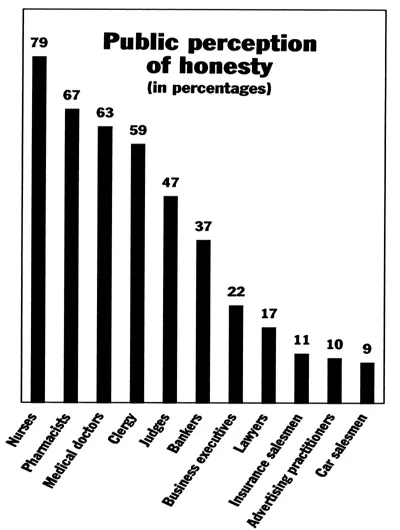
Face reality. In a recent Gallup poll on the honesty and ethics of people in thirty-two different professions, advertising and advertising practitioners ranked near the bottom, right between insurance salesmen and car salesmen. (Shown at left is an abbreviated list with the percentage of respondents who felt people of each profession were honest.)
If you don’t believe what an insurance or a car salesman tells you, why would you believe what you read in an advertisement? Both sources have the same degree of credibility.
Not only does advertising have an external problem with the public, but it also has an internal problem.
Advertising’s Problem Inside the Corporation
“What strategy does your advertising agency suggest?” we recently asked the CEO of a large client.
“We never ask our agency what to do,” he replied. “We tell them.”
The advertising era is over. Today clients seldom trust their ad agencies to help them make all-important strategic decisions. What used to be a marketing partnership has degenerated into a client/ vendor relationship. (A Patrick Marketing Group study of senior marketing executives found that only 3 percent of those interviewed claimed to have delegated the responsibility for establishing their brand identities to their advertising agencies.)
A recent survey of eighteen hundred business executives by the American Advertising Federation (AAF) shows that public relations is more highly regarded than advertising. The executives were asked which departments were most important to their company’s success. Here are the results:
- Product development 29 percent
- Strategic planning 27 percent
- Public relations 16 percent
- Research & development 14 percent
- Financial strategies 14 percent
- Advertising 10 percent
- Legal 3 percent
Only the legal department ranked lower than advertising in the AAF survey. Advertising might account for a substantial share of a company’s budget, but in the eyes of management its stature has been seriously eroded.
So what did the AAF do to counter the low score the advertising department received? They did what many companies do when they find themselves in trouble. They launched an advertising campaign to improve advertising’s perception in the business community. Theme: “Advertising. The way great brands get to be great brands.”
But if you believe that product development, strategic planning, public relations, research and development, and financial strategies are more important than advertising to a company’s success (and that is what the survey shows), then why would you believe an advertisement that boldly states, “Advertising is the way great brands get to be great brands”?
It’s a classic case of cognitive dissonance. You can’t hold advertising in low esteem and also believe an ad that says advertising builds great brands. Except, of course, if you don’t believe that great brands are important. Which would mean that the American Advertising Federation now has two problems: advertising and brands.
The weakest link in any advertising program is its credibility. An advertising message has little believability with the average person. Advertising is taken for what it is—a biased message paid for by a company with a selfish interest in what the consumer consumes.
Advertising’s Golden Era
It wasn’t always so. After World War II, advertising was the rising star in corporate America. At Procter & Gamble, Hershey’s, Coca-Cola, Campbell’s, and many other consumer goods companies, it was the advertising people that ruled the roost.
In Hollywood, they even made movies where advertising people were the heroes. The Hucksters, starring Clark Gable and Deborah Kerr, was a notable example. Also, The Man in the Gray Flannel Suit starring Gregory Peck. (People assumed that anyone who wore a gray flannel suit was in the advertising business, but Peck actually played the role of a PR person.)
Helped by the introduction of television after World War II, advertising volume exploded. By 1972, the annual per capita expenditure on advertising was $110. Today, the comparable number is $865. Truly we live in an overcommunicated society and it’s not getting any quieter. (Adjusted for the effect of inflation, the 1972 figure would have been $465.)
What happens when the volume of almost anything begins to soar out of sight?
Volume Up, Effectiveness Down
The rise of advertising volume coincided with a decline in advertising effectiveness. Every advertising effectiveness study shows the same results. The more advertising in a given medium, the less effective each individual advertisement is.
An advertisement in a thin magazine will generally be seen and read by more people than an advertisement in a thick issue of the same publication. A commercial on a television show with few commercials will generally be noticed by more people than a commercial on a TV show with many commercials.
Not only has advertising volume risen, but advertising costs have risen even faster. In 1972, for example, the price of a thirty-second Super Bowl commercial was $86,000 and it reached 56,640,000 people. Cost per thousand: $1.52.
Last year a thirty-second Super Bowl commercial cost $2,100,000 and reached 88,465,000 people. Cost per thousand: $23.74 or nearly 16 times as much. (To be fair, if you figure in inflation, the cost today is 3.7 times as much. On the other hand, a 270 percent increase in three decades is a big increase indeed.)
In addition to the media cost, there’s also the cost of production which is not cheap either. According to the American Association of Advertising Agencies, the average cost to produce a thirty-second TV commercial is currently $343,000.
Some categories are even more expensive. The average production cost of a thirty-second soft drink or snack commercial is $530,000. For apparel and clothing the average cost jumps to $1,053,000.
If you study advertising rates in all media, you will find exactly the same two trends. Increasing volumes, which reduce effectiveness, combined with increasing costs, which reduce efficiency.
Taken together, these two trends have made advertising an expensive and difficult way to influence customers and prospects. (If you have been thinking that your company was spending more on advertising and enjoying it less, you are probably right.)
Advertising Is an Anomaly
Most products and services go in the opposite direction. As time goes by, prices usually decline.
Compare communicating by phone with communicating by advertising. Back in 1972, the year MCI became operational, the average cost of a long-distance phone call was in the neighborhood of twenty cents a minute. Today it’s seven cents a minute or less.
The same phenomenon is true of airline fares, fast food, soft drinks, electronic products, and hundreds of other products and services. Over time as competition develops and as companies learn how to reduce their costs, prices (adjusted for inflation) tend to fall.
In 1990, only 5 million people in the United States used a cellular telephone and their average monthly bill was $81. Today 110 million people use cell phones and their average monthly bill is $45.
In just five years the average price of a digital camera dropped from $560 to $370, at the same time as the number of pixels (a mea-sure of quality) dramatically increased.
Perhaps the best example of constantly declining prices is the computer. A $1,000 personal computer you might buy today is more powerful than the million-dollar mainframe you could have bought thirty years ago.
Advertising Volume Keeps Growing
But higher prices and lower levels of effectiveness have not reduced the volume of advertising. Year after year advertising expenditures outpace the growth in GDP.
In 1997, U.S. advertising expenditures were up 7 percent over the previous year. In 1998, 8 percent. In 1999, 10 percent. And in the year 2000, another 10 percent. (Because of the terrorist attacks, the year 2001 was an exception. Ad spending fell 6 percent, only the second time in the last forty years that advertising spending actually declined from one year to the next.)
Current U.S. advertising expenditures are $244 billion a year, or a record 2.5 percent of the gross domestic product. This is within shouting distance of the Defense Department budget, which was $291 billion in fiscal 2000.
Other countries are beginning to join the United States as advertising-saturated societies. Hong Kong, Portugal, Hungary, Greece, and the Czech Republic already spend a higher percentage of their GDP on advertising than we do. Still, America currently accounts for 44 percent of the world’s total advertising expenditures.
237 Messages per Day
How many advertising messages is the average person exposed to during an average day? This is a question many communication experts have tried to answer, with the guesses ranging up to five thousand per day.
But what is a message? Is it a small-space magazine ad or a thirty-second television commercial? How do you compare a page of newspaper ads (with perhaps thirty small-space messages) that a person might be exposed to for half a second with a thirty-second television commercial? Does that mean the person who sees both is exposed to thirty-one advertising messages?
There’s a better way to estimate the per-capita daily consumption of advertising. An annual advertising expenditure of $244 billion translates into $2.37 per person per day.
For most people, advertising means television advertising. The average cost of a thirty-second television spot is in the neighborhood of $10 per thousand or one cent per person. Therefore the average person is exposed to 237 television commercials (or their equivalent in other media) every day or 86,500 television commercials a year.
Two hundred and thirty-seven television commercials are a lot of television commercials. It’s like watching a full-length motion picture containing nothing but TV commercials. And, of course, “capita” includes everybody from infants to nursing home residents. An upperincome individual in the prime of his or her life can expect to be exposed to four or five times as much advertising.
The Wallpaper Effect
As advertising volume has increased, advertising messages have become wallpaper. Advertisements surround us from early in the morning to late at night. It’s not only the volume of advertising that works against its effectiveness, it’s also the number of different messages the average individual is exposed to. The New York–based market-research firm CRM, for example, now tracks advertising expenditures for nine hundred thousand different brands.
As a result of the volume and the variety, we tend to tune all advertising messages out. Only when an ad is unusual do we pay any attention to it at all.
Just because an object is large doesn’t necessarily mean that anyone will pay attention to it. A typical living room might have 400 square feet of wallpaper, equivalent to 190 pages of the New York Times. Yet you can spend several hours in another person’s living room without being able to recall a single detail from the paper on the wall.
(If you have wallpaper in your home, when was the last time a stranger walked in and said, “Wow! That’s very interesting wallpaper.”)
You can be exposed to 190 pages of the New York Times advertising with the same result. The inability to recall a single detail from 400 square feet of advertising.
Do you know who Rosario Marin is? How about Mary Ellen Withrow? You don’t? That’s strange, because you see these names every day on the lefthand side of your money. Mary Ellen Withrow was treasurer of the United States during the Clinton administration; Rosario Marin, during the Bush administration. Money is like wallpaper. Except for the big numbers in the corners, you barely notice what’s printed on the bills.
In general, advertising is something you have trained yourself to avoid. If you read all the ads, you wouldn’t have time to do anything else.
There are exceptions. Your toilet is overflowing and you look for a plumber in the yellow pages. You’re moving to the suburbs and you look for a new house in the classifieds. You’re going on a date and you check the movie times in the weekend section.
Save for exceptions like these, perhaps 90 percent of all advertising falls into the “general” category. In other words, it is designed to motivate you to buy a certain brand. This is a difficult task indeed. The average consumer feels that he or she already knows enough about brands in order to decide which brand to buy.
A One-Sided Message
Even more important, the average consumer feels that the information presented in advertisements is one-sided. It doesn’t tell the whole story, it doesn’t present alternatives, and it is often misleading. No wonder advertising practitioners are only one step above car salesmen.
Who’s fooling whom? “Our product contains more vitamins, more minerals, and more proteins, than any other product on the market.” Sure, 1 percent more.
“Our truck has the longest wheelbase, the longest cargo bed, and the widest track in the industry.” Sure, one inch longer and one inch wider.
Then there’s the ever-popular no-nothing claim. “No other battery lasts longer than Duracell.” Translation: they’re all the same.
Years ago when there was little or no advertising, any advertising was effective. Ads were widely read and discussed. People looked forward to reading the four-color ads in Life magazine or watching the commercials on Texaco Star Theater.
But you can’t live in the past. Advertising is no longer fresh and exciting. There’s just too much of it. Advertising has moved to Florida and entered its retirement years.
How can this be when there is more advertising today than there ever was? Both in total volume and in per-capita volume. How can a communications technique be at the height of its popularity and still be on its way out?
History offers an explanation. When a communication technique loses its functional purpose, it turns into an art form.
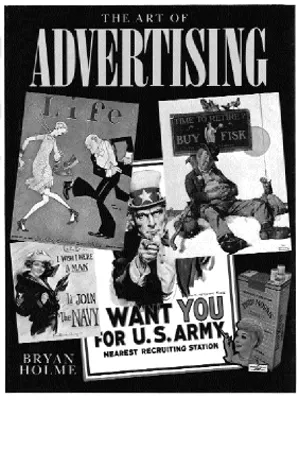
Art and advertising have been linked for decades. Illustrations are called artwork, and the people that design them, art directors. This book by Bryan Holme illustrates the linkage.
![]()
2
Advertising and Art
Before the age of the printed book, poetry was used to pass along stories from one generation to the next. It’s much easier to remember a story in rhyme than one in prose and then retell it to others. Homer (circa 850 b.c.) wrote his masterpieces The Iliad and The Odyssey in poetry.
Poetry may be just as popular today as it was in Homer’s time. The difference is that today poetry is an art form. Its communication function has been lost. Most authors do not use poetry these days to pass along information in verbal form. They use prose because printed books allow text to be easily passed to future generations.
Turnin...