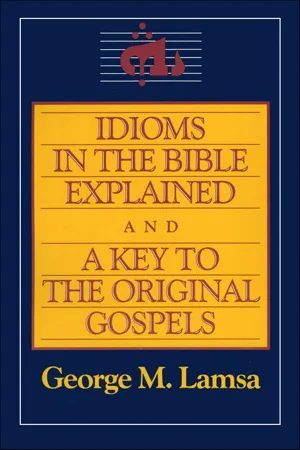
Explanations of nearly 1,000 ancient idioms, metaphors, and figures of speech in the Old and New Testaments, from a renowned Bible translator.
George M. Lamsa, who was raised speaking Aramaic in a community that followed customs largely unchanged since the times of Christ, offers accurate translations of important idioms, metaphors, and figures of speech found in the Scripture—and provides clear explanations of their meaning in biblical context.
Just as Shakespeare, Milton, and Browning wrote in the vernacular for English-speaking people, Moses, the prophets, and the apostles wrote for their own people in the plain language of their times, so that even the unlearned might understand God's Word. Over the centuries, inaccurate translations and misunderstandings of customs and concepts have led to difficulties in bringing the biblical message to contemporary English-speaking readers.
For example, when a man says to Jesus, "let me bury my father," Lamsa points out that this expression means, "Let me first take care of my father until he dies." Traditionally, scholars assumed that this man's father was dead and that Jesus was not interested in his burial. Lamsa's scholarship offers a more accurate understanding of the intent and spirit of this passage.
Idioms in the Bible Explained and a Key to the Original Gospels goes far in correcting such errors that have crept into Biblical scholarship. Obscure and difficult passages from both Old and New Testaments are listed and compared with the King James version (though it will be helpful when used with any English version). These make clear the original meaning of such ancient idioms and assure that our grasp of the biblical message is more sound and rewarding. To further uncover the original teachings of Scripture, Lamsa discusses at greater length such topics as "The Language of Jesus," "Aramaic Phraseology," "The Sayings of Jesus," "Early Translations," and more.
- 128 pages
- English
- ePUB (mobile friendly)
- Available on iOS & Android
eBook - ePub
Idioms in the Bible Explained and a Key to the Original Gospels
About this book
Information
Topic
Theology & ReligionSubtopic
Translating & InterpretingPart One
Idioms in the Bible
Explained
THE BOOK OF GENESIS
Let there be light. Gen. 1:3
Let there be enlightenment; let there be understanding.
Darkness. Gen. 1:4
Ignorance; lack of enlightenment and understanding.
Eden. Gen. 2:8
A delightful place; temporal life.
Garden. Gen. 2:8
Metaphorically—a wife; a family.
Tree of life in the midst of the garden. Gen. 2:9
Sex; posterity, progeny.
The tree of the knowledge of good and evil. Gen. 2:9
Moral law; the knowledge of good and evil.
The tree of life. Gen. 2:9
Eternal life.
The tree of good and evil. Gen. 2:17
Metaphorically—sexual relationship.
Good. Gen. 2:17
Anything perfect.
Evil. Gen. 2:17
Anything imperfect; contrary to good; immature.
Naked. Gen. 2:25
Exposed; ashamed.
Serpent. Gen. 3:1
An enemy; deception.
Thorns and thistles. Gen. 3:18
Grievances and difficulties.
Sent forth from the garden. Gen. 3:23
A loss of harmony; a lost paradise.
God took him away. Gen. 5:24
He died painlessly. He had a heart attack.
Sons of God. Gen. 6:2
Good men; the descendants of Seth.
My spirit shall not dwell in man forever. Gen. 6:3
I have become weary and impatient. (A scribal note.)
The Lord was sorry that He made man. Gen. 6:6
(A scribal note. See Old Testament Light—Lamsa.)
I set my bow in the clouds. Gen. 9:13
I set the rainbow in the sky.
I have lifted up my hands. Gen. 14:22
I am taking a solemn oath.
Thy seed. Gen. 17:7
Your offspring; your teaching.
Angels. Gen. 19:1
God’s counsel; spirits; God’s thoughts.
Looking behind. Gen. 19:17
Regretting; wasting time.
A pillar of salt. Gen. 19:26
Lifeless; stricken dead.
As the stars of heaven. Gen. 22:17
Many in number; a great multitude.
Went in at the gate. Gen. 23:18
Mature men who sat at the counsel.
Hand under thigh. Gen. 24:2
Hand under girdle; a solemn oath.
Tender eyed. Gen. 29:17
Attractive eyes.
He hath sold us. Gen. 31:15
He has devoured our dowry.
Wrestling with an angel. Gen. 32:24
Being suspicious of a pious man.
Coat of many colors. Gen. 37:23
A coat with long sleeves meaning learning, honor and a high position.
Spilling seed on the ground. Gen. 38:9
Spilling semen on the ground. (An ancient practice of birth control.)
No man shall lift up his hand or foot. Gen. 41:44
No man shall do anything without your approval.
Put his hand upon thine eyes. Gen. 46:4
Shall close your eyes upon your death bed.
Laying on of hands. Gen. 48:14
Blessing and approving a person.
His right hand upon the head. Gen. 48:17
A sincere blessing.
Unstable as water. Gen. 49:4
Undecided; in a dilemma.
The sceptre shall not depart from Judah. Gen. 49:10
There shall always be a king from the lineage of Judah.
Washed his garments in wine. Gen. 49:11
He will become an owner of many vineyards.
His teeth white with milk. Gen. 49:12
He will have abundant flocks of sheep.
His bow abode in strength. Gen. 49:24
He will become a valiant warrior.
The stone of Israel. Gen. 49:24
The strong race of Israel.
He gathered up his feet. Gen. 49:33
He stretched out his feet—He breathed his last...
Table of contents
- Contents
- Introduction
- Part One: Idioms in the Bible Explained
- Part Two: A Key to the Original Gospel
- Some Examples of the Usage of Aramaic Words
- About the Author
- Other Books by George M. Lamsa
- Credits
- Copyright
- About the Publisher
Trusted by 375,005 students
Access to over 1.5 million titles for a fair monthly price.
Study more efficiently using our study tools.
Frequently asked questions
Yes, you can cancel anytime from the Subscription tab in your account settings on the Perlego website. Your subscription will stay active until the end of your current billing period. Learn how to cancel your subscription
No, books cannot be downloaded as external files, such as PDFs, for use outside of Perlego. However, you can download books within the Perlego app for offline reading on mobile or tablet. Learn how to download books offline
We are an online textbook subscription service, where you can get access to an entire online library for less than the price of a single book per month. With over 1.5 million books across 990+ topics, we’ve got you covered! Learn about our mission
Look out for the read-aloud symbol on your next book to see if you can listen to it. The read-aloud tool reads text aloud for you, highlighting the text as it is being read. You can pause it, speed it up and slow it down. Learn more about Read Aloud
Yes! You can use the Perlego app on both iOS and Android devices to read anytime, anywhere — even offline. Perfect for commutes or when you’re on the go.
Please note we cannot support devices running on iOS 13 and Android 7 or earlier. Learn more about using the app
Please note we cannot support devices running on iOS 13 and Android 7 or earlier. Learn more about using the app
Yes, you can access Idioms in the Bible Explained and a Key to the Original Gospels by George M. Lamsa in PDF and/or ePUB format, as well as other popular books in Theology & Religion & Translating & Interpreting. We have over 1.5 million books available in our catalogue for you to explore.