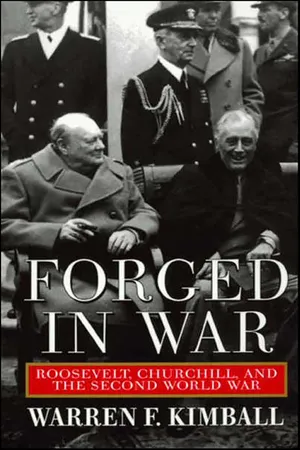
Roosevelt and Churchill continue to fascinate both the World War II generation and those who have grown up in the world formed by that struggle. Here is an inside look at their relationship and the politics, strategy, and diplomacy of the British-American alliance. Warren F. Kimball's lively analysis of these larger-than-life figures shows how they were at the same time realists and idealists, consistent and inconsistent, calculating and impulsive. The result is an unforgettable narrative.
- 432 pages
- English
- ePUB (mobile friendly)
- Available on iOS & Android
eBook - ePub
About this book
World War II created the union between Franklin Roosevelt and Winston Churchill, molding it from start to finish, while the partnership itself shaped many of the most significant moments of the war and the peace that followed. Their connection was truly forged in war.
Information
CHAPTER 1
The Players:
“A Pugnacious Looking
Bastard” and “This Artist,
This Seducer”
Never were there two less likely-looking warriors. Winston Spencer Churchill was, to be candid, short and fat; “very pink and cuddly,” commented one journalist’s wife upon her first close encounter. His round red cheeks invariably prompted the description “cherubic,” though nothing could be further from the truth. He waddled rather than walked and lectured rather than listened, talking endlessly about everything, the opposite of the virile, strong, silent leader that fiction idealized and John Wayne and Hollywood popularized. Much of his working time was spent lying abed, and when he did get up, it was often to prance around in soft slippers and pink bathrobe or his “siren suit” (designed to be pulled on easily in the event of an air raid), getups that brought derision from more than a few diarists. “A marvellous garment [Churchill’s dressing gown], rather like Joseph’s many-coloured robe,” General Alan Brooke, the chief of the Imperial General Staff, acidly commented, going on to describe a typical evening’s work with the prime minister:
Finally at 2:15 A.M. he suggested we should proceed to the hall to have some sandwiches, and I hoped this might at least mean bed. But, no! We went on till ten to three before he made a move for bed. He had the gramophone turned on, and in the many-coloured dressing gown, with a sandwich in one hand and watercress in the other, he trotted round and round the hall, giving occasional little skips to the tune of the gramophone.
On each lap near the fireplace he stopped to release some priceless quotation or thought. For instance he quoted a saying that a man’s life is similar to a walk down a long passage with closed windows on either side. As you reach each window, an unknown hand opens it and the light it lets in only increases by contrast the darkness at the end of the passage.1
That image of English eccentricity must be balanced against the description of Churchill from a soldier in the ranks during a formal inspection:” He’s a pugnacious looking bastard.”2 But as Adolf Hitler found out, it was more than just looks.
A search committee working in 1939, or even 1940, to hire a wartime leader would have carefully examined Winston Churchill’s résumé. After all, he had attended the British military academy at Sandhurst, had been first lord of the admiralty during the Great War of 1914–18, and had called stridently for Britain to rearm as Germany became more belligerent in the 1930s.
But those assets were more than offset by performance. Whatever Churchill’s fascination with things military, his academic performance at Sandhurst was undistinguished, and his military service uneventful and brief. His mother, the former Jennie Jerome and an American debutante from Baltimore when she married Randolph Churchill, once cautioned her son not to come home from India on leave early in his short army career. Though her real motive was to save money—always in short supply for a woman with champagne tastes—she hit on a truth when she warned young Winston: “They will say & with some reason that you can’t stick to anything. You have only been out six months….”3 His tenure during the First World War as civilian head of the British navy (first lord of the admiralty) was best remembered for the bloody debacle at Gallipoli in Turkey, where bad planning and worse execution cost thousands of lives. He had alienated the labor movement with his vocal opposition to socialism at home and bolshevism in Russia and had widened the gap by leaving the Liberal party in 1922,when it supported a Labour government. His vigorous public support for strong action against the general strike in 1926 only added to his reputation as being unsympathetic to the working class, though Churchill’s response was that his quarrel was with the socialist intellectuals who had captured the trade unions.4
Nor were his new colleagues in the Conservative party happy with him. During the 1930s he had infuriated Tory leaders by condemning even the very mild steps toward home rule in India they had proposed. His method and style of predicting confrontation with Germany had angered and alienated many of the very people upon whom any prime minister would have to depend. By the winter of 1937–38 “his propensity for self-inflicted injuries … had left his reputation in shreds.”5
Whatever Churchill’s dramatic personal style, the search committee, initially intrigued, would have looked suspiciously at the candidate’s preference for knights in shining armor and cavalry charges—despite his equal fascination with aircraft and technology. It would have shaken its collective head at his lack of political correctness and then slipped Churchill’s application into the stack marked “Routine Rejection” (just as a majority of Conservative party MPs would have done in May 1940 had they voted on a leader to replace then Prime Minister Neville Chamberlain).6
Franklin Delano Roosevelt had once the lean, lithe, athletic body and handsomeness of a Hollywood leading man. But all that remained after the ravages of polio in 1921 (then called infantile paralysis) and subsequent confinement to a wheelchair for twenty years was a leonine head and broad torso attached in incongruous fashion to a pair of wasted, completely useless legs. He could not walk or stand unaided. Benito Mussolini, leader of Fascist Italy, privately mocked Roosevelt as “that cripple” and described FDR’s speech in 1938 as either demented or a result of sickness of the brain. But outward appearances were not all that made Roosevelt, as well as Churchill, an improbable warlord.
The same hiring committee that had examined Churchill’s credentials would have found even less to commend Franklin Roosevelt’s candidacy for the job of American war leader. Family prominence—he was from the American equivalent of the landed gentry and a cousin of President Theodore Roosevelt—had gotten him into Columbia Law School, but a mediocre academic record was followed by a desultory and unsuccessful fling at the practice of law. He ran for office as a Democrat before the First World War because, he told a young woman, there were already too many Roosevelts in the Republican party trying to capitalize on Theodore’s name. (“The most calculating, unprincipled thing she’d ever heard,” was the woman’s later comment.7) Childish vices had continued into manhood; “vain,” “superficial,” and “spoiled” were the words used by contemporaries and biographers, though his affable charm struck all who met him, anticipating the later assessment of Supreme Court Justice Oliver Wendell Holmes: “A second-class intellect. But a first-class temperament!”8
Before contracting polio in 1921, Roosevelt seemed content to live in a comfortable cocoon of upper-class security and respectability. His love of sailing and a few years as Woodrow Wilson’s assistant secretary of the navy during the First World War gave him a parochial acquaintance with naval affairs; he was fascinated by great warships and naval lore but knew little about the army and its air force and displayed no interest in military strategy of any kind. Any letters of reference from that era would have pictured an ambitious conniver who, with an eye on his own political career, disloyally failed to support his boss, Josephus Daniels, before a congressional committee. Character references would have hinted at an extramarital affair, though no one would have known that Eleanor, his wife, had given him an ultimatum: She would file for divorce unless he gave up the other woman (Lucy Mercer). Divorce in that era meant the end of a political career, and FDR made the practical choice.
But his response to polio demonstrated a new grit and patience. The crippling disease either brought out or created an inner strength, which, added to his always breezy, optimistic style, made for a formidable public persona. At the same time the illness provided Eleanor Roosevelt a chance to develop her own sense of confidence and self-worth as she helped nurse him back to not only physical but political health. That strength of purpose was to serve them, and the nation, well during the two major crises of FDR’s presidency: the Great Depression and the Second World War.
Those assets brought him to the governor’s mansion in Albany, New York, in 1928 and to the White House in the election of 1932. But his election as president came with a mandate for dealing with domestic crisis, the Great Depression. Roosevelt had little interest or experience in international affairs. His few forays into that arena, in the form of speeches and articles, combined belligerence with ignorance.9 Whatever his political credentials, the search committee once again would have sent him the standard rejection letter.
But the Second World War leaders for Great Britain and the United States were not chosen by committee. Both Winston Churchill and Franklin Roosevelt rose to wartime power through the political process.
If British voters had been asked to pass judgment on Churchill the individual, as Americans do every four years on their presidents, his election could have come only at the moment of deepest British despair, when France collapsed in June 1940 after only token resistance. Appeasement had failed; its successor—Chamberlain’s postponement policy, predicated on the ability of the French to hold out—seemed to have left Britain at Hitler’s mercy. The situation demanded a new leader with new policies and a new sense of purpose.
When war had broken out nine months earlier, Chamberlain had tried to co-opt Churchill by bringing the government’s most vocal foreign policy critic into the Cabinet as first lord of the admiralty. But the very fact of having to go to war had discredited Chamberlain’s policies, and his ineffective public leadership in the months that followed left him vulnerable to any failure. Then came Norway, a disaster for all concerned. “The Norwegians lost their independence, the British their government, and the Germans most of their surface fleet—at least for the time being” and perhaps long enough to have interfered with German plans for an invasion of Britain. More immediately the bumbling Anglo-French response to Hitler’s violation of Norway’s neutrality (he took Denmark en route) made Britain—and the Chamberlain government—look weak and foolish. Even Churchill admitted that Hitler had “completely outwitted” them.
On May 9, 1940, following an all-too-slim victory on a vote of confidence in the House, Chamberlain decided to resign. He hesitated the next day, when the Germans began their roll westward through the Low Countries (prompting one Churchill supporter to complain, “It’s like trying to get a limpet off a corpse”), but could not delay any longer.
Change was inevitable, but Winston Churchill was not—at least not until Foreign Secretary Lord Halifax took himself out of the running. That left the king, George VI, with the reality that, in his own words, “there was only one person I could send for to form a Government who had the confidence of the country, & that was Winston.” No matter that Churchill had supported Chamberlain’s appeasement of Italy, the invasion of Norway, and the rest of the government’s policies after war had begun. Churchill promised action, and action was what Parliament and the public demanded.10
Roosevelt’s path to war leader was even more a matter of chance than Churchill’s. The Englishman had actively involved himself in foreign and defense policy issues throughout the 1930s, whereas FDR was reelected president in 1936 as a domestic problem solver. Yet in the years that followed the international crisis demanded increasing attention. The silly argument that FDR welcomed and even exacerbated the problems with Germany and Japan in order to distract attention away from his domestic failures is belied by the fact that those crises were initiated by the Germans and Japanese, not by the United States. Nor is there persuasive evidence that Roosevelt had lost faith in the New Deal, even if he worried that the public might not share his view.
In one sense American voters did choose Roosevelt as their war leader. Although the United States did not enter the fray formally until the Japanese attack on Pearl Harbor in December 1941—two years and three months after the war in Europe had begun and four and one-half years after Japan’s all-out assault on China—Roosevelt’s reelection in November 1940 was a choice of a war leader, or at least a leader most Americans thought or hoped would keep the nation out of all-out war without letting that war be “lost.” No one wanted to go to war, yet no one wanted Hitler to win. At the same time a growing number (a majority by mid-1940) believed that defeating Germany would require that the United States join the fighting.11
Roosevelt played to the numbers. Whatever his own beliefs about entering the war, he avoided that black-and-white issue like the plague. His “private” lobbying effort (what in the 1990s is called a political action committee) was led by the Committee to Defend America by Aiding the Allies. The name alone illustrated the strategy. His major aid program before the election was a swap of old, decrepit World War I-vintage destroyers for valuable base rights in seven British territories in the Western Hemisphere, and in October 1940, just before the election, FDR pandered to national fears by promising that “your boys are not going to be sent into any foreign wars,” never raising the question of how American support for the Allies might force war on the nation.12
Did he believe, before the election of 1940, that the United States should and would enter the war? Who knows? He quickly dropped his initial prediction in 1939 of a very short war resulting from either a quick German victory or the collapse of the Nazi regime. Within a few months he had moved firmly, and publicly, toward a neutrality that favored the Allies. But no evidence has surfaced to demonstrate that he lied actively and consistently to the American people about his ultimate intentions, and there are good reasons to conclude that he hoped that the United States could (or would have to) fight a limited war—with only naval and air forces engaged against the Germans. Even after his reelection Roosevelt told his secretary of state, Cordell Hull, and the American military chiefs in mid-January 1941 that the United States should be prepared to fight a defensive war in the Pacific, while the Navy should prepare to convoy supplies to Britain. But the Army should follow “a very conservative” approach, he said, focusing on protecting Latin America.13
But not lying is not the same as telling the truth. Clearly Roosevelt did not take the public into his confidence during the election campaign of 1940. He avoided and evaded answering awkward questions about how the United States could be neutral and still provide naval vessels and war supplies to one of the belligerents. The usual justification for such actions has been that FDR, wary of being told no if he asked the public to endorse greater assistance to Britain, needed time to “educate” Americans and their congressional representatives.14
But the public, the president, and politicians in general follow conventions—accepted usages that provide what reporters call plausible deniability for all parties. They use an adult version of the children’s taunt “Ask me no questions; I’ll tell you no lies.” Even the unsophisticated polls of that era (FDR occasionally suggested questions for t...
Table of contents
- Cover
- Title Page
- Dedication
- Contents
- Epigraph
- List of Illustrations
- Chapter 1: The Players “A Pugnacious Looking Bastard” and “This Artist, This Seducer”
- Chapter 2: “If Britain Is to Survive” September 1939-September 1940
- Chapter 3: “A Year of Indecision” October 1940–June 1941
- Chapter 4: “History Has Recorded Who Fired the First Shot” The Soviet Union and the: United States Enter the War: June 1941-December 1941
- Chapter 5: “It Is Fun to Be in the Same Decade with You” December 1941–July 1942
- Chapter 6: “The End of the Beginning”— and the “Beginning of the End” August 1942–February 1943
- Chapter 7: “I Am Not a Wilsonian Idealist, I Have Problems to Resolve” March-December 1943
- Chapter 8: “A New Heaven and a New Earth” December 1943-December 1944
- Chapter 9: The “Holy Alliance” December 1944—War’s End
- Appendix: On Health and the History of the Second World War 1
- Bibliography
- Index
- Acknowledgments
- Previous Books by Warren F. Kimball
- Copyright
- About the Publisher
- Endnotes
Trusted by 375,005 students
Access to over 1.5 million titles for a fair monthly price.
Study more efficiently using our study tools.
Frequently asked questions
Yes, you can cancel anytime from the Subscription tab in your account settings on the Perlego website. Your subscription will stay active until the end of your current billing period. Learn how to cancel your subscription
No, books cannot be downloaded as external files, such as PDFs, for use outside of Perlego. However, you can download books within the Perlego app for offline reading on mobile or tablet. Learn how to download books offline
Perlego offers two plans: Essential and Complete
- Essential is ideal for learners and professionals who enjoy exploring a wide range of subjects. Access the Essential Library with 800,000+ trusted titles and best-sellers across business, personal growth, and the humanities. Includes unlimited reading time and Standard Read Aloud voice.
- Complete: Perfect for advanced learners and researchers needing full, unrestricted access. Unlock 1.5M+ books across hundreds of subjects, including academic and specialized titles. The Complete Plan also includes advanced features like Premium Read Aloud and Research Assistant.
We are an online textbook subscription service, where you can get access to an entire online library for less than the price of a single book per month. With over 1.5 million books across 990+ topics, we’ve got you covered! Learn about our mission
Look out for the read-aloud symbol on your next book to see if you can listen to it. The read-aloud tool reads text aloud for you, highlighting the text as it is being read. You can pause it, speed it up and slow it down. Learn more about Read Aloud
Yes! You can use the Perlego app on both iOS and Android devices to read anytime, anywhere — even offline. Perfect for commutes or when you’re on the go.
Please note we cannot support devices running on iOS 13 and Android 7 or earlier. Learn more about using the app
Please note we cannot support devices running on iOS 13 and Android 7 or earlier. Learn more about using the app
Yes, you can access Forged in War by Warren F. Kimball in PDF and/or ePUB format, as well as other popular books in History & Military Biographies. We have over 1.5 million books available in our catalogue for you to explore.