In the colonial and antebellum South, black and white evangelicals frequently prayed, sang, and worshipped together. Even though white evangelicals claimed spiritual fellowship with those of African descent, they nonetheless emerged as the most effective defenders of race-based slavery.
As Charles Irons persuasively argues, white evangelicals' ideas about slavery grew directly out of their interactions with black evangelicals. Set in Virginia, the largest slaveholding state and the hearth of the southern evangelical movement, this book draws from church records, denominational newspapers, slave narratives, and private letters and diaries to illuminate the dynamic relationship between whites and blacks within the evangelical fold. Irons reveals that when whites theorized about their moral responsibilities toward slaves, they thought first of their relationships with bondmen in their own churches. Thus, African American evangelicals inadvertently shaped the nature of the proslavery argument. When they chose which churches to join, used the procedures set up for church discipline, rejected colonization, or built quasi-independent congregations, for example, black churchgoers spurred their white coreligionists to further develop the religious defense of slavery.
eBook - ePub
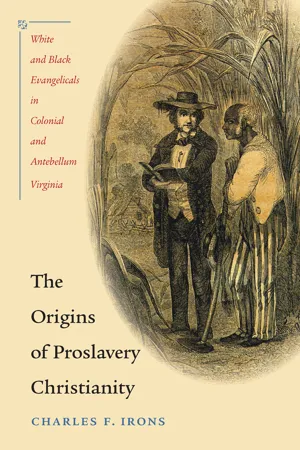
The Origins of Proslavery Christianity
White and Black Evangelicals in Colonial and Antebellum Virginia
- 384 pages
- English
- ePUB (mobile friendly)
- Available on iOS & Android
eBook - ePub
The Origins of Proslavery Christianity
White and Black Evangelicals in Colonial and Antebellum Virginia
About this book
Information
Chapter One
FISHERS OF MEN, 1680-1792
And he saith unto them, “Follow me, and I will make you fishers of men.”
—Matthew 4:19
Anglo-Virginians and African Virginians had a long history of interaction in the Old Dominion before some of them became evangelicals in the 1730s. Despite fluidity in the colony’s early years about the legal status of people of African descent, that history was generally a one-sided story of exploitation. 1 This was true in an ecclesiastical as well as an economic and personal sense. Just as English colonists coerced labor from African bodies and offered precious little in return, so too they suppressed African belief systems but did not invite Africans into their Anglican churches. Until the very end of the eighteenth century, as one scholar put it, “most of the slaves lived and died strangers to Christianity.”2
Sympathetic reformers within the Anglican Church blasted Virginia divines for their unwillingness to pursue the souls of black Virginians (or of Indian peoples, for that matter). Failure to do so, they argued, eroded Anglicans’ claim to be the spiritual shepherds of all Virginians and was in open defiance of the ministers’ early charge to preach to the “salvage people which doe or shall adjoine unto them, or border unto them.”3 Both an evangelical faction within the Anglican Church and a number of ministers from dissenting sects took up this critique of “Virginia’s Mother Church” when they arrived in Virginia in the 1730s and after. They hoped to distinguish themselves from traditional Anglicans through their attention to black Virginians. Africans and African Americans, for their part, helped to expose the limits of the Anglican Church’s spiritual reach by responding only haltingly to Anglicans’ late and desultory efforts to convert them. They were much more receptive to dissenting evangelical ministers, especially in the post-Revolutionary period. Black Virginians’ decision to listen to dissenters simultaneously helped to destroy the Anglican Church and to cement evangelicalism’s biracial character. Furthermore, Virginia’s African American converts repeatedly asserted that liberation should accompany conversion and thereby forced both Anglicans and evangelicals to explain the relationship between slavery and Christianity in new ways.
Anglo-Virginians and African Virginians in the seventeenth century were not as far apart doctrinally as Anglo-Virginians may have assumed. Some of the Africans who disembarked a Dutch man-of-war onto Virginia soil in 1619 bore Portuguese names, evidence that they had received baptism into the Catholic Church. There are few records of precisely how the commonwealth’s Anglican churches accommodated these Catholic interlopers, though the shared Christian heritage of Atlantic creoles and Virginia’s English settlers may have been one of the reasons that Anglo-Virginians in the colony’s first decades did not automatically assume that all men and women of African descent would be slaves for life. The names of free blacks living in Virginia in the 1640s, such as Emanuel Driggous, Bashaw Ferdinando, and John Francisco, illustrate the success that some people of color who arrived in Virginia as baptized Christians had in escaping slavery. Others who converted while living in Virginia also pressed the connection between Christianity and freedom. Several men and women of African descent sued in court for their freedom in the colony’s first decades on grounds that it was unlawful for Christians to hold one another in bondage.4
The demographic composition of the African arrivals and the occasional flexibility of Virginia’s laws had changed by 1705. Anglo-Virginians had been importing bonded laborers directly from Africa for more than a generation when, in that year, members of the colony’s elected assembly, the House of Burgesses, passed a comprehensive slave code. A few of the forced migrants who flooded into the commonwealth from Africa had knowledge of Christianity, and others practiced Islam; but the vast majority practiced African traditions foreign to Anglo-Virginians.5 White Virginians who wanted to preserve their access to bonded labor and who perceived a growing cultural distance between themselves and these new arrivals described Africans as “savages” or “heathens” and used this definition to justify their perpetual enslavement.6 Whites at the same time increased their financial commitment to African labor and intensified this sense of cultural difference by purchasing new slaves at a furious rate over the next several decades, roughly 1,000 persons per year between 1700 and 1740. This figure often surpassed the annual totals for voluntary European immigrants, and by 1760, more than 40 percent of Virginia’s population was African-based.7 In the context of such a tremendous influx of non-Anglican peoples, white authorities gave less weight to individual conversions and emphasized instead the unchurched status of the group. Since most African arrivals were not Christian, Anglicans felt justified in enslaving them.
Anglo-Virginians found in their King James Bible a description of Hebraic slavery that seemed to correspond perfectly to the labor patterns that emerged in the commonwealth during the late seventeenth century. English indentured servants, most of whom were baptized while infants into the Anglican Church, were the equivalent of the biblical ered ivri (Hebrew slaves), while men and women of African descent fit the description of ered canaani (non-Hebrew slaves). By law, the Israelites could not keep Hebrew slaves in bondage beyond a jubilee every seven years, roughly the terms of an indenture. They could, however, place those outside their covenant relationship with God into perpetual, hereditary slavery. As the summary of the Hebraic slave code in Leviticus indicates,
Both thy bondmen, and thy bondmaids, which thou shalt have, shall be of the heathen that are round about you; of them shall ye buy bondmen and bondmaids. Moreover of the children of the strangers that do sojourn among you, of them shall ye buy, and of their families that are with you, which they begat in your land: and they shall be your possession. And ye shall take them as an inheritance for your children after you, to inherit them for a possession; they shall be your bondmen for ever: but over your brethren the children Israel, ye shall not rule one over another with rigour.8
Some seventeenth-century Anglicans did believe that the Curse of Ham in Genesis 9 justified the enslavement of Africans, but most did not need to appeal to this mythology in the light of such a clear scriptural distinction between the servitude of Christians and non-Christians.9
Anglicans in Virginia who accepted this religious distinction between slave and free could not make the imaginative leap of including people of color in the body of Christ. They cited myriad difficulties in ministering to slaves, especially the linguistic and cultural differences between African arrivals and Englishmen. Many whites felt that such a gulf, in terms of both language and customs, made either conversion or true communion impossible. When Governor Francis Nicholson sought legislation in 1699 to spur the conversion of Indians and Africans, the burgesses protested that he was asking too much. People of African descent, the burgesses explained, were extremely unlikely converts, owing to the “Gros Barbarity and rudeness of their Manners, the variety and Strangeness of their Language and the weakness and shallowness of their Minds.”10 Anglo-Virginians complained of these obstacles into the eighteenth century, despite contemporary evidence that the difficulty of communicating the fundamentals of their faith might not have been so insurmountable, after all. Also in the seventeenth century, Portuguese settlers in South America routinely overcame the language barrier between them and their chattel by using a small corps of African Christians—mostly Kongolese—to catechize victims of the Atlantic slave trade. Protestant Englishmen only lacked access to a ready cadre of African catechists because they failed to recruit one following importation.11 Moreover, Anglican clergymen readily devised means to communicate with illiterate Englishmen and Algonquin-speaking Indians. New Englander John Eliot translated the Bible into Massachusett in 1663, and the challenge for southern divines of learning African dialects should not have differed by degree.
Slaves themselves made swift religious assimilation impossible, for Africans carried with them across the middle passage their own, durable belief systems. Men and women of African descent indicated a strong preference for remembered African traditions, for Islam, or, in the case of the Kongolese, a form of Catholicism. Though wars within Africa, the transatlantic voyage, and the auction block had a way of separating slaves with similar ethnic and theological origins, most Virginia slaves nonetheless retained some beliefs from their parents. There is considerable evidence for the vitality of these African traditions. In some cases, slaves from different West African ethnicities cobbled together a synthetic African religion, labeled by subsequent observers as “conjure” or “voodoo.” In others, ethnic enclaves enabled some men and women to keep ancestral traditions alive into the nineteenth century.12 As a result either of their adherence to African or African-based religions, of their contempt for the beliefs of their enslavers, or of the profound difficulty of communicating on a substantive theological level with white Anglicans, Virginia’s African slaves spurned the Church of England from the time of their arrival throughout the colonial period.
Africans, along with Indians and dissenters who also remained outside the Anglican Church, forced Anglicans to adopt a more limited understanding of the nature of their religious establishment. At the beginning of their sojourn in Virginia, English settlers had believed that their colonial church should encompass all of the colony’s residents, and their initial treatment of Indians reflected this understanding. In the relatively peaceful year of 1617, the colonists’ enthusiasm for inclusion of Indians within the Anglican Church peaked. Flushed with the triumph of Pocahontas’s Anglican baptism and subsequent journey to England, Anglo-Virginians planned a system of schools for Indians—hoping to facilitate similar cultural and religious transformations. One generous English donor to the proposed schools suggested that Indian children might be trained until the age of twenty-one, then given the same liberties as Englishmen. Opechancanough, powerful heir to the Powhatan Confederacy and kinsman of Pocahontas, brought all such dreams abruptly to an end when he led a devastating uprising against the Virginia English in 1622. His warriors killed 347 people, roughly one-quarter of the colony’s white residents. Colonialists then defined even geographically proximate Indians as outside and antagonistic to their community—and therefore excepted from the obligation of attending Anglican worship.13 Anglo-Virginians who still expressed a desire to convert and acculturate the Powhatans after this point generally restricted their proselytization to the native peoples whom they held in slavery. White Virginians from the 1620s through the 1670s thus conceived of Indian slavery as a way to facilitate conversion but recognized most Powhatans as beyond their reach.14
The absence of Africans from the established church was more theologically problematic than was that of the Powhatans. Anglo-Virginians could cultivate the fiction that Indians belonged outside the geographic bounds of their settlements, but they invited Africans into their most intimate spaces to perform their domestic and agricultural labor.15 Virginia blacks were thus undeniably parishioners of the colonial establishment, even if, as John Nelson explained, “few among them would have considered themselves as such” or “few, if any, of the dominant white inhabitants would have been willing to acknowledge it.”16 Rather than compel bonded African immigrants or the Scotch-Irish immigrants who came voluntarily into the commonwealth in the 1730s to join their churches or adopt their beliefs, Anglican Virginians simply abandoned the hope of a spiritually homogenous state. Enslaved Africans, by remaining outside Anglican worship, had demolished the establishment’s claim to universality. “What was left,” in one historian’s analysis, “was the derivative understanding of establishment: official confirmation and recognition, tax support, governmental surveillance, and special benefits and immunities” for a specific denomination.17 These special benefits were not enough to enable the Church of England to reach all Virginians, but they were burdensome enough that dissenters from the Anglican Church deeply resented its establishment.18
Despite whites’ decision not to introduce slaves to Anglicanism and thereby to jeopardize the correspondence between “slave” and “heathen,” some slaves expressed a persistent desire for admission into Virginia churches. Anglicans thus needed to clarify whether or not conversion affected a slave’s civil status. Many rightly feared that bondmen and -women might expect conversion to lead to emancipation, much as it had for Muslim and African slaves in medieval Europe. Legally savvy blacks such as Elizabeth Key, who won her freedom in 1656, and Fernando, who found his suit for liberty denied only because the judges could not (or would not) translate his Portuguese baptismal certificate, hastened a pronouncement from ecclesiastical and civil authorities by bringing the conflict between conversion and slavery to a head.19 In late 1667, Virginia’s General Assembly, which created the laws governing the establishment of religion, passed a statute denying that baptism implied manumission and closing such a route to freedom. Black Christians, even at this early stage, were already forcing whites to explain how Christianity and slavery were compatible.
Within the text of the statute, the burgesses offered a novel explanation for why they accepted the enslavement of their fellow Christians. It was important for converted Africans to remain in slavery, they argued, because the liberation of those such as Elizabeth Key created a powerful disincentive for planters to allow their slaves access to the Gospel. With this neat rationalization, the burgesses tried to recapture the moral high ground from the enslaved men and women who were calling on Anglo-Virginians to recognize their shared humanity. The burgesses framed themselves as the compassionate ones, suggesting in the statute “that diverse masters, ffreed from this doubt, may more carefuly endeavour the propagation of christianity by permitting children, though slaves, or those of greater growth if capable, to be admitted to that sacrament.”20 The law did not immediately bear fruit, and few if any slaveowners undertook new efforts to convert their slaves after the passage of the law. This lack of missionary activity allowed Anglo-Virginians’ association between “African” and “heathen” to remain intact for a few more decades. But the law created the theoretical possibility that Virginia slavery could continue even if that association somehow disappeared. It was thus a critical step in the transition of Virginia slavery into a system based on arbitrary racial differences rather than religious distinctions.
Morgan Godwyn, a passionate Anglican minister who was in Virginia when the burgesses passed the 1667 statute, was distraught that so many slaveholders were neglecting African souls. He recognized that failure to include blacks in the Anglican communion represented a departure from Anglican ideals and tried in vain to call his fellow churchmen to task for their sins of omission. Arriving in Virginia in 1665 or 1666, Godwyn perceived immediately the failure of whites to reach out spiritually to slaves and began chastising his parishioners for it. He continued to rebuke them after the passage of the law, which theoretically should have removed their objections to slave conversions. The minister was so strident in his advocacy for African Virginians that he soon wore out his welcome among Anglo-Virginians. He left the commonwealth in disgrace in 1670 but continued his crusade from afar, broadening his critique to include English treatment of slaves in Barbados as well.21
In a 1680 pamphlet titled The Negro’s & Indians Advocate, Suing for their Admission into the Church: or a Persuasive to the Instructing and Baptizing of the Negro’s and Indians in our Plantations, Godwyn identified white Barbadians’ and Virginians’ failure to incorporate slaves into the Anglican Church as “no less than a manifest Apostacy from the Christian Faith.” Accurately forecasting strategies that dissenters would use to criticize the established church, Godwyn warned that Anglicans’ inattention to blacks exposed Anglicans to legitimate charges of inconsistency. Indeed, he warned, Quakers were already making such accusations. “For shame cease to call your selves Christ’s Ministers,” he quoted one Quaker critic of the church as saying, “unless you will be contented to work in Christ’s Vineyard, to preach his Doctrine truly, and to exhort and edifie the poor of his Flock, as he commanded you; and to testifie both to small and great, bond and free, (as his Apostles and Ministers did).” Godwyn adopted the Friends’ line of attack against his own codenominationalists and insinuated that whites unwilling to invite blacks into their congregations should not even call themselves Christians, much less pretend to a lively establishment.22
At the same time that Godwyn demanded that blacks be included within the Church of England, he inadvertently helped...
Table of contents
- Title Page
- Copyright Page
- Table of Contents
- Acknowledgements
- Introduction
- Chapter One - FISHERS OF MEN, 1680-1792
- Chapter Two - GROWING PAINS, 1792-1815
- Chapter Three - THE FLOURISHING OF BIRACIAL CHRISTIANITY, 1815-1831
- Chapter Four - THE SPIRITUAL CHALLENGE OF NAT TURNER, 1831-1835
- Chapter Five - THE SECTIONAL CHURCH, 1835-1856
- Chapter Six - RELUCTANT, EVANGELICAL CONFEDERATES, 1856-1861
- Epilogue
- APPENDIX A
- APPENDIX B
- APPENDIX C
- NOTES
- BIBLIOGRAPHY
Trusted by 375,005 students
Access to over 1.5 million titles for a fair monthly price.
Study more efficiently using our study tools.
Frequently asked questions
Yes, you can cancel anytime from the Subscription tab in your account settings on the Perlego website. Your subscription will stay active until the end of your current billing period. Learn how to cancel your subscription
No, books cannot be downloaded as external files, such as PDFs, for use outside of Perlego. However, you can download books within the Perlego app for offline reading on mobile or tablet. Learn how to download books offline
We are an online textbook subscription service, where you can get access to an entire online library for less than the price of a single book per month. With over 1.5 million books across 990+ topics, we’ve got you covered! Learn about our mission
Look out for the read-aloud symbol on your next book to see if you can listen to it. The read-aloud tool reads text aloud for you, highlighting the text as it is being read. You can pause it, speed it up and slow it down. Learn more about Read Aloud
Yes! You can use the Perlego app on both iOS and Android devices to read anytime, anywhere — even offline. Perfect for commutes or when you’re on the go.
Please note we cannot support devices running on iOS 13 and Android 7 or earlier. Learn more about using the app
Please note we cannot support devices running on iOS 13 and Android 7 or earlier. Learn more about using the app
Yes, you can access The Origins of Proslavery Christianity by Charles F. Irons in PDF and/or ePUB format, as well as other popular books in History & North American History. We have over 1.5 million books available in our catalogue for you to explore.