![]()
PART I
Core Concepts
What Is Really Going on Behind the Scenes
Introduction
Negotiations will always involve a certain amount of smoke and mirrors. People bluff. Things can happen quickly. You need to think on your feet. They use a tactic. You counter it. You respond with your own tactic to move in a different direction. And so it goes. And yes, you need to be really good at recognizing, using, and countering all those tactics and strategies.
But, there is something else that you must know. You must also learn to read what is going on under the surface. You need to get behind the smoke and mirrors and get a picture of what is going on behind the scenes. The Core Concepts that will give you that picture are the Settlement Range and the Negotiation Cycle.
![]()
CHAPTER 1
The Settlement Range
The first Core Concept is the Settlement Range. The Settlement Range provides us with a critical visual picture of what is going on behind the scenes in a negotiation. Here is how it works.
Imagine a negotiation between a salesperson for a software company and a buyer. The buyer needs to purchase 11 licenses for this type of software. The salesperson has told him that the price for 11 licenses will be $500 each. Unbeknownst to the buyer, however, the salesperson is actually authorized to go as low as $400 per license in order to make this sale.
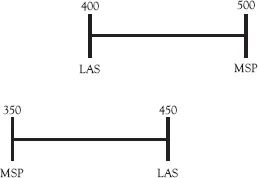
Let’s paint a picture of what we know about the salesperson’s negotiating position. We can do this by creating a range of all the possible agreements that the salesperson could make. Her opening offer is $500 per license and her absolute bottom line is $400 per license. If she can’t get the buyer to agree to at least $400, then she will walk away from this sale. Thus, she can make the sale at any price from $500 to $400. This is her Settlement Range. We call the opening offer the Maximum Supportable Position or MSP and the absolute bottom line the Least Acceptable Settlement or LAS.
Now let’s look at the buyer’s Settlement Range. He has been around the block a few times and he knows that there are often substantial discounts available for software. So he tells the salesperson that although his company really likes her software, the home-grown workarounds that they are using right now are adequate to do the job, although not as convenient. Therefore, although he would really like to purchase the software from her, he needs her to reduce her price to at least $350 per license. That is his Maximum Supportable Position (MSP). (Notice that for the buyer the MSP is the low dollar amount offered whereas for the seller the MSP is the high dollar amount offered.)
However, unbeknownst to the seller, the buyer has a budget of $5,000 for this software. The department that will be using the software has told him that under no circumstances can they go above $5,000 and that if the software costs more than that, they will continue to make do with what they have. The amount of $5,000 divided by 11 licenses is just over $450 per license. Therefore the buyer’s LAS, that is the absolute most that the buyer would be willing to spend, is $450 per license.
Figure 1.1 The settlement range
NOTE: Often people will use the term “bottom line” to indicate the point that is the last stop on their Settlement Range. That works okay for the seller since the seller’s bottom line is the lowest dollar amount they would accept in a price negotiation. However, when we are talking about the buyer we run into a tongue twister. Thus, the buyer’s bottom line is the most they would be willing to pay. Using the term LAS gets us out of the semantic problem. Furthermore, using the term LAS lets us use a single, universal term to apply to any negotiator’s worst case position for any issue that might be negotiated such as delivery, lead times, length of warranty, payment terms, royalty rates, and so on.
These two settlement ranges are shown in Figure 1.1 on page 4. It provides us with a visual image of what is actually going on in the minds of the two negotiators.
Now let’s take a look at the two ends of the range, the MSP and the LAS.
The Least Acceptable Settlement
The Least Acceptable Settlement, and more specifically the other party’s Least Acceptable Settlement, is the central focus of any negotiation.
Why? Because the other party’s LAS is the absolute best deal you can achieve. For that reason, we need to spend a few minutes examining where the LAS comes from, so that later on we will be able to develop a road map that will allow us uncover the other person’s LAS.
The first step is to start looking at how the other party builds their LAS. If we can determine how the LAS is built, then by looking for and finding those building blocks, we can work backward and make an educated guess as to where their LAS is located.
Let’s use an example of a situation that you may have experienced. Let’s say that you are looking for a new house. You currently live in East Podunk. Your house has become too small and you’re looking for a bigger house in the more upscale neighboring town of West Podunk.
You have found a house that is listed at $450,000, which you could actually afford to pay if necessary. So let’s look at several possible scenarios:
In Scenario 1, you have just started looking for a new house. You are in no great hurry. While you like that $450,000 house, it is not perfect. Houses come on the market fairly regularly in West Podunk. Therefore, you have decided that if you could get the house at a real bargain, you would buy it. Otherwise you will wait and see what else you can find. You set your LAS at $400,000.
In Scenario 2, you’ve been looking for over a year in order to find a new house. This house isn’t perfect, but neither are most of the other houses in West Podunk that have come on the market recently. You really would like to move and get this house-hunting business over with. You decide that your LAS is $425,000.
In Scenario 3 you been looking for six months and this house is perfect. You really want this house badly. You have fallen in love with it. You will try to get it for less, but if you can’t, your LAS is their asking price of $450,000.
In Scenario 4, it is mid-July. One of the primary reasons for moving from East Podunk to West Podunk is so your children can be in West Podunk’s superior school system. Even with a 45-day closing, this is tight timing if they are to start in September. The house is good enough, although not perfect, but you still decide that your LAS is $450,000, provided you can get the seller to move quickly on the closing.
In each of these scenarios, we’re talking about the same house. But in each of the four scenarios, there is a different set of circumstances, with each producing a different LAS for the exact same property.
In each case, you looked at the facts, that is the house, its condition, whether it is fairly priced for the market, all the features that it has, and so on. You also had to factor in your needs such as your need to stop house hunting or to get out of your current house. You factored in pressures such as time pressure—the need to move before the beginning of the school year.
Then, you looked at your alternatives, which would be to stay in your existing house, and you looked at the competition, namely the other houses for sale in West Podunk. Finally, you ran all that through your own subjective view. For example, the facts of the house don’t change, but how you look at them can to be very different from one person to another. One person thinks the house is adequate while another thinks that it’s absolutely perfect. You put all of these factors together, often subconsciously, and come up with a figure. That figure is your LAS.
How does the other party develop their LAS? The same way you did in developing your LAS for buying the house. They look at the facts, their own needs, the pressures that they face, what alternatives they have, what the competition is and any other relevant factors, and then they apply their own subjective evaluation to the mix. These are the building blocks of their LAS.
The LAS in a Competitive Environment
Many, many business negotiations involve sales and purchasing. And frequently, there is a high level of competition. If you buy or sell in a competitive environment, then this section is essential. If your negotiations are seldom, if ever, about buying and selling, or if you buy or sell in a noncompetitive environment, then go ahead and skip into the next section.
In most selling situations, there will be competition, and so in addition to looking at the facts, needs, pressures, and alternatives, it is important to pay particular attention to how the buyer uses available competition to develop their LAS. So let’s spend a few minutes looking at how the buyer builds their LAS where they have the luxury of being able to buy from more than one supplier.
If what is being purchased is a true commodity, it is easy for the customer to set their LAS. The lowest price that any one competitor is offering becomes the customer’s LAS. What is a true commodity? When one product can’t be differentiated from another, it becomes a commodity, much like wheat for example. From one farm to another, it is the same, so its price is based on supply and demand, not on negotiation. If a supplier can’t differentiate their product or services from their competitor’s product or services, the buyer will simply treat it like a commodity and set their LAS at the lowest price available from any one supplier.
If on the other hand, levels of quality, service, and so...