The
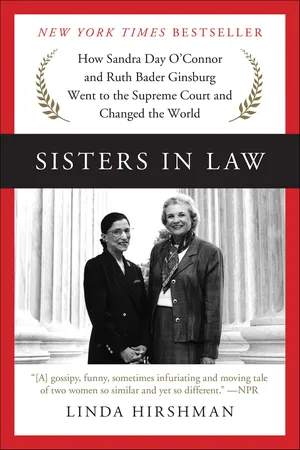
New York Times–bestselling "gossipy, funny, sometimes infuriating, and moving tale of two women so similar and yet so different" (
NPR).
The relationship between Sandra Day O'Connor and Ruth Bader Ginsburg—Republican and Democrat, Christian and Jew, western rancher's daughter and Brooklyn girl—transcends party, religion, region, and culture. Strengthened by each other's presence, these groundbreaking judges, the first and second to serve on the highest court in the land, have transformed the Constitution and America itself, making it a more equal place for all women.
Linda Hirshman's dual biography includes revealing stories of how these trailblazers fought for their own recognition in a male-dominated profession. She also makes clear how these two Supreme Court justices have shaped the legal framework of modern feminism, including employment discrimination, abortion, affirmative action, sexual harassment, and many other issues crucial to women's lives.
Sisters in Law combines legal detail with warm personal anecdotes that bring these women into focus as never before. Meticulously researched and compellingly told, it is an authoritative account of our changing law and culture, and a moving story of a remarkable friendship.
"A thorough, accurate, and most readable account of the careers of the two first women to serve as Justices of the Supreme Court." —Former Supreme Court Justice John Paul Stevens
"Smart, startling, and profoundly moving." —Stacy Schiff, Pulitzer Prize-winning author of
Cleopatra
"Superb." —
Library Journal, starred review
"Irresistible." —
New York Times Book Review
"Vital...Part of what makes Hirshman such a likable writer—in addition to her wit and ability to explain the law succinctly without dumbing it down—is her optimism." —
Washington Post
eBook - ePub
Sisters in Law
How Sandra Day O'Connor and Ruth Bader Ginsburg Went to the Supreme Court and Changed the World
- 432 pages
- English
- ePUB (mobile friendly)
- Available on iOS & Android
eBook - ePub
Sisters in Law
How Sandra Day O'Connor and Ruth Bader Ginsburg Went to the Supreme Court and Changed the World
About this book
Information
Part I
Sandra and Ruth Come into Their Own

Ruth Bader Ginsburg in 1972, the year she became the first female tenure-track faculty member at Columbia Law School.
1
Country Girl, City Kid
GROWING UP ON A RANCH
Sandra’s father, Harry Day, wanted to go to college. He thought he’d go to Stanford after serving in World War I. But just as he set out for college, his father, H. C. Day, died, leaving his parched and dusty family ranch in southeast Arizona in terrible financial straits. Harry had to leave California to see if he could rescue the cattle-raising operation. He never got to go to college. It was one of the regrets of his life.
But he was lucky in love. In 1927, on a cattle-buying trip to El Paso, he met Ada Mae Wilkey, from an El Paso ranching family, whom he had once known as a girl. Ada Mae, a college grad married briefly and abruptly divorced in the 1920s, had a checkered past. Still, her family didn’t want her marrying Harry Day and living on that primitive ranch with no power and no water. So the couple eloped.
Ada Mae was a trouper. She planted a garden around the little adobe house in the dry landscape. She played the piano and cooked huge meals, for the help or for parties. Biographer Joan Biskupic describes Sandra’s parents as presenting a decidedly mixed message, the father “a Gary Cooper individualist” can-do type, the mother a stockinged woman in a frock in the ’30s dust bowl, always “a lady.”
When, in 1930, Ada Mae was ready to give birth to the baby girl who would become Justice O’Connor, she went to El Paso, where there were modern health services. After a time, Harry Day came to visit his firstborn, Sandra.
DA, as she calls him, is the unrivaled star of O’Connor’s childhood memoir Lazy B: Growing Up on a Cattle Ranch in the American Southwest. The justice’s brother, Alan Day, who wrote the book with her, vividly recalls his oldest sibling as the favorite. His father “was on his best behavior when she was around, because Sandra would bring up stimulating subjects that he would want to talk about. And they would mentally head down the path together.” (There was also a sister, Ann, eight years younger than Sandra.) Harry Day was a vociferous conservative of the pure free-market variety. Self-reliance and individual responsibility were his touchstones. When Sandra was six, her parents sent her away to El Paso to live with her grandmother during the school year and go to proper schools. She found her grandmother totally annoying: “My grandmother was a nonstop talker. If her eyes were open, her lips were moving. It created quite a problem for all of those years, but somehow we survived.” Despite her pleas to return, with the exception of a single year in local schools, that’s where she stayed. There were simply no schools anywhere near the enormous cattle ranch.
It was not easy being Harry Day’s favorite kid. When she was fifteen, she was driving the ranch truck across the unmapped terrain of the huge isolated ranch to bring lunch to her father and the crew when she got a flat tire.
“I knew,” she recalls in Lazy B, “no one would be coming along the road either way to help. If the tire was to be changed, I had to do it.”
But when she jacked it up, the lug nuts were stuck and she could not get the tire off.
“Finally I decided I would have to let the truck back down until the truck rested on the ground again. . . . I pushed with all my might, but the lug nuts would not loosen. Finally I stood on the lug wrench and tried to jump a little on it to create more force. Joy! It worked. . . .
“I started the engine and continued on.”
But “it was late.”
When she arrived at the work site, “I could see DA but he didn’t acknowledge my presence.” She set out the lunch she had brought and “then I waited.” The crew finished branding and came over to eat.
“‘You’re late,’ said DA. ‘I know,’ I said. ‘I had a flat tire . . . and had to change it.’ ‘You should have started earlier,’ said DA. ‘Sorry, DA, I didn’t expect a flat.’ . . . I had expected a word of praise for changing the tire. But, to the contrary, I realized that only one thing was expected: an on-time lunch.”
Justice O’Connor says that she learned the value of no excuses from the incident. She must have quickly figured out that no excuses applied even when the incident was actually excusable. No matter how unfair, she would be better off not to directly defy the male authority figures in her life with demands for just treatment. As an only child for eight years and treated like a son, she had also internalized a sense of entitlement normally associated with straight white men. For the rest of her life she would combine her confidence in her own equal value with a unique ability to absorb a high level of injustice without complaint.
Within a year of the flat tire incident, Sandra left the ranch for Stanford. Sandra Day cut quite a swathe when she appeared in 1946 at the ripe age of sixteen. One of her dorm mates tells the story of how the girl from a remote Arizona ranch by way of an obscure El Paso private high school quickly rose to the top of the social order. “She had the most gorgeous clothes.” And, “after the first school dance . . . she came back with this cute guy, Andy, a returning vet, who had a red convertible. We were blown away.”
The Lazy B must have been a powerful experience. Even though after she turned six she lived on the ranch full time for only one year, all these years later, Justice O’Connor still calls herself a “cowgirl.”
BROOKLYN BORN AND BRED
Until she went away to college in 1950, Ruth Bader lived on the first two floors of 1584 East Ninth Street, in Brooklyn. It was a pretty, rectangular house. But it was a modest home. Ginsburg’s father, Nathan, had come from Russia and followed the classic Jewish immigrant path of going into the garment business, first as a furrier and then as a haberdasher. He never achieved much material success. When Ruth was two, her older sister Marilyn died of meningitis, leaving her an only child.
It’s a short block and a half from 1584 East Ninth Street to P.S. 238, on East Eighth, just across Avenue P. Seven years after P.S. 238 opened in 1930, tiny five-year-old Ruth Bader approached the high yellow brick building, pushed open the heavy doors, and walked across a terrazzo foyer to a big classroom with a hardwood parquet floor and high windows. There were a thousand children in this intimidating, enormous school, grades K–8, and classes often had thirty students in them.
Before she could read on her own, Ruth would sit in her mother’s lap while Celia Bader read to her. Her mother, who had been raised Orthodox, taught her more about the tradition of justice than the more rigid rules of the Jewish faith. When Ruth was older, she and her mother had a ritual of weekly outings, Ruth to the children’s section of the library, which was above a Chinese restaurant, and her mother to get her hair “done.”
Even in grammar school, the future Harvard student was already distinguishing herself. When she was appointed to the Supreme Court in 1993, P.S. 238 invited her to a celebratory breakfast. The principal gave Ruth her record card from the 1930s showing practically all A’s. The new justice reported very happy memories of her time there.
When she got to James Madison High School nine years later, she took up baton twirling and became a cheerleader. No mere bookish nerd, the honor society member and secretary to the English Department chair joined the orchestra, the school newspaper, and the pep squad.
It all sounds quite idyllic, except that her mother was dying. Celia Bader had her first treatment for cervical cancer just as the fourteen-year-old began her freshman year, and she died the day before graduation. Ruth used to sit in the sickroom, doing her homework. More than forty years later, Ginsburg stood in the White House Rose Garden with President Bill Clinton to accept her nomination to the Supreme Court of the United States. After the future justice thanked all the people who had made her nomination possible, she concluded, “I have a last thank-you. It’s to my mother. My mother was the bravest and strongest person I have known,” she recalled, “who was taken from me much too soon. I pray that I may be all that she would have been had she lived in an age when women could aspire and achieve and daughters are cherished as much as sons.”
Ruth graduated sixth in her class in 1950 and went to Cornell, one of two Ivy League schools that admitted men and women to classes together, and where smart girls abounded. Although her mother had managed to squirrel some money away for her daughter, who knew she was valued as much as a son, Ruth got lots of scholarship help. Ginsburg was participating in one of the greatest transformations in American history: the college education of the female children of immigrants and the working class. Ginsburg’s mother, “the strongest and bravest person” Ginsburg knew, had gone to work at age fifteen to send her brother to college. But like millions of girls in the postwar prosperity, her daughter, Ruth, went to college herself.
Ruth (“Kiki”) Bader was, to all appearances, a conventional college coed. She appeared in her sorority (AEPhi) house picture dressed in a buttoned-up cardigan over a straight skirt topped off with a trendy little knotted scarf. A pretty, popular sorority girl in the outfit du jour, Ruth already understood very well what it took to get along.
ROLE MODELS FOR A MEANINGFUL LIFE
One otherwise unremarkable night at Stanford, Sandra’s dorm mate, Mary Beth Growdon, invited her to a discussion at the home of her uncle, a professor at the university. When they arrived at Harry and Emilia Rathbuns’, Uncle Harry, a nonpracticing lawyer and engineer, was conducting a seminar on the meaning of human life. “What am I? Who am I? Where am I bound? What is my destination?” Sandra was mesmerized. Growing up as she had on a remote ranch and educated at a small-town boarding school, the new ideas she met at Stanford were a revelation for the bright and curious youngster.
And inspiration was Rathbun’s strong suit. He had read an undergraduate letter to the Stanford paper, expressing apprehension about venturing into an unknown world, and responded with a lecture to his next class. “My lecture that day was spontaneous,” Rathbun later recalled. “It was an outpouring. I couldn’t help myself. I had to tell those kids that the meaning of life was up to them, that no teacher and no school and nobody else could hand it to them like a diploma.”
As Rathbun had it, human evolution produced an ever-evolving “deepening of consciousness, awareness, our ability to perceive the nature of reality.” The goal of a human life was to continue that process, “overcoming our ignorance, seeing reality, dispelling illusion.” (Against all scientific thinking about the pace and causation of actual evolution, he concluded that if people would follow the clues he unearthed, they could actually move to the next stage of “evolution.”) Rathbun invoked what he called a natural human drive to evolve toward self-realization, which he defined as “realizing your potentialities” and “seeing things as they really are.” His lectures about the meaning of life often culminated in Rathbun reciting Rudyard Kipling’s paean to heroic individualism, “If” (“If you can trust yourself when all men doubt you,” et cetera).
Heady with inspiration, the young undergraduate may not have noticed that Rathbun’s theories about finding personal meaning could support almost any outcome. Indeed, in addition to generating a variety of social and religious experiments, including an association with the early northern California LSD scene, the Rathbuns spawned an antinuclear movement, a movement devoted to saving the earth, and one for the application of science to religion. As time went by, the Rathbun enterprises got increasingly weird, culminating in their frank admission that they were starting a “new religion.” The social historian Steven Geller, who, with the religion professor Martin Cook, wrote a book about the Rathbuns’ movement, says he was astonished to learn “how lightweight it was. Poof,” he says, “and it would blow away.”
But it is hard to overestimate its influence on the young Sandra Day. She credits Harry Rathbun with helping to shape her “philosophy of life.” The lectures on the meaning of life, which finally had to be moved to a huge auditorium, went on for decades after she left Stanford. More than a half century after her encounter with Rathbun, O’Connor, then a retired Supreme Court justice, returned to Stanford to deliver the inaugural speech in a series honoring him. She called Rathbun “the most inspiring teacher I had ever had.”
Rathbun’s loose commitment to bettering the world without a firm picture of what a better world would look like is visible throughout Justice O’Connor’s career. Although Rathbun’s teachings seem strangely empty, this openness to a multitude of ideas was something she emulated during her tenure in collective decision making in the Arizona legislature, where she began her political career. It was also brilliantly useful later, as the Court became more conservative during her tenure from 1981 to 2005. As she gradually became the crucial fifth “swing” vote between the four mostly conservative and the four mostly liberal justices, she was open to compromise. She would solve the problem before her without worrying about what big principle she was laying down. Like the American public’s opinion on contentious issues, Justice O’Connor’s decisions were mostly patchwork compromises that almost never set down any principles to guide future decision making. Her 1989 opinions in the closely divided cases about government Christmas displays, for example, drew an incomprehensible line between Christmas displays on courthouse steps (not allowed) and on a public lawn (allowed). But her “ineffable gift” for the social sweet spot and ability to take a position quite free of any singular theory steered the Court safely down a treacherous path for a long time.
Ruth, too, met a mentor at college when her government professor Robert Cushman asked her to be his research assistant. As Ruth arrived at Cornell in 1950, Cushman was heavily engaged in the most contentious political issue of the time: the anti-Communist crusade of Senator Joseph McCarthy. Cushman is legendary among political scientists for having sounded the alarm against what would become McCarthyism early, and, as the darkness fell, often. In 1944, when it was starting to become actively dangerous to call out society on its repression, he had spent his capital as president of the American Political Science Association sending out a warning, “Civil Liberty After the War.”
Cushman taught his young protégée that “our country was estranged from its most basic values.” Americans have a history, he wrote, of assuming that constitutional democracy is “the true way of life” and that all societies will, in the long run, come to recognize that. If this were true, even the most generous scheme of freedom of speech, press, and assembly would “involve no actual danger to the public security or the stability of our institutions.” But, Cushman continued, vested interests, in particular the vested interest of “our traditional capitalistic system of economic life,” were making “dangerous assaults” on “freedom of opinion and public discussion.” The would-be oppressors, Cushman accused, are after not merely Communists, but, under the guise of a threat to public security, they pursue “any reformer who proposes any change in our economic system.”
By 1948, Cushman was supervising the overtly anti-McCarthyite Studies in Civil Liberty, funded by the Rockefeller Foundation. As the red-hunting reached fever pitch, one of the series authors, Robert Carr, recommended that the prosecutorial House Un-American Activities Committee should be abolished for having “encouraged a widespread witch-hunting spirit both in government and in private life.”
Unlike Rathbun, Cushman left his protégée not only with a charge to make the world better but with a clear idea of how to make things better. He was an articulate spokesman for the value of traditional liberal freedom. A trained political scientist, he focused on a problem endemic to liberalism: how to protect the liberal regime of freedom against people, such as Communists, who use freedom to advance ideas that attack freedom itself. His solution was to be faithful to freedom even in the face of such an assault. Too often, he taught, people purported to be defending liberal democracy when they were really defending economic privilege. Life would be “better,” to Ruth’s mentor, if people stopped using the language of patriotism to defend their privileges and the less powerful were free to speak against them.
During her time with Cushman, the future justice learned that “there were brave lawyers who were standing up and defending people before the Senate Internal Security Committee and the House Un-American Activities Committee, and reminding legislators that this nation is great because we respect every person’s right to think, speak and publish freely, without Big Brother government telling them what is the right way to think.” Inspired, she got “the notion that lawyers could earn a living at that business, but could also help make things a little better for their community, both local—state, national—and world.” She saw “a trade plus the ability to use your learning, your talent, to help make things a little better for others.”
The young Cornellian left Cushman’s service with a broad commitment to liberal politics. A Jewish girl from Brooklyn in the 1940s, she’s unlikely to have been raised with conservative beliefs as O’Connor was. But as she describes it, her encounter with Professor Cushman enabled her to put a frame around her beliefs and inspired her to a life in the law, not a common dream for a female in 1952. As liberalism has done throughout its long history, the theory ultimately empowered her to see the grievances of a disempowered group, in her case, women like herself. Moreover, her later interest in women’s rights, while primary, was embedded in an ov...
Table of contents
- Dedication
- Author’s Note for the Paperback Edition
- Author’s Note
- Contents
- Introduction: Ruffled Collars
- Part I: Sandra and Ruth Come into Their Own
- Part II: Chief Litigator for the Women’s Rights Project
- Part III: FWOTSC
- Part IV: Sisters in Law
- Part V: Absolute Legacy
- Acknowledgments
- Notes
- Bibliography and Sources
- Index
- P.S. Insights, Interviews & More . . .*
- Praise
- Also by Linda Hirshman
- Credits
- Back Ad
- Copyright
- About the Publisher
Trusted by 375,005 students
Access to over 1.5 million titles for a fair monthly price.
Study more efficiently using our study tools.
Frequently asked questions
Yes, you can cancel anytime from the Subscription tab in your account settings on the Perlego website. Your subscription will stay active until the end of your current billing period. Learn how to cancel your subscription
No, books cannot be downloaded as external files, such as PDFs, for use outside of Perlego. However, you can download books within the Perlego app for offline reading on mobile or tablet. Learn how to download books offline
Perlego offers two plans: Essential and Complete
- Essential is ideal for learners and professionals who enjoy exploring a wide range of subjects. Access the Essential Library with 800,000+ trusted titles and best-sellers across business, personal growth, and the humanities. Includes unlimited reading time and Standard Read Aloud voice.
- Complete: Perfect for advanced learners and researchers needing full, unrestricted access. Unlock 1.5M+ books across hundreds of subjects, including academic and specialized titles. The Complete Plan also includes advanced features like Premium Read Aloud and Research Assistant.
We are an online textbook subscription service, where you can get access to an entire online library for less than the price of a single book per month. With over 1.5 million books across 990+ topics, we’ve got you covered! Learn about our mission
Look out for the read-aloud symbol on your next book to see if you can listen to it. The read-aloud tool reads text aloud for you, highlighting the text as it is being read. You can pause it, speed it up and slow it down. Learn more about Read Aloud
Yes! You can use the Perlego app on both iOS and Android devices to read anytime, anywhere — even offline. Perfect for commutes or when you’re on the go.
Please note we cannot support devices running on iOS 13 and Android 7 or earlier. Learn more about using the app
Please note we cannot support devices running on iOS 13 and Android 7 or earlier. Learn more about using the app
Yes, you can access Sisters in Law by Linda Hirshman in PDF and/or ePUB format, as well as other popular books in Law & Historical Biographies. We have over 1.5 million books available in our catalogue for you to explore.