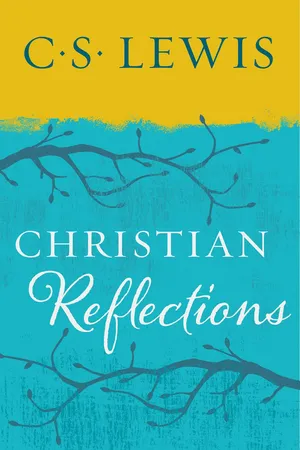
In Christian Reflections C.S. Lewis brings his vast and original intellect to bear on a wealth of subjects, including ethics, historicism, Christianity and culture. This selection of essays and papers, drawn from all stages of his career, presents Lewis at his most varied and profound.
‘If the heavenly life is not grown up in you, it signifies nothing what you have chosen in the stead of it, or why you have chosen it.’
—WILLIAM LAW
At an early age I came to believe that the life of culture (that is, of intellectual and aesthetic activity) was very good for its own sake, or even that it was the good for man. After my conversion, which occurred in my later twenties, I continued to hold this belief without consciously asking how it could be reconciled with my new belief that the end of human life was salvation in Christ and the glorifying of God. I was awakened from this confused state of mind by finding that the friends of culture seemed to me to be exaggerating. In my reaction against what seemed exaggerated I was driven to the other extreme, and began, in my own mind, to belittle the claims of culture. As soon as I did this I was faced with the question, ‘If it is a thing of so little value, how are you justified in spending so much of your life on it?’
The present inordinate esteem of culture by the cultured began, I think, with Matthew Arnold—at least if I am right in supposing that he first popularized the use of the English word spiritual in the sense of German geistlich. This was nothing less than the identification of levels of life hitherto usually distinguished. After Arnold came the vogue of Croce, in whose philosophy the aesthetic and logical activities were made autonomous forms of ‘the spirit’ co-ordinate with the ethical. There followed the poetics of Dr I. A. Richards. This great atheist critic found in a good poetical taste the means of attaining psychological adjustments which improved a man’s power of effective and satisfactory living all round, while bad taste resulted in a corresponding loss. Since this theory of value was a purely psychological one, this amounted to giving poetry a kind of soteriological function; it held the keys of the only heaven that Dr Richards believed in. His work (which I respect profoundly) was continued, though not always in directions that he accepted, by the editors of Scrutiny,1 who believe in ‘a necessary relationship between the quality of the individual’s response to art and his general fitness for humane living’. Finally, as might have been expected, a somewhat similar view was expressed by a Christian writer: in fact by Brother Every in Theology for March, 1939. In an article entitled ‘The Necessity of Scrutiny’ Brother Every inquired what Mr Eliot’s admirers were to think of a Church where those who seemed to be theologically equipped preferred Housman, Mr Charles Morgan, and Miss Sayers, to Lawrence, Joyce and Mr E. M. Forster; he spoke (I think with sympathy) of the ‘sensitive questioning individual’ who is puzzled at finding the same judgements made by Christians as by ‘other conventional people’; and he talked of ‘testing’ theological students as regards their power to evaluate a new piece of writing on a secular subject.
As soon as I read this there was the devil to pay. I was not sure that I understood—I am still not sure that I understand—Brother Every’s position. But I felt that some readers might easily get the notion that ‘sensitivity’ or good taste were among the notes of the true Church, or that coarse, unimaginative people were less likely to be saved than refined and poetic people. In the heat of the moment I rushed to the opposite extreme. I felt, with some spiritual pride, that I had been saved in the nick of time from being ‘sensitive’. The ‘sentimentality and cheapness’ of much Christian hymnody had been a strong point in my own resistance to conversion. Now I felt almost thankful for the bad hymns.2 It was good that we should have to lay down our precious refinement at the very doorstep of the church; good that we should be cured at the outset of our inveterate confusion between psyche and pneuma, nature and supernature.
A man is never so proud as when striking an attitude of humility. Brother Every will not suspect me of being still in the condition I describe, nor of still attributing to him the preposterous beliefs I have just suggested. But there remains, none the less, a real problem which his article forced upon me in its most acute form. No one, presumably, is really maintaining that a fine taste in the arts is a condition of salvation. Yet the glory of God, and, as our only means to glorifying Him, the salvation of human souls, is the real business of life. What, then, is the value of culture? It is, of course, no new question; but as a living question it was new to me.
I naturally turned first to the New Testament. Here I found, in the first place, a demand that whatever is most highly valued on the natural level is to be held, as it were, merely on sufferance, and to be abandoned without mercy the moment it conflicts with the service of God. The organs of sense (Matt. v, 29) and of virility (Matt. xix, 12) may have to be sacrificed. And I took it that the least these words could mean was that a life, by natural standards, crippled and thwarted was not only no bar to salvation, but might easily be one of its conditions. The text about hating father and mother (Luke xiv, 26) and our Lord’s apparent belittling even of His own natural relation to the Blessed Virgin (Matt. xii, 48) were even more discouraging. I took it for granted that anyone in his senses would hold it better to be a good son than a good critic, and that whatever was said of natural affection was implied a fortiori of culture. The worst of all was Philippians iii, 8, where something obviously more relevant to spiritual life than culture can be—‘blameless’ conformity to the Jewish Law—was described as ‘muck’.
In the second place I found a number of emphatic warnings against every kind of superiority. We were told to become as children (Matt. xviii, 3), not to be called Rabbi (Matt. xxiii, 8), to dread reputation (Luke vi, 26). We were reminded that few of the
—which, I suppose, means precisely the intelligentsia—are called (1 Cor. i, 26); that a man must become a fool by secular standards before he can attain real wisdom (1 Cor. iii, 18).
Against all this I found some passages that could be interpreted in a sense more favourable to culture. I argued that secular learning might be embodied in the Magi; that the Talents in the parable might conceivably include ‘talents’ in the modern sense of the word; that the miracle at Cana in Galilee by sanctifying an innocent, sensuous pleasure3 could be taken to sanctify at least a recreational use of culture—mere ‘entertainment’; and that aesthetic enjoyment of nature was certainly hallowed by our Lord’s praise of the lilies. At least some use of science was implied in St Paul’s demand that we should perceive the Invisible through the visible (Rom. i, 20). But I was more than doubtful whether his exhortation, ‘Be not children in mind’ (1 Cor. xiv, 20), and his boast of ‘wisdom’ among the initiate, referred to anything that we should recognize as secular culture.
On the whole, the New Testament seemed, if not hostile, yet unmistakably cold to culture. I think we can still believe culture to be innocent after we have read the New Testament; I cannot see that we are encouraged to think it important.
It might be important none the less, for Hooker has finally answered the contention that Scripture must contain everything important or even everything necessary. Remembering this, I continued my researches. If my selection of authorities seems arbitrary, that is due not to a bias but to my ignorance. I used such authors as I happened to know.
Of the great pagans Aristotle is on our side. Plato will tolerate no culture that does not directly or indirectly conduce either to the intellectual vision of the good or the military efficiency of the commonwealth. Joyce and D. H. Lawrence would have fared ill in the Republic. The Buddha was, I believe, anti-cultural, but here especially I speak under correction.
St Augustine regarded the liberal education which he had undergone in his boyhood as a dementia, and wondered why it should be considered honestior et uberior than the really useful ‘primary’ education which preceded it (Conf. I, xiii). He is extremely distrustful of his own delight in church music (ibid., X, xxxiii). Tragedy (which for Dr Richards is ‘a great exercise of the spirit’)4 is for St Augustine a kind of sore. The spectator suffers, yet loves his suffering, and this is a miserabilis insania . . . quid autem mirum cum infelix pecus aberrans a grege tuo et inpatiens custodiae tuae turpi scabie foedarer (ibid., III, ii).
St Jerome, allegorizing the parable of the Prodigal Son, suggests that the husks with which he was fain to fill his belly may signify cibus daemonum . . . carmina poetarum, saecularis sapientia, rhetoricorum pompa verborum (Ep. xxi, 4).
Let none reply that the Fathers were speaking of polytheistic literature at a time when polytheism was still a danger. The scheme of values presupposed in most imaginative literature has not become very much more Christian since the time of St Jerome. In Hamlet we see everything questioned except the duty of revenge. In all Shakespeare’s works the conception of good really operative—whatever the characters may say—seems to be purely worldly. In medieval romance, honour and sexual love are the true values; in nineteenth-century fiction, sexual love and material prosperity. In romantic poetry, either the enjoyment of nature (ranging from pantheistic mysticism at one end of the scale to mere innocent sensuousness at the other) or else the indulgence of a Sehnsucht awakened by the past, the distant, and the imagined, but not believed, supernatural. In modern literature, the life of liberated instinct. There are, of course, exceptions: but to study these exceptions would not be to study literature as such, and as a whole. ‘All literatures’, as Newman has said,5 ‘are one; they are the voices of the natural man . . . if Literature is to be made a study of human nature, you cannot have a Christian Literature. It is a contradiction in terms to attempt a sinless Literature of sinful man.’ And I could not doubt that the sub-Christian or anti-Christian values implicit in most literature did actually infect many readers. Only a few days ago I was watching, in some scholarship papers, the results of this infection in a belief that the crimes of such Shakespearian characters as Cleopatra and Macbeth were somehow compensated for by a quality described as their ‘greatness’. This very morning I have read in a critic the remark that if the wicked lovers in Webster’s White Devil had repented we should hardly have forgiven them. And many people certainly draw from Keats’s phrase about negative capability or ‘love of good and evil’ (if the reading which attributes to him such meaningless words is correct) a strange doctrine that experience simpliciter is good. I do not say that the sympathetic reading of literature must produce such results, but that it may and often does. If we are to answer the Fathers’ attack on pagan literature we must not ground our answer on a belief that literature as a whole has become, in any important sense, more Christian since their days.
In Thomas Aquinas I could not find anything directly bearing on my problem; but I am a very poor Thomist and shall be grateful for correction on this point.
Thomas à Kempis I take to be definitely on the anti-cultural side.
In the Theologia Germanica (cap. xx) I found that nature’s refusal of the life of Christ ‘happeneth most of all where there are high natural gifts of reason, for that soareth upwards in its own light and by its own power, till at last it cometh to think itself the true Eternal Light’. But in a later chapter (xlii) I found the evil of the false light identified with its tendency to love knowledge and discernment more than the object known and discerned. This seemed to point to the possibility of a knowledge which avoided that error.
The cumulative effect of all this was very discouraging to culture. On the other side—perhaps only through the accidental distribution of my ignorance—I found much less.
I found the famous saying, attributed to Gregory, that our use of secular culture was comparable to the action of the Israelites in going down to the Philistines to have their knives sharpened. This seems to me a most satisfactory argument as far as it goes, and very relevant to modern conditions. If we are to convert our heathen neighbours, we must understand their culture. We must ‘beat them at their own game’. But of course, while this would justify Christian culture (at least for some Christians whose vocation lay in that direction) at the moment, it would come very far short of the claims made for culture in our modern tradition. On the Gregorian view culture is a weapon; and a weapon is essentially a thing we lay aside as soon as we safely can.
In Milton I found a disquieting ally. His Areopagitica troubled me just as Brother Every’s article had troubled me. He seemed to make too little of the difficulties; and his glorious defence of freedom to explore all good and evil seemed, after all, to be based on an aristocratic preoccupation with great souls and a contemptuous indifference to the mass of mankind which, I suppose, no Christian can tolerate.
Finally I came to that book of Newman’s from which I have already quoted, the lectures on University Education. Here at last I found an author who seemed to be aware of both sides of the question; for no one ever insisted so eloquently as Newman on the beauty of culture for its own sake, and no one ever so sternly resisted the temptation to confuse it with things spiritual. The cultivation of the intellect, according to him, is ‘for this world’:6 between it and ‘genuine religion’ there is a ‘radical difference’;7 it makes ‘not the Christian . . . but the gentleman’, and looks like virtue ‘only at a distance’;8 he ‘will not for an instant allow’ that it makes men better.9 The ‘pastors of the Church’ may indeed welcome culture because it provides innocent distraction at those moments of spiritual relaxation which would otherwise very likely lead to sin; and in this way it often ‘draws the mind off from things which will harm it to subjects worthy of a rational being’. But even in so doing ‘it does not raise it above nature, nor has any tendency to make us pleasing to our Maker’.10 In some instances the cultural and the spiritual value of an activity may even be in inverse ratio. Theology, when it ceases to be part of liberal knowledge, and is pursued for purely pastoral ends, gains in ‘meritoriousness’ but loses in liberality ‘just as a face worn by tears and fasting loses its beauty’.11 On the other hand Newman is certain that liberal knowledge is an end in itself; the whole of the fourth Discourse is devoted to this theme. The solution of this apparent antinomy lies in his doctrine that everything, including, of course, the intellect, ‘has its own perfection. Things animate, inanimate, visible, invisible, all are good in their kind, and have a best of themselves, which is an object of pursuit.’12 To perfect the mind is ‘an object as intelligible as the cultivation of virtue, while, at the same time, it is absolutely distinct from it’.13
Whether because I am too poor a theologian to understand the implied doctrine of grace and nature, or for some other reason, I have not been able to make Newman’s conclusion my own. I can well understand that there is a kind of goodness which is not moral; as a well-grown healthy toad is ‘better’ or ‘more perfect’ than a three-legged toad, or an archangel is ‘better’ than an angel. In this sense a clever man is ‘better’ than a dull one, or any man than any chimpanzee. The trouble comes when we start asking how much of our time and energy God wants us to spend in becoming ‘better’ or ‘more perfect’ in this sense. If Newman is right in saying that culture has no tendency ‘to make us pleasing to our Maker’, then the answer would seem to be, ‘None.’ And that is a tenable view: as though God said, ‘Your natural degree of perfection, your place in the chain of being, is my affair: do you get on with what I have explicitly left as your task—righteousness.’ But if Newman had thought this he would not, I suppose, have written the discourse on ‘Liberal Knowledge its Own End’. On the other hand, it would be possible to hold...
Table of contents
Preface, by Walter Hooper
Christianity and Literature
Christianity and Culture
Religion: Reality or Substitute?
On Ethics
De Futilitate
The Poison of Subjectivism
The Funeral of a Great Myth
On Church Music
Historicism
The Psalms
The Language of Religion
Petitionary Prayer: A Problem Without an Answer
Modern Theology and Biblical Criticism
The Seeing Eye
Copyright
About the Publisher
Books by C. S. Lewis
Trusted by 375,005 students
Access to over 1.5 million titles for a fair monthly price.
Study more efficiently using our study tools.
Frequently asked questions
Yes, you can cancel anytime from the Subscription tab in your account settings on the Perlego website. Your subscription will stay active until the end of your current billing period. Learn how to cancel your subscription
No, books cannot be downloaded as external files, such as PDFs, for use outside of Perlego. However, you can download books within the Perlego app for offline reading on mobile or tablet. Learn how to download books offline
Perlego offers two plans: Essential and Complete
Essential is ideal for learners and professionals who enjoy exploring a wide range of subjects. Access the Essential Library with 800,000+ trusted titles and best-sellers across business, personal growth, and the humanities. Includes unlimited reading time and Standard Read Aloud voice.
Complete: Perfect for advanced learners and researchers needing full, unrestricted access. Unlock 1.5M+ books across hundreds of subjects, including academic and specialized titles. The Complete Plan also includes advanced features like Premium Read Aloud and Research Assistant.
Both plans are available with monthly, semester, or annual billing cycles.
We are an online textbook subscription service, where you can get access to an entire online library for less than the price of a single book per month. With over 1.5 million books across 990+ topics, we’ve got you covered! Learn about our mission
Look out for the read-aloud symbol on your next book to see if you can listen to it. The read-aloud tool reads text aloud for you, highlighting the text as it is being read. You can pause it, speed it up and slow it down. Learn more about Read Aloud
Yes! You can use the Perlego app on both iOS and Android devices to read anytime, anywhere — even offline. Perfect for commutes or when you’re on the go. Please note we cannot support devices running on iOS 13 and Android 7 or earlier. Learn more about using the app
Yes, you can access Christian Reflections by C. S. Lewis in PDF and/or ePUB format, as well as other popular books in Theologie & Religion & Literaturkritik für weibliche Autoren. We have over 1.5 million books available in our catalogue for you to explore.