The
New York Times bestselling author examines how metaphors influence every aspect of our lives, from art to medicine, psychology to the stock market.
Metaphor is much more than a mere literary device. Often hiding in plain sight, it is a critical aspect of how humans think and communicate. Metaphor is at work in all fields of human endeavor, including economics, business, science, and psychology.
In
I Is an Other, James Geary takes readers from Aristotle's investigation of metaphor right up to the latest neuroscientific insights into how metaphor works in the brain. Along the way, he demonstrates how metaphor affects financial decision making, creates effective advertising, and helps us achieve emotional insight and psychological change. Geary also explores how a life without metaphor, as experienced by some people with autism spectrum disorders, significantly changes the way a person interacts with the world.
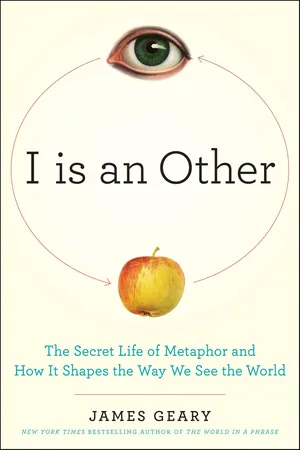
eBook - ePub
I Is an Other
The Secret Life of Metaphor and How It Shapes the Way We See the World
- 320 pages
- English
- ePUB (mobile friendly)
- Available on iOS & Android
eBook - ePub
About this book
Information
Subtopic
Études sur la communicationBibliography
Aaker, J. L. “Dimensions of Brand Personality.” Journal of Marketing Research 34, 3, 1997, pp. 347–356.
Aarts, H., and Dijksterhuis, A. “The Silence of the Library: Environmental Control over Social Behavior.” Journal of Personality and Social Psychology 84, 2003, pp. 18–28.
Ackerman, Joshua M., Nocera, Christopher C., and Bargh, John A. “Incidental Haptic Sensations Influence Social Judgments and Decisions.” Science 328, 5986, 25 June, 2010, pp. 1712–1715.
Addison, Joseph. “Pleasures of the Imagination.” Spectator 411, 1712, p. 21.
Aesop. Aesop’s Fables. Translated by V. S. Vernon Jones. Introduction by G. K. Chesterton. Illustrated by Arthur Rackham. Ware, Hertfordshire: Wordsworth Classics, 1994.
Al-Jurjani, Abdalqahir. The Mysteries of Eloquence. Hellmut Ritter, ed. Istanbul: Government Press, 1954.
Allbritton, David W., Gerrig, Richard J., and McKoon, Gail. “Metaphor-Based Schemas and Text Representations: Making Connections through Conceptual Metaphors.” Journal of Experimental Psychology: Learning, Memory, and Cognition 21, 1, 1995, pp. 612–625.
Allman, John M., Watson, Karli K., Tetreault, Nicole A., and Hakeem, Atiya Y. “Intuition and Autism: A Possible Role for Von Economo Neurons.” Trends in Cognitive Sciences 9, 8, 2005, pp. 367–373.
Andreassen, P. B. “On the Social Psychology of the Stock Market: Aggregate Attributional Effects and the Regressiveness of Prediction.” Journal of Personality and Social Psychology 53, 1987, pp. 490–496.
Arbib, Michael A. “From Monkey-like Action Recognition to Human Language: An Evolutionary Framework for Neurolinguistics.” Behavioral and Brain Sciences 28, 2005, pp. 105–167.
Ariely, Dan. Predictably Irrational: The Hidden Forces That Shape Our Decisions. London: HarperCollins, 2008.
Aristotle. The Rhetoric and the Poetics of Aristotle. Introduction by Edward P. J. Corbett. New York: Modern Library, 1984.
Arnheim, Rudolf. Visual Thinking. London: Faber and Faber, 1970.
Asch, S. E. “Forming Impressions of Personality.” Journal of Abnormal and Social Psychology 41, 1946, pp. 258–290.
———. “The Metaphor: A Psychological Inquiry.” In: Person Perception and Interpersonal Behavior. R. Taguiri and L. Petrullo, eds. Stanford, CA: Stanford University Press, 1955, pp. 86–94.
Asch, S. E. and Nerlove, Harriet. “The Development of Double Function Terms in Children: An Exploratory Investigation.” In: Perspectives in Psychological Theory: Essays in Honor of Heinz Werner. Bernard Kaplan and Seymour Wapner, eds. New York: International Universities Press, 1960, pp. 47–60.
Aubrun, Axel, Brown, Andrew, and Grady, Joseph. “Public Structures: A Constructive Model for Government.” Public Briefing, an occasional white paper series by Demos, March 2006.
Aubrun, Axel, and Grady, Joseph. “Provoking Thought, Changing Talk: Discussing Inequality.” In: You Can Get There from Here . . . , an occasional paper series from the Social Equity and Opportunity Forum of the College of Urban and Public Affairs at Portland State University, April 2008.
———. “ ‘Public Structures’ as a Simplifying Model for Government.” A report commissioned by the FrameWorks Institute on behalf of the Council for Excellence in Government and Demos, October 2005.
Aubusson, P. J., Harrison, A. G., and Ritchie, S. M., eds. Metaphor and Analogy in Science Education. Dordrecht, The Netherlands: Springer, 2006.
Avis, Paul. God and the Creative Imagination: Metaphor, Symbol and Myth in Religion and Theology. London: Routledge, 1999.
Barcelona, Antonio, ed. Metaphor and Metonymy at the Crossroads: A Cognitive Perspective. Berlin and New York: Mouton de Gruyter, 2003.
Barfield, Owen. History in English Words. London: Faber and Faber, 1962.
———. Poetic Diction: A Study in Meaning. Middletown, CT: Wesleyan University Press, 1973.
Bargary, Gary, et al. “Colored-speech Synaesthesia Is Triggered by Multisensory, Not Unisensory, Preception.” Psychological Science 20, 5, 2009, pp. 529–533.
Bargh, J. A. “Bypassing the Will: Toward Demystifying Behavioral Priming Effects“ In: The New Unconscious. Hassin, R., Uleman, J., and Bargh, J., , eds. Oxford: Oxford University Press, 2005, pp. 37–58.
———. “Losing Consciousness: Automatic Influences on Consumer Judgment, Behavior and Motivation.” Journal of Consumer Research 29, 2, 2002, pp. 280–285.
———. “The Unconscious Mind.” Perspectives on Psychological Science 3, 2008, pp. 73–79.
Bargh, J. A., and Chartrand, Tanya L. “The Mind in the Middle: A Practical Guide to Priming and Automaticity Research.” In: Handbook of Research Methods in Social and Personality Psychology. Reis, H. T., and Judd, C. M., eds. New York: Cambridge University Press, 2000, pp. 253–285.
Baron-Cohen, Simon. “The Biology of the Imagination.” Entelechy Journal 9, Summer/Fall 2007, http://www.entelechyjournal.com/simonbaroncohen.htm.
———. Mindblindness: An Essay on Autism and Theory of Mind. Cambridge, MA: MIT Press, 1997.
Barton, Nicholas. The Lost Rivers of London. London: Phoenix House Limited/Leicester University Press, 1962.
Bateson, Gregory. Mind and Nature: A Necessary Unity. New York: Bantam Books, 1980.
Battino, Rubin. Metaphoria: Metaphor and Guided Metaphor for Psychotherapy and Healing. Carmarthen, Wales: Crown House, 2005.
Battino, Rubin, and South, Thomas L. Ericksonian Approaches: A Comprehensive Manual. Carmarthern, Wales: Crown House, 2005.
Beardsley, Monroe C. The Aesthetic Point of View: Selected Essays. Michael J. Wreen and Donald M. Callen, eds. Ithaca, NY, and London: Cornell University Press, 1982.
Beattie, Geoffrey. Visible Thought: The New Psychology of Body Language. London: Routledge, 2003.
Bechara, Antoine, and Damasio, Antonio R. “The Somatic Marker Hypothesis: A Neural Theory of Economic Decision-making.” Games and Economic Behavior 52, 2005, p. 336–372.
Beer, Francis A., and De Landtsheer, Christ’l. Metaphorical World Politics. East Lansing: Michigan State University Press, 2004.
Belsky, Gary, and Gilovich, Thomas. Why Smart People Make Big Money Mistakes and How to Correct Them. New York: Simon and Schuster, 1999.
Benczes, Réka. “Analysing Metonymical Noun-Noun Compounds: The Case of Freedom Fries.” In: The Metaphors of Sixty: Papers Presented on the Occasion of the 60th Birthday of Zoltán Kövecses. Réka Benczes and Szilvia Csábi, eds. Budapest: Eötvös Loránd University, 2006, pp. 46–54.
Benyus, Janine. Biomimicry: Innovation Inspired by Nature. New York: Harper Perennial, 2002.
Berggren, Douglas. “The Use and Abuse of Metaphor.” Review of Metaphysics 16, 1962, pp. 237–258.
Bicchieri, Cristina. “Should a Scientist Abstain from Metaphor?” In: The Consequences of Economic Rhetoric. Arjo Klamer, D. N. McCloskey, and Robert M. Solow, eds. New York: Cambridge University Press, 1988, pp. 100–114.
Black, Max. Models and Metaphors: Studies in Language and Philosophy. Ithaca, NY: Cornell University Press, 1962.
Borges, Jorge Luis. Historia de la eternidad. Buenos Aires: Emecé, 1953.
———. Thi...
Table of contents
- Cover
- Title Page
- Epigraph
- Contents
- Foreword: Why I Is an Other
- Metaphor and Thought: All Shook Up
- Metaphor and Etymology: Language Is Fossil Poetry
- Metaphor and Money: How High Can a Dead Cat Bounce?
- Metaphor and the Mind: Imagining an Apple in Someone’s Eye
- Metaphor and Advertising: Imaginary Gardens with Real Toads in Them
- Metaphor and the Brain: Bright Sneezes and Loud Sunlight
- Metaphor and the Body: Anger Is a Heated Fluid in a Container
- Metaphor and Politics: Freedom Fries and Liberty Cabbage
- Metaphor and Pleasure: Experience Is a Comb That Nature Gives to Bald Men
- Metaphor and Children: How Should One Refer to the Sky?
- Metaphor and Science: The Earth Is Like a Rice Pudding
- Metaphor and Parables and Proverbs: Mighty Darn Good Lies
- Metaphor and Innovation: Make It Strange
- Metaphor and Psychology: A Little Splash of Color from My Mother
- Backword: The Logic of Metaphor
- Bibliography
- Index
- Acknowledgments
- Also by James Geary
- Copyright
- About the Publisher
Trusted by 375,005 students
Access to over 1.5 million titles for a fair monthly price.
Study more efficiently using our study tools.
Frequently asked questions
Yes, you can cancel anytime from the Subscription tab in your account settings on the Perlego website. Your subscription will stay active until the end of your current billing period. Learn how to cancel your subscription
No, books cannot be downloaded as external files, such as PDFs, for use outside of Perlego. However, you can download books within the Perlego app for offline reading on mobile or tablet. Learn how to download books offline
We are an online textbook subscription service, where you can get access to an entire online library for less than the price of a single book per month. With over 1.5 million books across 990+ topics, we’ve got you covered! Learn about our mission
Look out for the read-aloud symbol on your next book to see if you can listen to it. The read-aloud tool reads text aloud for you, highlighting the text as it is being read. You can pause it, speed it up and slow it down. Learn more about Read Aloud
Yes! You can use the Perlego app on both iOS and Android devices to read anytime, anywhere — even offline. Perfect for commutes or when you’re on the go.
Please note we cannot support devices running on iOS 13 and Android 7 or earlier. Learn more about using the app
Please note we cannot support devices running on iOS 13 and Android 7 or earlier. Learn more about using the app
Yes, you can access I Is an Other by James Geary in PDF and/or ePUB format, as well as other popular books in Langues et linguistique & Études sur la communication. We have over 1.5 million books available in our catalogue for you to explore.