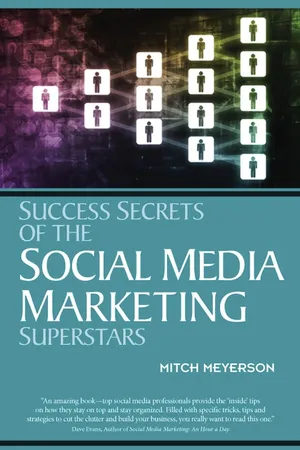
Online marketing expert Mitch Meyerson presents you with an unmatched advantage into the world of social media – the priceless secrets, strategies, tactics and insights of more than 20 of today’s social media elite. Handpicked to cover almost every aspect of social media marketing, Meyerson and this distinguished team of experts open their playbooks and teach you how to create effective social media campaigns to cut through the clutter, reach out to millions and grow your business. Features: • Proven tips and tactics from 20+ top social media marketers • The biggest mistakes businesses make with social media and how to fix them • Actionable plans for all areas including social networks, blogs, web TV and mobile marketing • Real-world case studies, best practices and proven techniques from the experts • Detailed list of resources
- 336 pages
- English
- ePUB (mobile friendly)
- Available on iOS & Android
eBook - ePub
Success Secrets of the Social Media Marketing Superstars
About this book
Information
SECTION I
STRATEGIES AND PRINCIPLES
dp n="19" folio="" ?dp n="20" folio="3" ? CHAPTER 1
BUILDING YOUR RELATIONSHIP STRATEGY
KEITH FERRAZZI AND TAHL RAZ
Keith Ferrazzi is the author of the bestselling books Never Eat Alone, with Tahl Raz, and Who’s Got Your Back? Both Forbes and Inc. have called Ferrazzi “one of the world’s most connected individuals.” As founder and CEO of the business consulting firm Ferrazzi Greenlight, he counsels the world’s top enterprises, dramatically accelerating the development of business relationships to drive sales, spark innovation, and create team cohesion. Tahl Raz is the publisher of KeithFerrazzi.com, where you can find more information and free resources.
Chapter Highlights
• Why it is critical to have a relationship strategy
• What generosity means
• The importance of vulnerability to establishing trust
• How candor creates believability and real-ness
• Why accountability is a must
In today’s virtual world, you don’t need a Twitter strategy or a Facebook strategy or even a Google strategy. You need a relationship strategy that leverages all aspects of social media.
We’re in the midst of a power shift, one of the most exciting and profound shifts in recent economic history. It’s a transformation so deep that we’re only now beginning to understand what it means for the future of business.
As I criss-cross the nation coaching CEOs and training sales teams, addressing the needs of companies big and small in every industry, it is clear that the winners in this emerging world, those primed for financial prosperity and market leadership, are the ones who take what I call a relationship-centric approach to every aspect of their business.
WELCOME TO THE SOCIAL BUSINESS REVOLUTION
Relationships are the ultimate source of advantage, the new heavyweight champion of the marketing ring. Social media, however, is the champ’s head trainer. There’s never been a better tool for relationship building. Social media allows for two-way conversations with an entire market, a reality that would have made the innovative Madison Avenue ad men in the 1950s fall off their Eames sofas.
But you shouldn’t try approaching social media without a deep understanding of the relationship-centric reality of Web 2.0, the reality of the ever-increasing importance of foundational mindsets like generosity, transparency, and candor. If you rush or go in without information, what you’ll get is an all-too-common experience nicely captured by Google’s Analytics Evangelist, Avinash Kaushik: “Social media [can be] like teen sex. Everyone wants to do it. Nobody knows how. When it’s finally done, there is surprise it’s not better.”
Luckily, through knowledge, practice, and commitment, social media can be exciting, engaging, pleasurable, and successful for any business.
dp n="22" folio="5" ?Smart innovators are learning that the model is no longer CRM (Customer Relationship Management) but rather CMR (Customer Managed Relationships).
The sales and marketing funnel isn’t linear, and it’s not a funnel. It’s more like concentric circles of awareness, interaction, engagement, participation, conversation, affinity, awareness, community, and trust. A funnel would imply passive consumption, but that’s no longer how things work. Today’s consumer behavior has changed to active participation. I post a question to my Facebook page, asking what people think about the Kindle, then double check it against comments on Amazon, and follow those comments to someone’s Twitter account . . . and on and on.
Social media can be like teen sex. Everyone wants to do it. Nobody knows how. When it’s finally done, there is surprise it’s not better.
Secrets • Secrets • Secrets • Secrets

A brand is no longer what the company says it is. It’s what their customers say it is. Companies still need to influence their brand, though. How do you do that? Not by interrupting your customers with brand-making promises, delivered as advertisements. You influence a brand by encouraging people associated with that brand—forging direct relationships, relationships built on action and experience and . . . CARING. That’s right, your next sales seminar is likely to be more like Oprah than your traditional hardcharging Joe Salesguy.
To be meaningful or memorable, these relationships must engage, enable, and empower. Memorable is an action, specifically a one-to-one action, and so really it is an interaction. Which brings us back to the beginning: Today’s consumer influence is built on a platform of one-to-one relationships.
So, what does all this mean for you, the individual looking to increase your influence and your business online?
dp n="23" folio="6" ?In today’s economy, the guy with the most relationships of the highest quality wins. Even the likes of IBM are turning to this “soft” side of business and recently published findings quantifying the value of one’s network. IBM’s research analysts found that each additional person in a consultant’s e-mail address book boiled down to $948 in additional annual revenue. That gives new heft to the idea that your “network is your net worth”!
Today’s most successful entrepreneurs, the Gary Vaynerchuks (who has close to a million followers on Twitter) and the Tony Hsiehs (who built Zappos from nothing to $1 billion in nine years) of the world, use social media to build relationships that turn customers into fans—and more profitable customers. They do it in entertaining, authentic, and sometimes provocative ways. You can, too. In fact, if you’re not out there in the social media space, you’re missing out on a golden opportunity to build those relationships. You’re missing a golden opportunity to introduce yourself and your business much more personally to more of the world than you were able to do before.
After a few missteps, I learned that Twitter provided what I had previously considered a sort of unattainable Holy Grail: a space where I could interact with fans much more authentically and spontaneously than ever before—asking questions, answering them, sharing insights, and even organizing impromptu meet-ups.

Now, I didn’t launch myself heavily in the social media space until my book tour for Who’s Got Your Back? in the summer of ’09. After taking in a truckload of advice—some good, some bad—I finally went out on the road with Tweetdeck on my Blackberry.
Once I finally got active in the medium, I was kicking myself for not starting long before. Social media allows me to open up the front of my relationship pipeline. I’m able to connect with more people of a similar mindset. It also allows me to ping the 25 people closest to me virtually every day; there’s no better way to stay on someone’s mental radar, which is not only how you build a relationship but also how you ensure that you’re the person people call when they need something.
Social media is expanding our relationship horizons. I can develop relationships on a scale beyond anything I even dreamed of back when I wrote Never Eat Alone. Still, the essential truth I expressed in that book remains unchanged in the online space: Networking means nothing if the connections you create are just names in your database. What makes for a happy life and white-hot success are mutual, meaningful two-way relationships marked by generosity and care. And for the most part, those are the kinds of relationships you need to be building online as you amass followers and friends.
Of course, social media isn’t just Twitter, Facebook, and LinkedIn. And the gurus in this book will be giving you a thousand and one incredible tips, tools, and strategies for launching “Brand You” online. What I’d like to offer you upfront, however, are some ground rules to focus you on relationship building before you get caught up in the tactics and technology of social media.
Fortunately, I’ve found that the rules for building relationships online aren’t that different than the rules for building relationships elsewhere. The only real difference is that online communication magnifies your ability to do damage, just as it magnifies your ability to succeed. But don’t let that scare you. Read on.
The most overused but apt metaphor for social media is that it’s a giant cocktail party. Indeed, if you want to take something meaningful away in terms of building relationships, the rules are exactly the same: get involved, listen empathetically, and look to give more than you get. The returns are really the same as well: lasting, loyal relationships that can make a difference to your business and your happiness.
dp n="25" folio="8" ?Before you take to Twitter et al, you’d better be a pro at what I call “relationship mastery.”
Ground yourself and your interaction with others in Four Mindsets: Generosity, Vulnerability, Candor, and Accountability. I teach a system that I’m calling Accelerated Relationship Development, which helps people build on that foundation with a rich skill set, and ultimately teaches them how to make their outreach purposeful by building a Relationship Action Plan—an alignment of your goals and dreams with the people you intend to help, and who can help you. All that stuff is important, incredibly important, but if I could only teach people one thing to create more meaningful relationships, it would be the Four Mindsets.
GENEROSITY
Generosity is the base from which all the other mindsets arise. It indicates a commitment to support that begins with the willingness to share your deepest insights and ideas with the world. It’s also the promise to help others succeed by whatever means you can muster. Nothing is more important if you want to build the kind of relationships that will build your business, online and off.
In a business setting, where people are distracted and in a hurry, leading with generosity is a great way to get someone’s attention. The more generous you are to other people in offering first your humanity and then your knowledge, advice, and talents, the more willing they’ll be to share their concerns.
At some point, your relationship will grow strong enough that you’ll be able to take even greater risks with each other. You’ll be able to tell them what you think they ne...
Table of contents
- Title Page
- Dedication
- Acknowledgements
- Foreword
- Preface
- SECTION I - STRATEGIES AND PRINCIPLES
- SECTION II - APPLICATIONS AND WEBSITES
- EPILOGUE
- GLOSSARY
- INDEX
- Subscribe to Entrepreneur Magazine
- Copyright Page
Trusted by 375,005 students
Access to over 1.5 million titles for a fair monthly price.
Study more efficiently using our study tools.
Frequently asked questions
Yes, you can cancel anytime from the Subscription tab in your account settings on the Perlego website. Your subscription will stay active until the end of your current billing period. Learn how to cancel your subscription
No, books cannot be downloaded as external files, such as PDFs, for use outside of Perlego. However, you can download books within the Perlego app for offline reading on mobile or tablet. Learn how to download books offline
Perlego offers two plans: Essential and Complete
- Essential is ideal for learners and professionals who enjoy exploring a wide range of subjects. Access the Essential Library with 800,000+ trusted titles and best-sellers across business, personal growth, and the humanities. Includes unlimited reading time and Standard Read Aloud voice.
- Complete: Perfect for advanced learners and researchers needing full, unrestricted access. Unlock 1.5M+ books across hundreds of subjects, including academic and specialized titles. The Complete Plan also includes advanced features like Premium Read Aloud and Research Assistant.
We are an online textbook subscription service, where you can get access to an entire online library for less than the price of a single book per month. With over 1.5 million books across 990+ topics, we’ve got you covered! Learn about our mission
Look out for the read-aloud symbol on your next book to see if you can listen to it. The read-aloud tool reads text aloud for you, highlighting the text as it is being read. You can pause it, speed it up and slow it down. Learn more about Read Aloud
Yes! You can use the Perlego app on both iOS and Android devices to read anytime, anywhere — even offline. Perfect for commutes or when you’re on the go.
Please note we cannot support devices running on iOS 13 and Android 7 or earlier. Learn more about using the app
Please note we cannot support devices running on iOS 13 and Android 7 or earlier. Learn more about using the app
Yes, you can access Success Secrets of the Social Media Marketing Superstars by Mitch Meyerson in PDF and/or ePUB format, as well as other popular books in Business & Marketing. We have over 1.5 million books available in our catalogue for you to explore.