Consumers are exposed to as many as 5,000 daily marketing messages via online, social media, and traditional marketing channels. Entrepreneurs will learn what it takes to get noticed by tapping into the playbooks of successful product producers including Nike, Red Bull, Steve Jobs, Dr. Dre and others.Successful marketer Al Lautenslager presents an entertaining look at what it takes to gain consumer buy-in and buzz across all marketing channels and reveals simple truths that any business can use to achieve the same, relative to their market. Led by Lautenslager, entrepreneurs learn how to zero in on their marketing goals, choose the best marketing tactics, integrate online and traditional marketing, and more. Points are illustrated through entertaining examples and case studies of little-known and well-known marketing and media phenomena such as flash mobs, Rachel Ray, Justin Bieber, and GoDaddy.com.
eBook - ePub
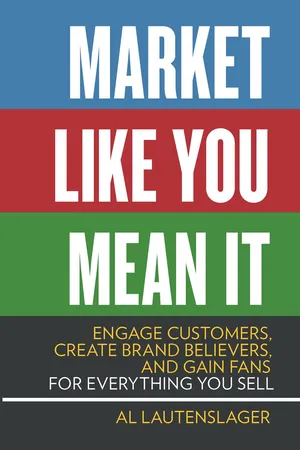
Market Like You Mean It
Engage Customers, Create Brand Believers, and Gain Fans for Everything You Sell
- 265 pages
- English
- ePUB (mobile friendly)
- Available on iOS & Android
eBook - ePub
Market Like You Mean It
Engage Customers, Create Brand Believers, and Gain Fans for Everything You Sell
About this book
Information
PART
I
GET NOTICED
CHAPTER
1
BREAKING THROUGH MARKETING CLUTTER
JUST LOOK AROUND. LOOK AT ALL THE MARKETING COMING your way. Marketing is all around you. As you’re reading this, there are likely signs, radio commercials, point-of-purchase displays, labels, offers in your mail, TV ads, magazines lying around, salespeople, online advertising, social media, and on and on and on—all around you. Add all these up and the number of marketing messages you’re exposed to every day usually amounts to more than 3,000; some say 5,000, and still others claim even more. Regardless, the point is that we are inundated by messages all day, every day. Walk into a grocery store or any retail establishment and this number soars. The same goes for the online content world; messages show up as blog posts, feature articles, special reports, slide presentations, infographics, downloads, webinars, online video, white papers, and more. The whole world of content marketing has exploded. Even if people do happen to set eyes on these messages, whether they actually take any notice is a different matter.
MESSAGES COMING AT YOU NOW
Messages that connect with your interests, needs, wants, and desires will lead you to stop, look, and listen to them, to take notice. The right message delivered in the right way to the right target gets noticed. If your target doesn’t want or need what you are talking about, getting noticed will be a proverbial pipe dream. Messages coming at you that make you more aware of these wants and needs will also get noticed. Let’s say that you have a dream home in your sights and you hear of ways to buy it and live in it; in this case, it’s very likely that you’ll take notice of these messages. Information about rental apartments, in this case, will not catch your attention.
Just think of a recent trip to the grocery store. Supermarkets are filled with a high density of messages, all of them screaming, “Buy me!” You don’t notice every one of these messages while food shopping; you scan and look for the food items that fit your preferences. Sometimes you see new things and may explore further, but taking initial notice is related to something you like, need, or want.
Part of getting noticed involves reaching for the emotions of people that marketing messages are intended for. To get people to pay attention to your marketing messages, you need to find their emotions. Messages with no emotional connection are not noticed and certainly not acted upon. If you can make people feel happy, proud, nostalgic, or comforted, they will be far more likely to notice your message. When crafting your message, think about how it will hit those senses and feelings. Once your senses and emotions are stimulated, you will take notice and become interested in pursuing more information. That is the purpose of a headline, a starburst, or a graphic: to pull an interested reader or prospect into the next sequence of messaging.
Marketers are trained to put their messages where their target markets are or where they look. Looking and noticing are two different things. Think about these differences. Think about satisfying needs, wants, and interests and you will get noticed.
CUTTING THROUGH THE CLUTTER
How does a marketer stand out in the crowded marketing storm? How can you, as a marketer, hit your target market right between the eyes? How can you cut through the media clutter that’s all around you? Answering these questions represents the holy grail of marketing. In this section we’ll talk about a few ways to break through the clutter; more ideas will be developed later in this book.
Every day there are new messaging ideas and repurposed content from thought leaders and marketers of all sizes and types, utilizing new methods that eventually come at you. If your messages are part of that clutter, your goal is to lift them above the clutter and get noticed. This book is full of ideas, stories, and situations that offer solutions to breaking through marketing clutter. Here are eight essentials to consider as you start off and move closer to that marketing holy grail:
1.Focus on solutions. This is what customers are really looking for. And when there is demand, half of your marketing job is done. Products and services that have a high demand get noticed early and often. Give your target market what they want or what they’re interested in looking at. Offer something that shouts, “I’m a problem solver” or “I’m a solution” quickly and your message will get noticed.
2.Aim at your target market. Marketing that doesn’t hit its intended target is classified as a waste, inefficient, or junk (as in “junk mail”). Marketing that does hit its target market is classified as interesting, effective, and very efficient. The key point here is to give your target market something that interests them. If you’re a senior citizen interested in classical music, a direct-mail piece about the newest music releases for the latest rock-and-roll bands just won’t do the job; you have no interest in that information. You’re not part of the rock-and-roll music target market.
3.Use headlines and subtitles. Make these titles (and subtitles) provocative, thought-provoking, extreme, and completely unexpected. One of the best headlines I’ve seen—one I know got noticed—was, “Things the Government Won’t Tell You About Terrorism.” Another one that garnered equal attention, was “7 Mistakes Banks Make Every Day.” Both would get my attention and make me want to read more.
4.Have a crystal-clear message. Graphics can get attention, but don’t let them overwhelm your marketing to the point where your message isn’t being communicated. The famous advertising guru David Ogilvy once said, “I do not regard advertising as an entertainment or an art form but as a medium of information. When I write an advertisement, I don’t want you to tell me that you find it creative. I want you to find it so interesting that you buy the product.” You can’t bore people into taking notice with boring or unclear messages.
5.Try extreme marketing messaging. The truth is, extreme marketing works. Things that state the opposite, the negative, and mistakes get attention. Here are examples of headlines or messages that get noticed because of their extreme nature:
–How to Run Your Company into the Ground in One Week
–How to Make Your Salespeople 10 Percent More Efficient
–How I Grew Profits by 0.005 Percent
All these headlines would probably get your attention and make you want to read on because of their extreme nature.
6.Offer a marketing hook. This is another way to get noticed and it’s especially prevalent in content marketing circles today. Simply put, information is offered as an incentive for additional contact. This “hooks” a prospect into the fold, setting the stage for further communication. That’s what I did as a business owner. One of my hooks was offering a list of “99 Direct Marketing Tips.” Another hook that I offered on my website was a special report titled “50 People to Instantly Add to Your Network.” People wanted that information. Offering the information separated me from the competition and customers and prospects became hooked. Here are other examples of hooks:
–Call us today for a free mortgage loan calculator.
–Download a free recipe ebook using our spices and seasonings.
–Stop by today for a free vase for your Mother’s Day flowers.
All these hooks offer something of value to an interested prospect. They’ll all increase not only the attention your pieces get but your response rates as well.
If you’re using print marketing to communicate to your target market, put these hooks in a starburst graphic. If it’s in an audio or video format, make it extreme, loud, and memorable. Online browsers and shoppers respond to free downloads and interesting and relevant content, including ebooks, top-ten lists, checklists, guides, workbooks, and more.
7.Leverage odd items, shapes, and sizes. Another thi...
Table of contents
- Cover
- Title Page
- Copyright
- Dedication
- Contents
- Acknowledgments
- PREFACE: Getting Noticed, Remembered, and Talked About
- Part I: GET NOTICED
- Part II: GET REMEMBERED
- Part III: GET TALKED ABOUT
- Epilogue
- About the Author
- Index
Trusted by 375,005 students
Access to over 1.5 million titles for a fair monthly price.
Study more efficiently using our study tools.
Frequently asked questions
Yes, you can cancel anytime from the Subscription tab in your account settings on the Perlego website. Your subscription will stay active until the end of your current billing period. Learn how to cancel your subscription
No, books cannot be downloaded as external files, such as PDFs, for use outside of Perlego. However, you can download books within the Perlego app for offline reading on mobile or tablet. Learn how to download books offline
Perlego offers two plans: Essential and Complete
- Essential is ideal for learners and professionals who enjoy exploring a wide range of subjects. Access the Essential Library with 800,000+ trusted titles and best-sellers across business, personal growth, and the humanities. Includes unlimited reading time and Standard Read Aloud voice.
- Complete: Perfect for advanced learners and researchers needing full, unrestricted access. Unlock 1.5M+ books across hundreds of subjects, including academic and specialized titles. The Complete Plan also includes advanced features like Premium Read Aloud and Research Assistant.
We are an online textbook subscription service, where you can get access to an entire online library for less than the price of a single book per month. With over 1.5 million books across 990+ topics, we’ve got you covered! Learn about our mission
Look out for the read-aloud symbol on your next book to see if you can listen to it. The read-aloud tool reads text aloud for you, highlighting the text as it is being read. You can pause it, speed it up and slow it down. Learn more about Read Aloud
Yes! You can use the Perlego app on both iOS and Android devices to read anytime, anywhere — even offline. Perfect for commutes or when you’re on the go.
Please note we cannot support devices running on iOS 13 and Android 7 or earlier. Learn more about using the app
Please note we cannot support devices running on iOS 13 and Android 7 or earlier. Learn more about using the app
Yes, you can access Market Like You Mean It by Al Lautenslager in PDF and/or ePUB format, as well as other popular books in Business & Marketing. We have over 1.5 million books available in our catalogue for you to explore.