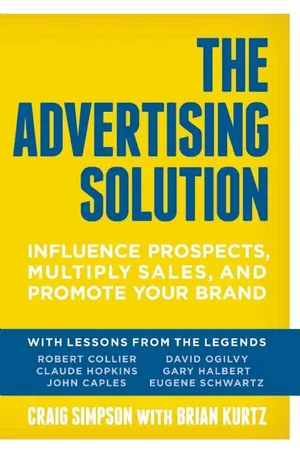
Distilling the wisdom of the world’s greatest advertisers, direct marketing expert Craig Simpson delivers an education on direct marketing and advertising copy that creates brand awareness, sells products, and keeps customers engaged. Walks readers through time-tested methods of creating effective ad copy that increases profits. Dissects the principles of legendary marketers like Robert Collier, Claude Hopkins, John Caples, and David Ogilvy.
eBook - ePub
The Advertising Solution
Influence Prospects, Multiply Sales, and Promote Your Brand
- 192 pages
- English
- ePUB (mobile friendly)
- Available on iOS & Android
eBook - ePub
The Advertising Solution
Influence Prospects, Multiply Sales, and Promote Your Brand
About this book
Information
CHAPTER 1
MEET THE LEGENDS WHO CREATED THE RULES OF MODERN PROMOTIONS
THERE HAVE BEEN MANY GREAT promoters and copywriters over the years, and we salute them all. But in this book, we’re going to focus on the real legends—the great marketing and advertising minds from the past who practically created the industry as we know it, and who continue to have a tremendous influence today.
Their discoveries and insights into what it takes to move others to action are as fresh and alive and relevant today as they were when they were first used to create powerhouse, record-breaking publicity and sales materials. These were colorful, creative individuals who invented the rules for promoting their products and themselves. And their rules work as well now as they did then. In this book, we will delve into their discoveries and how we can use them today. First, let’s learn a little about the lives of each of these remarkable individuals.
CLAUDE HOPKINS: THE FIRST SCIENTIST OF ADVERTISING
Claude C. Hopkins (1866–1932) was an advertising pioneer from the first part of the 20th century. His highly influential 1923 book Scientific Advertising introduced the world of advertising to principles like test marketing, the use of coupons and free samples, key coding ads to make sure responses could be tracked, and thoroughly researching a product to create meaningful copy instead of fluff.
These are all such standard practices today that we take them for granted, but they were all invented by Hopkins.
Hopkins believed that advertising had just one purpose: to sell something. That meant that advertising was to be judged by one measure only: the sales that were the direct result of the ad.
For each of his ads, Hopkins measured the cost per customer and the cost per sale. These were the yardsticks by which he compared his results so he could fine-tune his ads with each campaign. Then he turned his findings into principles that he applied and tested in campaigns for other products.
His campaigns were wildly successful, largely due to his thoroughly researched “reason why” copy. As a result, in 1907 he was hired by the Lord & Thomas advertising agency for the then unheard-of salary of $185,000 a year. (At the time, a professor at Harvard made less than $1,000 per year.)
In his autobiography, My Life in Advertising, Hopkins attributed much of his success to his Scotch mother, who “typified in a high degree the thrift and caution, the intelligence, ambition, and energy of her race.” From her he inherited “conspicuous conservatism,” and believed it was the lack of this quality that wrecked more advertisers and businesspeople than anything else. Hopkins called “safety first” his guiding star, which meant he took no chances in spending his clients’ money or creating campaigns on which the success of their businesses rested. The result was scientific advertising.
He also attributed much of his success to his father, a newspaperman who was the son of a poor clergyman. Hopkins grew up in poverty, which gave him an understanding of the poor and working class: what they wanted, what their struggles were. These were to become his future customers, and he knew how to talk to them so that they would see him as one of their own. If you are promoting anything, you must understand your audience—and make them know that you understand them—if you hope to influence them.
From an early age he made money by selling items door to door. He worked hard to support his family after his father died when Hopkins was only ten, which taught him a great deal about how to get his foot in the door. Once he did, he almost always made a sale. This experience, and his natural creativity, enabled him to see the broader picture when it came to selling. It was also during this time that he learned the value of giving free samples and coupons, which became the cornerstone of many of his later campaigns.
Hopkins originally planned to become a clergyman, but his philosophies didn’t suit the strict church structure of the time. So he looked for another way to earn his living.
He didn’t enter advertising right away, but started off as a bookkeeper for the Bissell carpet sweeper company in Grand Rapids, Michigan. He soon saw an opportunity in helping them write sales copy, although his bosses disagreed with his ideas. They wanted to sell the mechanics of the sweeper. But he believed that to appeal to female buyers, they should stress the design and beauty of the different kinds of wood he had advised the company to use in the sweepers. Although they dragged their feet, company executives ultimately went along with his ideas because they brought results—and you couldn’t argue with the results. One pamphlet Hopkins designed, promoting a special limited edition sweeper made from an exotic wood, sold more sweepers in six weeks than the company had managed in a full year.
From there, he became a full-time ad man, writing copy for products like lard, chicken incubators, shoes, medical products, liquefied ozone—the list goes on. Finally, as an executive and ultimately president of the Lord & Thomas advertising agency, his campaigns for big-name products like Palmolive, Quaker Oats, and Pepsodent Toothpaste really put him on the map.
The success of his campaigns largely rested on what he called “traced advertising.” Hopkins had no respect for unproven theories of advertising. He said each ad is a salesman, and you had to compare their response rates, just as you would compare the success rates of salesmen in your employ, holding them responsible for their cost and results.
He acknowledged there were basic laws of advertising that were generally accepted and backed by results, and that they should be learned. However, using these basic laws didn’t remove the need for scientific advertising. Every sales piece or ad, even if based on these principles, still had to be tested. We’ll look at many of these principles throughout this book.
Every aspect of Hopkins’ life contributed to his homespun style, his understanding of his audience, and his need to prove the effectiveness of what he created in terms of sales figures. We have much to learn from him today. The great David Ogilvy (one of the other legends profiled in this book) said:
Nobody should be allowed to have anything to do with advertising until he has read this book [Scientific Advertising] seven times. It changed the course of my life.
Claude Hopkins changed not just the world of advertising and promotions, but the way we perceive the world.
ROBERT COLLIER: THE PHILOSOPHER AD MAN
Robert Collier (1885–1950) was a fabulously successful direct mail marketer who ruled the field during the first half of the 20th century. He is believed to have written sales letters that brought in upwards of $100 million during the 1920s and 1930s. Today, that would amount to $1 billion.
How did he do it? Just by writing sales letters for a wide variety of products—letters that were sent out across America and brought back tons of orders. He sold sets of Harvard Classics, face cream, tractors, pipes, winter coats—there was nothing he couldn’t sell.
His discoveries and insight into human nature, and how he used them to manipulate interest in his products, are of tremendous practical use to promoters of all kinds today. It is well worth the effort to learn what he had to tell us in his classic works so we can increase the effectiveness of our attempts to influence others.
But Collier was more than a writer of ad copy. He was also the author of self-help books and New Thought metaphysical works, one of which, The Secret of the Ages, sold more than 300,000 copies during his lifetime. No doubt his understanding of people’s hopes and dreams enabled him to appeal to them in a way that got them to take the action he wanted.
Collier’s approach to life, which stressed abundance, visualization, faith, and confidence, recently found new fame as one of the building blocks of Rhonda Byrne’s bestselling 2006 book The Secret and the popular movement that sprang up around it.
There are some interesting parallels between Collier’s life and that of Claude Hopkins.
They both had early experience in publishing: Hopkins through his newsman father, Collier through his uncle Peter Fenelon Collier, who was the founder and publisher of the popular magazine Collier’s Weekly. They both lost parents early in life (Hopkins lost his father, Collier lost his mother). They both had early aspirations to enter the clergy. They both turned out to be unsuited for that kind of life and headed out to make their fortune elsewhere.
Like Hopkins, Collier started out working in a manufacturing setting. He worked in the West Virginia coal industry, where he educated himself in business and writing. Spending time with local people and watching their struggles gave him another kind of education in human nature.
It was here that he wrote his first sales letter. At the time he had no experience in sales, but he was enthusiastic and had an idea for an approach that would appeal to his audience; the result was a huge success. He applied what he learned from that letter to other letters for the company, and in this way he learned his craft through trial and error.
He was also helped by some of the works on advertising that were already classics at the time. He particularly credited Herbert Watson’s Business Correspondence Library for giving him the tools he needed.
Like Hopkins, Collier always judged his own work by the number of sales. Over time, as he experimented with different methods and weighed the results, he developed his own set of rules.
After eight years Collier moved to New York to work at his uncle’s publishing business. Thanks to his years writing copy in the coal industry, he was well-prepared to start working in the advertising department, where his career really began to take off.
The rules he developed for himself to sell coal to utility companies were universal rules that also worked to sell a “five-foot shelf” of Harvard Classics to up-and-coming families, which was a notable direct marketing offer of its day.
Collier used testimonials, order cards, return policies, and payment plans to sell untold numbers of books. These are all techniques we take for granted today, but they were breakthroughs back then. And of course, there was the brilliance of the copy, which appealed to people’s self-images and their aspirations for a better life. That’s what really got their attention so that they devoured his sales letters and were then motivated to place their orders.
Collier followed up his success selling Harvard Classics with a campaign that sold $2 million worth of O. Henry stories. An important aspect of his success was introducing a sense of urgency. People had to order by a certain date to receive a bonus item with their purchase. This technique is used everywhere today.
In his advertising primer, The Robert Collier Letter Book, Collier analyzed the letters from many of his major campaigns. As we learn why he tried certain techniques and see how they turned out, we become aware of how much thoughtful insight Collier applied to each of his sales letters. He didn’t just write off the top of his head: he tried to understand the desires of his audience and then did his best to appeal to those desires and inspire his prospects to take action.
Collier taught us all a great deal about human nature. Later in this book we’ll take a deep dive into learning the nuts and bolts of how he did what he did—and did as well as anyone in the history of advertising. Anyone can become more adept at influencing others by understanding how Collier did it.
JOHN CAPLES: THE MAESTRO OF HEADLINES
John Caples (1900–1990) was a dominating force in the world of direct-response advertising for most of the 20th century. His legendary career had its big start in 1926, when he wrote the fabulously successful (and often imitated) headline:
They Laughed When I Sat Down at the Piano But When I Started to Play!
The ad was successful because of the measurable response it produced, and measuring response was what John Caples was all about. He was a proponent of measurement in advertising to prove, scientifically, whether an advertisement worked.
In today’s fast-paced marketing environment, measuring results based on the specifics of your ads and where you’re advertising will make or break your business. John Caples understood that a long time ago. And thank goodness we can follow his advice today. There are people advertising on Facebook or on Google AdWords who are tracking their response rates exactly as Caples suggested. Unfortunately, there are still many online marketers who just throw ads out there and don’t track their results. They are missing the key point of and the opportunity in measurable response advertising. We must give Caples the credit for developing the idea of measuring response because those who follow his lead are the most successful internet marketers today.
But let’s start at the beginning.
The young Caples wa...
Table of contents
- Cover
- Title Page
- Copyright
- Contents
- ACKNOWLEDGMENTS
- PREFACE
- INTRODUCTION
- CHAPTER 1: MEET THE LEGENDS WHO CREATED THE RULES OF MODERN PROMOTIONS
- CHAPTER 2: CREATIVE SALESMANSHIP—A LITTLE GENIUS AND A LOT OF SWEAT
- CHAPTER 3: THE PSYCHOLOGY THAT SELLS
- CHAPTER 4: SECRETS OF WRITING GREAT COPY—PART I
- CHAPTER 5: SECRETS OF WRITING GREAT COPY—PART II
- CHAPTER 6: HEADLINES: IT’S ALL ABOUT GETTING YOUR PROSPECT’S ATTENTION
- CHAPTER 7: HOW TO BE CREATIVE
- CHAPTER 8: HOW TO BOOST YOUR RESPONSE TO EVERY AD
- CHAPTER 9: TEST, TEST, AND TEST AGAIN
- CHAPTER 10: THE TOP TEN LESSONS FROM THE LEGENDS
- ABOUT THE AUTHORS
- INDEX
Trusted by 375,005 students
Access to over 1.5 million titles for a fair monthly price.
Study more efficiently using our study tools.
Frequently asked questions
Yes, you can cancel anytime from the Subscription tab in your account settings on the Perlego website. Your subscription will stay active until the end of your current billing period. Learn how to cancel your subscription
No, books cannot be downloaded as external files, such as PDFs, for use outside of Perlego. However, you can download books within the Perlego app for offline reading on mobile or tablet. Learn how to download books offline
Perlego offers two plans: Essential and Complete
- Essential is ideal for learners and professionals who enjoy exploring a wide range of subjects. Access the Essential Library with 800,000+ trusted titles and best-sellers across business, personal growth, and the humanities. Includes unlimited reading time and Standard Read Aloud voice.
- Complete: Perfect for advanced learners and researchers needing full, unrestricted access. Unlock 1.5M+ books across hundreds of subjects, including academic and specialized titles. The Complete Plan also includes advanced features like Premium Read Aloud and Research Assistant.
We are an online textbook subscription service, where you can get access to an entire online library for less than the price of a single book per month. With over 1.5 million books across 990+ topics, we’ve got you covered! Learn about our mission
Look out for the read-aloud symbol on your next book to see if you can listen to it. The read-aloud tool reads text aloud for you, highlighting the text as it is being read. You can pause it, speed it up and slow it down. Learn more about Read Aloud
Yes! You can use the Perlego app on both iOS and Android devices to read anytime, anywhere — even offline. Perfect for commutes or when you’re on the go.
Please note we cannot support devices running on iOS 13 and Android 7 or earlier. Learn more about using the app
Please note we cannot support devices running on iOS 13 and Android 7 or earlier. Learn more about using the app
Yes, you can access The Advertising Solution by Craig Simpson, Brian Kurtz in PDF and/or ePUB format, as well as other popular books in Business & Advertising. We have over 1.5 million books available in our catalogue for you to explore.