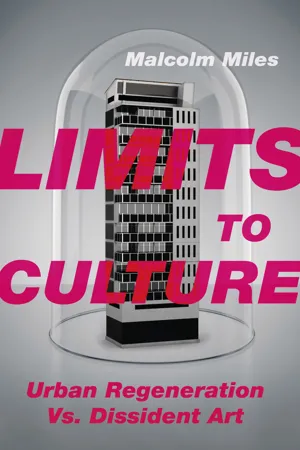
How can we unmask the vested interests behind capital's 'cultural' urban agenda? Limits to Culture pits grass-roots cultural dissent against capital's continuing project of control via urban planning. In the 1980s, notions of the 'creative class' were expressed though a cultural turn in urban policy towards the 'creative city'. De-industrialisation created a shift away from how people understood and used urban space, and consequently, gentrification spread. With it came the elimination of diversity and urban dynamism - new art museums and cultural or heritage quarters lent a creative mask to urban redevelopment. This book examines this process from the 1960s to the present day, revealing how the notion of 'creativity' been neutered in order to quell dissent. In the 1960s, creativity was identified with revolt, yet from the 1980s onwards it was subsumed in consumerism, which continued in the 1990s through cool Britannia culture and its international reflections. Today, austerity and the scarcity of public money reveal how the illusory creative city has given way to reveal its hollow interior, through urban clearances and underdevelopment.
- 224 pages
- English
- ePUB (mobile friendly)
- Available on iOS & Android
eBook - ePub
About this book
Information
1
Cultural Turns: A De-industrialised Estate
The strangeness of cities becomes familiar. Perhaps it began in the 1900s, with the frenetic ambience of electric light and tramcars, and the crowds which thronged metropolitan cities. But this was an optimistic world, soon to be fractured by an industrialised war that would redraw the map of Europe. In the inter-war years, European cities became sites of democracy as well as technology, and of growing diversity through migration. The whole continent was devastated again, with the bombing of civilian targets to an unprecedented extent, before a sense of renewed civic values and humanism prevailed in the post-war era. There was austerity, and bomb sites remained; yet there was a renewed hope in the 1950s and economic expansion in the 1960s, culminating in the prospect of really changing the world in May 1968. That failed. Europe, and the rest of the world, has moved politically to the Right and economically to free market irrationality ever since. It sometimes seems as if the project of Enlightenment became tenuous in the 1930s and 1940s but has finally been encapsulated in an unrecoverable past in today’s neoliberal realm of de-industrialisation: a new wasteland characterised by corporate greed, human rights abuses and environmental destruction. If there is a post-industrial state of mind, it is produced by an economic system but as much enhanced by design. The steel and glass corporate towers, non-places of travel, labyrinthine malls and new art museums in cool industrial sheds amid signs of gentrification, all contribute to a new, post-Enlightenment sense of the sublime. It is characterised by both scale and visual language: the 800,000 square metre Euralille and the 20-hectare CCTV building in Beijing, for instance, both designed by Rem Koolhaas, are daunting;1 and the steel, glass and pale grey cladding of post-industrial urban sheds and towers creates an other-worldly coldness, a feeling of alienation which is as much a source of awe as the Alps were for eighteenth-century travellers on the grand tour.
The new centres in their shiny splendour produce new margins. What was ordinary becomes marginal and residual. Contrasts deepen, real or imagined barriers emerge. Cities split. Owen Hatherley describes the redevelopment of Salford in Greater Manchester as generating a new, ‘dead centre’ in this enclave of wholesale reconstruction, entered from one side by an elegant bridge designed by Santiago Calatrava but from the other by bleak dual carriageways, dreary retail parks and old office complexes in down-at-heel Trafford.2 Salford houses two flagship museums, the Lowry and a branch of the Imperial War Museum, and Media City, where parts of the BBC have moved. Walking in Salford Quays, Hatherley co-opts the weather:
Looking out through torrential rain … at this, the most famous part of the most successfully regenerated ex-industrial metropolis, we can’t help but wonder; is this as good as it gets? Museums, cheap speculative housing, offices for financially dysfunctional banks? What of the idea that civic pride might mean a civic architecture … ?3
Yes, but civic pride is a nineteenth-century value, the last flowering of which occurred in the 1950s (as in the Festival of Britain). These towers contain rather than house their occupants, as cheap housing warehouses the poor; and Hatherley imagines, ‘barricading oneself into a hermetically sealed, impeccably furnished prison against an outside world … assumed to be terrifying’.4 As digital communications systems link the enclaves of the immaterial economy of financial services, media and public relations along never-closing electronic highways, the city becomes a sleepless world where humans operate in systems more extensive than their imaginations. Sleep is, in any case, according to art theorist Jonathan Crary, no use, ‘given the immensity of what is at stake economically’.5 Manchester is a city which never sleeps, or which cannot because the night-economy of alcohol and clubs is as important as its day-time commerce. Permanent consumption compensates the operatives of late capitalism for routine alienation; it is the only game in town, the sole (if soulless) remaining imperative, enforced by the soft policing of the news-entertainment-culture sector.
Time!
If Slavoj Žižek is accurate when he says that these are the end-times,6 the question is what is ending. Perhaps it is modernity and the values it espoused of freedom and human happiness. In the nineteenth century, this was translated into efforts to ameliorate the material conditions of the poor; the improvements – sewers, clean water, housing – were genuine, and culture in the form of new public art museums was one of them, but the strategy was always repressive: the prevention of revolt. Since the 1980s, culture has been co-opted to urban redevelopment, first as public art – since institutionalised to the point of offering a choice between bland new public monuments, corporate logos or visual pollution – then as the participation of artists in the design of environments (from over-designed parks and piazzas to wobbly bridges) and of publics in projects aimed at dealing with the new category of social exclusion. Following the 2007 financial services crisis (the crash) the regeneration industry has emerged in a more brutal guise, looking less to culture for an aura of respectability as it gets on with postcode clearances.
Meanwhile Beauty is radically other to the world produced by capital.7 Like art’s uselessness, or the autonomy claimed for modernism, Beauty is not productive but convulsive. It is met in unexpected moments and encounters which fade before they can be grasped, yet lingers in the mind, and is not at all confined to art. Beauty fractures capital’s routines, breaking the chains of consumer culture in the awareness, suddenly, of ‘the incommensurability of the voice of poetry’.8 And the moment, however ephemeral, is transformative.9
To speak of such moments is utopian, and always has been. But utopianism was the content of modernism, which became (at some point in the late twentieth century) encapsulated in a no longer accessible (hence mystified) past. Art historian Tim Clark argues that modernism and socialism ended at the same time: ‘If they died together, does that mean that … they lived together, in century-long co-dependency?’10 I must leave that for another book, saying here only that globalisation renders both modernism and socialism as obsolete as old wireless sets.
Globalisation concentrates capital in companies which appropriate powers previously vested in states, and produces super-elites. When national regulation is an obstacle, companies go to transnational bodies; the super-rich enjoy unlimited mobility and avoid the inconvenience of paying tax. For sociologist Martin Albrow, no single sovereign power can claim ‘legitimate authority’ over transnational institutions, so that the ‘decentred and delinked’ structures of the new world order become a ‘vacant discursive space’ where, ‘people refer to the globe as once they referred to the nation, hence globalism’.11 Zygmunt Bauman writes that, as states are ‘no longer capable of balancing the books’, they become instead ‘executors and plenipotentiaries of forces which they have no hope of controlling politically’.12 Peter Sloterdijk reads capital as aiming to put ‘working life, wish life and expressive life … [all] within the immanence of spending power’.13 In this context, some of the systems employed by global capital reproduce the practices of the eighteenth century: journalist James Ridgeway reports that: ‘Children are traded in large numbers … [as] a source of low-cost labour’ in the sex industry.14 The global oil industry looks to Arctic exploration now that burning fossil fuels has melted much of the ice, just as colonialists previously pillaged rainforests. After 9/11, an older pattern of private security has been revived, and Naomi Klein writes of ‘the Bush team’ devising a role for government, in which the job of the state is, ‘not to provide security but to purchase it at market prices’,15 Again, design plays its part in the production of a fear which serves the security sector, which has little connection with genuine safety. And design is central to the gleaming images which compensate for money’s trashing of the city, reproduced in glossy tourist brochures and the promotional material for waterside redevelopment schemes, employing star architects in de-industrialised sites ‘to sprinkle starchitect fairy dust’.16 The signs of change are highly visual, sometimes but not always economically successful, and often socially divisive.
Conspicuous division
The chasm between wealth and deprivation is especially visible in redevelopment zones next to neighbourhoods of residual poverty. David Widgery, a doctor in Limehouse, watched the building of Canary Wharf in London’s old Docklands, observing that, ‘[It] remains curiously alien, an attempt to parachute into the heart of the once industrial East End an identikit North American financial district … a gigantic Unidentified Fiscal Object.’17 A UFO, a strange object from another world, the design style which characterises enclaves of the global city of financial services, replicated in any city seeking world status.18 Steel and glass towers tend to be strangely opaque, despite all the glass, using surface design to redirect attention from the dealings which take place inside them. Widgery notes a similarity of design in the towers of Canary Wharf and the World Financial Center, New York (both designed by César Pelli), and compares work in the health service with the ethos of Canary Wharf:
Proletarian decency over monetarist efficiency; one driven by compassion and the solidarities of work and neighbourhood, the other by the simpler calculation of profit and loss. There is no physical monument to what generations of decent working-class East Enders have created and given and made and suffered. But César Peli … tells us that ‘A skyscraper recognises that by virtue of its height it has acquired civic responsibilities. We expect it to have formal characteristics appropriate for this unique and socially charged role.’ Now that would be interesting to see.19
Since the redevelopment of London Docklands in the 1980s, the rhetorical allusion to a civic sense has more or less disappeared. In Docklands, near the ExCeL event space and two chain hotels, a bronze sculpture, Landed by Les Johnson (2009), reduces the story of labour militancy and trade union organisation in the docks to the modelling of two day labourers under the foreman’s eye. This is a successor to the naturalistic, bronze likenesses that proliferated in urban squares and parks in the late nineteenth century to remind citizens of the values they should espouse, represented mainly by white men of the ruling class. Landed is entirely competent and I have no wish to pick on it, yet I wonder what else could have been made to convey the histories of work and workers’ solidarity which took place here.
With money comes mobility and a dissolution of allegiances. Bauman writes: ‘If the new extraterritoriality of the elite feels like intoxicating freedom, the territoriality of the rest feels less like home ground, and ever more like prison … more humiliating for the obtrusive sight of others’ freedom to move.’20 Planner Peter Hall argues that, ‘less fortunate groups are likely to be increasingly damned up in the cities, where they will perhaps be housed after a fashion’ but will ‘find themselves in but not of the city’.21 Bauman reads communication technologies as radically separating the mobile rich and the grounded poor: ‘The database is an instrument of selection, separation and exclusion … [which] washes out the locals.’22 Meanwhile in far-away places, the mobile class plays. Sociologist Mimi Sheller writes that Caribbean islands have become a new Garden of Eden accessible by international flights, with inclusive holiday villages and the added frissons of piracy and marijuana.23 The holiday brochures simulate the Land of Cockaigne,24 yet these sites of far-away consumption offer only another imperative to work to pay for their exploration.
Similarly selective narratives were used to market London’s Docklands redevelopment, with pictures of a sparkling Thames and water sports. For art historian Jon Bird, Docklands in the late 1980s was where multinationals swallowed up the generous offers of land available in enterprise zones to ‘spew out’ various types of architectural postmodernism and ‘high-tech paroxysms of construction that are as incoherent as they are unregulated’.25 The publicity material showed:
harmony and coherence, a unity of places and functions not brutally differentiated into respective spheres of work, home and leisure, but woven together by the meandering course of the river into a spectacular architectural myth of liberal civitas...
Table of contents
- Cover
- Title Page
- Copyright
- Contents
- List of Illustrations
- Introduction
- 1. Cultural Turns: A De-industrialised Estate
- 2. Creative Classes: Aesthetics and Gentrification
- 3. Colliding Values: Civic Hope and Capital’s Bind
- 4. New Cool: England’s New Art Museums
- 5. New Codes: Culture as Social Ordering
- 6. New Air: Urban Spaces and Democratic Deficits
- 7. Dissent: Antagonistic Art in a Period of Neoliberal Containment
- 8. Limits to Culture: Art after Occupy
- Notes
- Index
Trusted by 375,005 students
Access to over 1.5 million titles for a fair monthly price.
Study more efficiently using our study tools.
Frequently asked questions
Yes, you can cancel anytime from the Subscription tab in your account settings on the Perlego website. Your subscription will stay active until the end of your current billing period. Learn how to cancel your subscription
No, books cannot be downloaded as external files, such as PDFs, for use outside of Perlego. However, you can download books within the Perlego app for offline reading on mobile or tablet. Learn how to download books offline
Perlego offers two plans: Essential and Complete
- Essential is ideal for learners and professionals who enjoy exploring a wide range of subjects. Access the Essential Library with 800,000+ trusted titles and best-sellers across business, personal growth, and the humanities. Includes unlimited reading time and Standard Read Aloud voice.
- Complete: Perfect for advanced learners and researchers needing full, unrestricted access. Unlock 1.5M+ books across hundreds of subjects, including academic and specialized titles. The Complete Plan also includes advanced features like Premium Read Aloud and Research Assistant.
We are an online textbook subscription service, where you can get access to an entire online library for less than the price of a single book per month. With over 1.5 million books across 990+ topics, we’ve got you covered! Learn about our mission
Look out for the read-aloud symbol on your next book to see if you can listen to it. The read-aloud tool reads text aloud for you, highlighting the text as it is being read. You can pause it, speed it up and slow it down. Learn more about Read Aloud
Yes! You can use the Perlego app on both iOS and Android devices to read anytime, anywhere — even offline. Perfect for commutes or when you’re on the go.
Please note we cannot support devices running on iOS 13 and Android 7 or earlier. Learn more about using the app
Please note we cannot support devices running on iOS 13 and Android 7 or earlier. Learn more about using the app
Yes, you can access Limits to Culture by Malcolm Miles in PDF and/or ePUB format, as well as other popular books in Social Sciences & Urban Sociology. We have over 1.5 million books available in our catalogue for you to explore.