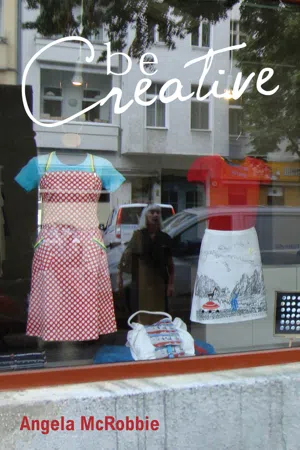
In this exciting new book Angela McRobbie charts the 'euphoric' moment of the new creative economy, as it rose to prominence in the UK during the Blair years, and considers it from the perspective of contemporary experience of economic austerity and uncertainty about work and employment.
McRobbie makes some bold arguments about the staging of creative economy as a mode of 'labour reform'; she proposes that the dispositif of creativity is a fine-tuned instrument for acclimatising the expanded, youthful urban middle classes to a future of work without the raft of entitlements and security which previous generations had struggled to win through the post-war period of social democratic government.
Adopting a cultural studies perspective, McRobbie re-considers resistance as 'line of flight' and shows what is at stake in the new politics of culture and creativity. She incisively analyses 'project working' as the embodiment of the future of work and poses the question as to how people who come together on this basis can envisage developing stronger and more protective organisations and associations. Scattered throughout the book are excerpts from interviews with artists, stylists, fashion designers, policy-makers, and social entrepreneurs.
- English
- ePUB (mobile friendly)
- Available on iOS & Android
eBook - ePub
About this book
Information
1
Clubs to Companies: Notes on the Decline of Political Culture in Speeded-Up Creative Worlds
The ‘Arts Labs’ of the New Cultural Economy
Creative Industry Sectors as defined in Creative Industries Mapping Document (DCMS 1998). Music, Performing Arts, Publishing Software, TV and Radio, Film, Designer Fashion, Advertising, Arts and Antiques, Crafts, Design, Architecture, Interactive Leisure Software.
Cultural Entrepreneur Club (initiative led by ICA, London, Nesta, Arts Council England, Goldsmiths College London and Cap Gemini Ernst and Young), 2000. Selected ‘new job’ titles of 400 invited members including Arts Promoter, Incubator, Consultancy for Inventor, Cultural Strategist, Multimedia Artist, Visual Support Consultant, Media Initiatives and Relationships, Digital Design Consultant, Branding and Communications, Arts in Business Consultants, Art-To-Go Sales, Events Organizer, New Media Agent, net casting/e label/cdrom, Music Portal, dance/music/youth culture, Bio-entrepreneur.1
This chapter provides a preliminary and thus provisional account of some of the defining characteristics of work and employment in the new cultural sector of the UK economy, and in London in particular.2 It also describes a transition from what can be labelled ‘first-wave’ culture industry work as defined by the Department of Culture, Media and Sport Creative Industries 1998 document (see above), to the more economically highly charged and rapidly mutating ‘second wave’ of cultural activity that has come into being in the last three years. This latter development is marked by de-specialization, by its intersection with internet working, by the utilizing of creative capacities provided by new media, by the rapid growth of multi-skilling in the arts field, by the shrunken role of the sector that I would describe as the ‘independents’,3 by a new partnership between arts and business with public sector support, and by government approval as evident in the most recently published Green Paper from the DCMS (2001). (For new job titles see above.) The ‘second wave’ comes into being as a consequence of the more rapid capitalization of the cultural field as small-scale previously independent micro-economies of culture and the arts find themselves the subject of commercial interest.
The expansion of these sections of employment also brings about, for a more substantial number of people, a decisive break with past expectations of work.4 As the focus for extensive interest in the media (TV and press), involvement in these fields provides to a much wider section of the population different ideas about how working lives can now be conducted. Through the profusion of profiles and interviews with hairdressers, cooks, artists and fashion designers, the public (especially young people) are presented with endless accounts of the seemingly inherent rewards of creative labour.5 The flamboyantly auteur relation to creative work, which has long been the mark of being a writer, artist, film director or fashion designer, is now being extended to a much wider section of a highly ‘individuated’ workforce. The media has always glamorized creative individuals as uniquely talented ‘stars’. It is certainly not the case that now, in post-industrial Britain, people genuinely have the chance to fulfil their creative dreams. Rather it is the case that there is a double process of individualization. First this occurs in the obsessive celebrity culture of the commercial media, now thoroughly extended to artists, designers and other creative personnel, and second in the social structure itself, as people are increasingly disembedded from ties of kinship, community and social class. They are, in a deregulated environment, ‘set free’, as Giddens would put it, from both workplace organizations and from social institutions (Giddens 1991).
What individualization means sociologically is that people increasingly have to become their own micro-structures, they have to do the work of the structures by themselves, which in turn requires intensive practices of self-monitoring, or ‘reflexivity’. This process where structures (like the welfare state) seem to disappear and no longer play their expected roles, and where individuals are burdened by what were once social responsibilities marks a quite profound social transformation as Bauman, Beck and others have argued (Bauman 2000a, b; Beck 2000). (In response to government initiatives to get people to take out their own pension schemes, a television advertisement for finance company Norwich Union asks ‘Are you an actor? Act now and get a stakeholder pension’ (C4 and ITV, May 2001).) Individualization in the UK could summarily be defined as the convergence of the forcefulness of neoliberal economics put in place by the Thatcher government from 1979 onwards, with mechanisms of social and demographic change, which result in new social groupings replacing traditional families, communities and class formations. Individualization is not about individuals per se, as about new, more fluid, less permanent social relations seemingly marked by choice or option. However, this convergence has to be understood as one of contestation and antagonism. Individualization thus marks a space of social conflict; it is where debates about the direction of change are played out and where new contradictions arise. This is most apparent in the world of work, since it is here that the convergence is most dramatically configured. Capital finds novel ways of offloading its responsibility for a workforce, but this relinquishing process no longer is confronted by traditional and organized ‘labour’. Instead, the new conditions of work are largely being experienced by ‘New Labour’ – by sectors of the working population for whom work has become an important source for self-actualization, even freedom and independence. This includes women for whom work is an escape from traditional marriage and domesticity, young people for whom it is increasingly important as a mark of cultural identity, and ethnic minorities for whom it marks the dream of upward mobility and a possible escape from the denigration.
The cultural sphere provides an ideal space for young people to explore such individualized possibilities, just as it also offers government opportunities for a post-industrialized economy unfettered by the constraints and costs of traditional employment. The impact of this intersection accounts for what I want to propose here as an acceleration in the cultural realm. There is a much expanded workforce comprising freelance, casualized and project-linked persons, and there is also a more fiercely neoliberal model in place with the blessings of government for overseeing the further de-regulation and commercialization of the cultural and creative sector (DCMS 2001). The culture industries are being ‘speeded up’ and further capitalized as the state steps back and encourages the privatization of previously publicly subsidized cultural provision (for example by buying in freelance arts administrators for single projects, rather than employing full-time staff). Those working in the creative sector cannot simply rely on old working patterns associated with art worlds, they have to find new ways of ‘working’ the new cultural economy, which increasingly means holding down three or even four ‘projects’ at once. This becomes a necessity as, in a crowded and competitive field, charges to the client fall (to pick up the business), and consequently to make ends meet the ‘cultural entrepreneur’ must be running several jobs at once.6 In addition, since these projects are usually short term there have to be other jobs to cover the short-fall when a project ends. The individual becomes his or her own enterprise, sometimes presiding over two separate companies at the one time.7 To sum up, if we consider the creative industries in the UK as a kind of experimental site, or case study, or indeed ‘arts lab’ for testing out the possibilities for ‘cultural entrepreneurialism’ (see Leadbeater and Oakley 1999), then I would suggest that we can also see a shift from first to second wave, which in turn (ironically) marks the decline of ‘the indies’ the rise of the creative sub-contractor and the downgrading of creativity.
On the Guest List? Club Culture Sociality at Work
Given the ongoing nature of these developments, the ‘authorial’ voice of the following pages is tentative, in that I am drawing on observations and trends emerging from my current work in progress on this topic. I propose a number of intersecting and constitutive features. They are as follows: first that imported into the creative sector are elements of youth culture, in particular those drawn from the energetic and entrepreneurial world of dance and rave culture; second that the realm of ‘speeded up’ work in the cultural sector now requires the holding down of several jobs at the one time; third that such working conditions are also reliant on intense self promotional strategies, and, as in any business world, on effective ‘public relations’; and fourth that where there is a new relation of time and space there is little possibility of a politics of the workplace, little time, few existing mechanisms for organization, and no fixed workplace for a workplace politics to develop. This throws into question the role and function of ‘network sociality’ (Wittel 2001). Thus fifth and finally we can see a manifest tension for new creative workers, highly reliant on informal networking but without the support of these being underpinned by any institutional ‘trade association’. They can only find individual (or ‘biographical’ as Beck puts it) solutions to systemic problems (Beck 1992).
The dance/rave culture that came into being in the late 1980s as a mass phenomenon has strongly influenced the shaping and contouring, the energizing and the entrepreneurial character of the new culture industries. The scale and spread of this youth culture meant that it was more widely available than its more clandestine, rebellious, ‘underground’ and style-driven predecessors, including punk. The level of self-generated economic activity that ‘dance-party-rave’ organization entailed, served as a model for many of the activities that were a recurrent feature of ‘creative Britain’ in the 1990s. Find a cheap space, provide music, drinks, video, art installations, charge friends and others on the door, learn how to negotiate with police and local authorities and in the process become a club promoter and cultural entrepreneur. This kind of activity was to become a source of revenue for musicians and DJs first, but soon afterwards for artists, so that the job of ‘events organizer’ is one of the more familiar of new self-designated job titles. The form of club sociality that grew out of the ecstasy-influenced ‘friendliness’ of the clubbing years gradually evolved into a more hard-nosed networking, so that an informal labour market has come into being, which takes as its model the wide web of contacts, ‘zines’, flyers, ‘mates’, grapevine, ‘word of mouth’ socializing, which also was a distinctive feature of the ‘micro-media’ effects of club culture (Thornton 1996). The intoxicating pleasures of leisure culture have now, for a sector of the under thirty-fives, provided the template for managing an identity in the world of work. Apart from the whole symbolic panoply of jargon, clothes, music and identity, the most noted features of this phenomenon were the extraordinary organizational capacities in the setting up and publicizing of ‘parties’. Now that the existence of raves and dance parties has become part of the wider cultural landscape having secured the interest and investment of major commercial organizations, it is easy to overlook the energy and dynamism involved in making these events happen in the first place. But the formula of organizing music, dance, crowd and space have subsequently proved to give rise to ‘transferable skills’, which in turn transform the cultural sector as it is also being opened up to a wider, younger and more popular audience.8
The example of the shaping up influence of club culture therefore sets the scene for this chapter. And where patterns of self employment or informal work are the norm, what emerges is a radically different kind of labour-market organization. While inevitably the working practices of graphic designers, website designers, events organizers, ‘media office’ managers and so on share some features in common with previous models of self-employed or freelance working, we can propose that where in the past the business side of things was an often disregarded aspect of creative identities best looked after by the accountant, now it is perceived as integral and actively incorporated into the artistic identity. This is illustrated in the activities of the Young British artists for whom the commercial aspect of the art world is no longer disparaged but is welcomed and even celebrated. Mentor and tutor to the Goldsmiths graduates, including Damien Hirst, Professor Michael Craig Martin reputedly encouraged the students to consider the partying and networking they had to do to promote their work as a vital part of the work, not as something separate.9 He also insisted that artistic values were not incommensurate with entrepreneurial values. To some extent this more openly commercial approach is also part of the logic (though unexpected for leftist critics) of breaking down the divide between high and low culture. If, for example, art is not such a special and exceptional activity, if it ought not to see itself as superior to the world of advertising, then what is to stop the artists from expecting the same kind of financial rewards, expense accounts and fees as the art directors inside the big agencies? The new relation between art and economics marks a break with past anti-commercial notions of being creative. Instead, yo...
Table of contents
- Cover
- Title page
- Copyright page
- Acknowledgements
- Introduction
- 1: Clubs to Companies: Notes on the Decline of Political Culture in Speeded-Up Creative Worlds
- 2: Unpacking the Politics of Creative Labour
- 3: The Artist as Human Capital: New Labour, Creative Economy, Art Worlds
- 4: The Gender of Post-Fordism: ‘Passionate Work’, ‘Risk Class’ and ‘A Life of One's Own’
- 5: Fashion Matters Berlin: City-Spaces, Women's Working Lives, New Social Enterprise?
- 6: A Good Job Well Done? Richard Sennett and the New Work Regime
- Conclusion: European Perspectives
- References
- Index
- End User License Agreement
Trusted by 375,005 students
Access to over 1.5 million titles for a fair monthly price.
Study more efficiently using our study tools.
Frequently asked questions
Yes, you can cancel anytime from the Subscription tab in your account settings on the Perlego website. Your subscription will stay active until the end of your current billing period. Learn how to cancel your subscription
No, books cannot be downloaded as external files, such as PDFs, for use outside of Perlego. However, you can download books within the Perlego app for offline reading on mobile or tablet. Learn how to download books offline
Perlego offers two plans: Essential and Complete
- Essential is ideal for learners and professionals who enjoy exploring a wide range of subjects. Access the Essential Library with 800,000+ trusted titles and best-sellers across business, personal growth, and the humanities. Includes unlimited reading time and Standard Read Aloud voice.
- Complete: Perfect for advanced learners and researchers needing full, unrestricted access. Unlock 1.5M+ books across hundreds of subjects, including academic and specialized titles. The Complete Plan also includes advanced features like Premium Read Aloud and Research Assistant.
We are an online textbook subscription service, where you can get access to an entire online library for less than the price of a single book per month. With over 1.5 million books across 990+ topics, we’ve got you covered! Learn about our mission
Look out for the read-aloud symbol on your next book to see if you can listen to it. The read-aloud tool reads text aloud for you, highlighting the text as it is being read. You can pause it, speed it up and slow it down. Learn more about Read Aloud
Yes! You can use the Perlego app on both iOS and Android devices to read anytime, anywhere — even offline. Perfect for commutes or when you’re on the go.
Please note we cannot support devices running on iOS 13 and Android 7 or earlier. Learn more about using the app
Please note we cannot support devices running on iOS 13 and Android 7 or earlier. Learn more about using the app
Yes, you can access Be Creative by Angela McRobbie in PDF and/or ePUB format, as well as other popular books in Social Sciences & Media Studies. We have over 1.5 million books available in our catalogue for you to explore.