Global Downtowns reconsiders one of the defining features of urban life—the energy and exuberance that characterize downtown areas—within a framework of contemporary globalization and change. It analyzes the iconic centers of global cities through individual case studies from Europe, Asia, Africa, Latin America, and the United States, considering issues of function, population, imagery, and growth. Contributors to the volume use ethnographic and cultural analysis to identify downtowns as products of the activities of planners, power elites, and consumers and as zones of conflict and competition. Whether claiming space on a world stage through architecture, media events, or historical tourism or facing the claims of different social groups for a place at the center, downtowns embody the heritage of the modern city and its future.
Essays draw on extensive fieldwork and archival study in Beijing, Barcelona, New York, Los Angeles, Chicago, Dar es Salaam, Dubai, Nashville, Lima, Philadelphia, Mumbai, Havana, Beirut, and Paris, among other cities. They examine the visions of planners and developers, cultural producers, governments, theoreticians, immigrants, and outcasts. Through these perspectives, the book explores questions of space and place, consumption, mediation, and images as well as the processes by which urban elites learn from each other as well as contest local hegemony.
Global Downtowns raises important questions for those who work with issues of urban centrality in governance, planning, investment, preservation, and social reform. The volume insists that however important the narratives of individual spaces—theories of American downtowns, images of global souks, or diasporic formations of ethnic enclaves as interconnected nodes—they also must be situated within a larger, dynamic framework of downtowns as centers of modern urban imagination.
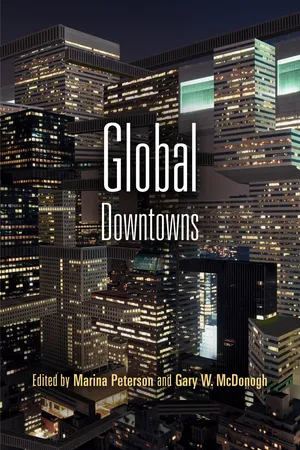
- 368 pages
- English
- ePUB (mobile friendly)
- Available on iOS & Android
eBook - ePub
Global Downtowns
About this book
Information
PART I

Imagination
1
Toward a Genealogy of Downtowns
How do we sense a city? Is it a matter of directing our gaze from building to street to traffic to neon signs and back to the building again, accumulating impressions of line, scale, enclosure, mass, and spectacle, just as we do when viewing a painting of a landscape? No, the immediacy of our body’s movement through the city requires a different kind of gaze, one that filters and edits our impressions according to preestablished systems of knowledge. For those cities where we consider ourselves at home, the knowledge is different from what it is for cities where we are visiting for the first time. At home, we enjoy exquisitely detailed knowledge of streets, buildings, traffic, and neon, as well as the memory of past experiences in these locations. This familiar knowledge of places and practices employs the city as a canvas on which we live our lives. First-time visitors, in contrast, see the city initially as a mirror of received knowledge: the city as icon of a region, the city as site of history, the city as filled with identifiable monuments, the city as outlet for enjoying regional foods and drink, and so on. Each of these represents an artifact to be collected, consumed by the senses, and made material through postcards and bric-a-brac that can be exhibited to the folks at home as evidence of the transforming effects of travel. After spending some time among the locals, the visitor begins to see the city as a possibility for living a life beyond a hotel room and suitcase, a more difficult-to-communicate series of impressions that tend to fade rapidly. Of course, even visitors are rarely without some previous experience in cities.
The global downtown, the focus of the chapters assembled in this volume, is a globalized, neoliberal variety of the new downtown. The new downtown is a redesign of the urban center, often sponsored and financed by corporate, rather than municipal, interests and employing design principles that simulate the features of cities without people. In this way, it is a refashioning of the morality of the urban community. It enters the experience of the knowers of the city as their bodies move through a city’s built environment. Redesigns of the urban center are not particular to the last forty years. They have a history that stretches back over 180 years. The whole concept of downtown qua downtown may be bound up with the process of redesign. My goal here is not to write that history, but to excavate the layers of that experience. I hope to lay bare the artifacts that contribute to the experience of redesigned downtowns, so that what have been called the “new downtowns” can be seen in sharper relief.
In describing the genealogy that has led us to these new downtowns, I want to explore the common experiences of all who enter the downtown, regardless of their place of habitation. Such a project is possible even while acknowledging that people with different histories will experience some aspects of the city differently. All ages, classes, genders, ethnicities, and races experience the organized waiting that is a traffic jam, and its opposite, the joy of free-flowing circulation through city streets. How one expresses the waiting or the joy may vary from person to person, perhaps even group to group, but the ways in which the city inhibits movement and then releases it again levels social distinction. It is therefore appropriate to begin with movement.
Latrocinium, with Apologies to Italo Calvino
Recently, I reread Italo Calvino’s Invisible Cities (Calvino 1978). The book describes fantastic cities framed by an extended conversation between a narrator named Marco Polo and an interlocutor in the person of the aging emperor Kublai Khan. In that book, the narrator constructs and deconstructs fifty-five different ways of life in cities, each more fanciful than the next, all to the delight of the reader. I want to begin this unwrapping of the term downtown by imagining a city that Calvino did not describe. I call that city Latrocinium.
Kublai Khan asks Marco Polo what cities lie just beyond the borders of his empire. “Highness,” begins Marco Polo, “there is a most famous city entirely devoid of any buildings, walls, gardens, or towers. That city is called Latrocinium, the capital of the Esconian Empire. One approaches Latrocinium on a five-lane highway through a desert. As one moves toward the city, the highway becomes increasingly crowded with vehicles of all sorts: wagons, chariots, dog carts, sport utility vehicles, semi tractor trailers, circus wagons, rag top convertibles, and motor scooters. As one nears the actual city limits the traffic appears to stop. This is, in fact, an illusion. You are definitely moving, but only very slowly. The pace is so slow, that you feel as if you are at a dead stop. You have truly entered Latrocinium.
The people of Latrocinium spend their days moving down this highway. It takes so much time to move around the city that they take pains to speak to each from their vehicles. To not do so would deprive them of one of the few opportunities for human contact. In this way, they form the same sorts of bonds one finds in the other cities I have described to you. However, in Latrocinium these bonds last only as long as the parallel lines of traffic progress at the same speed. In one of my visits, the line I was in suddenly accelerated, leaving behind a philosopher in the vehicle on my left with whom I was engaged in a conversation about the agency of the word, and a woman on my right with whom I was shamelessly flirting. Several minutes later, I found myself in an entirely different neighborhood of Latrocinium, as the people in the vehicles around me were now strangers.
[In the interests of space, I will exclude from the account several paragraphs where Marco Polo tells Kublai Khan how children are schooled in Latrocinium, how people provision themselves without abandoning their vehicles, and how the people of Latrocinium bury their dead.]
After several months of moving down the road in this fashion, your vehicle suddenly begins to pick up speed. The vehicles around you are moving, too, but at different paces. Then, spaces begin to grow between the vehicles. It seems as if there is more road available. You accelerate. You are now leaving Latrocinium. You are among the few who chose the road that actually leads somewhere else.
This new Invisible Cities story raises the sort of questions that have troubled intellectuals working in cities since Vitruvius, the fourth-century Roman architect and planner. Are cities one social organization or many? Are cities primarily territorial entities of mortar and brick, steel and glass, inhabited by people, or are they constructs of the imagination that people then give material form?
I have found the culture concept a useful analytic for parsing such questions, especially when dealing with the unambiguously large, internally complex versions of urban settlements, the metropolises of the world. As an analytic, the culture concept directs our attention toward “the socially acquired patterns within which people think, feel, and do, not the people themselves” (Brumann 1999: S23). Making generalizations about specific features within an aggregate is a different analysis task and a different rhetoric than making generalizations about the distinct-ness and qualities of an aggregate as a whole. (i.e., the culture of the city). The former approach “does not require physical proximity or a specific type of Gemeinschaft ties, only social interaction, however (mass-) mediated and casual this may be—just seeing, hearing or reading of one another may suffice for mutual imitation” (Brumann 1999: S23). As ethnographers of Latrocinium culture, we can say nothing at all about the city as a city. However, we can say a great deal about the practice of making and breaking social relationships as the traffic speeds up and slows down. We might even be able to generalize about specific features of this interior relational practice. What goes for Latrocinium also goes for all those other social organizations in the contemporary world in which the flow of people, goods, ideas, and energy is the primary organizational feature shaping people’s lives.
The Barest Essentials: The Isolated City
If one were to strip away the asphalt, cement, bricks, and mortar of cities, what would be left of urban life? The first principles of the urban are to be found in what is known as primitive trade. First identified by Karl Polanyi (1975) and elaborated by Conrad M. Arensberg, Harry W. Pearson (Polanyi, Arensberg, and Pearson 1957), and Marshall Sahlins (1972), primitive trade is balanced reciprocity between strangers where the goal of the exchange is the satisfaction of want, rather than the maintenance of social relations. This form of trade is contrasted with social exchanges of “gifts” where the ongoing social relations dwarf the values of the object exchanged. In trade, surpluses of goods and services in one location are exchanged to meet desires that cannot be satisfied adequately through production in another location. Because it takes place between relative strangers, that is, people who do not have sustained ties with each other, such trade is conducted in places outside the settlements of the actors involved. The resulting markets, fairs, and bazaars can be temporary, periodic, seasonal, or permanent. The longer they exist in the same place, the more often ancillary and opportunistic activities will co-occur in that place. This intersection of exchange among strangers in specific times and places is the one activity that is consistent across all urban experiences. Whatever co-occurs, such as ritual, administration, military, transportation, or production, gives this intersection its uniqueness, what Calvino might call its visibility. However, it is the exchange activity that gives rise to the phenomenon of the central place.
Central place is the name of the location where strangers assemble to trade. People’s use of land was shown by Johan Heinrich Thünen in 1826 to be a function of the exchange value for agricultural surplus production and the distance to the place of exchange, thereby establishing the importance of the calculation of marginal cost in people’s lives (1966). For producers in a region where places of exchange compete with each other, the desire to reduce this marginal cost and enjoy higher prices in exchange is a strong one. This must compete with population growth, which forces people to move away from each other and toward unused space to meet their basic needs. Over time, new places of exchange and transportation links are established. As the region fills with central places, people in the different locations begin to compete with each other to provide more specialized exchanges, the ones people desire most but exchange less often and are therefore willing to spend more time, effort, and treasure to attain. Every good, every service has a threshold where consumers will no longer move to exchange for it (Stine 1962). Out of this, Walter Christaller noted in 1933, a hierarchical system of central places develops, each level of the hierarchy marked by increases in specialization in the goods and services available for trade (1966; Lösch 1954). These principles apply to periodic markets (Skinner 1964), although some reflect these locational effects less clearly than others (Bromley 1974), as well as to towns and cities. Important exceptions to the hierarchy of central places are observable in cities and towns that follow the rank-size rule: the higher the center is in the hierarchy, the larger its size. This rule was elaborated by Brian J. L. Berry in 1971 to show that growth actually trickles down through the hierarchy from central city to suburb except when political processes intervene to distort this hierarchy (Berry 1971). Distorted hierarchies and uneven growth are more the norm than what he expected when he attempted to test the rank-size principle in real regions. The very highest nodes in the hierarchy are also places of great economic and political power. This power is used to restrict the growth of secondary and tertiary places to ensure that the metropolis, or primate city, will receive the greatest share of growth, wealth, and cultural prominence (Mera 1973; Rotenberg 1979).
William Cronon identifies the river as the natural feature that promoted Chicago as a central place. It provided a sheltered harbor for canoes, and later sailing ships, a passage from the lake to the interior prairie, and a boundary between open and flowing waters. With the Calumet portage a few miles to the south, the river was a gateway to the Mississippi watershed and trade routes throughout North America. This feature reduced marginal costs for every commodity that passed through it. It was this favorable transportation position that grabbed the attention of the market agents after 1833. They convinced investors that this site was a unique candidate for a central place that would quickly ascend the regional hierarchy, bringing the value of property along with it. Even after the first speculative boom collapsed in 1837, the site’s transportation advantages sustained market development disproportionate to all but a few other central places in all of North America (Cronon 1991: 23–41).
Stripped of its streets and buildings, the urban place is a central place, a place of exchange. As we add back the built features through which we identify cities, we are still seeing a place of exchange. Where, when, and whom to include and exclude from the exchange practices are the reason for the city to exist. Without that place of exchange, the very absence of which makes Latrocinium so disconcerting, the city cannot be seen.
Enter the Downtown: The Legacy of Burnham and Burgess
Neither Daniel Burnham, author of the plan for Chicago, nor Ernest Burgess, author of the seminal chapter of urban growth and development in Robert E. Park, Burgess, and Roderick Duncan McKenzie’s canonical Chicago School text, The City (1967), invented the idea of the downtown, the central business district. The continued popularity of this book contributed to distributing the idea among several generations of designers and planners. The liminality of the center, the axis mundi, is an idea as old as settled communities. However, both Burnham and Burgess gave it shape in ways that permitted powerful institutions to focus on it as a place of control. Nor were they operating in an intellectual vacuum. European urban restructuring of the downtown had been ongoing since the 1830s. What these fin de siècle modernists did was to brand the center for the planners and designers who followed them. The two were of different generations and never met, though they walked the same streets and were inspired by the lake-river city of Chicago for many years.
At the time when Burnham was developing his plans, the discourse on shaping the downtown to serve the powerful was dominated by two nineteenth-century planning regimes: the archaic school championed by Camillo Sitte, which designs a downtown as a holistic aesthetic with far-reaching sensory and psychological effects, and the modern school championed by Otto Wagner, which plans the downtown as an engineering problem of moving people and goods safely, hygienically, and without risk of fire (Rotenberg 1995: 161–66). Burnham’s plan for Chicago chose to privilege traffic flows over psychological comfort, remaining firmly within the modernist regime. It demanded a center to the web of streets, though the actual shape of that center itself can vary from a rectilinear to the radial grid. Paris (rectilinear) and Vienna (radial) provided two different models of how the center of established cities could be reconfigured for modern traffic flows, retail trade, and commercial real estate markets.
Burnham took the traditions of the nineteenth-century urban design visionaries and the Beaux Arts neoclassical design aesthetics of that school and produced a master plan for Chicago. That plan, published in 1909, allowed for almost infinite growth while retaining the City Beautiful Movement’s sense of grandeur and metropolitan self-consciousness that previously has been enjoyed only by the imperial metropoles of Europe. In sumptuous watercolor renderings, Burnham portrayed a city as if in the civil twilight of a new dawn. The shining beacon of light is located in an arbitrary place on the grid, near the river and the lakefront. This privileged place would become known as the downtown. The influences were readily apparent: Baron Haussmann for the radiating boulevards, Ebenezer Howard for the outer ring, Frederick Law Olmsted for the integrated park system, Charles McKim and Louis Sullivan for the water elements and the neoclassical simplicity in the sightlines, and Maxfield Parrish for the color palette. Yet of all the features, the system of circles radiating from a center of a rectilinear grid, like a stone tossed in a placid lake, is the prominent feature of the plan. These increasingly brighter circles are not evident in Burnham’s plan for San Francisco. There are more “circles on squares” in his plan for Manila, completed one year earlier. Starting with Manila and Chicago, Burnham would employ the style of illuminating the center of his cities with this bright light of color. This modern regime unfolded globally. It is first enacted in the metropol and later in the colonial capitals.1
These “circles on squares” are important in leading Burgess to think about the growth and social development of Chicago. Written in 1925 (fifteen years after the publication of Burnham’s plan and its wide dissemination under the patronage of the Commercial Club of Chicago), Burgess’s chapter is local in its vision, global in its impact. Park, McKenzie, and Louis Wirth, the other three authors of the book’s chapters, were more directly concerned with the social organization of specific groupings in the city. It was Burgess who focused on the...
Table of contents
- Cover
- Half title
- Dedication
- Title
- Copyright
- Contents
- Introduction: Globalizing Downtown
- Part I. Imagination
- Part II. Consumption
- Part III. Conflict
- Notes
- Bibliography
- List of Contributors
- Index
- Acknowledgments
Trusted by 375,005 students
Access to over 1.5 million titles for a fair monthly price.
Study more efficiently using our study tools.
Frequently asked questions
Yes, you can cancel anytime from the Subscription tab in your account settings on the Perlego website. Your subscription will stay active until the end of your current billing period. Learn how to cancel your subscription
No, books cannot be downloaded as external files, such as PDFs, for use outside of Perlego. However, you can download books within the Perlego app for offline reading on mobile or tablet. Learn how to download books offline
Perlego offers two plans: Essential and Complete
- Essential is ideal for learners and professionals who enjoy exploring a wide range of subjects. Access the Essential Library with 800,000+ trusted titles and best-sellers across business, personal growth, and the humanities. Includes unlimited reading time and Standard Read Aloud voice.
- Complete: Perfect for advanced learners and researchers needing full, unrestricted access. Unlock 1.5M+ books across hundreds of subjects, including academic and specialized titles. The Complete Plan also includes advanced features like Premium Read Aloud and Research Assistant.
We are an online textbook subscription service, where you can get access to an entire online library for less than the price of a single book per month. With over 1.5 million books across 990+ topics, we’ve got you covered! Learn about our mission
Look out for the read-aloud symbol on your next book to see if you can listen to it. The read-aloud tool reads text aloud for you, highlighting the text as it is being read. You can pause it, speed it up and slow it down. Learn more about Read Aloud
Yes! You can use the Perlego app on both iOS and Android devices to read anytime, anywhere — even offline. Perfect for commutes or when you’re on the go.
Please note we cannot support devices running on iOS 13 and Android 7 or earlier. Learn more about using the app
Please note we cannot support devices running on iOS 13 and Android 7 or earlier. Learn more about using the app
Yes, you can access Global Downtowns by Marina Peterson, Gary McDonogh, Marina Peterson,Gary McDonogh in PDF and/or ePUB format, as well as other popular books in Social Sciences & City Planning & Urban Development. We have over 1.5 million books available in our catalogue for you to explore.