In the past, violations of human rights were commonly portrayed as atrocities perpetrated by tyrannical dictatorships. Today, the images of torture at Abu Ghraib in Iraq, and the treatment of detainees at Guantanamo Bay, put the lie to this assumption. State violations of human rights have a global reach. Tony Evan's introduction to the politics of human rights examines the impact of globalisation on global human rights. He argues that the state's role in protecting and promoting rights has been severely weakened under globalisation – and that the emerging global order may be a cause of many human rights violations. As the value of the market grows, the value of individual human rights decreases. The Politics of Human Rights departs from traditional interpretations of human rights by focusing on the political economy of human rights, rather than on the philosophical or legal aspects.
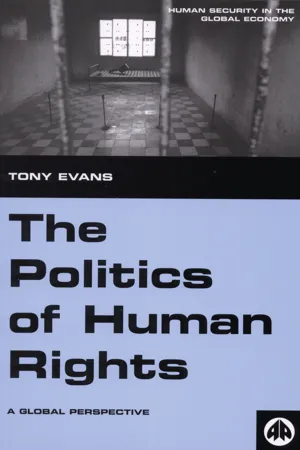
- 176 pages
- English
- ePUB (mobile friendly)
- Available on iOS & Android
eBook - ePub
About this book
Information
1
The Politics of Universal Human Rights
The Politics of Universal Human Rights
The purpose of this chapter is to place the development of the universal human rights regime within the context of post-Second World War global order. It begins with an examination of the relationship between human rights and configurations of power that characterized the post-World War order. This suggests that the current conception of human rights, like all dominant conceptions of rights, is the outcome of a political struggle aimed at achieving moral legitimacy. These questions are explored in more detail in Chapter 2, where the tripartite nature of human rights talk is also discussed. A section looks at the rise of human rights in the post-Second World War order and, more particularly, the role of the United States in placing human rights on the global political agenda. A further section looks at the socialist and less developed countries’ challenge to the US’s conception of universal human rights. The clash of ideologies, which was at the core of all Cold War struggles, meant that the United States moved to distance itself from the human rights regime under construction at the United Nations. Rather than engage in a global dialogue on the nature of human rights that gave voice to a full range of cultures, religions, and ideologies, the US used its considerable political and economic power to promote a particular conception of human rights that sought to legitimate its own interests and those of global capital. A penultimate section suggests that the post-Cold War order, which some suggest marks the end of the contemporary struggle over the concept of human rights, will not provide a more propitious context for rights than in the past. Finally, some brief remarks will be made about the future of universal human rights, in preparation for the following chapters.
HUMAN RIGHTS AS POLITICS
The creation of the United Nations placed universal human rights at the centre of global politics. Human rights are mentioned in the UN Charter seven times, including Article 68, which calls for the creation of the Commission on Human Rights. The Commission completed the final draft of the Universal Declaration of Human Rights (UDHR) during its first eighteen months of deliberations, a remarkable achievement, rarely matched before or since, for reaching any international agreement. That the UDHR remains the single, most important statement of human rights norms, more than fifty years later, places this achievement into even sharper perspective. In the following decades the Commission drafted a series of legally binding treaties, the most important of which are the International Covenant on Civil and Political Rights (ICCPR) and the International Covenant on Economic, Social and Cultural Rights (ICESCR). Other legally binding instruments include the Convention on the Prevention and Punishment of the Crime of Genocide (Genocide Convention), the Convention Against Torture and Other Cruel, Inhuman or Degrading Treatments or Punishments (Torture Convention) and the Convention on the Elimination of All Forms of Discrimination Against Women (CEDAW). The Commission also put in place procedures for implementing the rights set out in these treaties, including monitoring, periodic reports and arbitration. The Americas, Africa and Europe have also established regional human rights regimes with varying degrees of effectiveness.
Yet, despite all this activity, violations of human rights are almost a commonplace. Newspapers and other news media are filled with graphic reports and images of human rights violations, describing acts widely acknowledged as unlawful under international law. The disjuncture between the formal norms set out under international law and the normal practices of governments, transnational corporations, international financial institutions, the military and the police suggest two possibilities. The first, which human rights scholars widely accept, is that the international community has not matched its enthusiasm for setting human rights standards with a similar enthusiasm for creating the necessary machinery to implement those standards. Although the Commission on Human Rights has developed monitoring procedures and advisory programmes for implementing state obligations under international law, commentators generally acknowledge that these are weak. The problem of how to secure universal values in an international system of sovereign states, defined by the principles of domestic jurisdiction and non-intervention, remains at the centre of this observation. The second possibility concerns an approach to securing human rights that emphasizes post-violation redress, rather than an alternative approach that looks at the causes of violations and the means of prevention. This approach is reflected in the recent creation of an International Criminal Court and the courts set up to try perpetrators of human rights crimes in Rwanda and the former Yugoslavia. That the causes of many violations might be found in the structures of the global political economy, and the interests that these structures support, may offer some insight into why redress is favoured over structural reform. This second reason for the failure to provide adequate protection for human rights offers a central theme throughout this book.
As noted in the Introduction, and discussed in greater detail in Chapter 2, the theory and practice of human rights is generally conducted in the language of legal and philosophical reason, which focuses upon international law, methods of implementation and the source, justification and meaning of rights. If political questions concerning power and interest are considered at all, commentators usually view them within a realist or international society conception of global politics, which stresses the principles of sovereignty, domestic jurisdiction and non-intervention in the affairs of legitimate states (Kennan 1985; Vincent 1986). In this construction of the human rights debate, the legal, philosophical and political discourses that constitute ‘human rights talk’ adopt a liberal framework (Vincent 1986), leaving little room for alternative conceptions or interpretations that might raise challenging questions about current theory and practice. What legitimating role do human rights play in the current global order? Do all individuals and groups benefit from the dominant conception of universal human rights? Why do powerful Western liberal democracies so vigorously defend their particular conception of human rights? What role does the global political economy play in securing or denying access to the means for protecting human rights? Is international law the most effective way of promoting all human rights? Can we sustain the claim that human rights and democracy are two sides of the same coin, as many Western commentators assume? What is the future of human rights in the age of globalization? Although some authors have attempted to look at these questions in recent times, the dominant epistemology of human rights does not encourage such enquiry.
The convention of understanding ‘progress’ in the field of human rights by reference to law, including the creation of international institutions, reflects a widely held assumption that reason and rationality have triumphed over politics. These assumptions are often reflected in the assertion that the creation of the UDHR represents a symbolic moment of ‘arrival’, when the reason of rights finally prevailed, following two hundred years of struggle (Raphael 1967). At the end of the Cold War, which for some marks the ‘end of history’ (Fukuyama 1989), all that is left for the human rights debate are technical issues to do with improving implementational procedures and drafting new international laws that clarify already legitimated and universally accepted norms. If politics has any further role, it is confined to disagreements over these technical issues, which are themselves conditioned by the ‘givens’ of the existing, liberal world order. Power and interests are no longer part of the struggle for human rights. Consequently, with ‘depressing regularity’, those engaged in the theory and practice of human rights are prone to offering us exhortations of optimism and hope, which are ‘almost always expressed in the passive voice to increase its apparent authority’ (Watson 1979). What such an approach indicates is that the author’s argument is based more upon his or her perceptions of human nature, including a vision of how human beings ‘ought’ to treat one another, rather than the theory and practice of the current human rights regime.
For the critical reader, or simply the puzzled observer, the optimism found in the literature cannot be reconciled with the overwhelming evidence of human rights violations. What this situation reveals is the failure to take full account of the social and political construction of rights, the particular configuration of world order in which the current human rights regime operates and the interests that the current regime sustains. Given the political context of both the French and American revolutions, which are widely understood as seminal moments in the modern human rights movement, this seems a strange omission. These revolutions represent the climax of the struggle to overthrow an old social order and legitimate the new. They are revolutions in the sense that they sought a radical transformation of the accepted principles of social organization, rather than a mere seizure of power within the existing order. Thus, the principles of the new order – the people as sovereign, the authority of the civil administration and the rights of the citizen – replaced the principles of the old order – the divine right of kings, the authority of the Church and a duty to obey the monarch. Following the success of these revolutions, the old order, which for centuries provided the social context for political and economic action, was revealed as oppressive and tyrannical and the new as offering the conditions for human dignity, personal freedom and a future without fear.
From these historic events we can conclude that moral claims are closely linked to processes associated with the legitimation of interests. In other words, ‘ideas and practices concerning human rights are created by people in particular historical, social and economic circumstances’ (Stammers 1995: 488, original emphasis). The regimes that emerged from the French and American revolutions sought to legitimate their authority through the new language of natural law and human rights, which suggested an inclusive harmony of interests. The separation of private and economic life from public and political life, which is central to natural rights, was presented as a moral imperative in the interests of all the people, not the outcome of new power relationships that served the interests of particular groups. Although natural rights did not reveal ‘any universal truths about the relationship between individuals, society and the state’ (Stammers 1993: 74), it provided a moral justification for overthrowing the old order and replacing it with one that legitimated the interests of the dominant group in the new. As Issa Shivji has argued, human rights ‘mirror the struggles and concerns of the dominant groups in society at a particular time as these groups organize and reorganize to maintain their position’ or to overthrow the existing order (Shivji 1999: 253).
The political discourse on human rights therefore seems to offer two possible views of the role of power. The first suggests ‘power to the people’; where appeal to human rights offers a moral claim that trumps all other claims to the legitimate use of power, including law. The second sees human rights as ‘power over people’, expressed in exclusionary practices that deny the full participation of those who fail to support the interests of the dominant group (Evans 1997a). If the contradictions between ideas of freedom and the practice of exclusion are noted at all, the dominant group typically justifies these by arguing either that the excluded do not have the moral capacity to engage fully in decision-making processes or by simply labelling them ‘mad’ (Hindess 1992; Keeley 1990). Thus, the concept of human rights often supports competing conceptions that give a focus to deeply rooted political struggles. Put another way, the formal, institutionalized and legal practices of human rights reflect and sustain the interests of a dominant group in the existing order, while informal, privately motivated and, on occasion, extralegal action reflects the interest of an alternative order (Stammers 1999). Such a conclusion does, of course, raise questions about the role and status of many non-governmental organizations (NGOs) who seek to promote human rights through formal means. The answers to these questions are not pursued here, but may rely upon understanding NGOs as co-opted organizations that lend further legitimacy to the established order, rather than a radical movement that seeks to challenge that order (Taylor 2001).
HEGEMONY AND HUMAN RIGHTS IN THE POST-SECOND WORLD WAR ORDER
The United Nations Charter placed the promotion of human rights at the centre of the post-Second World War order. Given the historic relationship between human rights and interests described above, we have little reason to believe that the postwar order is any different from that of the past: human rights and interests remain inexorably linked. During much of the postwar period, hegemony has referred to the existence of a single dominant state, possessed of the material capabilities and political will to maintain a world order that reflects the hegemon’s own interests (Keohane 1984). In this context, the promotion of universal values, like human rights, might seem a distraction, particularly in an order said to be characterized by sovereignty, hegemony and the principles of non-intervention. However, social and political control is not maintained solely through the threat of military coercion, although on occasion the threat and use of force may be necessary, but rather through a system of formal and informal norms and rules that legitimate and shape the actions of weaker states. Recalling the French and American revolutions, at times of radical change in world order, the emergent hegemon seeks to distinguish itself from the past by articulating values that express its moral superiority in the new era.
Explaining this phenomenon requires an examination of the hegemon’s need to command obedience to rules that support its own interests without resort to the costly use of force. Recent attempts to explain this phenomenon have drawn upon the work of the Italian Marxist Antonio Gramsci. Gramsci argues that coercion alone cannot guarantee the long-term success of a hegemon, particularly where the resources necessary for coercion do not grow at the same rate as the hegemon’s sphere of influence. Instead, the hegemon must foster a consensus around a set of values that support the hegemon’s interests. Hegemony is therefore sustained in two ways: first, externally, by administering rewards and punishments and, secondly, internally, by providing ‘intellectual and moral leadership’ that shapes the beliefs, wants, opinions and values that reflect the hegemon’s interests (Gramsci 1996: 57–8). In Gramsci’s conception of hegemony, order is maintained through a ‘common social-moral language’ that expresses a singular vision of reality, ‘informing with its spirit all forms of thought and behaviour’ (Femia 1987: 24). The highest form of hegemony is exercised when the hegemon’s values are accepted as ‘common sense’ (Gramsci 1971: 419–25). Expressed more formally, less powerful actors are subject to processes of ‘socialization’ that bind the ruler and the ruled in a consensual order that legitimates power (Ikenberry & Kupchan 1990). In short, the hegemon exercises control through a combination of might and the legitimation of right.
Gramsci’s conception of hegemony offers the prospect of gaining an insight into the postwar politics of rights, including the role of the United States as the new global hegemon. The postwar economic potential of the United States was greater than any other country. US interests held more than 70 per cent of global financial assets and manufacturing output nearly doubled between 1938 and 1946, while other industrialized economies either declined or stagnated (UN Statistical Yearbook 1948). To exploit this historic opportunity, the United States sought to establish a new postwar world order safe for American export of goods and capital (Cafruny 1989: 110). Without finding new markets, postwar overproduction promised high unemployment, social unrest and a return to the days of the Depression. Added to this were isolationist calls to withdraw US troops from Europe immediately peace broke out, which, if heeded, would add millions to the ranks of the unemployed. To circumvent these dangers, the United States pursued two broad policies: first, support for postwar reconstruction in Europe and other regions of the world, a policy intended to re-establish markets as quickly as possible; and second, the establishment of a high-profile military presence in selected strategic countries to protect and police those markets.
It was therefore important that the United States did not return to its historic policy of isolationism, which informed its foreign policy during the interwar years (Evans 1996: 51–6; Chomsky 1994: 100–5). Supporting human rights as a universal principle – as a symbol of solidarity related to ideas of universal freedom and laissez-faire – offered the potential to resolve some of these problems by mobilizing public support for a new international political and economic order with the United States actively at its centre (Loth 1988).
During the years of war against fascism, wartime leaders saw the idea of human rights as a symbol that inspired the necessary ethos to sustain public support for a prolonged struggle. The call for the universal application of human rights inspired a sense of solidarity. The US Federal Government did not ask Americans to fight merely for a patriotic cause but for the survival of human freedom itself. Fascism not only represented a threat to state security but a threat to the life, liberty and happiness of all people everywhere. The Roosevelt Administration, for example, stressed that to be an American one had to act to protect a set of values that were the very rationale for the creation of the United States itself (Strong 1980). At the core of these values were the ideas of limited government, individual freedom, liberalism and laissez-faire economics, which some have argued have their roots in the motivations of the early settlers (Augelli & Murphy 1988). In a speech to the US Congress on 6 January 1941, President Roosevelt articulated these values, an event that is often cited as marking the birth of the modern human rights movement (Roosevelt 1941). In that speech, Roosevelt sketched his blueprint for a new world order founded upon four essential freedoms: freedom of speech, freedom of religion, freedom from fear and freedom from want.
Although at first sight these freedoms appear to go beyond a liberal conception of rights, the freedom from want was not intended to suggest freedom from economic deprivation or a right to social welfare. Instead, freedom from want was defined as an ‘economic understanding which will secure for every nation a healthy peacetime life for its inhabitants everywhere in the world’ (Roosevelt 1941). Thus, the freedom from want did not suggest that the deprived, the poor and the excluded had a right to claim assistance from those who benefited most from the prevailing structures of the global political economy but, rather, a duty to remove structural, commercial and cultural barriers between states, where such barriers threatened the potential expansion of liberalism on a global scale (Marks 1998). Such an approach to freedom from want remains prevalent today. For example, the economic assistance policies of the international financial institutions, particularly structural adjustment programmes, are aimed at creating the necessary conditions for a strong private sector at the expense of public policy designed to support the poor and excluded (Pugh 2000).
The postwar project for universal human rights therefore provided a vital image in gaining the support of Americans for US entry into the war and, later, an important image in justifying the United States’ global role in the postwar order. The Roosevelt Administration argued that Americans had a duty to remain engaged in world politics and to defend the universal human rights of all people everywhere (Hoffman 1977: 9). However, the project to promote universal human rights should also be seen within the context of hegemony and power (Falk 1980). By defining human rights as that set of rights associated with liberalism, the United States sought to project its sphere of influence over a much wider area and to gain access to world markets (Chomsky 1998). As the new economic and moral leader of the emerging postwar order, the United States sought to legitimate its role and thus justify intervention whenever and wherever others failed to act according to the interest of American capital. Crucially, the success of the project rested upon gaining popular international approval for a set of civil and political rights associated with liberalism, or more accurately, with that particular set of rights already enshrined in the Constitution of the United States of America.
THE POSTWAR DEVELOPMENT OF HUMAN RIGHTS
Richard Falk has pointed to the obvious tension between the need to promote universally accepted values, like ...
Table of contents
- Cover
- Title Page
- Copyright
- Dedication
- Contents
- Series Introduction
- Preface
- Introduction: Globalization and the Study of Universal Human Rights
- 1 The Politics of Universal Human Rights
- 2 The Discourse of Universal Human Rights
- 3 International Human Rights Law and Global Politics
- 4 The Political Economy of Human Rights
- 5 Globalization, Democracy and Human Rights
- 6 The Promise of Global Community and Human Rights
- Bibliography
- Index
Trusted by 375,005 students
Access to over 1.5 million titles for a fair monthly price.
Study more efficiently using our study tools.
Frequently asked questions
Yes, you can cancel anytime from the Subscription tab in your account settings on the Perlego website. Your subscription will stay active until the end of your current billing period. Learn how to cancel your subscription
No, books cannot be downloaded as external files, such as PDFs, for use outside of Perlego. However, you can download books within the Perlego app for offline reading on mobile or tablet. Learn how to download books offline
Perlego offers two plans: Essential and Complete
- Essential is ideal for learners and professionals who enjoy exploring a wide range of subjects. Access the Essential Library with 800,000+ trusted titles and best-sellers across business, personal growth, and the humanities. Includes unlimited reading time and Standard Read Aloud voice.
- Complete: Perfect for advanced learners and researchers needing full, unrestricted access. Unlock 1.5M+ books across hundreds of subjects, including academic and specialized titles. The Complete Plan also includes advanced features like Premium Read Aloud and Research Assistant.
We are an online textbook subscription service, where you can get access to an entire online library for less than the price of a single book per month. With over 1.5 million books across 990+ topics, we’ve got you covered! Learn about our mission
Look out for the read-aloud symbol on your next book to see if you can listen to it. The read-aloud tool reads text aloud for you, highlighting the text as it is being read. You can pause it, speed it up and slow it down. Learn more about Read Aloud
Yes! You can use the Perlego app on both iOS and Android devices to read anytime, anywhere — even offline. Perfect for commutes or when you’re on the go.
Please note we cannot support devices running on iOS 13 and Android 7 or earlier. Learn more about using the app
Please note we cannot support devices running on iOS 13 and Android 7 or earlier. Learn more about using the app
Yes, you can access The Politics of Human Rights by Tony Evans in PDF and/or ePUB format, as well as other popular books in Política y relaciones internacionales & Derechos humanos. We have over 1.5 million books available in our catalogue for you to explore.