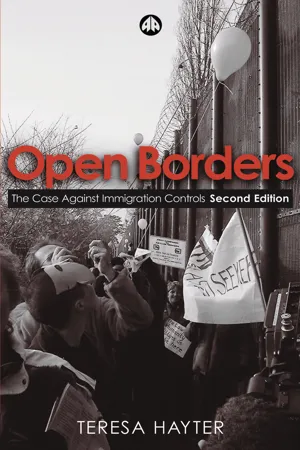
Assessing the impact of the increasing severity of border controls since they were first introduced, Teresa Hayter makes the controversial case for their abolition. Focussing on postwar immigration controls, especially the use of such controls against the peoples of former European colonies and East Europeans, and their effects on asylum seekers, Hayter examines the recent history of European coordination of border controls and the notion of 'Fortress Europe'. The new edition brings this seminal work up to date with a lengthy preface exploring how the practices of the British government over the past few years has continued the process Hayter outlines in the main text – of abusive and irrational border controls and the criminalisation of entire communities. This second edition also updates the bibliography and list of campaigning groups, and ends with a new manifesto for a world without borders, declaring 'no one is illegal!'
- 234 pages
- English
- ePUB (mobile friendly)
- Available on iOS & Android
eBook - ePub
About this book
Information
1 MIGRATION, AND MIGRATORY MYTHS
WORLD MIGRATION
Current opinion is that human beings originated in East Africa. From East Africa they migrated throughout the world. Everywhere else in the world, therefore, people are either immigrants or descended from immigrants. People migrate for a variety of reasons. Some migrations are voluntary, in the sense that people migrate to conquer and colonise new territories, to improve their economic well-being and prospects of employment, or simply to see the world. Many migrations are involuntary. People have been forced to migrate as slaves or indentured labour. Or they are forced to flee famines, wars or political persecution. Usually the very poor cannot migrate, except perhaps to neighbouring countries. Currently the vast majority of the world’s refugees are in countries where poverty is as great as it is in the countries they have been forced to flee from. On the other hand many of the most recent economic migrants, to the United States in particular, are from Asian countries where there has been rapid industrialisation, and where private foreign investment has both created links with industrialised countries and broken links with traditional methods of making a living.
Current nation states are the result of successive waves of immigration, most of which took place before the twentieth century. Although migrants are currently vilified and subjected to unprecedented levels of restriction, to deny the validity of migration is to deny part of the social nature of human beings. But the rate of migration in relation to total population is now lower than it has been at times in the past. In spite of scaremongering about the supposed threat of ‘swamping’ by immigrants and refugees, there is in fact little evidence that migration is increasing significantly, or likely to do so. The numbers about which so much fuss is made are in reality rather small.
Since the beginning of the industrial revolution and the imperialist expansion of Europe, the main migratory movements (apart from emigrations from Europe) have resulted from the requirements for labour of capitalist industry, mines and plantations. In the conquered territories these were often satisfied by the more or less overt use of force. In The New Helots Robin Cohen describes a spectrum of labour recruitment which ranges from total compulsion, as in the slave trade, through situations where people are forced into wage labour by regimes which deprive them of their land and/or force them to raise money to pay taxes and where once recruited they are virtually deprived of their liberty, to situations where the dislocations caused by imperialism and war more or less force people to seek work and safety abroad. After the Second World War European governments sent agencies to recruit workers from, for example, southern Europe, North Africa, Turkey and the Caribbean. Especially in Germany and Switzerland, workers were recruited on contracts which denied them the right to change employment or to settle and gave them few of the other rights enjoyed by native workers.
There have been four periods of major migrations from the beginning of the capitalist period in the sixteenth century until now. The first was entirely forced, the second partially so, the third was mainly voluntary, and the fourth has been more mixed. The first major migration was the forced transportation of between 10 and 20 million people as slaves from Africa to America. This took place from the sixteenth to the nineteenth centuries, after European colonisers had decimated local populations in the Americas and needed new labour for their mines and plantations. The second major migration was of indentured or bonded labour, or temporary slaves, from India and China, again to remedy the lack of cheap or available labour in the places of destination. In theory the indentured workers signed a contract with employers and labour agencies of their own free will. In practice for most of them the choice was little greater than that presented to slaves transported from Africa, and their contracts provided them with no political or human rights. Thirty million indentured workers left India during the colonial period and up to the First World War. They provided a workforce for the mines and plantations of Burma, Sri Lanka, Malaysia, Singapore, Mauritius, South Africa, Guyana and Jamaica. Several million Chinese people migrated in this way to South-east Asia, the Pacific Islands, the Caribbean and South Africa. After the period of the contract, which was of at least ten years, the migrants were meant to return to their country of origin. Some 24 million Indians did return. Many did not, for lack of money or sometimes from personal choice.
The third major world migration was of Europeans to America and Australia, which began in the eighteenth century and reached its peak in the first decade of the twentieth century. According to Sutcliffe in Nacido en otra parte it is estimated that, from the early nineteenth century to the 1920s, more than 60 million Europeans migrated to America and Australasia, of whom 5.7 million went to Argentina, 5.6 million to Brazil, 6.6 million to Canada, and 36 million to the United States. Other Europeans migrated to parts of Central and southern Africa. They did so for a variety of reasons, ranging from destitution to a desire for adventure. The experience was in many ways a positive one for the migrants, although its positive aspects have sometimes been exaggerated, for example in the mythology of enterprise, freedom and prosperity in the United States. Its counterpart was the destruction or subjugation of native peoples, and the occupation by the colonisers of much of the most fertile land.
POSTWAR MIGRATION TO INDUSTRIALISED COUNTRIES
The fourth major migration, which began in the 1950s, was a reverse flow from the South to the North. A few people had migrated in earlier periods to countries such as Britain and France from those countries’ colonial empires. But there was a large increase in migration after 1945. According to estimates by the United Nations Development Programme (UNDP) around 35 million people from the Third World, including 6 million ‘illegal immigrants’, came to settle in the industrialised countries between 1960 and 1990. In addition, by the 1990s, there were some 3–4 million refugees in the industrialised countries, according to UNHCR figures.
For most of this period, according to figures quoted by Sutcliffe in Nacido en otra parte, immigrants from the Third World were less than half of total immigrants to industrialised countries, though slightly over half in Britain’s case and a much higher percentage for the United States in the 1970s and 1980s (76 per cent and 87 per cent). Between 1960 and 1990 about 1 per cent of the population of the Third World migrated to the industrialised countries, or 0.0375 per cent of it per year. The migrants corresponded to an increase in the population of receiving countries of about 0.2 per cent per year. In most countries, including the United States, Canada and Australia which are traditional countries of immigration, there was emigration as well as immigration. Among European countries, there was net immigration during the last four decades to Germany and France; in Britain there were fluctuations, but generally there was net emigration (see p. 20); Italy and Spain were initially countries of emigration but have become countries of immigration as well. Statistics on immigrant populations in Europe are partial and often misleading. They tend to include immigrants from all parts of the world but to exclude ‘illegal’ immigrants and people born abroad who have become citizens of the country they have migrated to. According to figures published by the Organisation for Economic Co-operation and Development (OECD) foreign population as a percentage of total resident population in 1997 in some European countries was as shown in Table 1.1.
Table 1.1 Foreign population as a percentage of total resident population in European countries, 1997
Austria | 9.1 |
Belgium | 8.9 |
France | 6.3 |
Germany | 9.0 |
Italy | 2.2 |
Luxemburg | 34.9 |
Netherlands | 4.4 |
Sweden | 6.0 |
Switzerland | 19.0 |
UK | 3.6 |
Source: OECD
In most countries, where data exist, it seems that about half of these foreigners are of Third World origin. In Britain the proportion is about 20 per cent, but this is an underestimate of the total number of people of Third World origins who have settled in Britain because many of them have British nationality. Sutcliffe notes that ‘the demographic effect of immigration and emigration as a whole appears to be almost insignificant, which makes its apparent political importance the more striking. The latter results partly from the fact that immigration is an issue which the extreme right uses opportunistically …’.
The new immigrants were drawn to Europe because, in the postwar capitalist boom from the late 1940s to the early 1970s, its industries were expanding and they needed labour. At first workers came from the less prosperous European periphery or were Europeans who had been displaced by the war. Gradually they were supplemented by workers from the Third World, mainly from Africa and Asia. All the highly industrialised countries of Europe made use of temporary labour recruitment schemes, although in some countries, in particular Britain, such schemes were small, and spontaneous migration from colonies and former colonies predominated. Migration of workers to Britain virtually stopped in 1962 because of the introduction of immigration controls (see Chapter 2) and because of the early onset of economic stagnation in Britain. Migration from the Third World to other European countries more or less ended by the mid-1970s. At the same time workers migrated to North America and Australia, initially from Europe and then, when racial prohibitions and quotas ended, from Asia and Latin America.
The main case of temporary foreign worker recruitment, or the ‘guestworker’ system, was in the Federal Republic of Germany (FRG). Castles and Miller in The Age of Migration describe it as follows:
The German government started recruiting foreign workers in the late 1950s. The Federal Labour Office (Bundesrat für Arbeit – BfA) set up recruitment offices in the Mediterranean countries. Employers requiring foreign workers paid a fee to the BfA, which selected workers, testing occupational skills, providing medical examination and screening police records. The workers were brought in groups to Germany, where employers had to provide initial accommodation. Recruitment, working conditions and social security were regulated by bilateral agreements between the FRG and sending countries: first Italy, then Greece, Turkey, Morocco, Portugal, Tunisia and Yugoslavia.
The number of foreign workers in the FRG rose from 95,000 in 1956 to … 2.6 million in 1973 …
German policies conc...
Table of contents
- Cover
- Title Page
- Copyright
- Contents
- Preface to the First Edition
- Preface to the Second Edition
- Introduction
- 1 Migration, and migratory myths
- 2 Border controls
- 3 Refugees: Tightening the screw
- 4 Resistance
- 5 Re-open the borders
- Appendix
- Bibliography
- List of organisations and campaigns
- Index
Trusted by 375,005 students
Access to over 1.5 million titles for a fair monthly price.
Study more efficiently using our study tools.
Frequently asked questions
Yes, you can cancel anytime from the Subscription tab in your account settings on the Perlego website. Your subscription will stay active until the end of your current billing period. Learn how to cancel your subscription
No, books cannot be downloaded as external files, such as PDFs, for use outside of Perlego. However, you can download books within the Perlego app for offline reading on mobile or tablet. Learn how to download books offline
Perlego offers two plans: Essential and Complete
- Essential is ideal for learners and professionals who enjoy exploring a wide range of subjects. Access the Essential Library with 800,000+ trusted titles and best-sellers across business, personal growth, and the humanities. Includes unlimited reading time and Standard Read Aloud voice.
- Complete: Perfect for advanced learners and researchers needing full, unrestricted access. Unlock 1.5M+ books across hundreds of subjects, including academic and specialized titles. The Complete Plan also includes advanced features like Premium Read Aloud and Research Assistant.
We are an online textbook subscription service, where you can get access to an entire online library for less than the price of a single book per month. With over 1.5 million books across 990+ topics, we’ve got you covered! Learn about our mission
Look out for the read-aloud symbol on your next book to see if you can listen to it. The read-aloud tool reads text aloud for you, highlighting the text as it is being read. You can pause it, speed it up and slow it down. Learn more about Read Aloud
Yes! You can use the Perlego app on both iOS and Android devices to read anytime, anywhere — even offline. Perfect for commutes or when you’re on the go.
Please note we cannot support devices running on iOS 13 and Android 7 or earlier. Learn more about using the app
Please note we cannot support devices running on iOS 13 and Android 7 or earlier. Learn more about using the app
Yes, you can access Open Borders by Teresa Hayter in PDF and/or ePUB format, as well as other popular books in Social Sciences & Emigration & Immigration. We have over 1.5 million books available in our catalogue for you to explore.