The crisis of borders and prisons can be seen starkly in statistics. In 2011 some 1,500 migrants died trying to enter Europe, and the United States deported nearly 400,000 and imprisoned some 2.3 million people—more than at any other time in history. International borders are increasingly militarized places embedded within domestic policing and imprisonment and entwined with expanding prison-industrial complexes. Beyond Walls and Cages offers scholarly and activist perspectives on these issues and explores how the international community can move toward a more humane future.Working at a range of geographic scales and locations, contributors examine concrete and ideological connections among prisons, migration policing and detention, border fortification, and militarization. They challenge the idea that prisons and borders create safety, security, and order, showing that they can be forms of coercive mobility that separate loved ones, disempower communities, and increase shared harms of poverty. Walls and cages can also fortify wealth and power inequalities, racism, and gender and sexual oppression.As governments increasingly rely on criminalization and violent measures of exclusion and containment, strategies for achieving change are essential. Beyond Walls and Cages develops abolitionist, no borders, and decolonial analyses and methods for social change, showing how seemingly disconnected forms of state violence are interconnected. Creating a more just and free world—whether in the Mexico-U.S. borderlands, the Morocco-Spain region, South Africa, Montana, or Philadelphia—requires that people who are most affected become central to building alternatives to global crosscurrents of criminalization and militarization.
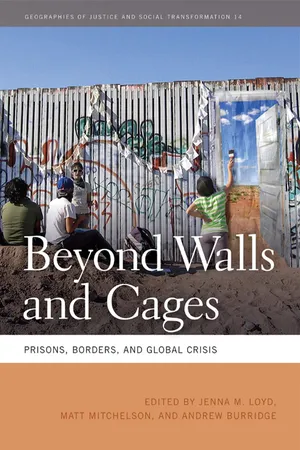
eBook - ePub
Beyond Walls and Cages
Prisons, Borders, and Global Crisis
- 344 pages
- English
- ePUB (mobile friendly)
- Available on iOS & Android
eBook - ePub
Beyond Walls and Cages
Prisons, Borders, and Global Crisis
About this book
Information
Publisher
University of Georgia PressYear
2012Print ISBN
9780820344126
9780820344119
eBook ISBN
9780820344928
Part I
Why Now?
Prisons, Borders, and Global Crisis
The first part of this book analyzes the growth of prisons and migration controls within a context of global crisis. The structural logics of prisons, borders, and capital accumulation have much in common even in seemingly distinct, distant places. The contributors to this part illustrate their theoretical and empirical analyses in a specific geographic context (or contexts). Yet the policing of mobility and the neocolonial project of conquest — in the name of, over, and through nation-states’ borders — are visible around the world. Rather than a meta-narration, the contributions to this part can be read as a series of complementary analyses, which resonate across scales from the global to the corporeal.
In the first two chapters that follow, the authors illustrate the global dimension of migration-related violence. We are reminded that an individual’s access to resources, political power, and mobility is shaped in large part by the uneven development and division of national territories. Apartheid is neither solely a matter of South African politics, nor has it ended — at least in terms of life and death around the world. The next chapter emphasizes that migrants’ material crossing points make manifest political-economic structures, class and gender inequities, agency and resistance. The authors use the concept of border sexual conquest to address the production of vulnerability, manageability, and marginalization for particular people and places in the Mexico-U.S. and Morocco-Spain border regions and beyond.
The concluding chapter of this part continues the analyses of the two preceding chapters and also signals the contributions of authors elsewhere in the book. Through this interview, we are reminded that capital’s complicity in the prison-industrial complex is not reducible to prison privatization, and there is a wide range of political-economic motives for the expansion of imprisonment. This analysis of criminalization reminds us that questions of “who crossed the line?” are often far less important than questions of “who drew the line?” — and who has the power to move and reshape the lines in question. The abolitionist analytic pushes for a political praxis that is not premised on — and can move beyond — distinctions and categorizations that yield harm.
Policing Mobility
Maintaining Global Apartheid from South Africa to the United States
In May 2008 anti-immigrant pogroms took place in many of South Africa’s main cities. The violence left sixty-two dead — some of them burned alive by mobs — including twenty-one South Africans. Dozens of women were raped, at least a hundred thousand people were displaced, and property worth millions of South African rand was destroyed, looted, or stolen. Coming fourteen years after Nelson Mandela assumed the presidency of the country, which marked the official end of the transition from a national system of formal racial segregation, the violence exposed the enduring nature of apartheid beyond what is normally associated with South Africa. The apartheid that horrifically revealed itself in May 2008 is a global one, embedded in the very fabric of a world order predicated on nation-states.
While the factors that led to the xenophobic terror in South Africa are complex, they are in significant part the result of practices of the South African state, including its creation of a deserving “us” and a threatening, foreign “them.”1 Through its boundary fences and border patrols, its arrests and deportations of unauthorized migrants, and its justifying rhetoric, South African officialdom helped to create the very “problem” that the violent mobs sought to eliminate. As Paul Verryn, a Methodist bishop based in Johannesburg who is critical of South Africa’s leadership for not being more welcoming of migrants, asserted at the time of the pogroms, “The locals believe they are doing what the government is doing anyway, getting rid of the ‘illegals.’”2
South Africa is hardly alone in fomenting cruelty toward migrants. Indeed, it does what all other nation-states do: privilege their nationals over noncitizens and, in doing so, elevate rights granted by states to select individuals over universal human rights. In a context of deep inequality between countries, national territorial divides have profound implications: which side of a boundary one is born on significantly determines the resources to which one has access, the amount of political power on the international stage one has, where one can go and under what conditions, and thus how one lives and dies. Thus, there is an inherent double standard — significant rights for some, fewer for others — a disparity that comes about by accident of birth.
While this privileging manifests in different ways, it draws upon various forms of violence to maintain its underlying inequalities, both within nation-states and between them. Just as in South Africa of old, where the state dictated where the majority of its inhabitants (black South Africans) could live and work, the contemporary regulation of international mobility and residence is inextricably tied to these inequalities. As such they draw upon and reproduce systematic violence and dehumanization.
Across the world, relatively rich and stable nation-states — whose advantages are largely born of imperialism and its associated forms of accumulation and dispossession — are increasingly erecting walls and fences along their perimeters and increasing their boundary and migrant policing units. In doing so, they are growing the number of people they detain for violating laws related to unauthorized entry, residence, and work.
In Malaysia, for example, the government since 2005 has employed a strike force — one that grew out of a civilian militia group that had been created in the 1960s to fight against alleged communists — to hunt down unauthorized migrants. (Most of the migrants come from Indonesia, with many others coming from Bangladesh, Burma/Myanmar, India, Nepal, and Vietnam.) The group’s leaders carry arms, and its deputized members have the right to enter homes or search people on the street without a warrant. Called Rela, the force has nearly half a million volunteer members, more than the total number in the country’s military and police forces. Their unauthorized migrant arrestees face up to five years in prison and a whipping of up to six strokes. Human rights groups accuse Rela members of violence, extortion, theft, and illegal detention.3
In addition to being subject to such overt brutality, the precarious existence of migrants in countries where they are not allowed to be — at least officially — or where they live with less than full citizenship rights facilitates their gross exploitation by capital. For instance, in the United Arab Emirates, where a well-pronounced racial-national hierarchy permeates social relations, an estimated three hundred thousand expatriate workers, most of them unauthorized, perform the most physically difficult work. Bused into wealthy Dubai on a daily basis from outlying camps segregated from the glitzy city, the migrants — from countries such as India, Pakistan, Sri Lanka, Ethiopia, and the Philippines — commonly work very long hours. Their pay is often so little that they are unable to save up sufficient funds to return to their home countries, a situation compounded by the fact that they frequently have to pay off debts to the labor contractors who tricked them into coming with false promises.4
While international migrant workers typically receive some protection through the legal-social mechanisms of the countries in which they find themselves, these protections are less extensive than those afforded citizen workers. This increases the vulnerability of migrant workers to exploitation and mistreatment by employers.
In theory, workers — unauthorized or not — can organize to defend themselves, but their ability to do so is quite circumscribed, especially if they are “illegal.” In the United States, 52 percent of companies where union drives are taking place threaten to call U.S. immigration authorities (a threat that is illegal to make) if the organizing campaign involves unauthorized immigrants.5 In such situations — given the very poor state of U.S. labor law (especially in the agricultural sector, in which abuse is rife) and its weak enforcement — the right to organize is highly compromised.6
The violence, marginalization, and exclusion experienced by migrant workers and their families occur most markedly in the wealthy and privileged countries of the global political economy. Again in the case of the United States — which is just one example among many — in the twenty-first century there has been a huge increase in migrant imprisonment and detention, including of children with their parents; a steep rise in workplace raids; and massive growth of deportations of both legal and unauthorized residents. There has also been a dramatic expansion of boundary enforcement, which means migrants must often literally risk their lives to enter the country clandestinely. The result is frequently death.
These fatalities occur across the globe, but it is the boundaries between the so-called first and third worlds, between the relatively rich and poor, secure and vulnerable, that are deadliest. In the U.S.-Mexico borderlands, the bodies of over five thousand migrants were recovered between 1995 and 2009. Undoubtedly, the true toll is far greater as the figure only includes bodies that are actually found, and relies in part on reporting from U.S. agencies, such as the Border Patrol, which have used very narrow criteria over the years for counting the fatalities of unauthorized crossers.7 Large numbers of migrants from the Dominican Republic and Haiti have also died — from drowning or shark attacks — while trying to negotiate the waters of the Caribbean to reach the United States. Similarly, along Europe’s perimeter many thousands have perished in the twenty-first century (often at sea), trying to clandestinely enter its territory.
“Apartheid” might seem like an inappropriate term to describe the context in which such tragedies unfold, given that there is no legally enshrined racial segregation between the so-called first and third worlds. Moreover, many people of third-world origin have citizenship, or live and work in countries throughout the West. Although national governments regularly discriminate in terms of who they allow to enter, reside, and work— and how and under what conditions — in the territories they oversee, they do so first and foremost on the basis of the would-be immigrant’s national citizenship and socioeconomic situation. This is a form of discrimination seen as fully legitimate in international affairs. Nonetheless, if we move beyond the question of the specific motivations that underlie the system of immigration regulation, and instead focus on effects and outcomes, there is little question that immigration enforcement in wealthy countries such as the United States or those of the European Union functions in an apartheid-like manner. Given that they regulate mobility and residence based on, among other factors, geographic origins — one of the foundations of supposed racial distinctions — they inevitably limit the rights and protections afforded to migrants because of an essentialized characteristic over which the migrants have no control. In doing so, state agents (re)produce sociogeographic, nation-state-based distinctions between “us” and “them,” “here” and “there,” drawing upon and exacerbating global socioeconomic inequalities.
In a similar fashion — by, among other means, creating and maintaining nominally independent black “homelands,” or bantustans — apartheid South Africa sought both to limit black mobility and to make certain that there was a sufficient supply of black labor in white-owned enterprises and in nominally white residential areas.8 All the while, the country denied those workers political rights and made their presence conditional and reversible. The ideal of “apartness” embraced by the champions of apartheid was never fully realized, nor could it have been given the interdependence of white and nonwhite South Africa. Indeed, the production and maintenance of the privilege enjoyed by white South Africans necessitated interaction with nonwhites in a highly exploitative manner (a fact explicitly acknowledged by high-level officials of the apartheid state).9 Furthermore, resistance by black people and others to legally enshrined segregation also undermined the proclaimed goal of purity.
The fact that there was a gap between the rhetoric and the reality of apartheid South Africa does not mean that its system of formal racial segregation was not significant. The apartheid system ensured unequal access to and unequal influence over the country’s sociopolitical and economic resources and processes on the basis of who allegedly belonged and who did not. It thus reflected and reproduced profoundly different life and death experiences for white and nonwhite South Africans as a whole, differential outcomes legitimated on the basis of geographic origin and ancestry.
“Black” and “white” — and other racial categories — are not first and foremost about distinctions of skin color or pigmentation or phenotype. As demonstrated by the historically shifting boundaries of whiteness in the United States, and by the wars in Northern Ireland, the former Yugoslavia, and Rwanda, what are effectively racial distinctions often exist between groups with no discernible physical differences. In this sense, “race” is based on power-imbued differences related to notions of ancestry and geographic origins, and associated ways of seeing and being. Racism reflects and shapes who gets what, who calls the shots. Mobility between countries — who has it and who does ...
Table of contents
- Cover Page
- Title Page
- Copyright Page
- Dedication
- Contents
- Acknowledgments
- Introduction
- Part I Why Now?
- Part II Global Crisis, National Struggles
- Part III Poverty and Wars at Home
- Part IV Battleground Arizona
- Part V Speaking Up! Standing Up!
- Part VI Ending Border Wars
- Contributors
- Index
Trusted by 375,005 students
Access to over 1.5 million titles for a fair monthly price.
Study more efficiently using our study tools.
Frequently asked questions
Yes, you can cancel anytime from the Subscription tab in your account settings on the Perlego website. Your subscription will stay active until the end of your current billing period. Learn how to cancel your subscription
No, books cannot be downloaded as external files, such as PDFs, for use outside of Perlego. However, you can download books within the Perlego app for offline reading on mobile or tablet. Learn how to download books offline
Perlego offers two plans: Essential and Complete
- Essential is ideal for learners and professionals who enjoy exploring a wide range of subjects. Access the Essential Library with 800,000+ trusted titles and best-sellers across business, personal growth, and the humanities. Includes unlimited reading time and Standard Read Aloud voice.
- Complete: Perfect for advanced learners and researchers needing full, unrestricted access. Unlock 1.5M+ books across hundreds of subjects, including academic and specialized titles. The Complete Plan also includes advanced features like Premium Read Aloud and Research Assistant.
We are an online textbook subscription service, where you can get access to an entire online library for less than the price of a single book per month. With over 1.5 million books across 990+ topics, we’ve got you covered! Learn about our mission
Look out for the read-aloud symbol on your next book to see if you can listen to it. The read-aloud tool reads text aloud for you, highlighting the text as it is being read. You can pause it, speed it up and slow it down. Learn more about Read Aloud
Yes! You can use the Perlego app on both iOS and Android devices to read anytime, anywhere — even offline. Perfect for commutes or when you’re on the go.
Please note we cannot support devices running on iOS 13 and Android 7 or earlier. Learn more about using the app
Please note we cannot support devices running on iOS 13 and Android 7 or earlier. Learn more about using the app
Yes, you can access Beyond Walls and Cages by Deborah Cowen, Melissa Wright, Nik Heynen, Jenna Loyd, Matthew Mitchelson, Andrew Burridge in PDF and/or ePUB format, as well as other popular books in Politique et relations internationales & Relations internationales. We have over 1.5 million books available in our catalogue for you to explore.