eBook - ePub
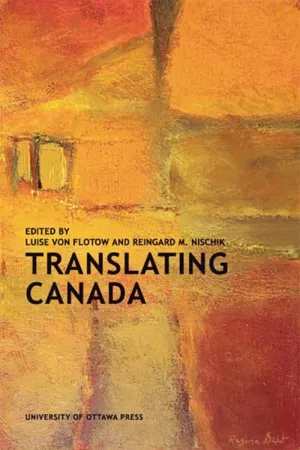
Translating Canada
- 352 pages
- English
- ePUB (mobile friendly)
- Available on iOS & Android
eBook - ePub
Translating Canada
About this book
In the last thirty years of the twentieth century, Canadian federal governments offered varying degrees of support for literary and other artistic endeavour. A corollary of this patronage of culture at home was an effort to make the resulting works available for audiences elsewhere in the world. Current developments in the study of translation and its influence as cultural transfer have made possible new assessments of such efforts to project a national image abroad. Translating Canada examines cultural materials exported by Canada in addition to those selected for acquisition by German publishers, theatres, and other culture brokers. It also considers the motivations of particular translators and the reception by German reviewers of works by a wide variety of Canadian writers -- novelists and poets, playwrights and children's authors, literary and social critics. Above all, the book maps for its readers a number of significant, though frequently unsuspected, roles that translation assumes in the intercultural negotiation of national images and values. The chapters in this collection will be of value to students, teachers, and scholars in a number of fields. Informed lay readers, too, will appreciate the authors' insights into the different ways in which translation has contributed to German reception of Canadian books and culture. Translating Canada examines cultural materials exported by Canada in addition to those selected for acquisition by German publishers, theatres, and other culture brokers. It also considers the motivations of particular translators and the reception by German reviewers of works by a wide variety of Canadian writers. Published in English.
Information
Subtopic
Translating & InterpretingIndex
LiteratureTelling Canada’s “Story” in German: Using Cultural Diplomacy to Achieve Soft Power
The focus of this chapter, and of this book, is the translation of Canadian writing into German. Three distinct elements are involved, of which the most important is “storytelling.” Stories travel through translation; they are the raw material of the translation process. However, we are not concerned here with producing literary criticism of Canadian writing, so our interest in the “source texts” will be limited. We are dealing instead with translation and reception: we want to understand why certain texts are selected for translation and why others are left aside. Which aesthetic, economic, or ideological considerations enter into the selection process? In what condition do Canadian stories arrive in the target language, German? And how are they read once they have been translated into the new cultural environment? Our third focus—with which we will start our overview—is on the use of stories by national governments and agencies in the service of cultural or public diplomacy: that is, as an instrument in gaining “soft power.”
In October 2001, Adrienne Clarkson, then the Governor General of Canada, and her writer husband John Ralston Saul led an official delegation on a state visit to Germany. In the delegation of about forty people, there were twenty “culture workers”: writers, poets, visual artists, actors, about half of whom were francophone: for instance, two writer-translators (Émile Martel and Daniel Poliquin), a dramatist (Michel Marc Bouchard), a literary critic (Pierre Cayouette), and a poet (Pierre Morency). The film director Atom Egoyan and two actors who are often associated with him, Don McKellar and Arsinée Khanjian, as well as academics and even wine growers were also part of the group. The focus was clearly on cultural exchange, an apparent attempt to further reinforce interest in Canada in a country that has had Canadian books on its bestseller lists and an extensive network of academics involved in Canadian Studies for more than twenty years. The strong francophone participation that marked this venture may have been related to a previously published anthology of Canadian writing translated into German, Anders schreibendes Amerika: Literatur aus Quebec 1945–2000 (Baier and Filion 2000), a collection of short fiction from Quebec, as well as recent stagings of contemporary drama from Quebec in Berlin and Cologne (see Jandl in this volume).
Since the early 1980s, Canada has become a cultural success in Germany and Austria,1 with Germany outranking every other country in terms of its great interest in Canadian fiction in translation.2 While this fascination is undoubtedly related to the strong Canadian Studies initiatives at German universities, there are many other factors in such a success story. They include Canadian government initiatives, which have made available extensive and repeated travel and translation grants for authors such as Margaret Atwood, Barbara Gowdy, Michael Ondaatje, Anne Michaels, and many others. But many of the reasons for the success also seem to lie with the German-speaking audience for whom Canada became a popular tourist destination throughout the 1980s and 1990s. Among the decisive factors were the emergence of green politics, a romantic notion of pristine Canadian nature, a broad, middle-class reading culture that is very interested in other (especially anglophone) cultures, the idea of Canada as an attractive North American alternative to the United States, and narrative topics in Canadian writing that are not plagued with the weighty themes and post–World War II soul searching of much contemporary German literature. In other words, when German-speaking readers read Canadian stories, they gain access to the engaging aspects of North American storytelling, set in an environment that they conceptualize as being closer to nature, and they find a pleasant alternative to both contemporary German prose and the increasingly difficult political flavour of the United States.
In the following section, I examine a number of aspects of cultural policy as initiated by the government. Such policy is used by many countries, including Canada, to create interest in their products in a highly competitive global market. I also explore nation branding as a more recent facet of this promotional form of diplomacy.
CULTURAL OR PUBLIC POLICY
When Canadian “culture workers” such as Émile Martel or Arsinée Khanjian travel abroad in official delegations, they represent the cultural establishment of Canada and are usually funded by the Department of Foreign Affairs and International Trade (DFAIT). In the words of Chris Barlow, one of the government officials responsible, they help to promote a “positive image of Canada as culturally diverse, creative, innovative and modern” (emphasis added) in countries designated as priorities by DFAIT.3 Barlow’s words give some indication of what is at stake in this activity: the promotion of Canada through the dissemination of its culture, the creation of images of Canada, and the globalization of Canada by making the country more visible in the context of increasing global competition. Such promotion may include the establishment of a chair in Canadian Studies (Mexico, 2002), or the launching of an anthology of Canadian poetry in translation (Nieve Immaculada, Guanajuato, Mexico, 2002), or a grand tour with the governor general (Russia and circumpolar tour, 2003), or funding for the dissemination and translation of Canadian plays in Germany (CEAD, Playwrights’ Union, International Translation Program). While these may seem to be mainly academic or cultural activities, foreign affairs and even more importantly trade initiatives are increasingly establishing business connections in the context of cultural events rather than reverting to traditional diplomacy or trade deals. Thus, the founding of a chair in Canadian Studies and the launching of anthologies of Canadian literature in translation can indeed be seen as foreign affairs and trade ventures.
As the so-called middle powers of the world compete for visibility and influence in an increasingly deregulated world, as far as information exchange and the media are concerned, they are turning to culture as a trademark or brand. Hence the official excursions to Germany (2001), Mexico (2002), and Russia (2003) and the founding of the 2002 “Trade Routes” initiative by the Canadian Ministry of Heritage, a “$500 million investment in Canadian arts and culture,” which clearly seeks to fuse culture and trade. The official government publication states that
Trade Routes supports the Government of Canada’s trade agenda to enhance prosperity and job growth in the knowledge-based sectors of the new economy. Through Trade Routes the Department of Canadian Heritage ensures that Canada’s arts and cultural entrepreneurs and organizations have access to the full range of the Team Canada Inc. network of government trade programs and services in order to expand export capacity and market development opportunities.4
It is hard to tell from this excerpt, and from much of the rest of the text, whether this program is supposed to support cultural production at home, use Canadian cultural products to enhance trade abroad, or simply aid Canadian culture workers in exporting their work. In any case, the point is that trade and culture are being explicitly linked in government documents and strategies. Indeed, the Government of Canada foreign policy document Canada in the World (1995) lists three “key objectives” for the “international actions of Canada in the years to come”:
• the promotion of prosperity and employment;
• the protection of our security, within a stable global framework;
• the projection of Canadian values and culture. (10)5
Prosperity, employment, and security appear to be assigned the same importance as the export of Canadian “values and culture.” The culture initiative is further explained as follows: “Canadian foreign policy should celebrate and promote Canadian culture and learning as an important way of advancing our interests in international affairs” (11). The approach is clearly that of public or cultural diplomacy that foreign affairs strategists in many countries were developing and pursuing over the course of the 1990s, a practice described by Evan Potter (2002):
Public diplomacy is the effort by the government of one nation to influence public or elite opinion of another nation for the purpose of turning the policy of the target nation to advantage [see www.publicdiplomacy.org6 for a variety of related definitions]. National goals and interests are communicated to foreign publics through a variety of means, including international broadcasting, cultivation of foreign journalists and academics, cultural activities, exchanges, programmed visits, speakers, conferences, and publications. (179)
Canada’s activities in Germany in 2001 were in line with this definition: a foreign public was approached through its journalists and academics, with cultural activities, programmed visits, speakers, and publications of Canadian works in translation. Whether trade agreements or simply sales will follow is another question, but a certain visibility was presumably achieved: that is, a step toward branding (a buzzword and concern of the 1990s and the beginning of the twenty-first century).
International affairs and communications specialists have traditionally called the larger scheme of intergovernmental contact “diplomacy.” But what we are discussing here is not diplomacy in the traditional sense of the term that Eyton Gilboa (2002, 83) describes. This type of diplomacy was once the realm of officials; it was “highly personal, formal, slow and usually protected by secrecy” (84). The version of diplomacy that Canada has recently been deploying in Russia, Germany, and Mexico has consisted of short trips with deliberately public events: readings, discussions, performances, and book sales. Professional diplomats were involved, but many other players appeared as well and in even more influential roles.
This is the kind of response that governments are developing to the decline in traditional diplomacy and to the growth in mass participation in political processes, a development that has transformed the power bases of many societies in recent years (Potter 2002). Analysts describe cultural/public diplomacy as a revolution in international relations. They ascribe it to a more open media access to information and a wider distribution of this information to the public. Public diplomacy results in soft power, which is defined as “the ability to achieve desired outcomes in international affairs through attraction rather than coercion” (Gilboa 2002, 84; emphasis added) and may gradually be replacing military and economic power. Attraction requires the effective use of global communication to persuade people around the world to support one’s causes and, presumably, buy one’s products.7 In other words, increasing globalization, often seen as increasing homogenization, has led to individual countries seeking to differentiate themselves through soft power, mobilizing culture to make the difference.
Image making at this level is based upon cultural nationalism and attempts at protectionism. Indeed, these have been driving and controlling forces in various cultural bodies in Canada ever since the 1950s, when ideas about Canadian culture and the need to create and protect it began to coalesce.8 Now in the early twenty-first century, after this extended period of cultural nationalism, there are, however, increasingly critical voices that insist on the need to widen the scope, if only because of technological changes. Proliferating new technologies now give consumers of culture a much greater say in what they can read, listen to, and watch. Consumers, Christopher Maule (2002) notes, have “an enlarged range of choice resulting from the ability to access material anywhere in the world” (2), and they cannot be constrained by protectionist walls of domestic policies. This freedom, in turn, affects cultural policies as well as content. In the Canadian context, analysts claim that Canadians can no longer just tell Canadian stories to other Canadians. They now have to “cooperate with others to tell stories of widespread interest to Canadians and others,” as Maule argues (7; emphasis added). And in the end, the more cooperative and international process of projecting Canadian values and culture in the world will make the materials less parochial and thus more “attractive.”
Maule, who writes from a hands-on foreign affairs position, seems to be echoing a recent cultural studies approach to the same issue. In Modernity at Large: Cultural Dimensions of Globalization (1996), Arjun Appadurai also takes up the mediazation of culture when he discusses “the mediascapes produced by private or state interests that are image-centred, narrative-based accounts of strips of reality” (35). He, too, asserts that increasing human mobility and the vast power of media-driven image making have thrown the nation-state into a crisis that may render it obsolete and cause other forms of allegiance and identity to develop, forms that are “largely divorced from territorial states” (169).
Nevertheless, Canada, and other nations, continue to seize upon national culture as an instrument of national foreign policy, ignoring the apparent paradox caused by technological and media developments that seriously impinge upon governments’ ability to control culture and cultural content in any nationalistic or protectionist way.
The recent Canadian government initiatives in public or cultural diplomacy (e.g., Trade Routes and the cultural venture to Germany described above)9 seem to have been inspired by Saul’s report on “Culture and Foreign Policy,” commissioned for the 1994 parliamentary review of Canadian foreign policy,10 and to some extent may predate the massive influence of new technologies. Saul clearly associates culture with foreign policy and in his conclusion expressly states that “culture is the image of Canada abroad. It is therefore central to foreign policy. Both political and trade initiatives are dependent on that image.” He calls for a “healthy home market for culture” and advocates policies on culture that do not shape or control it but simply deliver it. For him, this means improved production at home with increased culture budgets, better distribution methods abroad, with the possible establishment of a cultural agency akin to the British Council or the German Goethe-Institute, and changes in the profiles of diplomats to make them culturally informed salespeople.
Saul’s discourse on culture within Canada and its use abroad fluctuates between a focus on the old question of identity, on Canadians’ sense of themselves, and a mercantile focus on making Canada look interesting abroad. Recently, marketing strategists such as Simon Anholt (2002) have echoed this approach, apparently contradicting the globalizing effects of the technological revolution. Anholt, too, talks of this double purpose: “If a nation observes that its civic and cultural achievements are recognized abroad, this will help to create a more productive cultural environment [at home]” (4). In the world of foreign policy and trade (and in marketing), culture is thus still being assigned both an internal and an external purpose—its successes create feelings of national pride and creative energy at home while serving to sell products and push influence abroad. But the situation is rife with problems: one is funding; another is the perception within organizations such as DFAIT, which largely control the purse strings, that the culture “desk,” the culture portfolio, is a career dead end;11 still another is the reception of the translated cultural product in the new target culture environment.
NATION BRANDING
The job of branding Canada seems to have been enthusiastically embraced by the Department of Canadian Heritage. One of the goals of its Trade Routes program is “to brand Canada through arts and cultural exports.”12 Branding, which once referred to the ownership mark burned onto the flank of grazing cattle, is now a buzzword in marketing; according to one somewhat ironic definition, it has been “co-opted by the MBA crowd and now seems to refer to any activity that supports a company’s desire to clearly define its products and/or services.”13 Although critical, this definition gives the gist of the term, which has, in the era of soft diplomacy, shifted from products such as Coca-Cola, or services such as those offered by McDonald’s, to the cultural exports of individual countries. In branding products, the focus is on three main points:
(1) the unique selling point (USP) of a product or service;
(2) its status and the forums of visibility that will make it an international symbol of excellence;
(3) the experience of belonging that it promotes by reaching out to the most personal areas of the human imagination with such confidence and familiarity that it feels like a kindred spirit. (Macrae 1991, 31–40)
It may be difficult for those of us working in literary and cultural fields to imagine that the marketers of Coca-Cola or McDonald’s could aspire to create an “experience of belonging” or reach out to “the most personal areas of the human imagination” with their products. It is a fact, however, that these companies try to do so by telling stories: that is, by engaging their clients through narratives closely related to literature and culture. New marketing strategies developed in the mid-1990s have moved away from producing the same glossy images of products for dissemination throughout the world. I...
Table of contents
- Cover
- Title Page
- Copyright
- Contents
- Introduction
- 1 Telling Canada’s “Story” in German: Using Cultural Diplomacy to Achieve Soft Power
- 2 “Two Solitudes”? Anglo-Canadian literature in Translation in the Two Germanies
- 3 Translating the Canadian Short Story into German
- 4 The “Other Women”: Canadian Women Writers Blazing a Trail into Germany
- 5 Margaret Atwood in German/y: A Case Study
- 6 The “AlterNative” Frontier: Native Canadian Writing in German/y
- 7 From Beautiful Losers to No Logo! German Readings of Jewish Canadian Writing
- 8 Contemporary (English) Canadian Plays in German/y Equivalence in Difference?
- 9 Translated or Traduced? Canadian Literary and Political Theory in a German Context: Northrop Frye, Michael Ignatieff, and Charles Taylor
- 10 Selecting Canadiana for the Young: The German Translation of English Canadian Children’s Literature
- 11 French, Female, and Foreign: French Canadian Children’s Literature in German Translation
- 12 Northern Lights in German Theatres: How Quebec Plays Come to Germany
- 13 Low Motility: Transferring Montreal Playwright Stephen Orlov’s Sperm Count to Germany
- 14 Antonine Maillet in German: A Case Study
- Contributors
- Name and Title Index
- Subject Index
- Notes
Trusted by 375,005 students
Access to over 1.5 million titles for a fair monthly price.
Study more efficiently using our study tools.
Frequently asked questions
Yes, you can cancel anytime from the Subscription tab in your account settings on the Perlego website. Your subscription will stay active until the end of your current billing period. Learn how to cancel your subscription
No, books cannot be downloaded as external files, such as PDFs, for use outside of Perlego. However, you can download books within the Perlego app for offline reading on mobile or tablet. Learn how to download books offline
Perlego offers two plans: Essential and Complete
- Essential is ideal for learners and professionals who enjoy exploring a wide range of subjects. Access the Essential Library with 800,000+ trusted titles and best-sellers across business, personal growth, and the humanities. Includes unlimited reading time and Standard Read Aloud voice.
- Complete: Perfect for advanced learners and researchers needing full, unrestricted access. Unlock 1.5M+ books across hundreds of subjects, including academic and specialized titles. The Complete Plan also includes advanced features like Premium Read Aloud and Research Assistant.
We are an online textbook subscription service, where you can get access to an entire online library for less than the price of a single book per month. With over 1.5 million books across 990+ topics, we’ve got you covered! Learn about our mission
Look out for the read-aloud symbol on your next book to see if you can listen to it. The read-aloud tool reads text aloud for you, highlighting the text as it is being read. You can pause it, speed it up and slow it down. Learn more about Read Aloud
Yes! You can use the Perlego app on both iOS and Android devices to read anytime, anywhere — even offline. Perfect for commutes or when you’re on the go.
Please note we cannot support devices running on iOS 13 and Android 7 or earlier. Learn more about using the app
Please note we cannot support devices running on iOS 13 and Android 7 or earlier. Learn more about using the app
Yes, you can access Translating Canada by Luise von Flotow, Reingard M. Nischik, Luise von Flotow,Reingard M. Nischik in PDF and/or ePUB format, as well as other popular books in Literature & Translating & Interpreting. We have over 1.5 million books available in our catalogue for you to explore.