![]()
PART I
THE PIPERS AT THE GATE OF DAWN
![]()
CHAPTER 1
‘Thank you, Sir William’
In every country it is unfortunate not to be rich; in England it is a horrible misfortune to be poor.
Alexis de Tocqueville, Voyages en Angleterre et en Irlande en 1835
‘They used to tell me I was building a dream …’
E. Y. Harburg, ‘Brother can you spare a dime’, American song of the Great Depression, opening line
At this stage of the war, the main ideas of reconstruction were in their first bloom, but largely, also in a state of suspended animation. Like the sleeping beauty, they awaited the prince’s kiss. In almost every field of reconstruction, Beveridge’s report of December 1942 was to be the decisive breath of life.
Paul Addison, The Road to 1945, p. 171
IN JUNE 1941, Sir William Beveridge was called in by Arthur Greenwood to be offered a job. Greenwood was the Labour Minister for Reconstruction in Britain’s wartime coalition government. Beveridge was an egotistical sixty-two-year-old civil servant who believed his destiny was to organise key parts of Britain’s war effort. He was asked instead to chair an interdepartmental committee on the co-ordination of social insurance. The task hardly sounded inspiring. With tears, not of joy but of bitter disappointment, in his eyes, he accepted.1 It was the strangest of starts to one of the greatest of adventures – the founding of Britain’s modern welfare state.
Beveridge’s reaction was perhaps not surprising, for he was no ordinary civil servant. He was already well known as a radio broadcaster, academic, public servant and newspaper columnist; a man with more careers behind him than most ever enjoy. He was also by any standard, despite his detractors (of whom there were plenty), a member of the Great and the Good, at a time when such a class was perhaps more easily defined than at the start of the twenty-first century.
Born the son of a British judge in India in 1879 into a house staffed by twenty-six servants, he was schooled at Charterhouse. At Oxford he read mathematics and classics before, in 1903 at the age of twenty-four, he became in effect an Edwardian social worker and researcher at Toynbee Hall, the university foundation for the poor in the East End. It was there that ‘he learned the meaning of poverty and saw the consequences of unemployment’.2 The impoverishment of this part of London was to affect others in the tale of Britain’s welfare state, including Clement Attlee and Sir Keith Joseph, even if the conclusions each was to draw from the experience were to be rather different.
At Balliol, Beveridge recalled, the Master, Edward Caird, used to urge his charges ‘to go and discover why, with so much wealth in Britain, there continues to be so much poverty and how poverty can be cured’.3
Oxford and Toynbee Hall triggered in Beveridge a lifelong interest in unemployment and broader social questions, turning the young man into a social reformer, but one whose academic training convinced him that policy should be based on exhaustive research and detailed analysis. In his autobiography, Beveridge characterised his own progress at the time as being from ‘Oxford to Whitechapel, Whitechapel to Fleet Street, Fleet Street to Whitehall’.4 On the way, however, there had been a visit early in 1907 to Germany, where he had studied the systems of compulsory social insurance for pensions and sickness, though not yet for unemployment, which Bismarck had introduced in the 1890s. It was an important and fitting lesson, for Bismarck’s is the only name to rank above Beveridge’s as a welfare state designer, although of a rather different model.
Late in 1905 the twenty-six-year-old Beveridge, on a recommendation from Caird, was installed as a leader writer at the Tory Morning Post, a newspaper which eventually merged with the Daily Telegraph. There he was given licence to write on social policy and advocate labour exchanges and unemployment insurance, drawing on the forms of social insurance he saw in Germany. That work brought him to the attention of the thirty-three-year-old Winston Churchill, who four years earlier had crossed the floor of the Commons from the Conservative to the Liberal benches. In July 1908, Churchill brought Beveridge into the Board of Trade as a fulltime civil servant. Over the next three years, Beveridge played a crucial role in the creation of a national network of labour exchanges of which he became the first director; and then in the formation of the world’s first, if initially highly limited, statutory insurance scheme against unemployment. The measure was introduced in 1911 by David Lloyd George and by Churchill, who by 1906 had become so imbued with the cause of social reform that he declared Liberalism to be ‘the cause of the left-out millions’.5
In government service, Beveridge had seen Lloyd George as Chancellor introduce the first state pensions, dubbed by their grateful recipients ‘the Lord George’ (because only a Lord could afford to be so generous), and had seen the spectacular row over the 1909 ‘People’s Budget’ which raised the money to pay for them. The pensions, Lloyd George declared, lifted ‘the shadow of the workhouse from the homes of the poor’. Churchill, more temperately, declared of the first relatively meagre means-tested payments: ‘We have not pretended to carry the toiler on to dry land. What we have done is to strap a lifebelt about him.’
The first unemployment insurance in 1911 covered only about 2.75 million men, or roughly one in six of the workforce, in industries at high risk of cyclical unemployment such as iron and steel and shipbuilding. It ran out after fifteen weeks. But with it came the first state-backed insurance scheme for health. Lloyd George’s famous ‘Ninepence for Fourpence’ was more comprehensive, covering all male workers earning less than £160 a year. For the worker’s compulsory fourpence (just under 2p) a week, the employer had to add threepence and the state twopence. The scheme was administered by ‘approved societies’ and provided the services of a ‘panel’ family doctor, but no right to hospital care or medicine; with that came sick pay of ten shillings (50p) a week, but no cover for wives and children other than a maternity grant. What marked out the health and unemployment measures of the 1911 National Insurance Act from anything that went before was that both were contributory, compulsory and state organised, with employers, employees and the taxpayer each contributing: the so-called tripartite system. What they were not was comprehensive.
The same Liberal Government had also introduced the first tentative legislation on free school meals (for large families only), school medical inspections, and the first overtly redistributive budget – the ‘People’s Budget’ – to pay for it all. The House of Lords, then still the power-base of the landed aristocracy, was faced by a new supertax and what were, in effect, wealth taxes. They threw out what Lloyd George had declared to be ‘a war budget’ – one ‘for raising money to wage implacable warfare on poverty and squalidness’. He added the hope, which he almost lived to see realised, that ‘before this generation has passed away we shall have advanced a great step towards that good time when poverty and wretchedness and human degradation which always follow in its camp will be as remote to the people of this country as the wolves which once infested its forests’.6 The result, after a long battle, was the 1911 Parliament Act which removed for ever the right of the Lords to delay financial legislation.
Beveridge was thus not only a close Whitehall observer but a key player in the formation of what has been dubbed the ‘ambulance state’ – the lifebelt precursor to the modern welfare state which thirty years on he was to do so much to help create.
With the arrival of the First World War, Beveridge moved in to the Ministry of Munitions, where he was involved in deeply controversial moves to mobilise manpower and where he worked directly with Lloyd George. In 1916 he went to the Ministry of Food, becoming one of the chief architects of rationing and price control. He finished his first Whitehall career in 1919 at the age of thirty-nine as the ministry’s Permanent Secretary.
Peace saw him leave the civil service to become director of the London School of Economics, transforming it into a great base for the social sciences. During a spell as Vice Chancellor of London University he commissioned its massive and Teutonic Senate House (the building Hitler earmarked to be his London headquarters). In 1937 he went back to Oxford as Master of University College. His academic appointments did not, however, to use the title of his autobiography, remove him entirely from power and influence. In 1934 he was appointed chairman of the Unemployment Insurance Statutory Committee, whose job it was to keep the insurance fund solvent, and in 1936 he was brought back to Whitehall to help devise the rationing that operated from 1940. In 1941, when Greenwood called him in, Beveridge had a knowledge of the origins and scope of social services in Britain that was probably unequalled.
He was connected everywhere. R. H. Tawney, the great Christian socialist thinker, was his brother-in-law and friend. He knew well Sidney and Beatrice Webb, founders of the Fabian Society, who in fact had introduced him to Churchill. (Churchill’s aside,’I refuse to be shut up in a soup kitchen with Mrs Beatrice Webb’,7 appears to have been no barrier to the appointment.) It was in fact Mrs Webb who had first proposed a free health service for all in her minority report of the Poor Law inquiry of 1909. Clement Attlee and Hugh Dalton, two men to whom would fall the job of finding the cash for Beveridge’s plan, had been lecturers on his staff at the LSE. Dalton was to be Attlee’s first Chancellor of the Exchequer in 1945. As well as having worked with Churchill, Beveridge was a friend of John Maynard Keynes, whose new economics were to make the welfare state possible, and he knew Seebohm Rowntree, whose landmark studies of poverty in York in 1899 had first helped drive the 1906 Liberal Government into its reforming zeal and whose follow-up study in 1936 was to influence Beveridge’s own report. In a line to the future, his research assistant at Oxford was a bright young economist called Harold Wilson.
But Beveridge was not an easy man. José Harris, in her biography, is reduced to summing him up as ‘rather baffling’. To some, she says:
Others have been terser and harsher. Angus Calder in The People’s War describes him as ‘the outstanding combination of public servant and social scientist’, but adds: ‘He was also vain, humourless and tactless.’9
He tried to run the LSE as an autocracy, inducing a mutiny by the staff in favour of a constitution. Lionel Robbins, a young lecturer at the school who would later produce the Robbins report of 1963 which initiated the great post-war expansion of British universities, once said: ‘I doubt if it ever occurred to him to regard the great men of those days as his equals, let alone, what some of them certainly were from the academic point of view, his superiors.’10
Arrogance, brilliance and a belief in statistical evidence did not prevent him from espousing unlikely ideas. Harold Wilson, when Prime Minister, would recall having to talk him out of a firm belief that fluctuations in unemployment were linked to the price of wheat which was in turn affected by a sun-spot cycle.11 The weather, it seemed for a time, was all that there was to blame. He drove himself and others hard. Wilson, staying with him in his pre-war days at Oxford, recalls him rising at six to take an icy bath, following it with a couple of hours’ work before breakfast. If he was far from easy either to know or to work with, he was also no more consistent than the rest of us. Over his lifetime his views varied from strong support for the free market to a dirigiste view of the advantages of central control and planning during the First and Second World Wars, via a distinct if intermittent sympathy with Fabian socialism. At times he favoured generous social welfare, at others he believed ‘the whip of starvation’ was a necessary precondition for economic advance.12 After his report was published he was to become briefly a Liberal MP, and it is as a liberal and indeed Liberal document that his great work is best read: an attempt to bridge the desire for security and an end to poverty on one bank with encouragement for individuals to stand on their own two feet on the other.
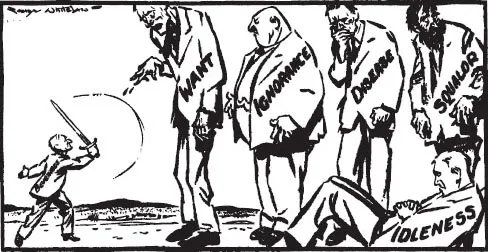
A mere four years before his clarion call for full employment, social security from cradle to grave, a national health service, and a war against ignorance and squalor, he had been for two long walks with Beatrice Webb, then in her eighties, over the downs near her Hampshire home. Her diary records:
If his desire for reform appeared to have waned, the war was to change that. But its arrival in 1939 left him bitter and frustrated. His talent and past experience, he felt, demanded a role in government. He bombarded government departments with offers of assistance, stringent criticism and unsolicited advice. He complained bitterly that ‘the present crew have no conception at all of how to plan for war.’ Along with other veterans of First World War administration, he gravitated to Keynes’s Bloomsbury house during the autumn and winter of 1939. The ‘ancient warhorses’, to use José Harris’s phrase, denounced Chamberlain’s incompetence to each other and devised alternative strategies.14
When Churchill became Prime Minister in May 1940, Beveridge wrote to remind the old bulldog of their ‘old association’ and to offer his talents. He followed up with letters to Attlee, Ernest Bevin and Herbert Morrison, the key Labour ministers in the newly formed coalition government. None wanted t...
![The Five Giants [New Edition]](https://img.perlego.com/book-covers/668404/9780008236168_300_450.webp)